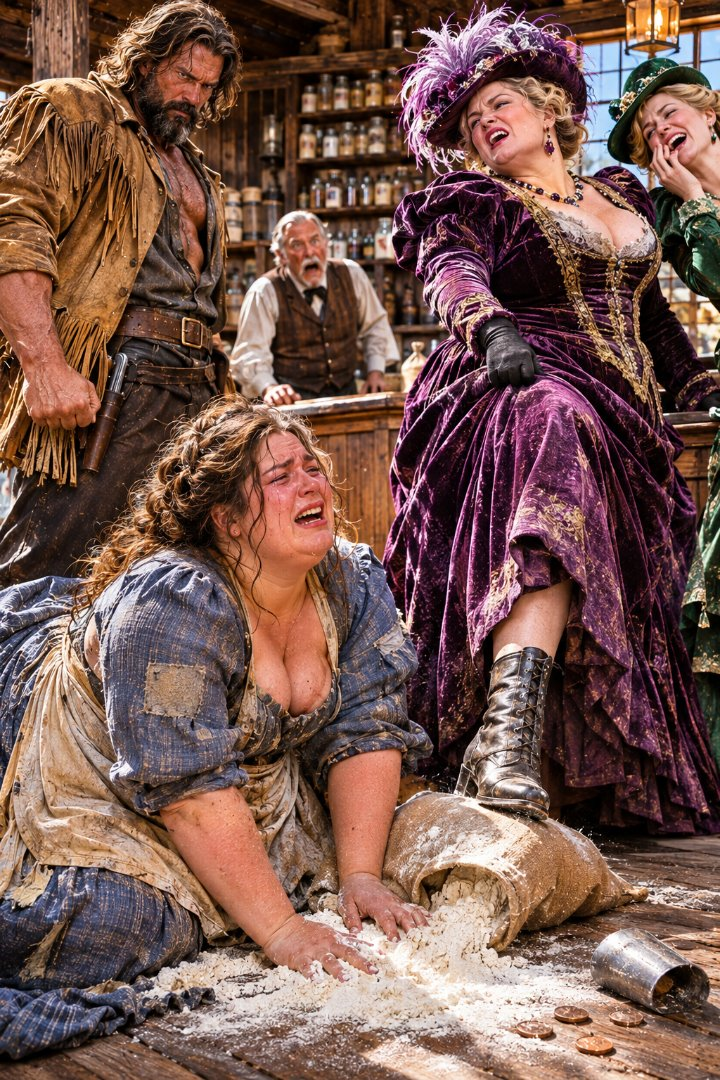
"YOU'RE FIVE CENTS SHORT, YOU FAT BEGGAR!" Josiah Gable shouted, shoving Abigail Trent's flour across the counter.
Harlon Boon stepped out of the shadows and caught a silver coin rolling beneath his boot.
A tiny cross had been scratched beside Thomas Trent's name on the merchant's open ledger.
That was when Harlon realized the widow's missing nickel was not the real problem.
Abigail Trent had been hungry for two days.
Not the sort of hunger that came from missing breakfast or working through supper. This was the deep, exhausting hunger that made a woman's hands tremble while she buttoned her dress, that turned the smell of fresh bread into something almost unbearable.
She had eaten the last of her potatoes on Wednesday.
Thursday, she had drunk hot water and pretended it was soup.
Now it was Friday afternoon, and thirty-five cents stood between her and a sack of flour.
Thirty-five cents.
She had counted the money four times before leaving her cabin.
Three dimes.
One nickel.
She had tied the coins into the corner of a handkerchief that had once belonged to her husband.
Thomas Trent had carried that handkerchief into the silver mines every morning.
After his death, Abigail had washed it carefully, folded it, and kept it beneath her pillow.
It was one of the few things the mining company had returned.
The other was his wedding ring.
The ring was gone now.
She had sold it during the winter to pay for firewood.
And she had cried afterward, not because she regretted surviving, but because she knew Thomas would have hated the thought of her freezing beside a ring she could no longer afford to keep.
"Mrs. Trent!"
Josiah Gable's voice snapped her back to the present.
He stood behind the broad wooden counter of Gable's Mercantile, his gray mustache twitching with irritation.
"Are you going to pay for these goods or stand there all afternoon?"
Abigail swallowed.
"I have thirty-five cents, Mr. Gable."
"Then you're five cents short."
"I know, sir."
"The price is forty."
"I know."
"Then what exactly are we discussing?"
Abigail looked at the flour.
It was a modest sack, nothing extravagant. Enough to make bread for several days if she stretched it carefully.
She had not asked for sugar.
She had not asked for coffee.
She had not even looked at the bacon hanging behind the counter.
Only flour.
"Would you consider letting me bring the remaining five cents on Monday?"
Gable stared at her.
"Credit?"
"Only until Monday."
"Mrs. Trent, this is a business. Not a church."
"I understand."
"Do you?"
His voice rose.
"Because every time someone comes through that door without enough money, I'm expected to feed them out of my own pocket."
Abigail felt the familiar heat of humiliation spreading across her face.
Behind her, a woman laughed.
It was a soft, deliberate sound.
The sort of laugh intended to be heard.
"Oh, Josiah," Beatrice Gable said. "You mustn't be so stern. Perhaps Mrs. Trent simply doesn't understand arithmetic."
Her companion giggled.
Clara Higgins, the banker's wife, stood beside Beatrice near a display of imported fabric.
Both women were dressed for an afternoon of shopping rather than an ordinary visit to a frontier store.
Beatrice wore midnight-blue velvet trimmed with gold.
Clara's crimson silk dress shimmered whenever she moved.
Their gloves were spotless.
Their boots had never known a day of honest labor.
Abigail knew those women well.
She had washed their clothing.
Scrubbed their linens.
Mended their children's stockings.
She had stood in their kitchens while they complained about servants, neighbors, and the inconvenience of having too much furniture.
And she had accepted their money because pride did not put food on a table.
"Perhaps," Clara said, examining Abigail's patched apron, "she spent her last nickel on that lovely dress."
Beatrice looked Abigail up and down.
"Oh, surely not. That dress must be older than the railroad."
The women laughed.
Abigail kept her eyes on the counter.
She had learned that looking at cruel people sometimes encouraged them.
Her dress had once been blue.
She remembered buying the fabric with Thomas during their first spring in Bitter Creek.
He had insisted on choosing it.
"That color makes your eyes look warm," he had told her.
She had laughed.
"Brown eyes are already warm, Thomas."
"Then it makes the rest of the world notice."
That was before the mine accident.
Before the funeral.
Before the company superintendent had handed her an envelope containing Thomas's final wages and informed her that the explosion had been an unfortunate consequence of dangerous work.
Before she discovered that a woman could work sixteen hours a day and still go hungry.
Now the dress was faded mustard-yellow, remade from its surviving fabric and other scraps, with an olive-green apron hiding the worst of its repairs.
Her broad hips strained against the old seams.
Her rounded belly pressed against the apron.
Her arms were thick from years of carrying laundry buckets, and her hands were rough with cracked skin.
She knew what people said about her body.
They had been saying it since she was a girl.
Thomas had been the first man who looked at her without making her feel she needed to apologize for occupying space.
After he died, the apologies returned.
Sometimes she made them without speaking.
By standing closer to walls.
By avoiding narrow aisles.
By lowering her eyes when strangers stared.
Today, however, she was too hungry to disappear.
"Mr. Gable," she said, "I washed three shirts for Mrs. Higgins yesterday."
Clara's smile faltered.
Abigail turned toward her.
"You said you would pay me this morning. Five cents for the last shirt. If you could settle that now, I would have enough."
Clara's expression hardened.
"That shirt was ruined."
Abigail blinked.
"Ruined?"
"The collar was stiff."
"I washed it exactly as you instructed."
"My husband couldn't possibly wear it."
Abigail remembered the shirt.
White cotton.
Pearl buttons.
A small stain near the left cuff.
She had soaked it for an hour, scrubbed it carefully, and ironed the collar until it lay perfectly flat.
She had delivered it wrapped in clean linen.
"Mrs. Higgins, I checked it before I brought it."
Clara lifted her chin.
"Are you suggesting I'm lying?"
The store became quiet.
Abigail felt the eyes of everyone nearby settle upon her.
"No, ma'am."
"Then I suggest you stop embarrassing yourself."
Beatrice smiled.
"Honestly, Clara, you are too generous. If I were you, I wouldn't let her touch another piece of clothing."
Abigail's throat tightened.
Losing Clara's washing would mean losing nearly a dollar each month.
A dollar could buy flour, potatoes, and sometimes a little salt pork.
She could not afford to argue.
"I apologize," she whispered.
Clara looked satisfied.
"Good."
Gable pushed the flour farther away.
"Now, Mrs. Trent, unless you have another five cents, I'll thank you to leave."
Abigail looked down at her money.
She knew what she had to do.
She began gathering the coins.
One dime slipped from her trembling fingers.
It struck the edge of the counter, bounced twice, and rolled onto the wooden floor.
She reached for it.
Another coin fell.
Then another.
Within seconds, her money lay scattered near a sack of flour that had been knocked against the counter.
The sack tipped.
White powder spilled across the floorboards.
"Oh, for heaven's sake!" Gable exclaimed.
Abigail dropped to her knees.
"I'm sorry."
She reached for the nearest coin.
"I'm terribly sorry."
Her apron brushed through the flour.
She tried to keep her skirt beneath her, but the old fabric caught against a splinter.
A seam tore.
The sound was small.
To Abigail, it might as well have been a gunshot.
Beatrice burst into laughter.
"Oh, Clara! Did you hear that?"
Clara covered her mouth.
"Her dress!"
"Well, with all that weight, what did she expect?"
Abigail closed her eyes.
For one terrible moment, she wished the floor would open beneath her.
She wanted to be somewhere else.
Anywhere else.
Back in the little cabin with Thomas humming while he sharpened his tools.
Back at the table where they had once shared biscuits and talked about children they hoped to have.
Back in a life where five cents had never seemed capable of destroying a human being.
"YOU'RE FIVE CENTS SHORT, YOU FAT BEGGAR!"
Gable's shout cracked across the room.
Abigail flinched.
The merchant pointed toward the door.
"Take your money and get out before you make another mess!"
She did not answer.
She simply lowered her head and continued gathering her coins.
A tear slipped down her cheek.
Then another.
She wiped them away with the back of her wrist.
She had promised herself she would not cry in front of these people.
She had made that promise every morning for nearly two years.
Today, she broke it.
What Abigail did not know was that a man standing beside the rear shelves had heard every word.
His name was Harlon Boon.
And he had buried enough good people to recognize cruelty when he saw it.
Harlon was forty-three years old.
He stood six feet three inches tall, with shoulders broad enough to make most doorways appear inconvenient.
His ash-blond hair was tied loosely at the back of his neck.
A sandy beard, already threaded with gray, covered his jaw.
He wore a dark green buckskin jacket, a worn leather vest, and boots that carried the dust of two days' travel.
A rifle rested safely near his supplies.
A hunting knife hung at his belt.
He had come down from the mountains to trade beaver pelts for coffee, salt, flour, and ammunition.
He had expected an ordinary afternoon.
Instead, he had watched a hungry woman beg for five cents she had already earned.
He had watched a merchant use poverty as entertainment.
And he had watched two wealthy women laugh while someone less fortunate knelt at their feet.
Harlon had spent fifteen winters alone in the mountains.
He had faced blizzards that buried cabins.
He had crossed rivers swollen with spring runoff.
He had once spent three nights trapped beneath a fallen pine with a broken ankle, surviving on melted snow.
But nothing made him angrier than people who enjoyed another person's helplessness.
He stepped away from the shelves.
His boots struck the floor.
THUD.
THUD.
THUD.
Beatrice noticed him first.
Her laughter stopped.
Clara turned.
Gable straightened behind the counter.
Harlon approached without hurry.
He did not look at the wealthy women.
He looked at Abigail.
She was still kneeling.
Her fingers were white with flour.
A copper coin had become trapped beneath the edge of her apron.
She was trying to reach it without tearing the dress further.
Harlon stopped beside her.
"Ma'am."
Abigail looked up.
For a moment, she saw only a pair of enormous boots.
Then her gaze traveled upward.
And upward.
Until she found a weathered face looking down at her.
There was no amusement in his eyes.
No disgust.
Only concern.
"Are you hurt?" he asked.
She shook her head.
"No, sir."
He glanced at the spilled flour.
"Mind if I help?"
She hesitated.
Then nodded.
Harlon bent and retrieved the coin from beneath her apron.
He placed it gently in her palm.
"Think this belongs to you."
"Thank you."
Her voice barely carried.
He straightened and turned toward the merchant.
"Mr. Gable."
The merchant forced a smile.
"Boon. Didn't know you were in town."
"Got in this morning."
"Looking to trade those pelts?"
"Eventually."
Harlon looked at the flour.
"How much does the lady owe?"
Gable cleared his throat.
"Five cents."
Harlon reached into his pocket.
He placed a silver coin on the counter.
It struck the wood with a clear metallic sound.
CLINK.
"That ought to cover it."
Abigail stared.
"Sir, please."
Harlon looked down.
"I didn't ask for charity."
"I know."
"I can work for what I need."
"I believe you."
"Then I can't accept—"
"Ma'am," he said gently, "I'm buying supplies today. Reckon I can decide what to do with my change."
She did not know how to answer.
No one had offered her anything without demanding something in return since Thomas died.
Beatrice folded her arms.
"How touching."
Harlon turned.
"The mountain savage has found himself a charity case," she continued.
Clara gave a nervous little laugh.
Harlon studied Beatrice.
"Ma'am, where I come from, folks don't laugh at someone for being hungry."
Beatrice's cheeks reddened.
"Well, I never—"
"Then perhaps today would be a fine day to start."
The store fell silent.
Clara stepped forward.
"Mr. Boon, you have no idea what kind of woman you're defending."
Harlon looked at her.
"I know she washed your husband's shirt."
Clara stiffened.
"That has nothing to do with—"
"And I know you said it was ruined."
"It was."
"Strange."
His voice remained calm.
"I passed your husband outside the bank this morning. He was wearing a clean white shirt. Pearl buttons. Little repair on the left cuff."
Abigail looked up sharply.
She had made that repair herself.
Harlon continued.
"Looked freshly washed to me."
Clara's mouth opened.
No words came.
Gable shifted behind the counter.
"Now, Boon, there's no reason to turn a small misunderstanding into—"
"Then give the lady her flour."
The merchant stared at him.
Harlon did not blink.
"Please," he added.
Somehow, the word made the demand more intimidating.
Gable reached for the flour.
He wrapped the sack in brown paper.
His movements were stiff.
Abigail slowly rose to her feet.
Her knees ached.
She brushed flour from her apron, though it did little good.
Harlon offered her the parcel.
She accepted it.
"Thank you," she whispered.
He nodded.
"What's your name?"
"Abigail Trent."
"Harlon Boon."
"I know who you are."
He raised an eyebrow.
"That so?"
"People talk about the man who lives beyond the high ridge."
"Usually nothing flattering."
Despite herself, Abigail smiled.
It was small.
Uncertain.
Almost forgotten.
But Harlon noticed.
For a moment, something softened in his expression.
Then Beatrice spoke.
"You'd better be careful, Mr. Boon. Mrs. Trent has a habit of accepting help she cannot repay."
Abigail's smile vanished.
Harlon turned toward her.
"Seems to me she works for what she gets."
Clara scoffed.
"Then perhaps you should hire her yourself."
Harlon was silent for a moment.
He looked at Abigail.
"Can you cook?"
She blinked.
"Yes."
"Wash clothes?"
"Yes."
"Keep a cabin?"
"I've kept my own."
He nodded.
"My place needs work."
Abigail stared at him.
"Are you offering me employment?"
"Honest wages. Food. A roof."
Beatrice let out an incredulous laugh.
"You cannot seriously mean to take that woman into the mountains!"
Harlon ignored her.
Abigail tightened her grip on the flour.
"How far is your cabin?"
"Two days uphill."
"Is it safe?"
"Safer than some places in this town."
She looked toward the door.
Beyond it lay the muddy street, the cold cabin, and another evening alone.
Then she looked back at the mountain man.
"Why would you offer work to someone you just met?"
Harlon considered her question.
"Because I saw how you carried yourself when everyone here tried to make you bow your head."
Abigail's eyes filled again.
But these tears felt different.
They were not born entirely of shame.
For the first time in months, someone had spoken to her as though she mattered.
She opened her mouth to answer.
Before she could speak, Josiah Gable slammed a heavy ledger onto the counter.
"Hold on, Boon."
Harlon turned.
The merchant's expression had changed.
The embarrassment was gone.
In its place was something colder.
"Mrs. Trent has an outstanding account."
Abigail went still.
"What account?"
Gable opened the ledger.
"One her late husband left unsettled."
Abigail stared at him.
"Thomas paid his bills before he died."
"Then perhaps you'd better explain why his name is still here."
He turned the book toward her.
Abigail stepped closer.
The page was covered in carefully written entries.
Names.
Dates.
Amounts.
Some had been crossed out.
Others remained open.
Near the bottom, she saw the name she had written a thousand times during her marriage.
THOMAS TRENT.
Her breath caught.
Beside it stood a figure.
$480.00.
Abigail stared.
Four hundred and eighty dollars.
It was more money than she had earned in nearly two years of washing clothes.
"That can't be right."
Gable tapped the page.
"Nevertheless, there it is."
"My husband never borrowed that kind of money."
"Apparently, he did."
"He would have told me."
"Perhaps your husband kept secrets."
Abigail shook her head.
"No."
The word came out stronger than she intended.
Gable narrowed his eyes.
"Mrs. Trent, I suggest you remember your position."
Harlon stepped closer.
"Let me see that."
Gable hesitated.
"Private business records."
"Then why'd you open them in front of half the town?"
The merchant's jaw tightened.
Harlon held out his hand.
After a moment, Gable reluctantly turned the ledger.
Harlon studied the entry.
Thomas Trent.
Four hundred and eighty dollars.
The date was written six days before the mine explosion.
But the amount was not what caught Harlon's attention.
Beside Thomas's name was a tiny cross.
Two intersecting lines.
Barely visible.
Harlon's expression changed.
He had seen that mark before.
Not in a store ledger.
Not in a banker's account book.
But on a folded piece of paper carried by a dying man in the mountains.
A man who had begged Harlon to deliver a warning.
A man who had disappeared before sunrise.
Harlon leaned closer.
"Where'd this entry come from?"
Gable's face tightened.
"My records."
"Who wrote it?"
"I did."
"When?"
"The date is plainly marked."
Harlon looked at him.
"That wasn't my question."
Abigail watched the exchange.
Something had changed.
The mountain man who had defended her over five cents now seemed interested in something far more serious.
Gable reached for the ledger.
Harlon placed one broad hand on the counter.
He did not touch the merchant.
He did not raise his voice.
But Gable stopped moving.
"Mr. Boon," the merchant said carefully, "I think you've interfered quite enough."
Harlon looked at the tiny cross again.
Then at Abigail.
"Mrs. Trent."
"Yes?"
"Did your husband ever mention a man named Elias Mercer?"
Abigail frowned.
The name meant nothing at first.
Then a memory stirred.
Thomas sitting at their kitchen table.
His face pale.
A folded letter beside his plate.
He had looked up when she entered and quickly covered the paper with his hand.
She remembered asking whether something was wrong.
And Thomas had answered, "Just a matter at the mine."
But later that night, while he thought she was asleep, she had heard him whisper a name.
Mercer.
Her heart began pounding.
"Why do you ask?"
Harlon did not answer immediately.
He was looking at Gable.
The merchant's face had lost its color.
"Mr. Boon," Gable said, "I think you should leave."
Harlon remained motionless.
"Not until I understand why a dead miner's name is sitting beside a mark that doesn't belong in a store ledger."
Abigail felt the room tilt beneath her.
"Mr. Boon, what does that mark mean?"
Harlon turned toward her.
His expression was grave.
"Mrs. Trent, I need you to tell me something."
She swallowed.
"What?"
"Before your husband died, did he ever bring home a small leather notebook?"
Abigail's breath stopped.
Because Thomas had brought home a notebook.
Brown leather.
Worn corners.
A broken brass clasp.
He had hidden it beneath a loose floorboard beside their bed.
And three days after his funeral, two strangers had come to her cabin asking about his personal belongings.
She had told them she knew nothing.
She had never told anyone what she found beneath that floorboard.
Not even the sheriff.
Abigail stared at Harlon.
"How could you possibly know about that?"
Before he could answer, the mercantile door opened.
A gust of wind swept across the floor.
The bell above the entrance rang once.
Every face turned.
A man stood in the doorway wearing a dark coat and carrying a black leather satchel.
Abigail recognized him immediately.
He was one of the two strangers who had searched her cabin after Thomas's funeral.
And now he was staring directly at the open ledger.
His face went white.
Then he looked at Abigail and spoke four words.
"Where is the notebook?"






Comments 0