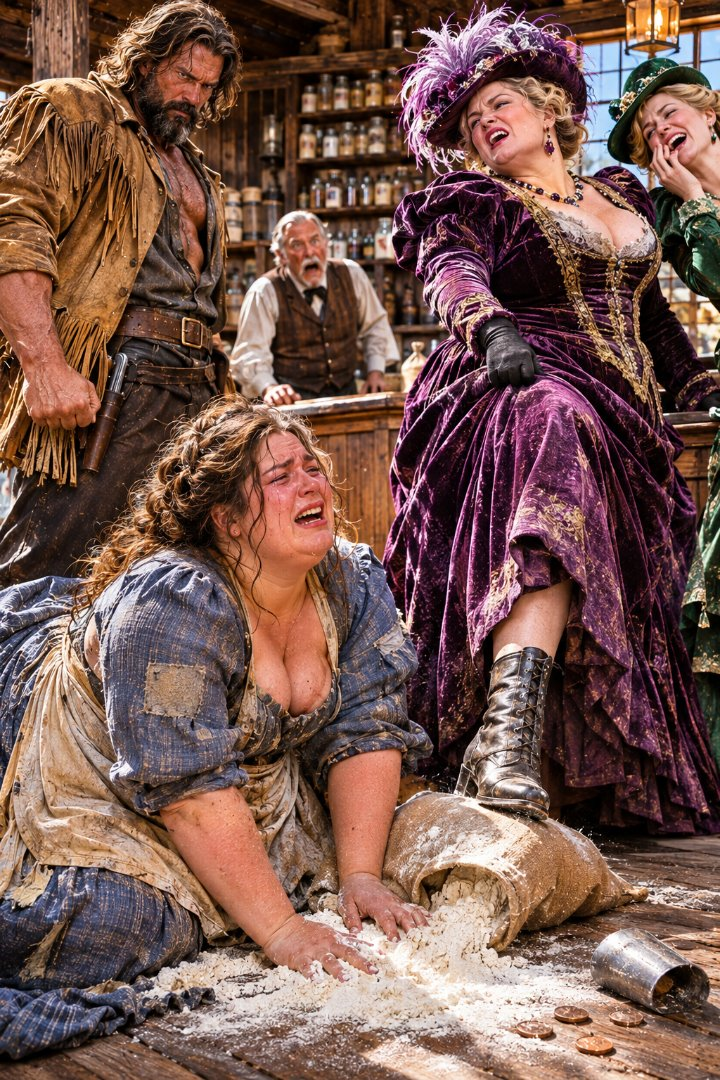
"THOMAS!"
Abigail Trent's scream tore through the morning air.
Her husband lay on the church steps, blood spreading across his shirt.
Only minutes earlier, he had stood before the people of Bitter Creek and offered the evidence that could destroy the men who had stolen two years of his life.
Now his eyes were closing.
"No. No, Thomas. Look at me."
Abigail pressed both hands against his wound.
Blood seeped between her fingers.
"Stay with me."
Thomas tried to speak.
She leaned closer.
His lips barely moved.
"Whitcomb."
Abigail froze.
"What?"
"Amos."
Then his eyes closed.
"THOMAS!"
Dr. Miriam Foster dropped to her knees beside them.
"Abigail, move your hands just enough for me to see."
Abigail obeyed.
The physician pulled open Thomas's shirt.
Her expression tightened.
"The bullet entered high on the right side. We need to stop the bleeding."
"Is he going to die?"
Dr. Foster looked at her.
"I don't intend to let him."
She turned toward the crowd.
"Clean cloth! Hot water! Now!"
Martha Bell hurried toward the church.
Two women followed.
Abigail remained beside Thomas, holding his hand.
His skin was cold.
Too cold.
For two years, she had mourned him.
For two years, she had believed she would never hear his voice again.
Now she had found him, only to watch another man try to take him away.
She bent close.
"You listen to me, Thomas Trent."
Her voice shook.
"You promised me six apple trees."
A tear fell onto his hand.
"You haven't planted a single one."
His fingers moved faintly.
Abigail caught her breath.
"That's right. You stay."
Behind her, horses thundered down the street.
Harlon Boon was pursuing the gunman.
And Abigail knew the man he was chasing.
Amos Whitcomb.
The undertaker who had buried Elias Mercer beneath Thomas's name.
The man everyone believed had left Bitter Creek.
The man who had just tried to kill her husband.
Harlon saw the rider turn toward the northern road.
He seized the reins of a saddled horse outside the blacksmith's shop.
"Borrowing this!"
The blacksmith waved him on.
Harlon mounted despite the pain in his wounded arm.
Then urged the horse forward.
The rider ahead wore a dark coat and broad-brimmed hat.
He rode hard.
But Harlon knew the road.
Beyond the church, it narrowed between two fences before turning toward the abandoned cemetery.
There was only one place a horse could cross the creek without risking a broken leg.
Harlon took the shorter trail through the cottonwoods.
Branches struck his shoulders.
His wounded arm burned.
But he kept riding.
When he emerged beside the creek, Amos Whitcomb was approaching the crossing.
Harlon drew his revolver.
"WHITCOMB!"
The undertaker turned.
His face twisted.
Then he fired.
The shot struck a tree beside Harlon.
Harlon ducked.
"Drop the gun!"
Whitcomb fired again.
His horse stumbled on the wet stones.
The animal lurched sideways.
Whitcomb lost his balance and fell into the shallow creek.
His revolver disappeared beneath the water.
Harlon dismounted.
The undertaker struggled to his feet.
He reached for a knife.
Harlon aimed his revolver.
"Don't."
Whitcomb froze.
Water streamed from his coat.
His face was pale beneath his gray beard.
"You don't understand," he gasped.
Harlon approached carefully.
"Then explain it."
Whitcomb shook his head.
"They'll kill Margaret."
Harlon's expression changed.
"Your wife?"
Whitcomb nodded desperately.
"They told me she was dead. Then they told me she was alive, but only if I did what they wanted."
"Who told you?"
"Charles Higgins."
Harlon kept the revolver steady.
"And you believed him?"
Whitcomb began crying.
"I buried Mercer. I knew what they had done. They made me help cover it up."
"You could have told the sheriff."
"I tried!"
Whitcomb's voice broke.
"I went to Judge Crowe. The next day, Margaret disappeared."
Harlon stared at him.
The undertaker continued.
"Higgins told me she'd be released if I kept quiet. When Thomas returned, he said everything would be ruined unless I stopped him."
Harlon's jaw tightened.
"So you shot an innocent man."
Whitcomb lowered his head.
"Yes."
For several moments, only the creek could be heard.
Then Harlon stepped closer.
"Margaret is alive."
Whitcomb looked up sharply.
"What?"
"She was held in Tunnel Seventeen. She's free now."
The undertaker stared.
His face crumpled.
"Margaret?"
Harlon nodded.
"She's waiting in Bitter Creek."
Whitcomb began sobbing.
He dropped the knife.
Harlon kicked it away.
Then bound the man's wrists with a length of rope.
"You'll answer for what you did."
Whitcomb did not resist.
Harlon looked toward the distant town.
"And you'd better pray Thomas Trent survives."
By afternoon, Dr. Foster had removed the bullet.
Thomas lay in a small room behind the church, pale and unconscious.
Abigail sat beside him.
She had not moved for hours.
Martha brought soup.
Abigail barely touched it.
Harlon returned shortly before sunset.
His clothes were muddy.
His wounded arm had reopened.
But he was alive.
Abigail rose when she saw him.
"Did you find him?"
Harlon nodded.
"Amos Whitcomb."
She closed her eyes.
"Thomas said his name."
"He's in custody."
Abigail looked toward the bed.
"Did he say why?"
Harlon told her.
About Margaret.
About Higgins.
About the threats.
About the undertaker's desperate belief that killing Thomas would save his wife.
Abigail listened silently.
When Harlon finished, she looked down.
"All these people."
Her voice trembled.
"All these people hurting one another because Charles Higgins told them they had no choice."
Harlon nodded.
"Fear can make people do terrible things."
Abigail looked at him.
"But they still chose."
"Yes."
She sat beside Thomas again.
"And Thomas chose to protect people."
Harlon looked toward the bed.
"He did."
Abigail touched her husband's hand.
For a moment, she remembered the man who had once carried her across a muddy street because her boots were leaking.
The man who had stayed awake all night when she had a fever.
The man who had made promises about apple trees and children and growing old together.
Their marriage had not been perfect.
But it had been real.
And the cruelty of other people had stolen years they could never recover.
She looked at Harlon.
"Thank you for bringing Whitcomb back alive."
He nodded.
"Thought Margaret deserved to hear the truth from him."
Abigail studied his face.
There was exhaustion there.
Pain.
And something she had come to recognize.
A kindness that did not demand repayment.
She reached for his hand.
"You're a remarkable man, Harlon Boon."
He gave a faint smile.
"Just a stubborn one."
Abigail almost laughed.
Then Thomas stirred.
She turned immediately.
"Thomas?"
His eyes opened.
He looked confused.
Then he saw her.
"Abby?"
She began crying.
"I'm here."
He swallowed.
"Did I miss supper?"
Abigail laughed through her tears.
Dr. Foster hurried into the room.
"Well, Mr. Trent, if you're making jokes, perhaps you'll survive long enough to complain about my cooking."
Thomas managed a weak smile.
Abigail pressed his hand against her cheek.
He was alive.
And this time, she would not have to bury him.
Three days later, the territorial marshal arrived in Bitter Creek.
His name was Samuel Whitaker.
He came with six armed officers and written authority from the territorial government.
Sheriff Rusk handed over the prisoners, the ledger, the original survey authorization, and the testimony of the freed miners.
The marshal spent two days examining the evidence.
He interviewed Thomas.
Margaret Whitcomb.
Caleb Voss.
Martha Bell.
Clara Higgins.
And every former prisoner strong enough to speak.
The truth emerged piece by piece.
Blackstone Silver had secretly reopened abandoned workings and used imprisoned miners to extract ore without paying wages.
Charles Higgins had moved the profits through the bank.
Josiah Gable had prepared false debts to seize land containing valuable mineral claims.
Walter Pritchard had overseen the operation.
Judge Nathaniel Crowe had protected it through fraudulent orders and the suppression of complaints.
Clara Higgins had knowingly signed financial transfers and helped conceal the operation.
Thomas Trent had initially signed an authorization for legitimate drainage repairs.
When he discovered the document had been altered, he joined Elias Mercer in collecting evidence.
Higgins murdered Mercer.
Pritchard arranged the false funeral and kept Thomas imprisoned because he knew where the original records were hidden.
The forged confession had been used to threaten Thomas into silence.
And Amos Whitcomb, forced into helping conceal Mercer's death, had eventually become another instrument of the conspiracy.
None of it was simple.
But for the first time, every part of the story was being examined in daylight.
When the marshal finished reading the evidence, he looked toward Abigail.
"Mrs. Trent."
She stood.
"Yes, sir?"
"Your husband's signature on the altered authorization was obtained through deception. The original document and witness testimony establish that he did not knowingly approve the unlawful operation."
Abigail felt her knees weaken.
The marshal continued.
"The murder confession was coerced. Mr. Trent will not be charged on the basis of that document."
Thomas lowered his head.
Abigail began crying.
The marshal looked toward the crowd.
"And the debts used to seize the miners' property are fraudulent."
A murmur spread through the room.
He raised his voice.
"Those claims will be challenged and reversed through the territorial courts."
Martha Bell covered her mouth.
A miner beside her began sobbing.
Abigail looked toward Josiah Gable.
The merchant sat between two officers.
His face was gray.
The man who had once shouted that she was a fat beggar could no longer meet her eyes.
The trials took place over the following months.
Judge Crowe was removed from office and prosecuted for corruption and conspiracy.
Charles Higgins was convicted of murder, fraud, and his role in the unlawful imprisonment of the miners.
Walter Pritchard received a lengthy prison sentence for his leadership of the operation and the violence committed under his orders.
Josiah Gable was convicted of fraud and conspiracy.
His mercantile was sold to help repay the families he had exploited.
Clara Higgins testified against her husband.
Her cooperation did not erase her crimes.
She was held accountable for the financial fraud she had helped conceal, but her testimony helped recover money and establish the extent of the operation.
Before her sentencing, she asked to speak with Abigail.
They met in a small room at the courthouse.
Clara wore a plain gray dress.
Without her expensive jewelry and carefully arranged hair, she looked older.
"Mrs. Trent," she began.
Abigail sat across from her.
"Clara."
The banker's wife lowered her eyes.
"I owe you an apology."
Abigail waited.
Clara swallowed.
"For the lies. For the cruelty. For everything I did to you."
Her voice broke.
"I knew you were hungry. I knew you were working yourself sick. And I still treated you as though you were beneath me."
Abigail looked at her quietly.
Clara continued.
"I told myself I was protecting my family."
She wiped her eyes.
"But I was protecting my comfort."
Abigail felt a familiar ache.
She remembered the mercantile.
The laughter.
The unpaid five cents.
The way Clara had made her feel ashamed simply for existing.
Finally, Abigail spoke.
"You hurt me."
Clara nodded.
"I know."
"You helped people take my home."
"Yes."
"And you knew Thomas was alive while I mourned him."
Clara began crying.
Abigail looked down at her hands.
For a moment, she considered all the things she could say.
All the anger she had carried.
Then she looked up.
"I hope you become a better person, Clara."
The woman stared.
"Can you forgive me?"
Abigail was quiet.
"Perhaps someday."
Clara lowered her head.
Abigail continued.
"But forgiveness isn't something you can demand because you're finally sorry."
The words were gentle.
And final.
She stood.
Then walked out.
Amos Whitcomb confessed to shooting Thomas and helping conceal Mercer's body.
He also testified about the threats against Margaret.
The court considered the coercion he had suffered, but he still faced punishment for his actions.
Margaret visited him before he was transferred to serve his sentence.
Their reunion was painful.
She did not pretend his choices had been harmless.
But she listened.
And when he told her how he had believed she was dead, she took his hand.
They agreed to write to each other.
Their future would be difficult.
But the lies separating them were finally gone.
Elias Mercer received a proper burial.
His remains were moved from the grave marked Thomas Trent to a new resting place beside the cemetery's eastern fence.
The townspeople gathered.
Harlon stood near the grave.
Thomas stood beside Abigail, leaning on a cane.
Martha Bell placed wildflowers on the coffin.
Sheriff Rusk removed his hat.
And Abigail watched as the man who had tried to save Bitter Creek was finally buried beneath his own name.
Afterward, she approached the headstone.
"Elias," she whispered, "I'm sorry I didn't know."
Thomas stood beside her.
"He wouldn't blame you."
Abigail looked at him.
"Do you think he knew we'd find the truth?"
Thomas nodded slowly.
"He hoped someone would."
She placed a small bouquet beside the stone.
"Then I hope he can rest now."
Winter arrived early that year.
Snow covered the high ridge.
The roads became difficult.
And Bitter Creek began rebuilding itself.
The stolen wages recovered from Blackstone Silver's accounts were distributed to the surviving miners and the families of those who had died.
The false debts were canceled.
Property titles were restored.
The bank was placed under new management.
Martha Bell received compensation for Samuel's death.
She used part of it to repair her home and the rest to help families who had lost their breadwinners.
Sheriff Rusk remained in office after cooperating with the investigation, though he never forgot how easily he had been misled.
He began requiring written evidence before allowing property seizures.
And whenever someone complained that the process took too long, he answered, "Better slow justice than another stolen home."
Abigail's cabin could not be restored.
The fire had destroyed too much.
But the land was legally hers again.
The court also awarded her compensation for the fraudulent seizure and destruction of her property.
For the first time in years, Abigail had money.
Not charity.
Not pity.
Money that belonged to her.
She stood beside the ruins one cold morning, holding the charred piece of doorway Harlon had rescued.
Thomas stood beside her.
His strength had returned slowly.
He still walked with a cane.
Some nights he woke from dreams of the mine.
Other nights he sat beside the stove until dawn, unable to bear the darkness.
Abigail had learned not to demand that he become the man he had been before.
They had both changed.
And neither could pretend otherwise.
Thomas looked toward the empty foundation.
"We could rebuild."
Abigail was quiet.
He continued.
"Same place. Same porch. Maybe a bigger kitchen."
She looked at him.
"Would you want that?"
He hesitated.
Then shook his head.
"Not really."
Abigail smiled sadly.
"Neither would I."
Thomas looked toward the mountains.
"Too many memories."
She nodded.
They stood quietly.
Then he said, "Abby, I owe you another apology."
She turned.
"For what?"
"For thinking love meant making every decision alone."
Her eyes filled.
Thomas continued.
"I thought I was protecting you by keeping secrets."
He swallowed.
"But I left you without answers. Without a choice."
Abigail took his hand.
"You were trying to survive."
"I know."
He looked at her.
"But if we're going to have a future, I don't want us to build it on silence."
She nodded.
"Neither do I."
For a long moment, they stood together.
Then Thomas looked toward the ridge.
"There's something else."
Abigail felt a familiar tightening in her chest.
But his expression was gentle.
Not frightened.
Not secretive.
Just sad.
"I know how much Harlon means to you."
She looked down.
Thomas continued.
"I saw it when we were in the mine."
"Thomas—"
He shook his head.
"I'm not angry."
Abigail looked up.
He smiled faintly.
"That man kept you alive when I couldn't."
Her eyes filled.
"And you care about him."
She swallowed.
"Yes."
Thomas nodded.
"I thought so."
For a moment, neither spoke.
Then Abigail whispered, "I love you, Thomas."
He took her hand.
"I know."
She began crying.
"But I don't know how to return to the life we had."
Thomas looked toward the ruins.
"Neither do I."
The admission hurt.
But it was honest.
He squeezed her hand.
"We don't have to decide everything today."
Abigail looked at him.
He smiled sadly.
"Perhaps we can begin by being truthful with each other."
She nodded.
"Yes."
And for the first time since his return, Abigail felt that they were speaking not as two people trying to recover a vanished marriage, but as two people learning who they had become.
By spring, Thomas had made his decision.
He wanted to leave Bitter Creek.
Not because he was ashamed.
Not because he wanted to escape the truth.
But because the town held too many memories of captivity.
Dr. Foster had offered him work helping repair buildings in a settlement east of Silver Junction.
The work was light enough for his recovering strength.
And the community needed someone who understood timber supports and drainage systems.
Thomas came to Abigail one evening carrying a folded letter.
"I've accepted the position."
She looked up.
"When do you leave?"
"Next month."
Abigail nodded slowly.
He sat beside her.
"Abby, I've been thinking about us."
She looked at him.
"So have I."
Thomas took a breath.
"We loved each other."
Her eyes filled.
"We still do."
"Yes."
He smiled sadly.
"But love doesn't always mean we can return to the same life."
Abigail looked down.
Thomas continued.
"Those two years changed me."
She nodded.
"They changed me too."
He reached for her hand.
"I don't want you spending the rest of your life trying to make me whole."
Tears slid down her cheeks.
"Thomas..."
He squeezed her fingers.
"And I don't want to spend mine asking you to become the woman you were before I disappeared."
Abigail began crying.
He drew her into his arms.
They held each other for a long time.
There was no anger.
No betrayal.
No sudden loss of affection.
Only the painful understanding that sometimes two people could survive terrible things and still discover that the future they once imagined no longer belonged to them.
When they finally pulled apart, Thomas kissed her forehead.
"I want you to be happy, Abby."
She touched his face.
"I want that for you too."
They agreed to separate with kindness.
Their legal marriage was dissolved through the proper court process later that year.
Thomas retained enough of the recovered compensation to begin again.
Abigail kept her restored property and the award for her destroyed cabin.
They wrote to each other afterward.
Not as strangers.
Not as enemies.
But as two people who would always be grateful that the other had survived.
Harlon Boon returned to his mountain cabin when the roads cleared.
He did not ask Abigail to follow.
He did not make promises.
He simply told her where she could find him.
"If you ever need anything," he said, "you know the trail."
Abigail smiled.
"I do."
He looked at her for a long moment.
Then nodded.
"Take care of yourself."
She reached for his hand.
"You too."
He mounted his horse.
Then rode toward the high ridge.
Abigail watched until he disappeared.
For several weeks, she remained in Bitter Creek.
She helped Martha organize a fund for miners' widows.
She arranged for the recovered wages to reach families who had moved away.
And she made one decision entirely for herself.
She would never wash Clara Higgins's curtains again.
Instead, she purchased a small building near the center of town.
It had once been a saddler's workshop.
She repaired the roof.
Painted the walls.
Installed a large stove.
And opened a bakery.
She called it The Apple Tree.
On the first morning, she placed six pies in the window.
Apple.
Peach.
Blackberry.
Cherry.
Pumpkin.
And cinnamon custard.
The smell filled the street.
People gathered outside.
Martha arrived first.
Then Sheriff Rusk.
Then several miners with their families.
By noon, every pie was gone.
Abigail stood behind the counter, flour on her apron, laughing as she counted the money.
For the first time in years, she was being paid fairly for her work.
Nobody asked her to apologize for her size.
Nobody mocked her clothes.
Nobody called her a beggar.
And when a hungry little girl entered the bakery with only three pennies, Abigail gave her a warm roll.
The child's mother began apologizing.
Abigail shook her head.
"There's nothing to apologize for."
She smiled.
"Everyone deserves something warm to eat."
Harlon returned to Bitter Creek in late summer.
He arrived with a wagon carrying timber, flour, and a small wooden crate.
Abigail saw him through the bakery window.
Her heart began beating faster.
She wiped her hands on her apron.
Then hurried outside.
"Harlon!"
He turned.
A smile spread across his face.
"Afternoon, Abigail."
She laughed.
"That's all you have to say?"
He looked amused.
"Would you prefer a speech?"
She stepped forward and embraced him.
For a moment, he stood surprised.
Then his arms closed gently around her.
She could feel his heartbeat.
Steady.
Warm.
Familiar.
When they stepped apart, he looked toward the bakery.
"You did all this?"
Abigail smiled.
"With a little help."
He studied the sign.
The Apple Tree.
His expression softened.
"Good name."
She nodded.
"Thank you."
He looked toward the wagon.
"Brought you something."
He lifted the wooden crate.
Inside were six young apple saplings.
Abigail stared.
Her eyes filled.
"Harlon..."
He looked almost embarrassed.
"Thought you might have room behind the bakery."
She covered her mouth.
Six apple trees.
The promise Thomas had once made.
Not forgotten.
Not erased.
Simply transformed into something new.
She looked at Harlon.
"Would you help me plant them?"
He smiled.
"That's why I brought a shovel."
They spent the afternoon working behind the bakery.
The ground was soft from recent rain.
Harlon dug the holes.
Abigail placed the saplings.
Together, they packed earth around the roots.
When the last tree stood upright, Abigail stepped back.
Six young trees.
Six small beginnings.
Harlon stood beside her.
For a moment, neither spoke.
Then he said, "Abigail."
She looked at him.
"I meant what I said at the church."
Her heart tightened.
"About caring for me?"
He nodded.
"I still do."
She looked down.
He continued.
"But I won't ask you to rush into anything."
Abigail reached for his hand.
"I know."
He studied her.
She smiled through her tears.
"And I care about you too."
Harlon's expression softened.
Abigail took a breath.
"I spent so many years believing I had to be grateful for whatever kindness people offered."
She looked toward the bakery.
"Then I met you."
He said nothing.
"You helped me without asking me to become someone else."
Her voice trembled.
"You never made me feel ashamed."
Harlon gently squeezed her hand.
"You never had anything to be ashamed of."
She smiled.
"I know that now."
He stepped closer.
"Abigail, would you let me court you?"
She laughed softly.
The question was so old-fashioned.
So careful.
So completely Harlon.
She looked into his eyes.
"Yes."
His smile widened.
"I'd like that."
She leaned forward.
And kissed him.
It was gentle.
Unhurried.
A kiss between two people who had known grief and discovered that tenderness could survive it.
When they stepped apart, Harlon rested his forehead against hers.
"Well," he whispered.
Abigail laughed.
"Well, indeed."
One year later, the apple trees were growing.
The bakery had become the busiest gathering place in Bitter Creek.
Abigail employed two women who had lost their husbands in the mining scandal.
They received fair wages.
Regular meals.
And the freedom to speak without fear.
Martha Bell visited every morning.
Sheriff Rusk bought coffee every afternoon.
And the families of the freed miners often gathered beneath the young trees.
Thomas wrote from his new home.
His health had improved.
He had found satisfaction in honest work.
And he had begun teaching younger builders how to recognize unsafe structures.
In his last letter, he wrote that he had planted an apple tree outside his cottage.
Abigail smiled when she read it.
She wrote back that her six trees were growing beautifully.
There was peace between them.
Not the peace of forgetting.
The peace of having told the truth.
Harlon began spending more time in Bitter Creek.
He still loved the mountains.
Still traveled the high trails.
Still returned to his cabin when the weather allowed.
But he had discovered something he had not expected to find again.
A place where someone waited for him.
And Abigail had discovered that love did not require her to disappear inside another person's life.
One evening, Harlon arrived at the bakery carrying a small velvet box.
Abigail looked at him.
"Harlon?"
He smiled nervously.
"Got something to ask."
She laughed.
"You look like you're about to face a grizzly bear."
He shook his head.
"Grizzly would be easier."
Then he knelt.
Abigail covered her mouth.
Harlon opened the box.
Inside was a simple gold ring.
No enormous stone.
No expensive display.
Just a beautiful ring made to be worn every day.
"Abigail Trent," he said, "you are the bravest woman I've ever known."
Her eyes filled.
"You walked through mountains to find the truth. You stood against men who thought money made them untouchable."
He swallowed.
"And you taught me that a heart can heal without forgetting what it loved before."
Abigail began crying.
Harlon smiled.
"I don't have a fortune."
She laughed through her tears.
"Good."
"I have a cabin, a stubborn mule, and a great deal of firewood."
She laughed harder.
He looked at her.
"And I have the rest of my life, if you'd care to share it."
Abigail knelt beside him.
She took his face in her hands.
"Yes, Harlon Boon."
His eyes filled.
"Yes?"
She kissed him.
"Yes."
They married beneath the apple trees the following spring.
Martha stood beside Abigail.
Sheriff Rusk witnessed the ceremony.
The bakery women decorated the tables with wildflowers.
Children scattered petals across the grass.
Harlon wore a clean dark coat.
Abigail wore a simple cream-colored dress she had chosen because it made her feel beautiful.
Not smaller.
Not hidden.
Beautiful.
When the minister asked whether they would love and honor one another, Harlon looked directly into Abigail's eyes.
"I will."
And Abigail answered without hesitation.
"I will."
Afterward, the townspeople gathered for supper.
There was music.
Laughter.
Fresh bread.
And more apple pie than anyone could finish.
At one point, Abigail noticed Josiah Gable's former mercantile across the street.
It now belonged to a cooperative of local farmers.
The old sign had been removed.
The building had been repainted.
The place where she had once been humiliated was now a place where families could purchase food without fraudulent debts or cruelty.
Abigail smiled.
Then Harlon approached.
"Penny for your thoughts?"
She laughed.
"Only a penny?"
He grinned.
"Times are hard."
She took his hand.
"I was thinking about the day we met."
His expression softened.
"The flour."
She nodded.
"Five cents."
Harlon smiled.
"Five cents."
Abigail looked toward the bakery.
The warm windows.
The children laughing.
The apple trees moving gently in the evening breeze.
Then she looked at the man beside her.
"You know something?"
"What?"
"Josiah Gable thought I was worth less than a sack of flour."
Harlon's expression grew serious.
"He was wrong."
She smiled.
"I know."
He kissed her forehead.
"You're worth more than all the silver in those mountains."
Abigail laughed softly.
Then she took his hand and led him toward the music.
Behind them, the six apple trees stood in the golden evening light.
Their roots had taken hold.
Their branches were growing.
And Abigail Boon, once a hungry widow with thirty-five cents in her pocket, walked into the future with a home, a family, a thriving business, and a love that never asked her to be anything less than herself.






Comments 0