"It's Diane Doyle."
Sergeant Kowalski's voice came through the phone so clearly that, for a moment, I thought I had misunderstood her.
"My mother?"
"Your father identified Diane Doyle as the person who arranged the financing."
I pressed my free hand against the hospital wall.
"No."
The word escaped before I could stop it.
Not because I believed my mother was innocent.
Not because I trusted her.
But because the idea of Diane Doyle secretly arranging a quarter-million-dollar financing agreement, placing my name on the paperwork, and allowing my brother to conceal it seemed almost too enormous to fit inside the family I thought I knew.
"Mrs. Doyle?"
"I'm here."
"Your father has provided information suggesting your mother negotiated the agreement. We're working to verify his account."
I closed my eyes.
"Who gave her the money?"
"That's still under investigation."
"Was it someone connected to Raymond Keller?"
"We're examining that possibility."
I looked toward Hazel's hospital room.
My daughter was asleep, her little hand resting beside Captain Marshmallow.
Three days earlier, I had been worrying about whether she would like her new second-grade teacher.
Now I was listening to a police investigator explain that my mother might have secretly placed my name on a six-figure business obligation.
And the man who had nearly killed Hazel was somehow connected to it.
"Sergeant," I whispered, "what exactly did my father tell you?"
She paused.
"He said your mother believed the grand opening would solve the family's financial problems."
"How?"
"By securing an additional investment."
I swallowed.
"From whom?"
Before she could answer, a nurse approached the doorway.
"Ms. Doyle? Your daughter is asking for you."
I looked at the nurse.
Then at my phone.
"I have to go."
"Of course," Kowalski said. "We'll speak again soon. Please continue preserving any messages you receive."
I ended the call.
For several seconds, I stood still.
Then I went back to my daughter.
Hazel was sitting slightly upright, looking worried.
"Mommy?"
"I'm here, sweetheart."
"Where were you?"
"Just outside."
She held up Captain Marshmallow.
"He fell."
I picked up the rabbit from the edge of the bed and tucked him beneath her arm.
"There. Rescued."
Hazel smiled.
Then she looked at me carefully.
"Are you mad?"
I sat beside her.
"Why would I be mad?"
"Your face looks like when the washing machine broke."
I laughed despite myself.
That had been a memorable afternoon.
Water everywhere.
A ruined basket of towels.
Hazel standing in the doorway wearing rain boots because she thought the laundry room had become a swimming pool.
"I'm not mad at you," I said.
"Are you mad at somebody?"
I hesitated.
"Yes."
She considered that.
"Grandma?"
I felt my chest tighten.
"Why do you ask?"
"Because she hasn't come."
I brushed a strand of hair from her forehead.
"Sweetheart, Grandma's choices aren't your responsibility."
Hazel looked down at the rabbit.
"Did she do something bad?"
I wanted to protect her from the truth.
But I didn't want to teach her that love required pretending everything was fine.
"Grandma has made some choices that hurt people," I said carefully.
Hazel frowned.
"Can she say sorry?"
"She can."
"Will she?"
I swallowed.
"I don't know."
Hazel thought about that for a long moment.
Then she whispered, "I hope she does."
I kissed her forehead.
"So do I."
And I meant it.
Not because an apology could repair what had happened.
But because I wanted Hazel to grow up knowing that adults could admit when they were wrong.
Even if my family had never been particularly good at it.
At 9:37 that evening, Lorraine convinced me to eat half a turkey sandwich.
I was sitting beside Hazel's bed when a message arrived from my father.
"Patty, please don't let your mother convince you that I planned this."
I stared at the screen.
Another message appeared.
"I signed things I shouldn't have. I know that. But I didn't know they were using your identity."
I felt anger rise.
I typed:
"You knew my name was on the agreement."
He answered after almost a minute.
"Not at first."
I stared at the words.
Not at first.
That was becoming my father's favorite defense.
He hadn't known everything.
He hadn't understood the consequences.
He hadn't intended to hurt anyone.
But he had always known enough to keep quiet.
I typed:
"When did you find out?"
The response took several minutes.
"Before Thanksgiving."
I closed my eyes.
The envelope.
The kitchen.
The conversation Mom had interrupted.
Dad had known for nearly a year.
He had watched me work, raise Hazel, and struggle to pay bills while my name was attached to an agreement I had never authorized.
And he had said nothing.
I typed:
"You had almost a year to tell me."
Three dots appeared.
Then disappeared.
Finally:
"I was afraid you'd never forgive me."
I stared at the screen.
I wanted to tell him that fear wasn't an excuse.
That silence was a choice.
That every day he had waited was another day he had allowed someone else to decide what happened to me.
Instead, I wrote:
"You should have been more afraid of what keeping quiet could do."
He didn't answer.
At 10:06, my mother called.
I watched the screen.
Diane Doyle.
I almost declined.
Then I remembered the officer at my house.
The wooden box.
The missing brass charm.
The blue medical folder.
I answered.
"Mom."
"Patricia, we need to settle this."
Her voice was calm.
Too calm.
"Settle what?"
"Everything."
I looked toward Hazel.
"That isn't possible tonight."
"Your father is making statements to the police that are simply not true."
"Then tell the police your version."
She exhaled sharply.
"I am trying to keep this family together."
I closed my eyes.
"By entering my house without permission?"
"I was retrieving family property."
"My daughter's medical records aren't family property."
Silence.
Then she said, "I was worried about what you might do with those documents."
I stared at the wall.
"What documents?"
"The business records."
"Mom, the blue folder you took contains Hazel's vaccination records."
She hesitated.
"Then I picked up the wrong folder."
I almost laughed.
My mother had never been good at admitting a mistake.
She usually preferred inventing a reason the mistake was someone else's fault.
"Return everything you took," I said.
"I will."
"And don't enter my house again."
"Patricia—"
"Do you understand?"
She went quiet.
Then she said, "You've changed."
I looked at Hazel.
"Yes."
For the first time, the word didn't frighten me.
Mom lowered her voice.
"Your father wants all four of us to sit down."
I stared at the wall.
"All four?"
"You, me, Walter, and Travis."
"At the house?"
"Tomorrow."
I looked toward Lorraine.
She was reading in the visitor's chair.
"Why?"
"Because this has gone far enough."
I almost laughed.
My daughter had lost her spleen.
A man had driven drunk.
My family had concealed information.
Someone had used my name on business documents and register transactions.
And my mother believed the problem was that I had asked too many questions.
"Mom, I'm not leaving Hazel to attend a family meeting."
"She's in a hospital. She's being cared for."
"She's seven."
"Patricia, you cannot use your daughter as an excuse forever."
I went still.
For several seconds, I couldn't speak.
Then I said quietly, "You need to think very carefully about what you just said."
She sighed.
"Oh, don't start."
I ended the call.
My hands were shaking.
But this time, I didn't cry.
The next morning, Dr. Reeves told me Hazel's recovery was progressing.
Her pain was better controlled.
She was eating small amounts.
Her surgical team was pleased with the healing so far.
We still had several important steps before discharge, including more education about life without a spleen and a plan for follow-up care.
I listened carefully.
I wrote everything down.
Then I asked whether Hazel could spend a few minutes sitting in a chair beside the window.
Dr. Reeves smiled.
"With assistance, that should be fine."
Hazel was delighted.
She called it her "big adventure."
Lorraine helped us arrange the pillows.
I sat beside her.
For fifteen minutes, we watched clouds drift across the sky.
Hazel pointed to one shaped like a dinosaur.
Another looked like a giant marshmallow.
She insisted the third looked like Travis.
I nearly choked on my coffee.
"Why Uncle Travis?"
"Because it's grumpy."
Lorraine laughed so hard she had to put down her cup.
I laughed too.
And for a brief moment, the weight on my chest lifted.
At 11:24 a.m., Rebecca Shaw called.
The attorney I had contacted.
Her voice was steady and direct.
"Ms. Doyle, I've reviewed the documents you sent."
I stepped into the hallway.
"Thank you."
"I want to be clear about something. A document bearing your name doesn't automatically establish that you agreed to its terms."
I closed my eyes.
Relief moved through me.
"Even if someone signed it?"
"If you didn't authorize the signature, that's a serious issue. We need to examine the original documents, the circumstances of execution, and any related records."
I nodded.
"What about the debt?"
"We'll investigate whether you have any actual legal obligation. Don't assume you're responsible simply because your name appears."
I leaned against the wall.
"Thank you."
She continued.
"I also want you to avoid discussing the disputed paperwork privately with family members until we understand what happened."
"My mother wants a meeting."
"Then I recommend you decline."
I hesitated.
"My father says he wants to tell me the truth."
"Then he can provide information through counsel or to the investigators."
I looked toward Hazel.
"He's frightened."
Rebecca paused.
"Ms. Doyle, his fear doesn't require you to expose yourself to additional risk."
I swallowed.
She was right.
I knew she was right.
But I had spent thirty-six years believing that my father's problems were somehow mine to solve.
It was difficult to stop.
At noon, my father called.
I answered.
"Dad."
"Patty, please. Just hear me out."
I closed my eyes.
"Rebecca says I shouldn't meet with you privately."
"Rebecca?"
"My attorney."
Silence.
Then he said, "You hired a lawyer?"
"Yes."
He exhaled.
"Your mother isn't going to like that."
I stared at the wall.
"I didn't hire her for Mom."
Dad was quiet.
Then he said, "I deserve that."
I didn't answer.
He continued.
"I want to tell you what happened at the grand opening."
"Then tell the police."
"I already told them some of it."
"Then tell them the rest."
He hesitated.
"Patty, there's something I need you to understand."
I closed my eyes.
"What?"
"Raymond Keller wasn't supposed to be there Friday."
My heart tightened.
"What do you mean?"
"Travis told him not to come."
"Why?"
"Because Raymond had threatened to expose the financing arrangement."
I leaned against the wall.
"And then he showed up anyway?"
"Yes."
"What did he want?"
Dad exhaled.
"More money."
I stared at the floor.
"How much?"
"Fifty thousand."
My breath caught.
"On top of the eighteen thousand five hundred?"
"Yes."
I closed my eyes.
"Why?"
"Because he had copies of the original agreement."
I thought about the brown folder.
The photographs.
The keys.
The blue wristband.
"Did he threaten to give them to the police?"
Dad hesitated.
"He threatened to give them to you."
I went still.
"Me?"
"Yes."
I stared at the wall.
"Why would he do that?"
"Because your name was on the paperwork."
I felt cold.
Raymond Keller had known.
He had known someone had used my name.
He had known I might not be aware of it.
And he had used that information to pressure my family.
"Dad," I whispered, "what did Mom do?"
He didn't answer.
"Dad?"
His voice broke.
"She told Travis to handle it."
I closed my eyes.
"What does that mean?"
"I don't know everything."
I almost laughed.
There it was again.
The same sentence.
The same escape.
"Dad, you were there. You held Raymond's keys."
"I know."
"You gave them back."
"I know."
"Then stop telling me what you don't know and tell me what you did."
Silence.
Then he whispered, "I told Raymond to leave."
My heart pounded.
"And?"
"He refused."
"What happened next?"
"Travis took him outside."
I went still.
"Why?"
"I thought he was going to calm him down."
I closed my eyes.
"Did he?"
Dad didn't answer.
Then he said, "When Raymond came back, he was furious."
I swallowed.
"About what?"
"He said Travis had cheated him."
I stared at the wall.
"Cheated him how?"
Dad's voice dropped.
"That's what I need to explain."
I waited.
Then he said, "Patty, I want you to come to the house."
I closed my eyes.
"No."
"Please."
"No, Dad."
He was quiet.
Then he whispered, "I understand."
For the first time, he didn't argue.
At 1:46 p.m., I received a message from the unknown number.
"Travis is trying to get everyone together."
I stared at it.
"Who is everyone?"
The reply came quickly.
"Your parents. You. Him."
I typed:
"I know."
A pause.
Then:
"Don't go."
My stomach tightened.
"Why?"
"Because he wants you to sign something."
I closed my eyes.
"What?"
"A statement."
I sat up.
"What kind of statement?"
The reply appeared slowly.
"That you authorized the house account and approved the transaction adjustments."
My heart slammed against my ribs.
I stared at the screen.
The family meeting.
The pressure.
The insistence that I come alone.
It wasn't about reconciliation.
It was about paperwork.
I typed:
"Do you have proof?"
A photograph arrived.
It showed a printed document on a desk.
At the top:
STATEMENT OF AUTHORIZATION AND ACCOUNT RESPONSIBILITY
Below it was my name.
Patricia Doyle.
The first paragraph stated that I had retained administrative control of the bar's register system.
The second claimed I had approved the use of my house account for promotional expenses.
The third said I had authorized certain transaction adjustments during the grand opening.
I read it twice.
Then a fourth paragraph made my stomach turn.
It stated that any errors or omissions in those records were my responsibility.
I stared at the screen.
They weren't just trying to explain the transactions.
They were trying to make me accept responsibility for them.
I forwarded the photograph to Rebecca.
Then to Sergeant Kowalski.
At 2:18, Rebecca called.
"Ms. Doyle, do not sign that document."
"I won't."
"Do not attend a meeting where you may be pressured to sign it."
"I understand."
She paused.
"Where did you get the photograph?"
"Someone who used to work for Travis."
"Do you know their identity?"
"No."
"Then we need to treat the source carefully. But the document itself is concerning."
I nodded.
"Can you contact my family?"
"I can communicate with their counsel regarding the disputed business matters."
I exhaled.
"Please do."
She continued.
"And Ms. Doyle?"
"Yes?"
"Stop answering calls where they pressure you. Written communication is easier to preserve."
I looked toward Hazel.
"Okay."
This time, the word felt like a decision.
Not surrender.
At 3:07, Mom sent another message.
"Your father is waiting. We need to talk today."
I replied:
"My attorney will handle business matters."
The response came almost immediately.
"YOU HIRED A LAWYER AGAINST YOUR OWN FAMILY?"
I stared at it.
Then:
"After everything we've done for you?"
I didn't answer.
Another message appeared.
"Your brother is right. You've become impossible."
I set the phone down.
A few minutes later, Dad called.
I declined.
Then Travis.
I declined.
Then Mom again.
I declined.
The calls stopped.
For almost an hour, there was silence.
I should have felt relieved.
Instead, I felt uneasy.
My family rarely stopped pushing unless they were planning another approach.
At 4:22, Lorraine returned from the cafeteria carrying two cups of tea.
She handed one to me.
"You look worried."
"I am."
"About Hazel?"
"Always."
She sat beside me.
"And?"
"My family wants me to sign a statement saying I approved the transactions."
Lorraine stared at me.
"Did you?"
"No."
"Then don't sign it."
I managed a small smile.
"Rebecca said the same thing."
"Rebecca sounds sensible."
I nodded.
Lorraine took a sip of tea.
Then she said, "Patty, there's something I've wanted to ask you."
"What?"
"Why do you still feel responsible for making your parents happy?"
I looked down.
I didn't know how to answer.
She waited.
Finally, I said, "Because if I don't, they get angry."
Lorraine nodded.
"And what happens when they get angry?"
I thought about it.
They called.
They criticized.
They withheld affection.
They made me feel selfish.
They told me I was ungrateful.
But nothing happened that I couldn't survive.
I looked at Lorraine.
"I guess they get angry."
She smiled gently.
"Exactly."
I stared at my tea.
It was such a simple observation.
And yet it felt like someone had opened a window in a room I'd lived in my entire life.
At 5:31, Hazel asked whether she could have her purple cupcakes when we got home.
"Absolutely," I said.
"With sprinkles?"
"Extra sprinkles."
"And Captain Marshmallow can watch?"
"Of course."
She smiled.
Then she asked, "Can Miss Lorraine come?"
I looked at Lorraine.
She raised an eyebrow.
"Only if I'm invited."
Hazel grinned.
"You're invited."
Lorraine placed a hand over her heart.
"I'm honored."
I laughed.
Then Hazel looked at me.
"Can Grandpa come too?"
My smile faded.
I hesitated.
"We'll see, sweetheart."
She nodded.
Then she whispered, "I wish everybody could be nice."
I brushed her hair away from her forehead.
"So do I."
At 6:14, my father sent a message.
"Patty, I found the original agreement."
I sat up.
Another message appeared.
"Travis thought he had every copy. He doesn't."
My heart began pounding.
I typed:
"Give it to the police."
He replied:
"I will."
Then:
"But I want you to know what your mother signed."
I stared at the screen.
"Send it to Rebecca."
A pause.
Then:
"I need to explain one part first."
I closed my eyes.
"Dad, no more secrets."
He didn't answer.
A few minutes later, a photograph arrived.
It showed the first page of the original financing agreement.
The lender was listed as a private investment company.
The borrower was a business entity connected to Doyle's Tap House.
And the guarantor was listed as Patricia Doyle.
My stomach tightened.
I enlarged the document.
The signature looked like mine.
But it wasn't.
Then I noticed something else.
The date.
The agreement had been signed on the same day my mother had told me she was taking Hazel to the zoo.
I remembered that day.
Hazel had been five.
Mom had offered to watch her while I worked.
It had seemed like an unusually generous gesture.
Now I wondered whether the date was a coincidence.
Or whether someone had deliberately chosen a day when I would be distracted.
I scrolled down.
The second page contained the repayment terms.
The third contained the ownership transfer clause.
Then I reached the final page.
There was a handwritten note.
My father's handwriting.
"Patricia did not attend signing. Diane said she had permission."
I stared at the words.
Dad had known I wasn't there.
He had written it down.
And he had allowed the agreement to proceed anyway.
I felt tears rise.
Not because I was surprised.
Because some part of me had still hoped he hadn't known.
At 7:02, Sergeant Kowalski called.
"Mrs. Doyle, we've received the additional documents."
I stood up.
"Did Dad give you the original?"
"We're arranging to obtain it."
I swallowed.
"Is he cooperating?"
"He has provided information, yes."
I closed my eyes.
"Good."
She paused.
"There's something else we need to discuss."
My heart tightened.
"What?"
"Your family has contacted us regarding the register transactions."
I stared at the wall.
"What did they say?"
"They claim you retained administrative access."
"I did."
"And that you were responsible for certain adjustments."
"I wasn't."
"We understand your position. We're reviewing the audit logs."
I swallowed.
"Sergeant, they're trying to blame me."
"We're examining the evidence, not simply accepting anyone's account."
I nodded.
Then she said, "We may need to interview you formally about the system."
"I'll cooperate."
"Your attorney can be present."
"Thank you."
Before ending the call, she added, "Mrs. Doyle, please don't attend any private family meeting tonight."
I frowned.
"I wasn't planning to."
"Good."
There was something in her voice.
Something urgent.
"Sergeant, what's happening?"
A pause.
"We're following up on information involving the original agreement."
I swallowed.
"Is my father safe?"
"We're working to establish that."
The call ended.
At 7:49, Travis sent a message.
"Patty, we need to stop this before Dad ruins everything."
I stared at it.
Another message appeared.
"He's confused. He's saying things that aren't true."
I didn't answer.
Then:
"Mom is falling apart."
I looked toward Hazel.
She was asleep.
I typed:
"Have your attorney contact mine."
Travis replied immediately.
"Are you seriously doing this?"
I didn't respond.
Then another message appeared.
"You're going to regret making this public."
I stared at the screen.
I saved it.
Forwarded it.
Then blocked his number.
My hands were shaking.
But I didn't unblock him.
At 8:26, my father called from a number I didn't recognize.
I answered.
"Patty."
"Dad?"
His voice was barely audible.
"I'm sorry."
I closed my eyes.
"Where are you?"
"At the house."
"Are you alone?"
A pause.
"No."
My stomach tightened.
"Who's there?"
"Your mother."
I swallowed.
"And Travis?"
Another pause.
"Yes."
I stood up.
"Dad, call the police if you're afraid."
He exhaled shakily.
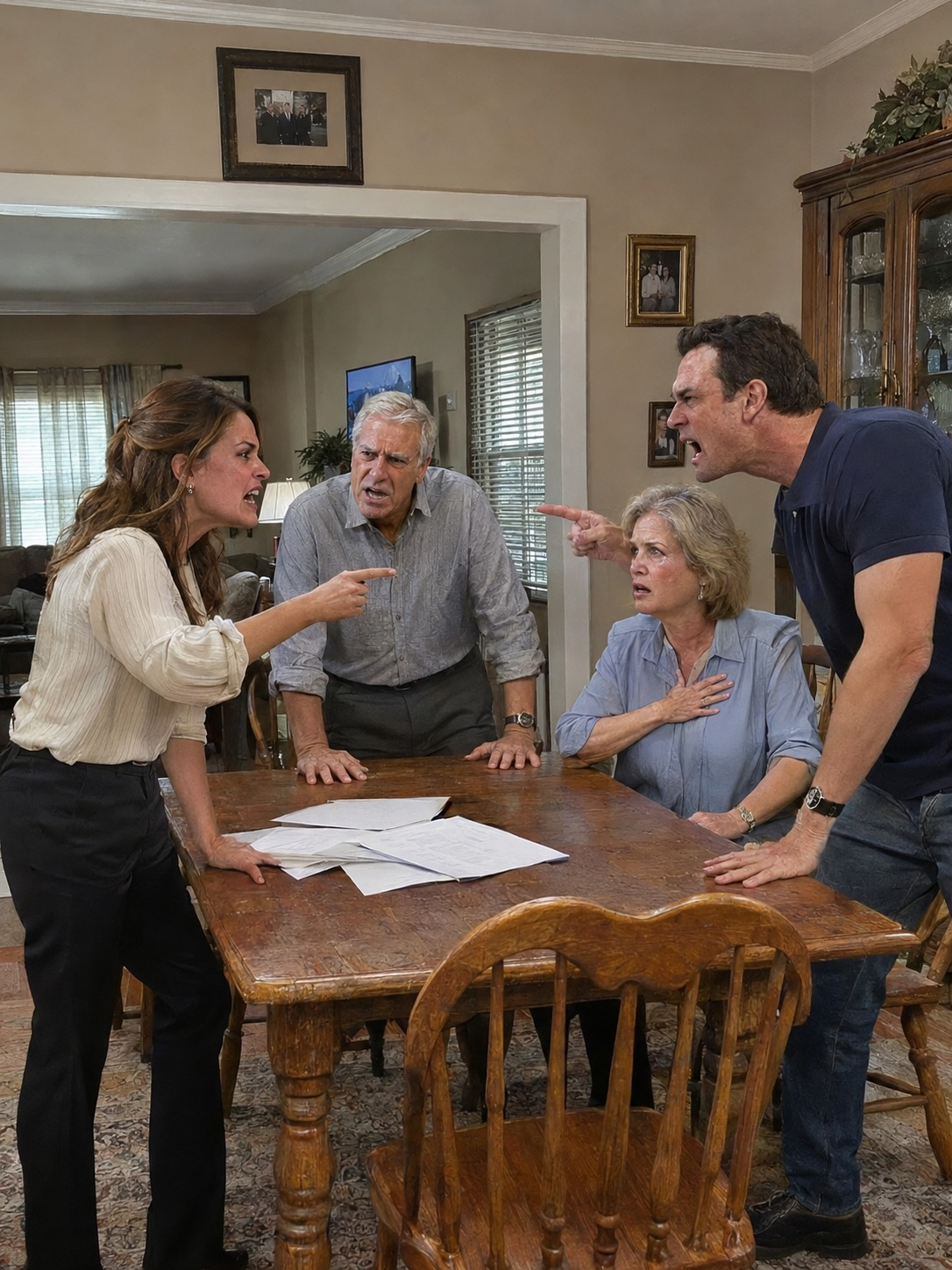
"They're sitting at the dining room table."
I felt cold.
The same table.
The one where we'd eaten Thanksgiving dinner.
The one where Dad had promised me half the business.
The one where Mom had told me to stop complaining.
The one where Travis had always taken the seat at Dad's right hand.
"Why are you telling me this?"
Dad whispered, "Because there's a fourth chair."
I stared at the wall.
"What?"
"They set a place for you."
My heart pounded.
"Dad, I'm not coming."
"I know."
He sounded frightened.
Then he whispered, "Patty, your mother has the statement."
I closed my eyes.
"The one they want me to sign?"
"Yes."
"And?"
He hesitated.
"She says you already signed it."
My stomach dropped.
"What?"
"I told her that wasn't possible."
I gripped the phone.
"Then what did she say?"
Dad's breathing became uneven.
"She said it didn't matter."
I went still.
"Why?"
He whispered, "Because she has the original."
I stared at the wall.
"The original what?"
Before he could answer, I heard my mother's voice.
"Walter, put the phone on speaker."
Dad didn't respond.
Then Travis spoke.
"Come on, Dad. We're all family here."
A chair scraped across the floor.
My father whispered, "Patty, don't believe anything they show you."
Then the line went quiet.
I heard my mother say, "It's time she learned what happens when she turns against us."
My heart slammed against my ribs.
A second later, my phone vibrated.
An incoming video call.
From my father's number.
I stared at the screen.
Then I answered.
The camera showed the dining room table.
Four chairs.
Four place settings.
My mother sat at one end.
Travis sat beside her.
My father was on the opposite side, pale and motionless.
The fourth chair was empty.
On the table lay a thick folder.
My mother looked directly into the camera.
"Patricia," she said, "you should have come when we asked."
Then Travis reached into the folder.
He pulled out a document.
Held it toward the camera.
And I saw my name printed beneath a statement I had never signed.
My mother smiled.
"Now," she said, "let's discuss what your father is going to tell the police."
Behind her, the dining room door slowly opened.
Someone stepped into the room.
And every person at the table turned toward the doorway.






Comments 0