I dragged my finger across the photograph and stopped breathing.
The woman standing behind the drunk driver was my mother.
Diane Doyle.
She was wearing the burgundy blouse she'd bought specifically for the grand opening, with her dark auburn hair tucked neatly behind one ear.
But it wasn't her presence that frightened me.
It was her expression.
My mother wasn't smiling for the camera.
She was staring at the man in the orange shirt.
And her hand was gripping his arm.
"Mrs. Doyle?" Kevin Whitmore asked through the phone.
I couldn't answer.
I enlarged the photograph again.
The man with the gray ponytail stood beside my father. Walter was holding a set of keys with a black rectangular fob and a silver bottle opener attached.
The driver appeared to be reaching toward them.
Behind them, my mother had one hand wrapped around his upper arm.
Her mouth was open.
She looked angry.
Or frightened.
I couldn't tell which.
But I knew one thing.
My family had seen this man before he climbed into the truck that nearly killed my daughter.
And they had lied about it.
"Patricia?" Kevin repeated.
I swallowed.
"I'm here."
"Do you recognize the woman?"
"She's my mother."
He went silent.
Then he said something that made my stomach tighten.
"I was afraid you were going to say that."
I stepped farther down the hospital hallway.
Hazel was sleeping, and Lorraine was sitting beside her bed with a book in her lap.
I didn't want either of them hearing this conversation.
"Kevin, where did you get this photograph?"
"I took it."
"Why?"
"I was photographing the grand opening for the bar's social media page."
I frowned.
"Do you work there?"
"Not exactly. I do freelance photography. Travis hired me to take pictures of the new beer garden."
That explained the angle.
The photograph was clear, professionally framed, and taken from slightly above eye level.
The people in the background were blurred, but the four figures near the outdoor bar were sharply focused.
My father.
My mother.
The driver.
And someone partially visible behind the counter.
I studied the image again.
"What time was this taken?"
"About four-thirty."
I looked at the clock on the hallway wall.
The accident had happened shortly before five.
"Are you certain?"
"The camera records the time. I checked the original file."
My throat tightened.
"Did you see the man leave?"
Kevin hesitated.
"Yes."
"Was he drunk?"
"I can't tell you how much he'd had to drink. But he was unsteady. He knocked into a table, and he was talking loudly."
I closed my eyes.
"Did anyone try to stop him?"
"That's what I've been trying to tell you."
I waited.
He lowered his voice.
"Your mother grabbed his arm. Your father had his keys. There was an argument."
"What were they arguing about?"
"I couldn't hear everything. Music was playing, and people were talking."
"Did you hear anything?"
A pause.
"Your mother said, 'Walter, don't give them back.'"
My fingers tightened around the phone.
"And my father?"
"He said something about not making a scene."
I leaned against the wall.
That sounded like Dad.
Don't make a scene.
Keep everyone calm.
Avoid embarrassment.
It was the Doyle family philosophy, condensed into four words.
"Kevin, did my father give him the keys?"
"I saw the man holding them afterward. I didn't actually see the handoff."
I appreciated the distinction.
After everything that had happened, I needed facts.
Not guesses.
Not rumors.
Not another person telling me what they thought I wanted to hear.
"Do you still have the original photograph?"
"Yes."
"Please don't delete it."
"I won't."
"And please give it to the police."
"I've already left a message for the investigator."
"Good."
He hesitated.
"Mrs. Doyle, there's something you should understand."
"What?"
"I didn't contact you because I wanted to hurt your family."
I looked toward Hazel's room.
"My family isn't the one lying in a hospital bed."
He said nothing.
Then I heard him exhale.
"You're right."
When I returned to Hazel's room, Lorraine took one look at my face and closed her book.
"What happened?"
I sat beside her.
"I know my parents saw the driver before the crash."
I showed her the photograph.
She studied it carefully.
"That's Diane."
"Yes."
"And Walter."
"Yes."
She enlarged the image.
"Who's the man?"
"I don't know his name yet."
Lorraine looked at me.
"But he's the driver?"
"He matches the man in the news footage. The police will have to confirm it."
She nodded.
Then she looked toward Hazel.
The little girl was sleeping with Captain Marshmallow tucked beneath her uninjured arm.
Lorraine's eyes filled.
"Those people," she whispered.
I didn't ask which people she meant.
The driver.
My parents.
My brother.
At that moment, I wasn't sure there was much difference between the anger I felt toward any of them.
But anger wasn't evidence.
I kept reminding myself of that.
It was the only thing stopping me from driving straight to Doyle's Tap House and demanding answers in front of everyone.
At 12:46 p.m., Sergeant Kowalski called.
"Mrs. Doyle, I received your message."
"Did Kevin contact you?"
"He did. We're arranging to obtain his original photographs."
I sat up.
"Then you know my parents were with the driver."
"We're reviewing that information."
I took a breath.
"Can you tell me his name now?"
There was a pause.
"The suspect's identity has been released publicly. His name is Raymond Keller. He's fifty-eight."
Raymond Keller.
I repeated it silently.
The name meant nothing to me.
Or so I thought.
Then something stirred in my memory.
A man sitting at the far end of the bar.
Gray ponytail.
Orange shirt.
A loud laugh.
I had seen him before.
Not recently.
Years earlier.
"Mrs. Doyle?"
"I'm here."
"Do you recognize the name?"
"I'm not sure."
"Take your time."
I closed my eyes.
Raymond Keller.
Ray.
Someone had called him Ray.
I remembered Travis shouting across the bar.
"Hey, Ray! You playing Saturday?"
It had been during one of the summer volleyball tournaments.
I couldn't remember the year.
But I remembered the man laughing.
And I remembered Dad pouring him a beer.
"He's been to the bar," I said.
"How do you know?"
"I think I've seen him there before."
"Would you be able to identify him from a photograph?"
"Possibly."
Kowalski told me she would arrange a formal identification procedure if needed.
Then she asked another question.
"Did your family ever mention Mr. Keller in connection with the business?"
I thought carefully.
"No. Not by name."
"All right."
I hesitated.
"Sergeant, if my parents knew he was impaired, could they be in trouble?"
"That depends on what happened and what the evidence establishes."
I looked down.
"I understand."
"We're investigating the driver's conduct and his activities before the collision. Please don't confront anyone about the photographs."
"I won't."
"Has anyone contacted you since we last spoke?"
I told her about Travis appearing at the hospital.
About my father's calls.
About the forged document.
She listened carefully.
"The business document may be a separate legal matter," she said. "Preserve it and consider speaking with an attorney who represents your interests."
"I will."
Before ending the call, she added, "Mrs. Doyle, I know this is difficult. But you are doing the right thing by sharing information rather than trying to investigate it yourself."
I looked at Hazel.
"I just want to know what happened to my daughter."
"I understand."
For the first time, I believed someone outside that hospital room might actually help me find out.
At 1:18, my mother called.
I watched her name flash across the screen.
Diane Doyle.
For years, seeing that name had made me straighten my shoulders.
Check my tone.
Prepare to explain myself.
I answered.
"Hello, Mom."
"Patricia, where have you been?"
I almost laughed.
"In the hospital."
"Don't be sarcastic."
"I'm not."
She sighed dramatically.
"Your brother said you had him thrown out."
"He was shouting outside Hazel's room."
"He was worried about his niece."
"Then why didn't he come when she was in surgery?"
Silence.
Then she said, "We have been over this."
"No, Mom. We haven't."
Her voice sharpened.
"Patricia, I am not doing this with you."
I looked at the photograph on my phone.
My mother gripping Raymond Keller's arm.
My father holding his keys.
The driver standing between them.
"Did you know Raymond Keller?" I asked.
The line went quiet.
Then she said, "Who?"
"Raymond Keller."
"I don't know what you're talking about."
"The man who hit Hazel."
She inhaled sharply.
I heard it.
A tiny sound.
But unmistakable.
"Why are you asking me about him?"
"Because you were standing next to him at the bar."
Another silence.
Then she said, "You need to be very careful about making accusations."
"I'm asking a question."
"You're upset. You're not thinking clearly."
I closed my eyes.
There it was again.
The old trick.
If I disagreed with her, I was emotional.
If I questioned her, I was confused.
If I demanded an answer, I was causing trouble.
"Mom, there's a photograph."
Her breathing changed.
"What photograph?"
"From the grand opening."
"Who gave it to you?"
I didn't answer.
"Patricia, who gave you that picture?"
"Did you know he was drunk?"
"Don't use that word."
I stared at the wall.
"What word?"
"Drunk."
"Mom, he was arrested on suspicion of driving impaired."
"That doesn't mean anything has been proven."
"Then tell me what happened."
She lowered her voice.
"Your father was trying to help someone."
"Help him do what?"
"That's none of your business."
I felt something inside me turn cold.
"My daughter was in the minivan he hit."
"I know that!"
Her voice cracked.
For one second, I heard something that sounded like genuine distress.
Then she recovered.
"And I am sick of you acting like you're the only person suffering."
I couldn't speak.
She continued.
"Do you have any idea what this could do to the bar? To your father? To the employees who depend on us?"
I looked through the doorway at Hazel.
Her small fingers were curled around the rabbit's ear.
"Mom," I said quietly, "Hazel asked me if she would still be herself without her spleen."
Silence.
"She asked whether she'd done something wrong."
My mother said nothing.
"She asked why the truck hit her."
I waited.
Then Diane whispered, "Patricia, please."
For a moment, I thought she might apologize.
Instead, she said, "Don't make this worse."
I ended the call.
I sat still for several minutes.
My hands were shaking again.
Not from fear.
From the effort of holding back everything I wanted to say.
I wanted to tell my mother that the bar wasn't a child.
It couldn't bleed.
It couldn't wake from surgery asking whether it was still whole.
It couldn't be frightened by the sound of a passing truck.
A business could lose money.
It could close.
It could be rebuilt.
Hazel couldn't be replaced.
I thought about all the times Mom had told me to put family first.
Every holiday.
Every birthday.
Every emergency involving Travis.
Family first, Patty.
That's what matters.
But apparently family meant the bar.
The building.
The reputation.
The people whose names were on the paperwork.
Not my daughter.
Not me.
I wiped my face before returning to Hazel's bedside.
She was awake.
"Mommy?"
"Hi, sweetheart."
"Why are you sad?"
I sat beside her.
"Just tired."
She studied me.
Then she held out Captain Marshmallow.
"You can borrow him."
I smiled through my tears.
"Are you sure?"
She nodded.
"He helps."
I took the rabbit.
And for a moment, I let myself be comforted by a seven-year-old who had already suffered more than she should have.
At 2:37, Kevin sent another message.
"I found something else in the photos. Can you call?"
I stepped into the hallway.
He answered immediately.
"Mrs. Doyle, I went through the pictures from yesterday."
"What did you find?"
"Raymond Keller wasn't just a guest."
I frowned.
"What do you mean?"
"He was wearing a staff wristband."
I stared at the wall.
"A what?"
"One of the blue bands Travis gave employees and volunteers so they could move between the service area and the beer garden."
I remembered those wristbands.
Travis had ordered them for special events.
Blue for staff.
Orange for guests participating in tournaments.
Black for vendors.
I had helped design the system years earlier.
"Are you sure it was blue?"
"Yes. I have a close-up."
He sent the photograph.
I opened it.
Raymond Keller stood beside a table holding an empty plastic cup.
On his right wrist was a blue band.
I enlarged the image.
There was a small white stamp on it.
A curved D.
The bar's logo.
My stomach tightened.
"Why would he have that?"
"I don't know."
"Was he working?"
"I never saw him serving anyone."
"Then why give him access?"
Kevin hesitated.
"That's what I wondered."
I looked at the photograph again.
The blue band wasn't proof of anything by itself.
But it meant someone at the bar had given Raymond a level of access ordinary guests didn't have.
And if he had been inside the service area, there might be records of his movements.
Security footage.
Employee logs.
Transaction histories.
I thought about the archive deletion request.
Thirty days of records.
Travis's account.
My administrator approval.
The timing suddenly felt less accidental.
"Kevin, have you told the police about the wristband?"
"I'm sending them the photographs."
"Good."
He paused.
"Mrs. Doyle, there's one more thing."
I waited.
"The photographer before me quit."
"What?"
"Travis originally hired someone else. A woman named Melissa Grant. She was supposed to cover the entire opening."
"Why did she quit?"
"I don't know. Travis called me Thursday night and offered extra money if I could replace her."
I frowned.
"Did he say why?"
"He said she was unreliable."
I thought about that.
Travis had a habit of calling people unreliable when they refused to do what he wanted.
"Do you know how to reach her?"
"I have her business page."
"Send it to Sergeant Kowalski."
"I will."
I thanked him.
Then I ended the call.
At 3:11, I opened my laptop.
I didn't access the bar's transaction system.
Not yet.
Sergeant Kowalski had told me not to investigate on my own, and I intended to respect that.
Instead, I opened the folder containing the records I had already preserved.
The security notification.
The deletion request.
The forged ownership document.
My family's messages.
The news photograph.
Kevin's photographs.
I created a simple timeline.
Friday, 4:30 p.m. — Raymond Keller photographed at Doyle's Tap House.
Friday, approximately 4:52 p.m. — collision reported.
Friday, 5:58 p.m. — surgical consent signed.
Friday, 6:07 p.m. — Hazel taken into surgery.
Friday, 8:41 p.m. — Mom's message dismissing Hazel's injuries.
Friday, 10:12 p.m. — Mom's warning not to mention the bar.
Saturday, 12:06 a.m. — administrator password-reset attempts.
Saturday, 12:12 a.m. — transaction archive deletion request.
I stared at the sequence.
I had spent years building spreadsheets for my family.
Tracking expenses.
Reconciling deposits.
Explaining missing money.
Now I was organizing evidence that might expose them.
The irony wasn't lost on me.
But I didn't feel satisfaction.
I felt sick.
I would have traded every document in that folder for one ordinary Friday afternoon.
One where Hazel came home from camp.
One where we ordered pizza.
One where she complained about having to brush her teeth.
One where the worst thing that happened was discovering we'd run out of her favorite ice cream.
At 4:02, Dr. Reeves came to check on Hazel.
She was pleased with her progress.
Hazel had managed a little food.
Her pain was being controlled.
Her vital signs remained stable.
The doctor explained that recovery would take time, but the immediate signs were encouraging.
I asked whether Hazel would be able to return to school.
"Eventually," she said. "We'll give you a plan before discharge."
I nodded.
Hazel looked at her.
"Can I still play soccer?"
Dr. Reeves smiled gently.
"We'll talk about activities as you heal. Right now, your job is to rest."
Hazel sighed.
"That's boring."
I laughed.
It surprised both of us.
Dr. Reeves smiled.
"Being bored can be a good sign."
After she left, Hazel asked whether we could watch a movie.
I climbed carefully onto the edge of the bed.
We watched an animated film about a lost dog finding its way home.
Halfway through, Hazel fell asleep against my arm.
I stayed still.
My phone vibrated several times.
I ignored it.
For forty minutes, I was simply her mother.
Not a witness.
Not an accountant.
Not the daughter of Walter and Diane Doyle.
Just the person she trusted to keep her safe.
At 5:26, I finally checked my messages.
There was one from Travis.
"Stop talking to people from the bar."
Another.
"You're making a huge mistake."
Then a third.
"Mom says someone sent you pictures. Whoever it was is lying."
I stared at the screen.
I hadn't told Travis about Kevin.
I hadn't told Mom his name.
But they knew someone had contacted me.
And they were frightened.
I typed:
"If the photographs are false, the police can determine that."
He replied almost instantly.
"You don't understand what you're doing."
I looked at Hazel.
Then I wrote:
"I understand exactly what happened to my daughter."
Three dots appeared.
Disappeared.
Then:
"Dad wants you at the house tomorrow."
I didn't respond.
Another message arrived.
"All four of us need to sit down."
I stared at the words.
All four.
Mom.
Dad.
Travis.
Me.
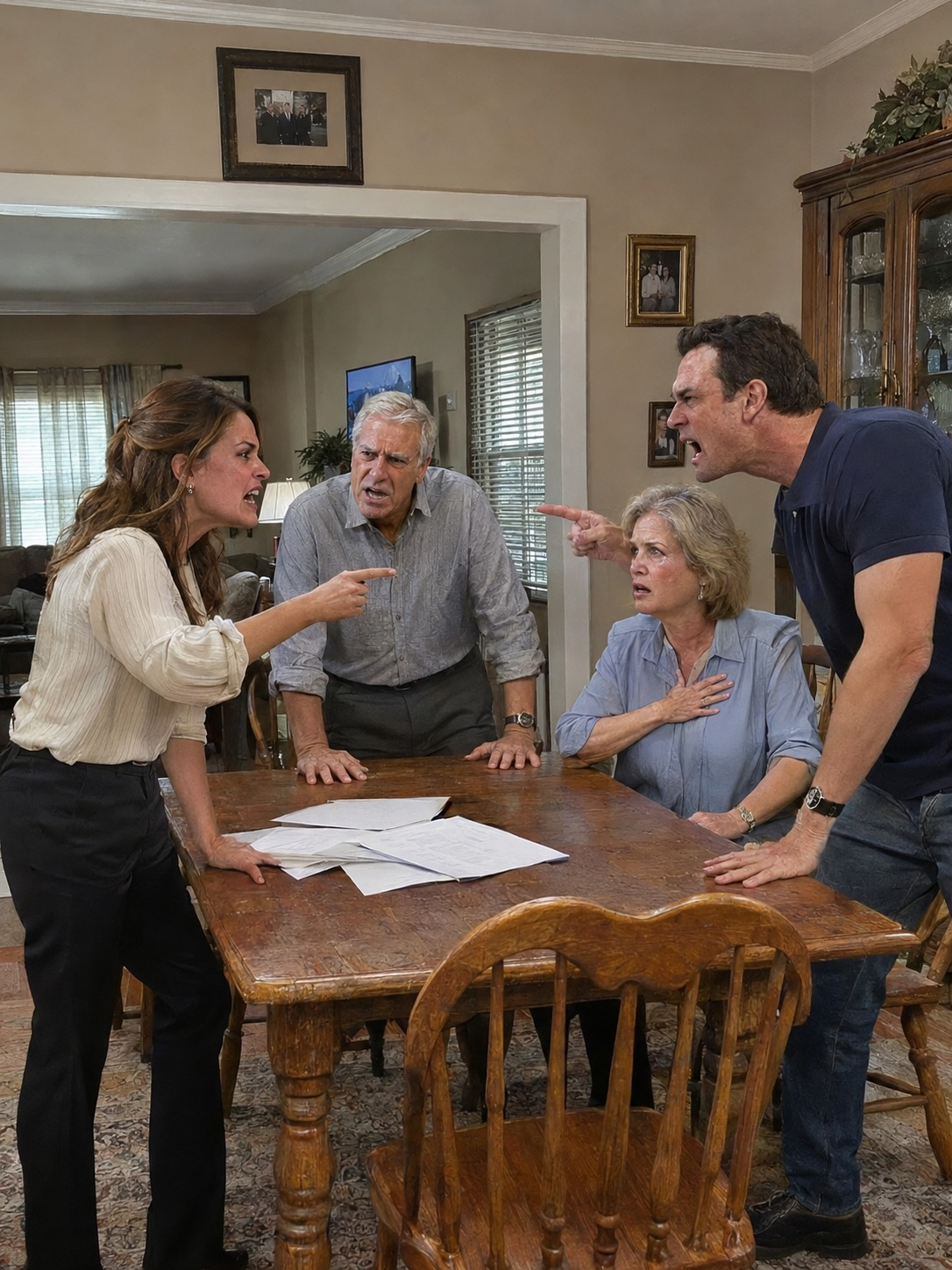
The same four people who had gathered around the dining room table for birthdays, holidays, and family arguments.
The same table where Dad had once promised me that hard work would always be rewarded.
The same table where Mom had told me to stop being selfish when I asked for help.
I could almost see them sitting there.
Mom with her arms crossed.
Travis leaning forward, ready to interrupt.
Dad staring at the tabletop.
And me, trying to explain why I deserved to be heard.
For years, those conversations had ended the same way.
I apologized.
I agreed.
I said okay.
Not this time.
At 6:14, Lorraine returned with dinner.
She brought chicken soup, crackers, and a small container of applesauce for Hazel.
While Hazel ate, I showed Lorraine the latest messages.
She read them carefully.
"Are you going?"
"To the house?"
"Yes."
I looked down.
"I don't know."
"Then don't decide tonight."
I nodded.
She handed the phone back.
"Whatever you do, don't go alone."
I looked at her.
"You'd come with me?"
"Of course."
I smiled faintly.
"My mother would hate that."
Lorraine shrugged.
"Your mother doesn't have to like me."
I laughed.
A real laugh.
Small, exhausted, but real.
Then Hazel looked up from her applesauce.
"Why are you laughing?"
"Because Miss Lorraine is very brave."
Hazel nodded seriously.
"She used to teach fifth grade."
Lorraine smiled.
"Exactly. Nothing scares me anymore."
For a moment, the room felt warm.
Safe.
Almost normal.
Then my phone rang.
Sergeant Kowalski.
I answered immediately.
"Mrs. Doyle, I need to ask you something."
"Of course."
"Did your family ever employ Raymond Keller?"
I frowned.
"Not that I know of."
"Was he involved in the bar's renovation?"
I thought about the beer garden.
Dad had hired contractors.
Travis had coordinated deliveries.
There had been construction workers, electricians, and landscapers.
I hadn't been involved.
"I don't know," I admitted.
Kowalski paused.
"We've obtained information suggesting he had a business connection to Doyle's Tap House."
My heart began pounding.
"What kind of connection?"
"We're still verifying the details."
I closed my eyes.
"Sergeant, my brother is trying to delete records."
"We're aware of the information you provided."
"Please tell me you can stop him."
"We're taking steps to preserve relevant evidence."
I nodded.
Then she said something unexpected.
"Mrs. Doyle, has anyone from your family mentioned a private event held at the bar on Thursday evening?"
I frowned.
"Thursday?"
"Yes."
"No."
"All right."
"Why?"
A pause.
"We're trying to establish Mr. Keller's activities during the days before the collision."
I looked toward Hazel.
"What happened Thursday?"
"I'm not able to discuss that yet."
I swallowed.
"Okay."
Before ending the call, she added, "Please keep your phone available. We may need to speak with you again."
I promised I would.
Then I sat down.
Thursday evening.
A private event.
Raymond Keller.
A blue staff wristband.
My family's desperate attempts to control the story.
The pieces were beginning to connect.
But I still couldn't see the whole picture.
At 7:03, an email arrived from Martin Ellison.
The attorney.
The subject line read:
ADDITIONAL DOCUMENT DISCOVERED.
I opened it.
"Ms. Doyle, during our preliminary review, we located correspondence indicating that the proposed ownership transfer was discussed before the document bearing your signature was prepared. I cannot yet provide conclusions about its validity. However, I believe you should be aware that your father requested a separate meeting with our office last November."
I stared at the message.
Last November.
Thanksgiving.
The envelope.
Mom interrupting us in the kitchen.
I scrolled down.
There was an attachment.
A scanned handwritten note.
It was written on Doyle's Tap House stationery.
I recognized my father's handwriting immediately.
The note was dated three days before Thanksgiving.
It contained only two sentences.
"I need to correct the ownership arrangements before something happens to me. Patricia has earned more than anyone knows."
My eyes filled with tears.
For a moment, I couldn't breathe.
Dad had known.
He had known how much I'd contributed.
He had known the promises mattered.
He had tried to do something.
Then I noticed another line beneath the note.
A handwritten instruction from the attorney's file.
"Client requested follow-up. Meeting canceled by Diane Doyle."
I stared at the words.
My mother had stopped the meeting.
I didn't know why.
I didn't know what Dad had intended.
But I knew he had tried to change something.
And someone had prevented it.
My phone vibrated.
A message from Dad.
"Patty, I need to see you before your mother does."
I sat up.
Another message appeared.
"There's something about Raymond Keller you don't know."
My heart pounded.
I typed:
"Then tell me."
Three dots appeared.
Disappeared.
Then:
"Not over the phone."
I stared at the screen.
Before I could respond, another message arrived.
"Come to the house tonight. Use the back door. Don't tell Travis."
I looked toward Lorraine.
She was helping Hazel adjust Captain Marshmallow beneath the blanket.
I wanted to believe my father.
I wanted to believe the man who had once promised me half the business was finally ready to tell the truth.
But I had believed him before.
And belief had cost me years.
I opened the message again.
Then my phone rang.
An unfamiliar number.
I answered.
"Hello?"
A woman spoke.
"Patricia Doyle?"
"Yes."
"My name is Melissa Grant."
I stood up.
The original photographer.
The woman Travis had replaced the night before the grand opening.
"I understand you were at the bar Thursday," I said.
Her breathing sounded uneven.
"Yes."
"Why did you leave?"
She didn't answer immediately.
Then she whispered, "I didn't quit."
My stomach tightened.
"What?"
"Your brother fired me because I took a photograph he didn't want anyone to see."
I gripped the phone.
"Of what?"
She lowered her voice.
"Mrs. Doyle, Raymond Keller wasn't the only person drinking that night."
I went still.
"Who else?"
There was a long silence.
Then Melissa said, "I can send you the photograph, but you need to promise me something."
"What?"
"Don't open it while you're alone."
A message arrived.
One attachment.
No explanation.
I pressed the image.
It began loading.
And as the first faces appeared on the screen, I recognized the person sitting beside Raymond Keller.
It was someone who should never have been there.






Comments 0