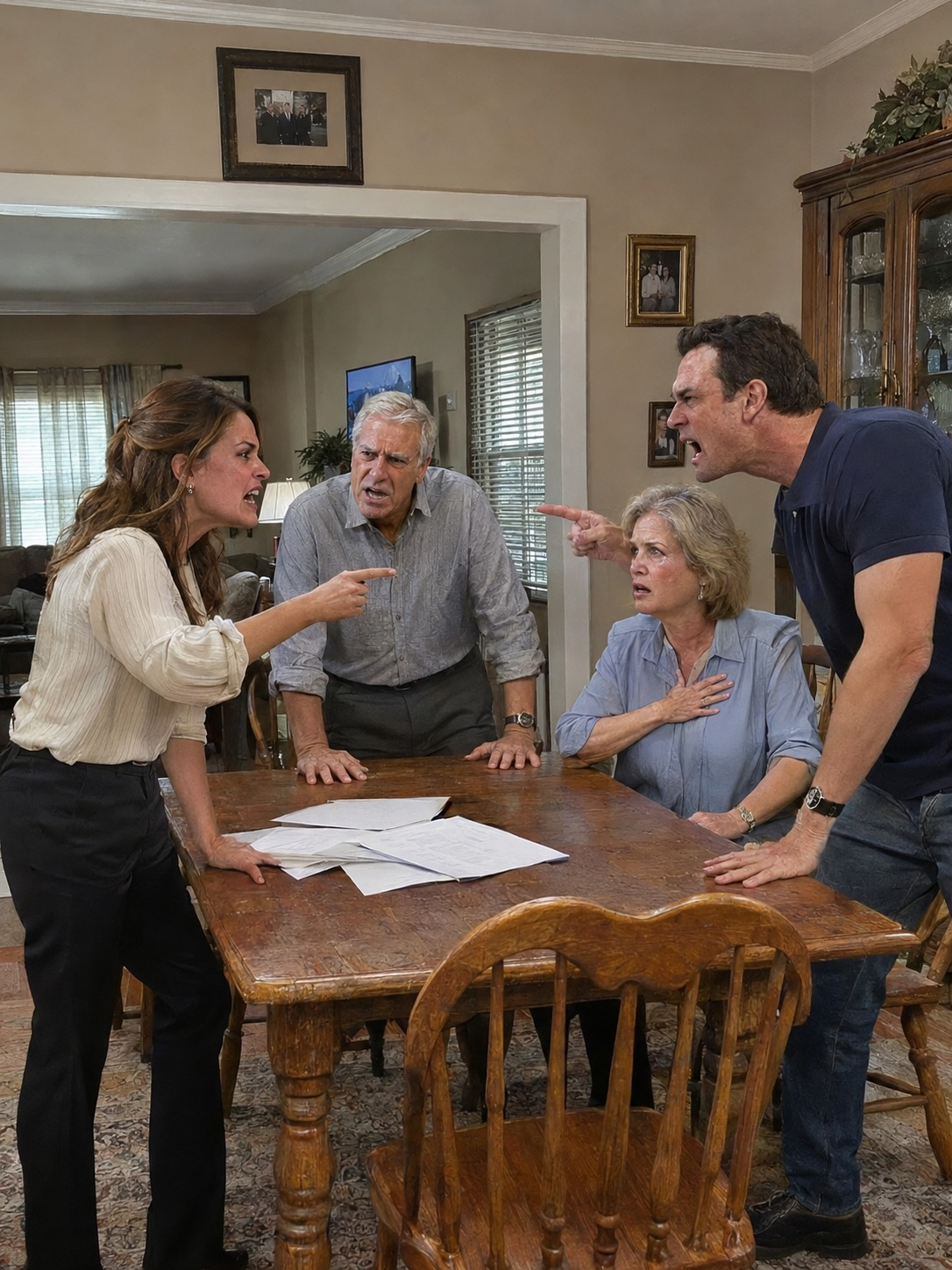
The door handle turned.
I stood between the door and Hazel's hospital bed.
"Mom?"
The door opened three inches.
My mother's face appeared in the narrow gap.
She looked different.
Her carefully styled hair was falling out of place. Her lipstick had faded, and the pearl earrings she wore to every important family occasion were missing.
But her eyes were the same.
Cold.
Determined.
And fixed on me.
"Patricia," she whispered. "We need to talk."
I didn't move.
"Not here."
She glanced past me.
"Is Hazel asleep?"
"Yes."
"Then come into the hallway."
I looked at her.
"Why did you bring someone to the county recorder's office pretending to be me?"
Her expression changed.
Only slightly.
But I saw it.
"Lower your voice."
"No."
"Patricia."
"Who is she?"
My mother glanced toward the nurses' station.
"You're making a scene."
I almost laughed.
My daughter had nearly died.
My brother had been arrested.
My father's business was under investigation.
And my mother was still worried about appearances.
I stepped backward and pressed the nurse call button.
"Mom, you need to leave."
She pushed the door open another inch.
"Don't be ridiculous."
"Leave."
Her eyes narrowed.
"That building belongs to this family."
I felt something inside me settle.
"No," I said. "It doesn't."
She stared at me.
"Grandma left it to me."
My mother's mouth tightened.
"Your grandmother had no idea how difficult you would become."
I looked at her for a long moment.
Then I said the words I should have said years earlier.
"She knew exactly who I was."
Nurse Emily arrived before my mother could answer.
"Is everything all right?"
"No," I said. "This visitor needs to leave."
My mother straightened.
"I'm her mother."
Emily looked at me.
"Ms. Doyle?"
"I don't want her in my daughter's room."
Emily nodded.
"Understood."
Hospital security arrived moments later.
My mother protested.
She told them I was emotional.
She said I had misunderstood a family matter.
She insisted she had every right to visit her granddaughter.
But the security officer remained calm.
"Ma'am, the child's parent has requested that you leave."
My mother turned toward me.
"Patricia, you'll regret this."
I looked at her.
"Maybe I'll regret plenty of things."
My voice shook.
"But I won't regret protecting Hazel."
For the first time in my life, my mother had no immediate answer.
Security escorted her down the hallway.
I watched until she disappeared around the corner.
Then I closed the door.
And locked it.
Hazel was awake.
She watched me from beneath her purple blanket.
"Was that Grandma?"
I sat beside her.
"Yes, sweetheart."
"Is she mad?"
I brushed a strand of hair from her forehead.
"She is."
Hazel thought about that.
"Did I do something?"
My heart broke a little.
"No."
"Are you sure?"
"Absolutely."
She looked down at Captain Marshmallow.
"Grandma gets mad a lot."
I swallowed.
"Sometimes she does."
Hazel considered this.
Then she whispered, "I don't like it when grown-ups yell."
I kissed her forehead.
"Neither do I."
She reached for my hand.
"Can we go home soon?"
I smiled through tears.
"That's the plan."
She nodded.
"Good."
Then she added, "Our house is quieter."
I held her hand until she fell asleep again.
At 8:41 the following morning, Rebecca Shaw called.
I recognized the time immediately.
8:41.
The minute my mother had sent the message that changed everything.
She survived. Stop seeking attention.
Now, four days later, I was sitting beside the same hospital bed.
But something had changed.
I no longer believed my mother's words defined my worth.
"Patricia," Rebecca said, "I have good news."
I sat up.
"Tell me."
"The county recorder's office flagged the attempted deed transfer before it was accepted for recording."
I closed my eyes.
"Thank God."
"The document was submitted for review, but the recording was halted after questions arose about the identity of the person presenting it."
I exhaled.
"Who was the woman pretending to be me?"
"Investigators have identified her as a woman who had previously performed administrative work for a business associated with Martin Ellison."
My stomach tightened.
"Did she know the identification was fake?"
"That's being investigated."
I nodded.
Rebecca continued.
"The identification and deed have been preserved as evidence. We've also initiated the appropriate steps to protect the property record while the disputed documents are examined."
I covered my mouth.
"So Mom can't just take the building?"
"Not through that attempted transfer. And we're pursuing additional safeguards."
Tears filled my eyes.
"Thank you."
Then Rebecca said, "Patricia, there's something important about the original deed."
I held my breath.
"What?"
"Your grandmother purchased the building through a separate arrangement when the business opened. The property was titled in your name, with adults handling matters on your behalf while you were a child."
I closed my eyes.
"Why didn't anyone tell me?"
"That's a question your father will need to answer."
I swallowed.
Rebecca continued.
"The ownership of the building and the ownership of the operating business are separate legal matters. But the property records are much clearer than the disputed business-interest documents."
I nodded.
"Does that mean the building is mine?"
"The recorded title supports your ownership, subject to resolving the challenges and any valid encumbrances. We have strong grounds to protect your interest."
I began crying.
Not because I suddenly felt rich.
Not because I wanted revenge.
But because my grandmother had tried to give me security.
And for decades, the people closest to me had kept me from knowing it existed.
Later that morning, Sergeant Kowalski visited the hospital.
She wore a dark jacket over a pale blue shirt and carried a thin folder.
"How's Hazel?"
"Better."
I smiled.
"They're talking about sending her home soon."
Kowalski's expression softened.
"I'm glad."
We sat in the family lounge.
She explained that the investigation had reached an important stage.
Raymond Keller remained responsible for his decision to drive while impaired. Evidence from the collision, witness statements, and the toxicology investigation supported the case against him.
But the investigation into Doyle's Tap House had uncovered additional conduct.
Financial records.
Disputed signatures.
Attempts to delete transaction histories.
Pressure on witnesses.
And evidence concerning the decision to return Raymond's keys.
I listened without interrupting.
Then I asked, "What about my mother?"
Kowalski paused.
"The parking-lot footage shows her handing the keys to Raymond after your father had taken them."
I closed my eyes.
"She knew he was drunk."
"Multiple witnesses described behavior consistent with impairment. Investigators are examining what each person knew."
I nodded.
"And Martin?"
"He was present near the truck and had contact with Raymond. His financial and documentary activities are also under investigation."
I swallowed.
"What about Kevin's statement?"
"Kevin Whitmore denied signing it. The document was submitted through channels connected to Ellison's office, and we're examining the evidence of how it was created."
"And Jenna?"
"Her recorded conversation with Travis is part of the evidence."
I looked down.
"She was so brave."
"She was."
I hesitated.
"Did you find out why Travis kept using my account?"
Kowalski nodded.
"The technical records indicate that your credentials and account identity were used in ways you did not authorize. Investigators have obtained device, access, and transaction records that help distinguish your actual activity from activity performed by others."
I closed my eyes.
For days, my family had tried to make the records tell a story about me.
But the records had preserved their own story.
One my family hadn't expected anyone to read.
There was one question I still needed answered.
"Sergeant, why did my mother give Raymond his keys?"
Kowalski studied me.
"Your mother has provided an account of the exchange."
I swallowed.
"What did she say?"
"She said she believed another person had arranged to drive him home and that the situation was being handled."
I stared at her.
"But she handed him the keys."
"Yes."
I closed my eyes.
Kowalski continued.
"Your father says he objected. Your brother says he believed Raymond would wait for his ride. The footage and witness statements are being used to assess those claims."
I nodded.
Then I asked, "Who was supposed to drive him?"
"An employee had been asked to arrange transportation, but no confirmed ride was waiting when Raymond left."
I stared at the floor.
All those people.
All those explanations.
And Raymond had still driven away.
"Was Lorraine's call too late?"
Kowalski shook her head gently.
"She called before the collision. The timing of the response is being reviewed. She gave the information she had."
I swallowed.
Lorraine had tried.
Jenna had tried.
And Hazel had paid the price for the choices of people who hadn't tried hard enough.
Kowalski closed her folder.
"Patricia, there is one more thing."
I looked up.
"Your father has provided a full statement concerning the ownership documents."
I felt my chest tighten.
"Everything?"
"He has acknowledged withholding documents and making representations about your authorization that you dispute."
I looked down.
For years, my father had protected everyone except me.
Now he was finally telling the truth.
It didn't erase what he'd done.
But it meant the lies were no longer the only record.
Three days later, Hazel came home.
I had imagined that moment so many times.
The front door.
The familiar hallway.
The smell of laundry detergent.
The little shoes beside the stairs.
But when I finally carried her overnight bag inside, I realized how much I had changed.
Before the accident, home had been the place where I recovered from my family's demands.
Now I wanted it to be something better.
A place where those demands couldn't reach us.
I'd changed the locks.
Updated the security system.
Removed old shared access.
And made sure only people I trusted could enter.
Hazel stood beside me, holding Captain Marshmallow.
She looked around.
Then smiled.
"Everything's still here."
I laughed.
"Of course it is."
She hurried carefully toward the living room, following the activity restrictions her doctors had explained.
Her purple blanket waited on the couch.
Her favorite books were stacked on the table.
And beside them sat a small box of cupcakes.
Purple frosting.
Extra sprinkles.
Hazel gasped.
"Mommy!"
I grinned.
"The cupcake boss delivers."
She laughed so hard she had to stop and hold her abdomen.
I immediately moved closer.
"Easy, baby."
She nodded.
"Okay."
Then she whispered, "Best day ever."
I kissed her forehead.
For me, it was.
Recovery wasn't simple.
There were follow-up appointments.
Vaccinations.
Instructions about fever and infection.
Conversations with Hazel's school about her medical needs.
A plan for physical recovery and returning to normal activities safely.
Some nights she still woke frightened.
Sometimes a loud engine made her flinch.
Sometimes she asked whether the truck would come back.
I never told her there was nothing to fear.
Instead, I told her what was true.
She was safe at home.
We had people helping us.
And I would listen whenever she needed to talk.
We found a counselor experienced in helping children after traumatic events.
Hazel liked her because she had a shelf full of stuffed animals.
After the third appointment, Hazel announced that Captain Marshmallow was considering a career in therapy.
I told her he had excellent qualifications.
She agreed.
The legal cases took longer.
Months, not days.
The kind of months filled with paperwork, appointments, and phone calls that arrived when I was trying to make dinner.
But this time, I wasn't alone.
Rebecca helped me challenge the disputed guarantees and ownership documents.
The forensic review confirmed that the signatures attributed to me on the financing agreement and attempted property transfer were not genuine.
Device and access records showed that the critical approvals had originated from equipment associated with the bar and Ellison's office, not from my workplace or personal devices.
The lender ultimately withdrew its claim that I had personally guaranteed the disputed obligation.
I cried when Rebecca told me.
Then I laughed.
Then I cried again.
For the first time since the accident, I could look at my bank account without wondering whether a debt I hadn't created was about to swallow our future.
The ownership dispute required more work.
My grandmother's original trust papers were authenticated.
The records showed that the beneficial interest intended for me had not been properly transferred when I turned twenty-five.
My father's use of that interest in business financing became part of the civil proceedings.
Eventually, through a court-approved settlement and the resolution of competing claims, my ownership rights were recognized and the financial consequences of the unauthorized transactions were addressed.
The building's title was confirmed in my name.
Not because my father finally decided to give it to me.
Because Grandma Rose had arranged it that way.
And because the records proved it.
The criminal cases unfolded separately.
Raymond Keller accepted responsibility for driving while impaired and causing the crash.
He was sentenced after the court considered the evidence, the injuries, and the impact on the victims.
I attended the hearing.
Jenna sat beside me.
Hazel stayed home with someone I trusted.
When I spoke, I didn't shout.
I told the court about the emergency surgery.
About my daughter's fear.
About the lifelong medical precautions she would need because of a decision made in a matter of minutes.
Raymond listened with his head lowered.
Afterward, through his attorney, he sent a letter expressing remorse.
I read it once.
Then I put it away.
His remorse could be real.
It could not give Hazel back her spleen.
Both things could be true.
Travis faced consequences for his actions involving Erin, the attempted destruction of records, and the financial misconduct uncovered during the investigation.
He eventually entered guilty pleas to charges supported by the evidence.
Martin Ellison also faced criminal proceedings connected to falsified documents and financial wrongdoing, along with professional disciplinary action.
My mother was held accountable for her role in the fraudulent property-transfer attempt and related conduct.
My father's cooperation did not excuse his years of concealment. He faced civil liability and consequences for the false statements and unauthorized financial representations he had made.
There were hearings.
Agreements.
Sentences.
Restitution orders.
And enough legal paperwork to fill an entire filing cabinet.
But the most important result wasn't a headline.
It was that the truth had finally been established in places where my family couldn't simply deny it.
Doyle's Tap House never reopened under my brother's management.
The business's debts, regulatory problems, and legal claims made the old operation impossible to continue.
The company was wound down through a supervised process.
Employees received the compensation and notices required through that process, and Rebecca helped me understand which obligations belonged to the operating company and which affected the property.
I was determined not to let innocent employees become invisible casualties of my family's choices.
I met with several of them.
Some were angry.
Some were frightened.
Some had worked there longer than Travis had been managing it.
One bartender named Susan hugged me and cried.
"I kept thinking someone would finally listen."
I hugged her back.
"I wish we'd listened sooner."
I didn't promise to save the old bar.
I couldn't.
And I no longer wanted to preserve something merely because my father had spent thirty years calling it his legacy.
Instead, I sold the equipment that could legally be sold, settled the remaining property-related obligations with professional help, and made a decision that surprised almost everyone.
I kept the building.
But I changed what it was for.
The idea came from Hazel.
One Saturday afternoon, we drove past the old bar.
The sign had been removed.
The windows were dark.
The volleyball courts stood empty behind the building.
Hazel looked out the window.
"Mommy?"
"Yes?"
"Why does nobody go there anymore?"
I considered how to answer.
"The old business closed."
She nodded.
Then she asked, "Can a building be something different?"
I glanced at her in the rearview mirror.
"Sure."
She thought about that.
"Could it be somewhere kids go after school?"
I smiled.
"Maybe."
"With books?"
"Definitely."
"And cupcakes?"
I laughed.
"You're very committed to cupcakes."
She grinned.
"They help people."
I looked back at the building.
For years, I'd thought of it as a place where I was expected to give everything and ask for nothing.
But Hazel saw empty rooms.
Windows.
Space.
Possibility.
And for the first time, I realized I didn't have to keep the building's old story.
I could give it a new one.
Nine months later, we opened Rose's House.
Not a bar.
Not a restaurant.
A community learning center with an after-school reading program, homework help, art workshops, and a small café that served coffee, sandwiches, and, on Fridays, purple-frosted cupcakes.
We worked with local educators and community organizations.
The old office became a quiet reading room.
The former beer garden became an outdoor activity space.
The volleyball courts were repaired and repurposed for supervised recreation.
And the wall where Dad had hung the photograph of the original grand opening now held a framed picture of Grandma Rose.
Beneath it was a small plaque.
ROSE DOYLE
She believed every child deserved a place to belong.
On opening day, Hazel wore a purple dress.
Her arm had healed.
Her surgical scars were fading.
She still needed medical precautions, and we continued following her doctors' guidance.
But she was laughing.
Running when cleared to do so.
Making friends.
And arguing passionately about which books belonged on the children's shelves.
She had survived something terrible.
But it would not be the only story of her childhood.
Lorraine came to the opening.
Our friendship had taken time to repair.
She had apologized without excuses.
She had given investigators everything she knew.
And she had respected the boundaries I set afterward.
I didn't immediately return to trusting her with Hazel's care.
Trust wasn't something I could restore simply because I wanted the discomfort to end.
But slowly, through honest conversations and consistent actions, we found our way back to each other.
On opening day, Lorraine stood beside Grandma Rose's photograph.
Her eyes filled with tears.
"She would have loved this," she whispered.
I smiled.
"I hope so."
Lorraine looked at me.
"She would have been proud of you."
I glanced toward Hazel, who was showing Jenna the new reading corner.
"I think she'd have been proud of her."
Lorraine laughed softly.
"Both of you."
Then she reached into her purse.
"I brought something."
It was a small photograph.
Grandma Rose standing outside the bar in 1994.
I was beside her in my yellow dress.
Grandma had one hand on my shoulder.
I stared at it.
"Where did you get this?"
"Your father gave it to me years ago when I helped organize some old photographs for a neighborhood history project."
I smiled through tears.
In the picture, Grandma was looking down at me.
Not at the camera.
At me.
I placed the photograph beside her plaque.
My father didn't attend the opening.
That was his choice.
Or perhaps it was mine.
The truth was more complicated than either.
We had spoken several times after the legal proceedings.
He had apologized.
Not the old apologies that ended with explanations.
Not the ones that asked me to understand why Travis needed more.
Real apologies.
He acknowledged the documents he'd hidden.
The money he'd used.
The promises he'd broken.
The times he'd watched me carry responsibilities that weren't mine.
He never asked me to forgive him immediately.
And I didn't.
I told him that if he wanted a relationship with me, it would have to be built on honesty.
If he wanted to know Hazel, he would need to respect her safety and my decisions.
He agreed.
We began with occasional letters.
Then carefully arranged conversations.
I didn't know whether our relationship would ever become what I'd once wanted.
But I no longer needed it to.
My life wasn't waiting for my father's approval.
My mother and Travis remained outside our lives.
I didn't send angry messages.
I didn't argue.
I didn't explain myself over and over.
I simply stopped giving them access to the parts of my life they had repeatedly harmed.
That boundary brought me more peace than any apology they could have offered.
One evening, almost a year after the accident, Hazel and I stayed late at Rose's House.
The last families had gone home.
The chairs were stacked.
The café lights glowed warmly against the front windows.
Hazel sat at a table, finishing a drawing.
I was checking the next week's schedule when she called me.
"Mommy?"
"Yes, sweetheart?"
"Come see."
I walked over.
She held up her picture.
It showed a brick building with a purple door.
A woman stood outside holding a cupcake.
A little girl stood beside her with a rabbit.
Above them, in enormous uneven letters, Hazel had written:
OUR HAPPY PLACE.
My throat tightened.
"That's beautiful."
She smiled.
"Do you like it?"
"I love it."
She looked toward Grandma Rose's photograph.
"Do you think Great-Grandma would like it?"
I sat beside her.
"I think she'd put it on the refrigerator."
Hazel giggled.
"Even though it's too big?"
"Especially because it's too big."
She leaned against me.
For a while, we sat quietly.
Then she asked, "Mommy, are we okay now?"
I looked at her.
Her bright eyes.
Her healed arm.
The little scar that reminded me how close I'd come to losing her.
I thought about everything we'd survived.
The hospital.
The fear.
The lies.
The courtroom.
The long months of rebuilding.
I could have told her that nothing bad would ever happen again.
But that wouldn't have been true.
Life would still be difficult sometimes.
There would be illnesses.
Disappointments.
Hard decisions.
But there would also be birthdays.
School concerts.
Purple cupcakes.
Ordinary mornings.
And a mother who would never again make her daughter feel that she had to earn the right to be loved.
"Yes, baby," I said. "We're okay."
Hazel smiled.
"Good."
Then she looked at her drawing.
"Can we hang this up?"
"Where?"
She pointed to the wall beside Grandma Rose's picture.
"Right there."
I laughed softly.
"That's a pretty important spot."
Hazel nodded.
"I know."
So I found a frame.
And together, we hung her drawing beside Grandma's photograph.
That night, after we locked up Rose's House, Hazel and I walked to the car.
The evening air was cool.
The sky above Dayton was turning pink and gold.
Hazel held my hand.
"Mommy?"
"Yes?"
"Can we have pancakes tomorrow?"
I smiled.
"Absolutely."
"Purple ones?"
I laughed.
"How do you make purple pancakes?"
She looked at me as though the answer were obvious.
"With love."
I stopped walking.
Then I knelt in front of her.
"Come here."
She wrapped her arms around my neck.
I held her carefully, feeling the warmth of her small body against mine.
A year earlier, I had sat in a hospital room wondering whether my daughter would survive.
I had begged my family to come.
I had waited for my father to choose me.
I had tried to understand how my mother could dismiss my child's suffering.
I had believed that if I explained myself well enough, someone would finally see what mattered.
But I no longer needed to convince them.
Hazel was here.
She was alive.
She was loved.
And she knew it.
I kissed her cheek.
"Purple pancakes it is."
She grinned.
Then she took my hand again.
We walked toward the car beneath the evening sky.
Behind us, the lights of Rose's House glowed through the windows.
A building that had once held so many secrets now welcomed children through its doors.
A legacy that had nearly been stolen had become something generous.
And the little girl who had almost lost her life was planning breakfast.
I opened the car door.
Hazel climbed into her seat.
She buckled in carefully and settled Captain Marshmallow beside her.
Then she looked up at me.
"Mommy?"
"Yes?"
"You're the best cupcake boss ever."
I laughed.
"And you're my favorite customer."
She smiled.
"Forever?"
I leaned down and kissed her forehead.
"Forever."
Then I closed her door, walked around to the driver's seat, and took us home.
Not to the life my family had chosen for me.
To the life my daughter deserved.
And the life I finally knew I deserved, too.






Comments 0