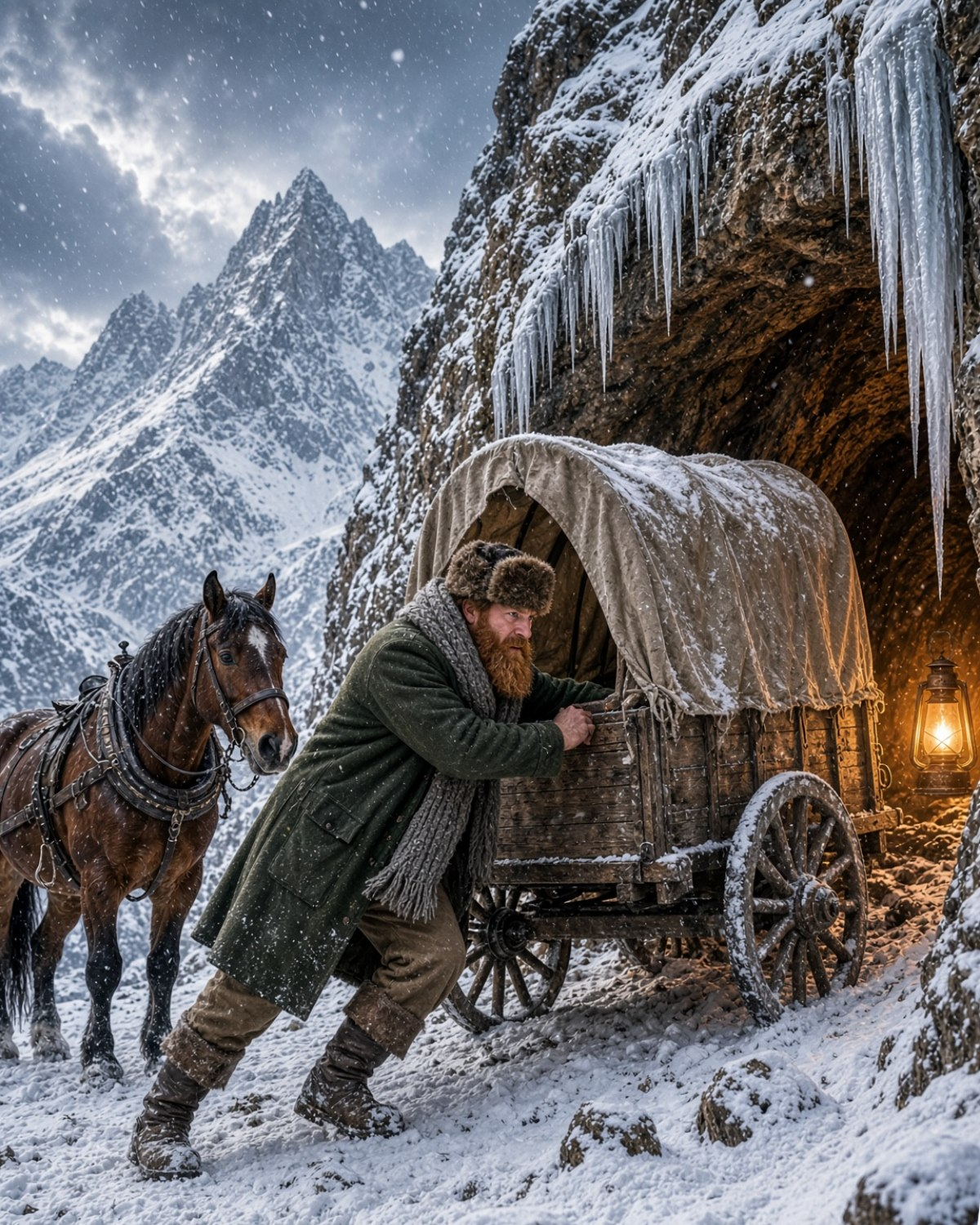
Pierce Holbrook dropped the lantern.
"Clara?"
The name tore out of him before he could stop it.
The lantern struck the stone floor, rolled against his boot, and nearly shattered. Its flame flickered behind the glass, throwing wild shadows across the black basalt walls.
Beneath the wooden hatch, the pale hand remained motionless.
Then the voice came again.
"Pierce... it's me."
His heart slammed against his ribs.
He knew that voice.
He had heard it every morning for nine years.
He had heard it singing while bread baked in their little kitchen in Garnet Basin. He had heard it laughing beside him on summer freight roads. He had heard it whispering his name on the last terrible night of November, when Clara lay burning with fever beneath a thin blanket.
He had heard it stop.
And now, beneath a mountain in the middle of a Montana blizzard, he was hearing it again.
"Clara?"
His knees weakened.
He caught himself against the wall.
The hand beneath the hatch moved.
Its fingers curled around the splintered edge.
"Help me."
Pierce stepped forward.
Then stopped.
Something was wrong.
The voice had Clara's softness, but the words came too slowly. Each syllable seemed dragged through a throat that had forgotten how to speak.
And Clara had been dead for seven weeks.
He had buried her himself.
He remembered the frozen cemetery outside Garnet Basin. The minister's trembling hands. The thin wooden coffin. The sound of hard earth striking the lid.
He remembered standing alone after everyone else had gone.
He had not imagined those things.
He had lived them.
"Who are you?" he demanded.
The hand disappeared.
A faint scraping sound followed.
Then silence.
Pierce swallowed.
"Answer me."
Nothing.
The storm screamed beyond the wagon.
Snow hissed through the gaps in the canvas.
Brim backed against the far wall and gave a frightened snort.
Pierce looked at the horse.
The animal's eyes were wide, but he was not staring at the hatch anymore.
He was watching Pierce.
That frightened him in a different way.
Pierce had been traveling for five days with little sleep and barely enough food. He had spent the afternoon fighting a dying wagon uphill while a blizzard advanced across the mountains.
His clothes were damp with sweat.
His hands were numb.
His stomach was nearly empty.
He knew what cold and exhaustion could do to a man's mind.
Years earlier, a freighter named Samuel Rusk had spent two nights stranded near the Continental Divide. When rescuers found him, he insisted that his dead mother had been sitting beside his fire.
Samuel had described her dress.
Her hands.
The smell of her cooking.
He had sworn she was real.
The doctor in Helena called it a fever brought on by exposure.
Pierce had never forgotten the story.
Now he looked at the hatch and wondered whether he had finally reached the same place.
A place where loneliness and cold could make the dead speak.
He retrieved the lantern.
The glass had survived.
He turned the wick higher.
Warm light spread across the floor.
"All right," he whispered. "Let's find out."
He approached the hatch carefully.
The pale hand was gone.
He knelt and lowered the lantern toward the narrow opening.
"Can you hear me?"
A faint sound came from below.
Not a voice this time.
Breathing.
Fast.
Uneven.
Pierce felt the hair rise along his neck.
He leaned closer.
"Whoever you are, I need you to answer me."
A long pause followed.
Then a whisper.
"Cold."
Pierce closed his eyes.
It was not Clara's voice anymore.
Or perhaps it never had been.
The single word sounded higher.
Younger.
He forced himself to think clearly.
Someone might actually be trapped beneath the hatch.
An injured traveler.
A child.
A survivor from another freight party.
The old underground space might extend beyond the hollow, with another entrance hidden somewhere along the hillside.
That would explain how someone could have reached it.
It would also explain the strange airflow.
Pierce gripped the iron handle.
"Stand back. I'm opening it."
He pulled.
The hatch resisted.
He inserted the hatchet blade beneath the edge and pushed downward on the handle.
The wood groaned.
The iron hinge squealed.
Then the panel rose several inches.
A rush of cold air escaped.
Pierce lifted harder.
The hatch opened halfway before striking a rock protruding from the wall.
He wedged it in place with a broken board.
Then he raised the lantern.
A narrow shaft descended beneath the floor.
Its walls were lined with rough stone.
An old wooden ladder disappeared into the darkness.
Pierce counted the visible rungs.
Five.
Then the lantern light faded.
He could not see the bottom.
"Hello?"
His voice traveled downward.
A moment later, something answered.
A weak cough.
Pierce leaned closer.
"Can you climb?"
No reply.
He looked at the ladder.
The wood was dark and dry.
The upper rungs appeared solid, but the lower ones were hidden.
He tested the first rung with his boot.
It creaked.
He withdrew his foot.
The storm struck the wagon again.
The canvas snapped.
A heavy thud shook the entrance.
Pierce turned sharply.
One of the loose sideboards had shifted.
Snow was blowing through the opening.
He could not leave the shelter unattended.
Not with Brim inside.
Not with the wagon barely holding together.
And certainly not with an unknown shaft beneath his feet.
He looked down.
"Listen to me. I have to secure the entrance. Then I'll come back."
A faint voice rose from below.
"Don't..."
Pierce froze.
"Don't what?"
The answer was barely audible.
"Don't close it."
He stared into the darkness.
Then he remembered Amos Bell's brass tag.
DON'T BLOCK THE—
Pierce slowly reached into his coat.
He took out the tag and held it beside the lantern.
The final letters remained hidden beneath corrosion.
He rubbed them with the edge of his glove.
A little green residue came away.
The beginning of the next word became clearer.
A.
Then another letter.
I.
Pierce's breath caught.
DON'T BLOCK THE AIR.
He read it again.
The warning was not about the wagon.
Not directly.
It was about the air.
He looked down into the shaft.
A steady current moved upward through the opening.
The lantern flame leaned away from it.
The underground passage was drawing air from somewhere beyond the mountain.
If he closed the hatch, he might cut off the only reliable source of fresh air inside the hollow once the snow buried the wagon.
Pierce understood.
Amos had discovered the danger.
Perhaps he had survived a storm here.
Perhaps he had learned that the hollow became deadly when the entrance was sealed.
The brass tag had been left as a warning.
But why bury it?
And why had Amos disappeared?
Pierce looked toward the storm.
The wagon shuddered beneath another gust.
There was no time to solve everything.
He secured the hatch in its open position with a short length of rope.
Then he hurried toward the entrance.
The upper canvas had torn loose.
Snow was piling against the wagon's exterior.
Pierce grabbed the hammer and drove two more nails into the sideboard.
The wood was beginning to split.
He added a strip of leather around the frame and tied it tightly to the rock.
The wagon steadied.
He pressed his hand against the canvas.
The wind pushed back with enormous force.
It felt as though a giant stood outside, trying to force his way in.
Pierce leaned his shoulder against the boards.
"Hold together," he muttered.
The wagon groaned.
He thought of Clara.
Of the little blue flower she had painted inside the sideboard.
The flower was somewhere beneath the canvas now.
Hidden.
Perhaps already broken.
He tightened the final knot.
"Just a little longer."
He stepped back.
The wall held.
For now.
He turned toward Brim.
The horse had moved closer to the hatch.
His head was lowered.
His ears pointed toward the opening.
Pierce approached him.
"What's got your attention?"
Brim snorted softly.
Pierce looked down.
A faint sound rose from the shaft.
A cough.
Then another.
This time there was no mistaking it.
Someone was alive beneath the floor.
Pierce set the lantern beside the hatch.
"All right. I'm coming down."
He removed his coat and folded it beside the opening.
The underground space might be narrow.
The heavy wool could catch against the ladder.
He kept his scarf and gloves.
Then he tied one end of his rope around a basalt projection and secured the other around his waist.
He tested the knot twice.
He lowered himself onto the first rung.
The ladder creaked.
He waited.
Nothing moved.
He descended another rung.
Then another.
The air grew colder.
Not the biting cold of the storm outside.
A deep, damp cold that seemed to rise from the earth itself.
Pierce lowered the lantern ahead of him.
The shaft continued for perhaps twelve feet.
At the bottom, a narrow passage extended into darkness.
The walls were rough stone.
The floor was packed earth.
Old wooden supports stood at irregular intervals.
Pierce recognized the construction immediately.
It was a mining passage.
Not a natural cave.
Someone had dug beneath the basalt bluff.
He reached the bottom and stepped onto the ground.
The earth felt solid.
He raised the lantern.
The passage was barely wide enough for a man to walk upright.
Its ceiling was supported by thick wooden beams.
Some were badly warped.
Others had been reinforced with iron brackets.
Pierce studied them.
This work had been done years ago.
Perhaps decades.
He had hauled mining equipment across Montana long enough to recognize the signs.
But he had never heard of a mine beneath this particular hillside.
The old freight road passed through the area because it offered the easiest route between two valleys.
There were no recorded claims here that he knew of.
He took one careful step forward.
"Hello?"
A weak cough answered from farther inside.
Pierce followed the sound.
The passage turned sharply to the left.
Beyond the bend, the lantern revealed a small chamber.
An old wooden crate stood against one wall.
A rusted pickaxe lay beside it.
Several empty tin cans were scattered across the floor.
And in the far corner, beneath a pile of filthy blankets, something moved.
Pierce stopped.
"Who's there?"
The blankets shifted.
A face appeared.
A boy.
Perhaps twelve years old.
His cheeks were hollow.
His lips were cracked.
His hair was dark and tangled.
He wore a torn wool jacket much too large for him.
One hand clutched a small piece of wood.
The other rested against his chest.
Pierce stared.
"Good Lord."
The boy blinked against the lantern light.
"Are you real?"
Pierce swallowed.
"As real as I can manage."
The boy tried to sit up.
Pain crossed his face.
He collapsed back against the blankets.
Pierce hurried forward.
"Easy. Don't move."
He knelt beside him.
The boy's skin was cold.
His breathing was shallow.
There was a dark stain on the cloth wrapped around his left ankle.
Pierce examined it.
Blood.
Dried.
The ankle was swollen badly.
"How long have you been down here?"
The boy looked confused.
"I don't know."
"What's your name?"
"Eli."
"Eli what?"
"Eli Mercer."
Pierce repeated the name silently.
He did not recognize it.
"Where are your people, Eli?"
The boy's eyes filled with fear.
"They left."
Pierce frowned.
"Who left?"
"The men."
"What men?"
Eli shook his head.
"Please don't make me go back."
Pierce glanced toward the passage.
"Back where?"
The boy gripped his sleeve.
"Where they took my father."
Pierce felt something tighten in his chest.
He looked at the child's face.
There was no reason to doubt the fear in those eyes.
Whatever had happened, the boy believed he was still in danger.
Pierce lowered his voice.
"Listen to me. I'm not with anybody. My name's Pierce Holbrook. I'm a freight driver. I got caught in the storm."
Eli stared at him.
"Holbrook?"
"That's right."
The boy's expression changed.
He looked toward Pierce's coat.
Then at his face.
"You're the man from Garnet Basin?"
Pierce frowned.
"How do you know that?"
The boy swallowed.
"My father knew your wife."
The words struck Pierce harder than the falling ice.
He sat back.
"What did you say?"
"Your wife. Clara."
Pierce felt the chamber tilt around him.
For a moment, he could hear nothing but his own breathing.
He had come into the mountains to escape the memory of Clara's death.
Now a starving boy in a hidden mine was speaking her name.
"How did your father know Clara?"
Eli looked toward the passage.
"She helped him."
"With what?"
The boy hesitated.
Pierce leaned closer.
"Eli, I need you to tell me."
The boy's lower lip trembled.
"She gave him something."
"What?"
"A paper."
Pierce stared.
"What kind of paper?"
"I don't know. He wouldn't let me read it."
"Where is your father now?"
Eli's eyes dropped.
"They took him."
"Who took him?"
The boy did not answer.
Pierce looked at the injured ankle.
Then at the empty tins.
The child needed warmth and food.
Whatever story he carried could wait a few minutes.
Pierce removed his scarf and wrapped it around Eli's shoulders.
"Can you stand?"
The boy tried.
A sharp cry escaped him.
Pierce caught him before he fell.
"All right. Don't try again."
He examined the ankle more carefully.
The swelling suggested a severe sprain or fracture.
He would not know which until the boy reached a doctor.
If they ever reached one.
Pierce looked toward the passage.
The ladder was narrow.
Carrying Eli up would be difficult.
But leaving him here was impossible.
He took the rope from his waist and tied it around the boy's chest, creating a rough support harness.
Then he lifted him carefully.
Eli was frighteningly light.
Pierce had carried sacks of flour heavier than this child.
The boy wrapped his arms around Pierce's neck.
"Don't leave me."
Pierce tightened his grip.
"I'm not leaving you."
He carried Eli through the passage.
The lantern swung from his free hand.
Their shadows moved across the rough stone walls.
At the base of the ladder, Pierce stopped.
He looked up.
The hatch remained open.
A faint amber glow from the lantern above illuminated the upper rungs.
He could hear Brim moving.
And beyond the wagon, the storm was still raging.
Pierce studied the ladder.
He would have to climb first, then pull Eli up with the rope.
It was dangerous.
But possible.
He set the boy on a dry ledge.
"Stay here."
Eli grabbed his sleeve.
"No."
Pierce knelt.
"Look at me."
The boy obeyed.
"I'm going up that ladder. Then I'm going to pull you out. I won't leave you down here."
Eli stared at him.
"You promise?"
Pierce hesitated.
He had made promises before.
Promises to Clara.
Promises that he would find another doctor.
Promises that she would get better.
Promises he had been unable to keep.
He looked at the frightened child.
Then he nodded.
"I promise."
Eli slowly released his sleeve.
Pierce climbed the ladder.
His knee protested with every rung.
He reached the top and pulled himself into the hollow.
Brim greeted him with a low snort.
Pierce secured the rope around the basalt projection.
Then he lowered the free end through the hatch.
"Eli! Put it around your chest like I showed you!"
A faint reply came from below.
"All right!"
Pierce waited.
The rope moved.
Then tightened.
"Ready?"
"Ready!"
Pierce planted his boots.
He pulled.
The boy rose slowly.
The rope scraped against the edge of the hatch.
Pierce adjusted the angle.
Pulled again.
Eli appeared beneath the opening.
His face was pale.
His eyes were squeezed shut.
"Almost there," Pierce said.
He reached down.
Caught the boy beneath the arms.
And lifted him onto the stone floor.
Eli collapsed against him.
For a moment, neither moved.
Then the boy began crying.
Not loudly.
Just small, exhausted sobs against Pierce's shoulder.
Pierce held him.
He had forgotten how light a child could feel.
He had forgotten what it meant to have someone depend on him.
"You're all right," he whispered.
"You're out."
He carried Eli toward the sheltered rear wall.
Brim stepped aside.
Pierce laid the boy on one of the blankets and covered him with the other.
Then he took a small piece of dried beef and softened it in warm water.
He offered it carefully.
Eli ate slowly.
Pierce watched him.
The boy was starving.
There was no other word for it.
His cheeks were sunken.
His wrists were thin.
His clothes hung loosely from his shoulders.
"How long were you down there?"
Eli chewed.
"Since yesterday."
Pierce frowned.
"Only yesterday?"
The boy nodded.
"Maybe longer. It was dark."
Pierce studied him.
The child looked as though he had gone hungry for much longer than two days.
"Where did you come from?"
Eli swallowed.
"The old camp."
"What old camp?"
"The one beyond the ridge."
Pierce shook his head.
"There's no camp beyond that ridge."
"There is."
"Not anymore."
Eli looked at him.
"They're still there."
Pierce felt a chill unrelated to the cold.
"Who?"
The boy glanced toward the wagon.
Then toward the hatch.
"The men who took my father."
Pierce lowered his voice.
"Why would they take him?"
Eli hesitated.
"He found something."
"What?"
The boy's eyes filled again.
"Something they wanted."
Pierce leaned closer.
"What did your father find?"
Eli looked toward Clara's wooden box.
His expression changed.
"That box."
Pierce turned.
The small pine box sat on the ledge beside the wall.
He looked back at the boy.
"What about it?"
Eli pointed.
"My father had one like it."
Pierce stared.
"Lots of people have boxes like that."
"No."
Eli shook his head.
"Not like that one."
Pierce felt his patience thinning.
"Eli, what are you trying to tell me?"
The boy swallowed.
"My father said the woman from Garnet Basin had the other half."
Pierce looked at Clara's box.
The brass latch.
The worn corners.
The little scratch near the lid.
He had never examined it closely.
Clara had owned it before they married.
She told him it had belonged to her mother.
Pierce had never questioned the story.
Why would he?
It was a wooden box.
A place for letters and small keepsakes.
Nothing more.
He stood and crossed to the ledge.
He picked it up.
The box felt heavier than he remembered.
He opened the lid.
Inside lay Clara's Bible.
Her wedding ring.
The anniversary photograph.
And a folded handkerchief.
Pierce removed the contents carefully.
He examined the bottom.
Nothing.
Then he turned the box over.
A small brass screw was set into each corner.
One screw looked newer than the others.
Pierce frowned.
He had never noticed that before.
He took the screwdriver from his toolbox.
The screw turned easily.
Too easily.
He removed it.
Then the others.
The bottom panel shifted.
Pierce's heart began beating faster.
He lifted the thin wooden board.
Beneath it lay a narrow compartment.
And inside the compartment was a folded piece of paper.
Pierce stared.
For seven weeks, he had carried this box everywhere.
He had slept beside it.
Protected it from rain.
Nearly died trying to save it.
And he had never known there was something hidden inside.
He unfolded the paper.
It was a letter.
The handwriting was Clara's.
He recognized it immediately.
The neat, sloping letters.
The careful spacing.
The way she always crossed her capital T's too low.
His hands began to shake.
At the top of the page were four words.
For Pierce, if necessary.
He sat down slowly.
Eli watched him from beneath the blankets.
Pierce stared at the letter.
He had wanted one more word from Clara.
One more sentence.
One more chance to hear her tell him everything would be all right.
Now he held words she had written before she died.
Words she had hidden from him.
He began reading.
My dearest Pierce,
If you have found this letter, then something has happened that I was afraid to tell you about.
Pierce stopped.
His throat tightened.
He forced himself to continue.
I know you believe I have always told you everything. I wanted that to be true. But last summer, a man came to Garnet Basin carrying something that belonged to my father.
Pierce frowned.
Clara rarely spoke about her father.
She had told him the man died when she was young.
A railroad worker.
Killed in an accident.
That was all Pierce knew.
He read on.
The man said my father did not die the way I was told. He said there were men who had spent years searching for what he left behind.
Pierce's pulse quickened.
I did not believe him at first. Then he showed me the other half.
Pierce looked at Eli.
The boy stared back.
"The other half," Pierce whispered.
Eli nodded.
"My father."
Pierce returned to the letter.
I was afraid to involve you. You had already worked so hard to keep us safe. I thought I could settle the matter quietly.
A gust struck the wagon.
The canvas rattled.
Pierce barely heard it.
But I made a mistake.
He read the sentence twice.
Clara had never written words like that lightly.
If the man returns, do not trust anyone who claims to be working for the mining company. Do not give them the box. And above all, do not let them find—
The letter ended.
Pierce stared at the unfinished sentence.
The bottom of the page had been torn away.
Not cut.
Torn.
He turned the paper over.
Nothing.
He examined the hidden compartment.
Empty.
He looked at Eli.
"Your father. What was his name?"
The boy hesitated.
"Thomas Mercer."
Pierce repeated it.
The name meant nothing to him.
"Did he know Clara was sick?"
Eli looked confused.
"He said she was in danger."
Pierce felt something cold settle inside his chest.
"Did he say what kind of danger?"
Eli nodded slowly.
"He said somebody wanted her quiet."
Pierce stared at him.
Outside, the blizzard hammered the wagon.
Inside, the lantern burned low.
For seven weeks, Pierce had believed Clara died because the winter was cruel, the town was poor, and the doctor arrived too late.
He had watched her cough.
He had held her hand.
He had listened to her struggle for breath.
Now a boy was telling him that someone had wanted her silent.
Pierce looked at the letter again.
The words blurred.
He blinked hard.
No.
He would not allow himself to believe such a thing without proof.
Clara had been sick.
The doctor had examined her.
The druggist had supplied medicine.
There had been no mystery.
No secret.
No reason for anyone to harm her.
But the hidden letter was real.
The false bottom was real.
And Eli Mercer knew about both.
Pierce folded the paper carefully.
"Tell me everything your father said."
Eli opened his mouth.
Then stopped.
His eyes moved toward the entrance.
Pierce turned.
The wagon had gone strangely quiet.
The wind was still howling beyond it, but the familiar rattling of the loose sideboards had stopped.
Pierce frowned.
He stood.
Then he heard something.
A dull impact against the outer frame.
He froze.
Another impact followed.
Then a third.
Not the random blows of wind-driven debris.
These sounds were evenly spaced.
Deliberate.
Pierce looked toward the canvas.
Snow had piled high against the outside.
No one could possibly be standing there.
Not in that storm.
Not on that exposed hillside.
He reached for the hatchet.
Eli grabbed his blanket.
"Mr. Holbrook?"
Pierce raised one hand.
"Quiet."
The boy's face drained of color.
Pierce moved toward the entrance.
The wagon creaked.
A small patch of canvas bulged inward.
Then relaxed.
Pierce stopped.
He could hear something beyond the wall.
A scraping sound.
Metal against wood.
Someone was working at the wagon's outer frame.
Pierce tightened his grip on the hatchet.
"Who's out there?"
No answer.
The scraping stopped.
For several seconds, only the storm could be heard.
Then a voice came through the canvas.
Low.
Muffled.
Almost lost beneath the wind.
"Holbrook."
Pierce felt his blood turn cold.
He had not told anyone where he was going.
No one knew he had taken shelter beneath the basalt cliff.
He stepped closer.
"Who is it?"
The voice answered.
"Open the wagon."
Pierce looked toward Eli.
The boy had pulled the blanket over his mouth.
His eyes were wide with terror.
Pierce turned back.
"Identify yourself."
A pause.
Then the voice spoke again.
"I know you have the boy."
Pierce stopped breathing.
Behind him, Eli whispered something.
Pierce barely heard it.
"What?"
The boy shook his head violently.
"Don't open it."
Pierce looked at the canvas.
A thin metal point pushed through the fabric.
Then another.
Someone was cutting through the wagon wall.
The blade moved downward.
Slowly.
Carefully.
Pierce raised the hatchet.
The canvas split.
A narrow black opening appeared.
Through it, he saw the outline of a gloved hand.
Then the hand reached inside.
And in its fingers was a small silver locket Pierce recognized instantly.
Clara's locket.
The one he had placed around her neck before they closed the coffin.
The hand held it steady.
Then the stranger outside whispered:
"Your wife didn't die of lung fever, Holbrook. And if you want to know who killed her, you'd better listen to what I'm about to—"






Comments 0