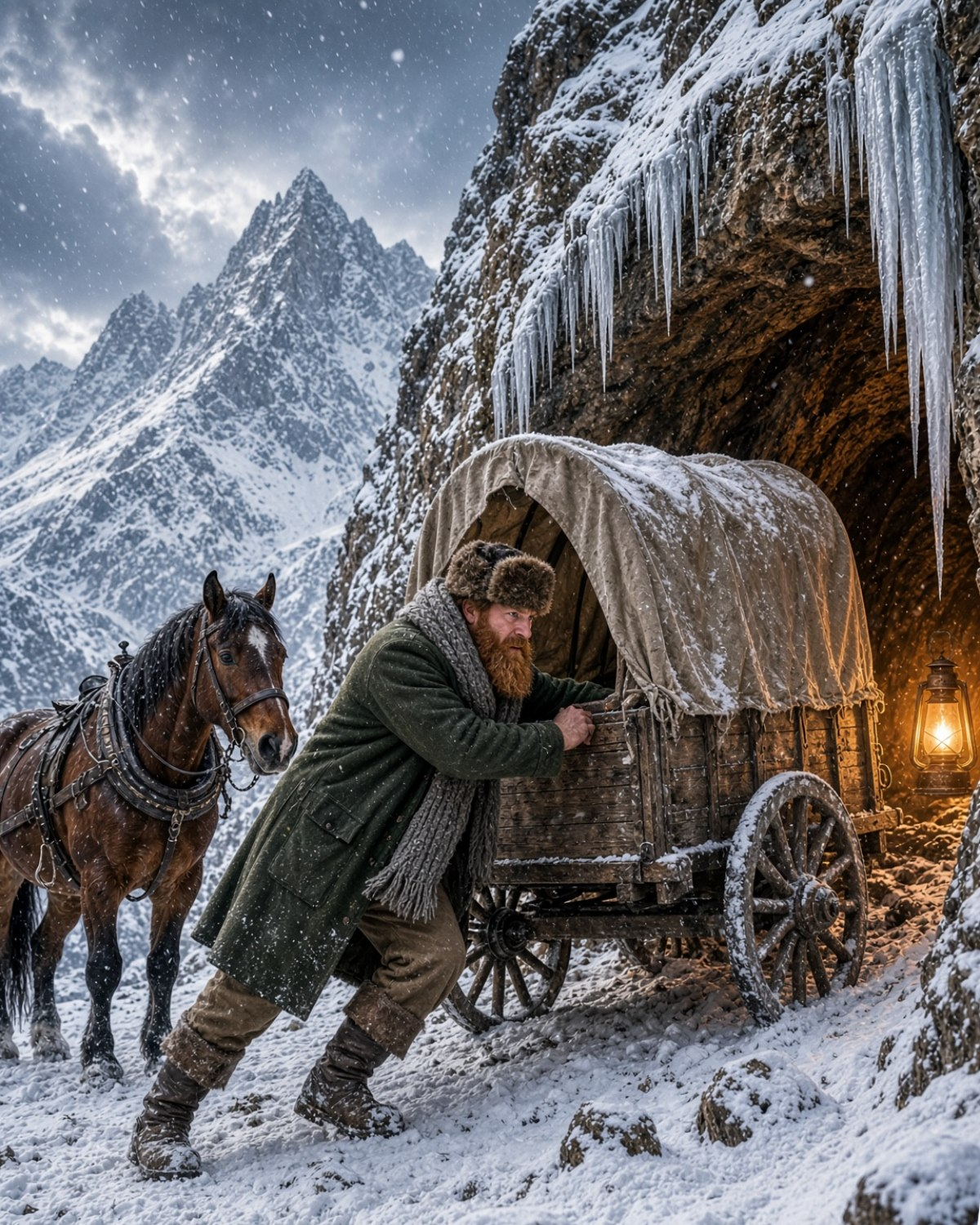
"Move, Brim! For God's sake, move!"
Pierce Holbrook pulled hard on the leather reins as his old freight horse stopped dead in the middle of the frozen mountain road.
Then Pierce noticed something scratched into the brass plate on the horse's battered harness.
Three crooked letters.
RUN.
The warning had been there for years.
But for the first time, Pierce understood why someone had carved it.
The horse wasn't being stubborn.
He was afraid.
And whatever frightened him was coming from the north.
Pierce loosened his grip on the reins.
"All right, old boy," he whispered. "You know something I don't."
Brim stood motionless, his dark chestnut coat trembling beneath the worn harness. His ears pointed toward the northern mountains, then flattened so tightly against his skull that Pierce could barely see them.
The animal's nostrils widened.
A long cloud of white vapor rolled from his mouth.
Then the wind stopped.
Not gradually.
Not the way a passing gust sometimes faded between the ridges.
It simply vanished.
One moment, the January wind had been tugging at Pierce's coat and scattering loose snow across the freight road.
The next, there was nothing.
No whisper through the dry grass.
No rattling of the wagon's canvas cover.
No distant whistle between the rocks.
Only silence.
Pierce had spent twenty years hauling freight through Montana's mountain country. He had watched spring floods swallow bridges, seen lightning kill cattle in open fields, and once survived three days trapped beneath an overturned wagon during an October snowstorm.
He knew the mountains had ways of warning a man.
And this was one of them.
He slowly turned toward the north.
Beyond the distant ridgeline, a dark wall stretched across the horizon.
It was not an ordinary bank of winter clouds.
The upper portion was almost black.
Below it hung a thick gray curtain that seemed to connect the sky to the earth.
And beneath that curtain, something white was moving.
Not falling.
Moving sideways.
Pierce felt his stomach tighten.
"Dear God."
The words escaped before he could stop them.
He climbed onto the wagon's broken running board and raised himself high enough to see over the nearest rise.
The storm extended farther east and west than his eyes could follow.
There was no clear edge.
No opening.
No promise of better weather beyond it.
The entire northern horizon appeared to be advancing toward him.
He estimated the distance.
Then he estimated the wind.
Twenty years of freight driving gave him an answer he did not want.
An hour.
Perhaps less.
Pierce stepped down.
He was forty-six years old, though the last three months had made him feel closer to sixty.
His hands were broad and permanently roughened by ropes, iron fittings, and frozen leather. His beard had gone gray faster than he expected, and deep lines surrounded eyes that had once been quick to laugh.
Those eyes had not seen much worth laughing about since November.
Since Clara.
He pushed the thought away.
There would be time to remember the dead if he managed to remain among the living.
"Come on, Brim."
He tugged gently at the bridle.
The horse did not move.
Pierce looked back at the wagon.
It stood crooked on the road, its patched canvas cover sagging between bent wooden hoops.
The left wheel leaned at an ugly angle.
The axle beneath it had cracked three days earlier near Deer Lodge Crossing.
Pierce had reinforced it with a length of iron strap, two wooden braces, and enough rawhide to hold a stubborn man's prayers together.
It had carried him another thirty miles.
But the wagon was failing.
Every turn of the wheel widened the crack.
Every frozen rut threatened to finish what the crossing had started.
A sensible man would have abandoned it.
A sensible man would have sold it back in Garnet Basin when the trader offered eleven dollars for the iron.
Pierce had not been sensible.
Not where that wagon was concerned.
Clara had ridden beside him in it for nine years.
She had laughed when the springs bounced too hard.
She had wrapped blankets around his shoulders on cold mornings.
She had once insisted on painting a little blue flower inside the front sideboard because, she said, even a freight wagon deserved something beautiful.
The flower was still there.
Faded.
Scratched.
Almost hidden beneath years of dirt.
Pierce had looked at it every morning since her death.
And every morning, he had found another reason not to leave the wagon behind.
Now the mountain was preparing to make the decision for him.
He studied the road ahead.
It wound south between scattered outcroppings before disappearing around a distant ridge.
His cousin Walt's ranch lay somewhere beyond those mountains.
Fifty miles, according to the last letter.
Four days of travel under decent conditions.
A lifetime away under the sky now gathering to the north.
Pierce reached into his coat and touched the folded letter inside his breast pocket.
He did not remove it.
He knew every word.
Pierce,
There is work here if you want it.
There is a bed.
There is room at the table.
You don't have to explain anything.
Come before the worst of winter.
Your cousin, Walt.
That last sentence had seemed like ordinary advice when Pierce first read it.
Now it sounded like a warning delivered too late.
He looked toward the storm again.
The gray curtain had grown thicker.
The distant peaks were disappearing one by one.
Pierce climbed down from the road's frozen shoulder and knelt beside the damaged axle.
He pushed his glove into the gap between the iron strap and the splintered wood.
The crack had widened.
A thin line of fresh wood showed where the axle had begun tearing farther apart.
He pressed against the wheel.
It shifted.
Too much.
Pierce closed his eyes.
"Not today," he muttered.
He rose and scanned the surrounding terrain.
There were no buildings.
No smoke.
No fences.
No sign that another human being had passed through recently.
The old freight road had once been busy with wagons carrying ore, flour, tools, whiskey, and machinery between the mining settlements and the valleys.
But Garnet Basin was dying.
The silver mine had closed.
The merchants had packed their shelves into crates.
Families had left behind houses with curtains still hanging in the windows.
Even the saloon had stopped lighting its lamps.
Pierce remembered walking through the settlement on his final morning.
The street had been nearly empty.
A broken sign swung above the abandoned assay office.
Snow had collected on the steps of the church.
The building where Clara died stood at the far end of town, its upstairs window dark.
He had not looked at it.
He had kept his eyes on Brim's back and driven away.
There was nothing left for him there.
At least, that was what he had told himself.
A sudden snort brought him back.
Brim stamped his front hoof.
Pierce turned.
The horse was looking toward the southwest.
Not toward the storm.
Toward the hillside.
Pierce followed his gaze.
A line of black basalt cliffs rose from the frozen slope about two hundred yards away.
The rock formation looked like a broken wall left behind by some ancient fortress.
Snow clung to its ledges.
Long icicles hung beneath the overhangs.
At the base of the largest bluff, the darkness deepened into a narrow recess.
Pierce stared.
He remembered that place.
Not clearly at first.
Only fragments.
A summer freight run.
A teamster named Amos Bell.
Three wagons waiting out a thunderstorm farther down the road.
A bottle passed around beside a fire.
And a warning spoken by a man who had spent too many winters in the mountains.
"Never take shelter in that black hollow," Amos had said.
Pierce remembered laughing.
"Why not? Rocks don't leak."
Amos had looked at him without smiling.
"That place has a name."
"What name?"
"The Coffin."
The other teamsters had gone quiet.
Pierce remembered that too.
He had assumed they were enjoying an old mountain superstition.
Amos had pointed toward the dark recess.
"Three walls of stone and one way out. Looks safe enough until the snow starts drifting across the mouth. Then a man can find himself buried standing up."
Pierce had shrugged.
"Better than freezing in the open."
"Maybe," Amos had replied. "But a coffin doesn't care whether the man inside is dead yet."
That had been nearly twelve years ago.
Pierce had not thought of the conversation since.
Now he stood in the middle of an abandoned freight road, staring at the same hollow while a blizzard approached from the north.
The memory no longer seemed amusing.
He looked at the surrounding terrain.
The hollow sat beneath a broad overhang.
Its back wall appeared solid.
The two sidewalls angled inward, creating a narrow pocket sheltered from the prevailing wind.
The opening faced southeast.
That mattered.
If the storm came from the north, the cliff itself would absorb much of its force.
But the wind could curl around the rock and drive snow into the entrance.
Amos had been right about that.
The hollow could become a trap.
Unless something blocked the opening.
Pierce slowly turned toward his wagon.
He looked at the warped sideboards.
The patched canvas.
The iron-rimmed wheels.
The cracked axle.
Then he looked back at the hollow.
An idea formed.
It was a bad idea.
Possibly a deadly one.
But it was the only idea he had.
He could use the wagon as a wall.
Not a perfect wall.
Not even a particularly strong one.
But enough to break the wind.
Enough to keep the drifting snow from filling the hollow as quickly.
Enough, perhaps, to give a man and a horse a fighting chance.
Pierce walked to the wagon and placed his palm against the sideboard.
The wood was cold beneath his glove.
"Well, Clara," he said quietly, "looks like your old wagon has one more trip to make."
He waited.
The words disappeared into the stillness.
For a moment, he imagined her sitting on the wagon seat, wrapped in the faded brown blanket she used to keep across her knees.
He could almost hear her voice.
Don't stand there talking to yourself, Pierce. Get moving.
His throat tightened.
He swallowed.
Then he unhooked the brake.
The wagon shifted slightly.
The damaged wheel groaned.
Pierce moved to Brim's head.
"Listen to me, boy."
The horse watched him.
"We're not going down that road."
He pointed toward the black cliffs.
"We're going over there."
Brim turned his head.
His ears moved forward.
Pierce gave a humorless little laugh.
"That's right. The place sensible men avoid."
He began leading the horse off the road.
The wagon followed reluctantly.
Its wheels broke through crusted snow and struck buried stones.
Every few feet, the damaged axle produced a sharp wooden complaint.
Pierce winced at each sound.
The distance to the hollow was not great.
But the slope was uneven.
The ground rose sharply near the cliff.
And the wagon was heavier than it looked.
Inside were the few possessions Pierce had refused to sell.
A small iron cooking pot.
A coffee tin.
A sack of flour.
A little dried beef.
Two blankets.
A hatchet.
A coil of rope.
A battered toolbox.
A handful of nails.
A small oil lantern.
And a wooden box containing Clara's Bible, her wedding ring, and the photograph taken on their first anniversary.
He had sold his freight teams.
He had sold his warehouse lease.
He had sold his good winter coat.
But he had kept that box.
He would have walked barefoot through the mountains before leaving it behind.
The wagon lurched.
Pierce caught the sideboard.
"Easy!"
Brim stopped.
The left wheel had dropped into a frozen rut.
Pierce crouched beside it.
The axle had twisted.
The iron reinforcement was pulling loose.
He looked at the hollow.
Still more than a hundred yards away.
Then at the storm.
The first hard gust struck him.
Snow lifted from the ground and swept across the road.
Pierce turned his face away.
The wind vanished almost as quickly as it arrived.
But he understood what it meant.
The storm was beginning to reach him.
He had less time than he thought.
He pulled the hatchet from the wagon and chopped at the frozen earth around the trapped wheel.
The blade rang against a stone.
He struck again.
And again.
A chunk of ice broke loose.
He cleared the rut with his boot, then placed a flat piece of wood beneath the wheel.
"Come on, Brim."
The horse leaned into the harness.
The wagon creaked.
The wheel rose.
For one terrible second, the axle seemed ready to split completely.
Then the wagon rolled free.
Pierce exhaled.
"Good boy."
He rubbed the horse's neck.
Brim's skin trembled beneath his hand.
The animal was sweating under the harness despite the cold.
Pierce knew that was dangerous.
Sweat could freeze.
A wet horse in a Montana blizzard could die even with shelter.
He would have to remove the harness and dry the animal as soon as they reached the hollow.
If they reached it.
He took the reins again.
The climb grew steeper.
Pierce began helping from behind, pushing the wagon whenever Brim struggled.
His boots slipped.
His lungs burned.
The old injury in his right knee, earned when a freight horse kicked him fifteen years earlier, began throbbing.
He ignored it.
The wind returned.
This time it did not stop.
It swept across the hillside in a steady, bitter current.
Fine snow struck Pierce's face.
He pulled his scarf higher.
The distant mountains were almost gone.
He could no longer see the northern ridge clearly.
Only a shifting gray mass advancing across the land.
Pierce glanced toward the hollow.
Its entrance was closer now.
He could see the uneven stone floor beneath the overhang.
The ceiling was low near the back.
The opening was wide enough for the wagon if he approached at the correct angle.
But there was a problem.
A large stone lay directly in the path.
Too heavy to lift.
Too deeply frozen to move.
He would have to steer around it.
That meant turning the damaged wagon sharply uphill.
The left wheel would take most of the strain.
Pierce studied the angle.
Then he looked at Brim.
The horse was breathing hard.
His sides moved rapidly.
Pierce knew he could not ask much more of him.
He unfastened part of the harness and adjusted the traces.
Then he took the lead rope and guided Brim toward the left side of the stone.
The wagon followed.
Its front wheels turned.
The right wheel climbed a small ridge of frozen earth.
The left wheel dragged behind.
Pierce heard a crack.
He stopped.
The sound had come from beneath the wagon.
He knelt.
The iron strap around the axle had shifted.
One of the wooden braces was splitting.
A long splinter hung from the underside.
Pierce touched it.
The wood came away in his hand.
He stared at the broken piece.
For a moment, he felt the old familiar anger rise inside him.
The anger he had carried since Clara's death.
At the doctor who arrived too late.
At the mine owners who closed the camp.
At the druggist who demanded payment before handing over the medicine.
At himself for not having enough money.
At God for allowing a woman who had never harmed anyone to die gasping for breath in a freezing room.
He gripped the splinter until its sharp edge pressed through his glove.
Then he threw it into the snow.
"No."
His voice was low.
He stood.
"Not this time."
He moved behind the wagon.
Brim waited in front, his head lowered.
Pierce placed his shoulder against the rear frame.
He dug his boots into the snow.
And pushed.
The wagon moved an inch.
Then another.
The damaged wheel turned reluctantly.
Pierce grunted with effort.
His knee screamed.
His back tightened.
The wagon moved forward.
Three feet.
Five.
The wheel cleared the stone.
Pierce nearly fell when the resistance suddenly eased.
He caught himself against the sideboard.
His breath came in ragged clouds.
He looked up.
The hollow was directly ahead.
For the first time since seeing the storm, he allowed himself a small measure of hope.
Then he noticed something that made him stop.
There were marks in the snow near the entrance.
Not fresh tracks.
Not animal prints.
Long, shallow grooves.
Parallel lines running from the exposed hillside toward the darkness beneath the cliff.
Pierce stepped closer.
He brushed snow away with his boot.
The grooves continued beneath the overhang.
They looked like old wagon ruts.
That made sense.
Other teamsters might have used the hollow before him.
But something about the marks troubled him.
They were too close together.
And one ended abruptly beside a dark stain on the stone.
Pierce crouched.
He scraped at the stain with his glove.
It was not blood.
It was old soot.
Someone had built a fire here.
Long ago.
He looked deeper into the hollow.
The darkness concealed the back wall.
He could see only a narrow patch of stone and several icicles hanging from a crack in the ceiling.
A cold draft moved outward from the recess.
Pierce frowned.
That was strange.
The wind was blowing toward the cliff.
Air should not have been moving out of the hollow.
Unless there was another opening somewhere inside.
He considered investigating.
Then another gust struck the hillside.
This one was stronger.
Snow swirled around his legs.
Brim jerked his head and stamped nervously.
Pierce looked toward the north.
The storm was much closer.
The distant road had vanished beneath a curtain of blowing snow.
There was no time.
He returned to the wagon.
"All right, boy. Last stretch."
He led Brim forward.
The horse hesitated at the entrance.
Pierce tugged gently.
"Come on."
Brim stepped beneath the overhang.
His hooves struck stone.
The sound echoed.
The horse stopped again.
Pierce felt the reins tighten.
He turned.
Brim was staring into the darkness at the back of the hollow.
His ears flattened.
A low, uneasy sound came from his throat.
Pierce followed the animal's gaze.
Nothing moved.
Nothing made a sound.
Only darkness.
"Easy," he whispered.
He stepped farther inside.
The rock walls rose around him.
The ceiling hung low enough that he could almost touch it with his hatchet.
The hollow was larger than it appeared from the road.
Perhaps twenty feet deep.
Wide enough near the entrance for Brim to turn.
Narrower at the rear.
The stone floor sloped slightly upward.
That was good.
Meltwater would be less likely to collect near the back.
The walls were mostly solid basalt.
No obvious cracks large enough to admit snow.
Pierce examined the entrance.
If he could wedge the wagon across it, the sideboards would block much of the wind.
He could stretch the patched canvas over the remaining gaps.
Then use snow and loose stones to seal the bottom.
The plan was crude.
But possible.
He removed Brim's harness and led him to the sheltered side of the hollow.
The horse remained restless.
Pierce rubbed his neck.
"You're all right."
He took a blanket from the wagon and laid it across the animal's back.
Then he returned to the entrance.
The wagon stood outside at an awkward angle.
He would have to turn it almost sideways.
Without Brim pulling, he would need to move it by hand.
He studied the wheels.
The left axle might survive one more movement.
It might not.
He took the rope and tied it around the front frame.
Then he passed the rope around a thick projection of basalt near the entrance.
He could use the rock as an anchor.
Pull the wagon sideways.
Guide it into position.
He tested the rope.
It held.
Pierce wiped snow from his beard.
"One more job," he whispered.
He leaned backward against the rope.
The wagon shifted.
Wood groaned.
The damaged wheel scraped against stone.
He pulled again.
The wagon turned several inches.
He adjusted his footing.
Pulled harder.
The rope tightened.
His gloves slipped.
He wrapped the line around his forearm and leaned back with everything he had.
The wagon moved.
Slowly.
Painfully.
But it moved.
The front corner approached the basalt wall.
Pierce stopped and checked the angle.
Another two feet.
Perhaps three.
That was all.
He glanced at the storm.
The first heavy sheets of snow were sweeping across the hillside.
The sky had darkened so much that the afternoon looked like evening.
The temperature was dropping.
His fingers had begun to ache inside his gloves.
He knew what came next.
Numbness.
Clumsiness.
Confusion.
Then sleep.
He had seen men freeze to death.
Some had died with their boots on and their hands folded as though waiting patiently for breakfast.
Others had torn off their coats in the final stages of hypothermia, convinced they were burning alive.
Pierce had once helped carry a frozen teamster from a snowbank outside Helena.
The man's eyes had remained open.
Pierce still remembered them.
He tightened his grip on the rope.
"Not me."
He pulled.
The wagon moved another foot.
The left wheel struck a buried stone.
The frame shuddered.
Pierce stopped.
A sharp metallic ping sounded beneath the wagon.
Then a wooden crack.
He knew that sound.
He had been expecting it for days.
The axle was finally breaking.
Pierce dropped the rope and rushed toward the wheel.
He crouched beside it.
The iron strap had snapped loose.
The wooden brace was split.
The axle had begun separating along its length.
He placed both hands beneath the frame, trying to lift enough weight off the wheel to prevent further damage.
The wagon shifted.
He grunted.
His right knee buckled.
He nearly fell.
Then he heard another sound.
Not from the wagon.
From inside the hollow.
A deep, muffled knock.
Pierce froze.
He looked over his shoulder.
Brim stood near the rear wall, trembling.
The horse's eyes were wide.
Pierce listened.
The wind howled outside.
Snow struck the canvas.
A loose iron fitting rattled against the wagon frame.
Then came the sound again.
Three dull knocks.
Slow.
Evenly spaced.
From somewhere beneath the stone floor.
Pierce remained motionless.
He had spent twenty years in the mountains.
He knew the sound of ice shifting.
He knew the sound of rocks cracking in the cold.
He knew the groan of timber under pressure.
This sounded different.
Almost deliberate.
He stood slowly.
"Hello?"
His voice echoed inside the hollow.
No answer.
He took one step toward the darkness.
Brim backed away.
Pierce stopped.
A third sound came from beneath the rocks.
This time it was closer.
A faint scrape.
Then silence.
Pierce stared at the stone floor.
His heart began beating harder.
He remembered Amos Bell's warning.
That place is a coffin.
He had always assumed the old teamster meant the snow.
But now, standing inside the hollow with a dying wagon and a blizzard closing around him, Pierce wondered whether Amos had known something else.
He took the lantern from the wagon.
His hands were stiff as he opened its glass chimney.
He struck a match.
The flame flickered.
He touched it to the wick.
Warm amber light filled the lantern.
Pierce lowered the glass and turned toward the rear of the hollow.
The light moved across the black stone.
Across old soot.
Across a narrow crack near the floor.
Then across something half-buried beneath loose rocks.
Pierce stepped closer.
He knelt.
Brim gave a frightened snort.
Pierce brushed away the first layer of dirt.
Then another.
A small metal object appeared beneath his glove.
He pulled it free.
It was an old brass freight tag.
Corroded.
Bent.
And attached to a short length of broken leather.
Pierce held it toward the lantern.
There were letters stamped into the metal.
He wiped away the grime.
The name became visible.
AMOS BELL.
Pierce stopped breathing.
The old teamster.
The man who had warned him about the hollow twelve years earlier.
Pierce stared at the tag.
Amos had disappeared during a winter freight run in 1883.
His wagon had been found abandoned near the mountains.
No body had ever been recovered.
Most people believed he had wandered into a storm and frozen.
Pierce had believed it too.
But the brass tag was here.
Inside the hollow.
Beneath the stones.
And something had been knocking under the floor.
Pierce slowly turned the tag over.
On the back, someone had scratched a message into the brass.
The letters were small.
Uneven.
Cut deeply enough to survive years beneath the rocks.
Pierce raised the lantern.
He read the first three words.
Then the fourth.
His blood went cold.
The message said:
DON'T BLOCK THE—
Before Pierce could read the final word, a violent crack exploded from the wagon outside.
The ground seemed to jump beneath his boots.
He spun toward the entrance.
The broken left wheel collapsed.
The wagon tilted sharply toward the cliff.
And directly above it, the enormous icicles began to break loose.
One by one.
Pierce looked up.
The largest one was already falling.






Comments 0