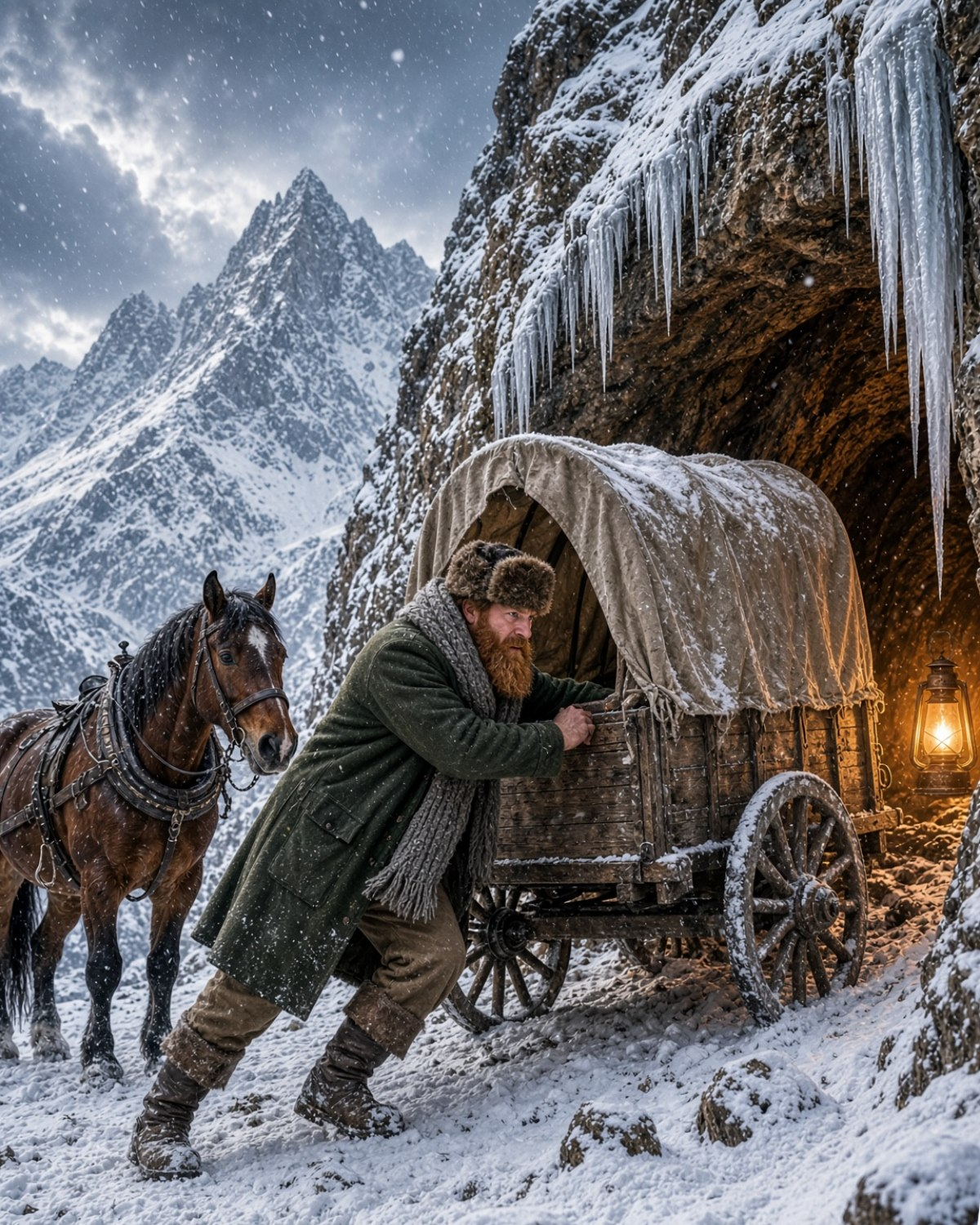
The first icicle struck the wagon like a rifle shot.
Pierce Holbrook threw himself backward.
"Brim! Get back!"
A second spear of ice crashed through the wagon's canvas cover, tearing a jagged hole above the driver's seat. The third struck the frozen ground inches from Pierce's boot and shattered into a hundred glittering pieces.
He stumbled against the basalt wall.
For one terrible second, he thought the entire overhang was coming down.
The sound rolled through the hollow like distant cannon fire.
Then everything stopped.
Except the wind.
Pierce stood with his back pressed against the rock, his lantern swinging wildly from one hand.
Outside, the damaged wagon had settled at an ugly angle.
Its left wheel lay twisted beneath the frame.
The axle was broken completely.
The canvas roof sagged where the ice had torn through it.
And the wooden sideboards were now leaning toward the entrance of the hollow.
Pierce stared.
His wagon was finished.
After nine years carrying Clara through Montana's mining country, after thousands of miles over mountain roads, after surviving mud, floods, and broken bridges, the old freight wagon had finally given up.
It had chosen the worst possible place to die.
He lowered his lantern.
"Well," he whispered, "you stubborn old thing."
His voice cracked.
He swallowed hard.
There was no time to mourn a wagon.
The storm was coming.
And the horse was still alive.
Pierce turned toward Brim.
The gelding stood near the rear wall, trembling beneath the blanket Pierce had thrown over him. His eyes followed the lantern's movement, and his ears twitched toward every unfamiliar sound.
"Easy, boy."
Pierce approached slowly.
"Nothing's coming for you."
He rested a hand against the horse's neck.
The muscles beneath the dark chestnut coat were tight.
Brim's breathing was too fast.
Pierce knew that kind of fear.
It was not the ordinary nervousness of a horse hearing thunder.
The animal had been uneasy since they entered the hollow.
And now Pierce had found Amos Bell's freight tag buried beneath the stones.
He looked down at the brass plate still clutched in his left hand.
AMOS BELL.
On the reverse, the unfinished warning remained.
DON'T BLOCK THE—
The final word had been hidden beneath a thick patch of corrosion.
Pierce rubbed it with his thumb.
Nothing.
He held the tag closer to the lantern.
The scratched letters were deep, but the last part of the message had been damaged.
He could make out the beginning of another letter.
Perhaps an A.
Perhaps an O.
He frowned.
"Don't block the what?"
The question sounded foolish inside the empty hollow.
But the more he examined the tag, the more certain he became that Amos had written it himself.
Pierce remembered the old teamster's hands.
Huge hands.
Two fingers missing from his left hand after a freight accident near Helena.
Amos had always held his pencil awkwardly, pressing hard enough to tear paper.
The scratches on the brass were deep and uneven.
Exactly the sort of marks Amos might have made.
Pierce turned the tag over again.
Why would Amos Bell leave a warning beneath a rock floor?
Why had it been buried?
And why had the old man warned everyone away from this place?
A violent gust struck the wagon.
The canvas snapped.
Pierce looked toward the entrance.
Snow was beginning to blow beneath the overhang.
The first thin drifts were forming against the rocks.
He had questions.
But questions would not keep him warm.
He slipped the brass tag into his coat pocket.
Then he went to work.
The wagon's broken axle had changed everything.
Originally, Pierce had planned to turn the wagon sideways across the opening.
Now he could not roll it another inch.
But the collapse had left the wagon at an angle that might still serve his purpose.
The front half stood outside.
The rear corner had shifted toward the basalt wall.
The sideboards faced the prevailing wind.
If he could drag the broken frame another few feet, he might wedge it across most of the entrance.
He studied the gap.
Then he studied the wagon.
He would have to lighten it.
Pierce climbed into the tilted bed.
The floorboards groaned beneath his weight.
He took out the flour sack first.
Then the cooking pot.
The toolbox.
The blankets.
The coffee tin.
The dried beef.
The hatchet.
The coil of rope.
He carried everything into the hollow, placing the supplies along the back wall.
Finally, he reached for the small wooden box beneath the driver's seat.
Clara's box.
It was made of pine, with a brass latch that had never closed properly.
The corners were worn smooth from years of travel.
Pierce lifted it carefully.
For a moment, he stood motionless.
He remembered Clara sitting beside him on a warm June afternoon, her dark hair pinned beneath a straw hat.
She had been laughing at something he said.
He could no longer remember the joke.
That frightened him more than he wanted to admit.
He remembered the sound of her laughter.
The way she tilted her head.
The small crease beside her left eye.
But the words that made her laugh had vanished.
He held the box tighter.
"I'm trying, Clara."
A gust of wind struck the wagon.
The entire frame shuddered.
Pierce climbed down immediately.
He carried the box inside and placed it on a dry ledge near the rear wall.
Then he returned to the entrance.
The snow was getting heavier.
The sky beyond the cliffs had turned a sickly gray.
The mountains were disappearing.
Pierce could no longer see the old freight road.
He had perhaps twenty minutes before the storm reached full strength.
He took the rope and secured one end around the wagon's rear axle housing.
The other end he looped around the same basalt projection he had used earlier.
He tested the knot.
It held.
Then he wrapped the free end around his waist.
He leaned backward.
The rope tightened.
The wagon did not move.
Pierce planted his boots.
Pulled harder.
The broken wheel scraped against stone.
The frame shifted half an inch.
He stopped to catch his breath.
His right knee throbbed.
He could feel sweat gathering beneath his shirt.
That was dangerous.
Sweat would freeze as soon as he stopped moving.
He loosened his scarf and opened his coat slightly.
Then he pulled again.
The wagon moved another inch.
A sharp crack came from the damaged sideboard.
Pierce stopped.
He looked at the frame.
The wood was beginning to split where the rope pulled against it.
He needed a different approach.
He took the hatchet and removed two loose boards from the wagon bed.
Then he slid one beneath the broken axle housing.
He used the second as a lever.
The wagon rose slightly.
Just enough.
Pierce kicked a flat stone beneath the frame.
The weight settled onto the stone.
Now the broken wheel was no longer carrying the full load.
He returned to the rope.
Pulled.
The wagon shifted.
Another foot.
Then another.
The rear corner scraped against the basalt wall.
Pierce gritted his teeth.
"Come on."
He pulled with everything he had.
The wagon lurched sideways.
Its broken wheel dragged across the frozen ground.
The frame struck the rock with a heavy thud.
Pierce fell backward into the snow.
For a moment, he lay there staring at the darkening sky.
His chest heaved.
His arms trembled.
Then he laughed once.
A short, exhausted sound.
"That'll do."
He rolled onto his side and pushed himself upright.
The wagon now blocked most of the hollow's entrance.
The front wheels remained outside.
The rear frame was wedged against the rock.
The canvas cover hung across the opening like a torn curtain.
It was ugly.
Crooked.
Unstable.
But it was a wall.
Pierce stepped inside.
The difference was immediate.
The wind still entered through the gaps.
But its force had weakened.
The hollow no longer felt completely exposed.
Brim lifted his head.
Pierce gave the horse a tired nod.
"See? Told you we weren't finished."
The horse snorted.
Pierce almost smiled.
Almost.
Then another gust hit.
The wagon shook.
A loose board rattled.
Snow blew through a gap near the ground.
Pierce's expression hardened.
The wall was not finished.
He needed to seal it.
He took the patched canvas tarp from the wagon and dragged it inside.
It was stiff with cold.
He shook off the snow and stretched it across the largest opening.
Using nails from his toolbox, he fastened the canvas to the surviving sideboards.
The hammer blows echoed through the hollow.
Each strike sounded louder than it should have.
Pierce worked quickly.
He nailed the upper edge first.
Then the sides.
Then he weighted the bottom with loose stones.
He left a narrow opening near the upper corner for ventilation.
A man could survive cold longer than he could survive poisoned air.
He had learned that lesson years earlier when two miners died inside a sealed winter cabin after their stove filled the room with smoke.
He would not make the same mistake.
He stepped back.
The canvas trembled beneath the wind.
But it held.
Pierce turned toward Brim.
The horse was still staring at the rear wall.
Not at the entrance.
Not at the storm.
At the floor.
Pierce followed his gaze.
The place where he had found Amos Bell's tag lay near a shallow crack in the basalt.
Loose stones covered part of it.
The soot stain extended along the wall.
Pierce walked closer.
He knelt beside the crack.
A faint current of cold air touched his cheek.
He frowned.
The draft was coming from below.
He held the lantern near the opening.
The flame bent slightly.
Not toward the crack.
Away from it.
Air was rising from beneath the stone floor.
Pierce sat back on his heels.
There was a space under the hollow.
A cavity.
Perhaps a narrow passage.
Perhaps an old drainage channel carved by water over centuries.
That explained the strange draft.
It might also explain the knocking sounds.
Ice expanding beneath the rock could produce hollow, rhythmic noises.
Pierce wanted to believe that.
He wanted a simple explanation.
But then he noticed something else.
A small piece of wood protruded from beneath the stones.
He brushed away the loose gravel.
The wood was dark and old.
Its surface had been worn smooth.
A straight edge.
Then a second.
Pierce pulled.
The object resisted.
He cleared more stones.
A corner appeared.
It was not a natural branch.
It was a piece of worked timber.
Pierce leaned closer.
A narrow strip of iron ran along one side.
The iron was badly rusted.
He touched it.
A hinge.
The wood belonged to some kind of hatch.
Pierce's mouth went dry.
Someone had built something beneath the hollow.
He placed the lantern on a nearby stone and began clearing the debris.
The work was slow.
His fingers were stiff.
The rocks were frozen together.
He used the hatchet to loosen the smaller pieces.
One by one, he removed them.
The outline became clearer.
A rectangular wooden panel lay beneath the stones.
Perhaps three feet long.
Two feet wide.
The iron hinge was attached to a wooden frame set into the rock.
Pierce stared.
He had never heard of a cellar beneath this cliff.
There had never been a settlement here.
No cabin.
No mine entrance.
No trading post.
Only the old freight road.
And the hollow the teamsters called a coffin.
He remembered Amos Bell's warning.
Three walls of stone and one way out.
Pierce looked at the hatch.
Maybe Amos had been wrong.
Maybe there had always been another way.
He reached for the edge.
Then stopped.
The storm struck the wagon with such force that the entire hollow trembled.
The canvas snapped violently.
A board cracked.
Pierce jumped to his feet.
He rushed toward the entrance.
Snow was pouring through a gap near the upper corner.
The wagon's front frame had shifted under the pressure.
One of the nails had pulled loose.
Pierce grabbed the hammer.
He drove the nail back.
Then another.
The wind howled outside.
The sound was no longer a distant warning.
It was a living thing.
A thousand voices screaming through the mountains.
Pierce pressed his shoulder against the sideboard while fastening a rope around the frame.
He tied the rope to a stone projection inside the hollow.
Then he added a second line.
The wagon steadied.
For now.
He looked through a narrow opening in the canvas.
The world beyond had vanished.
No road.
No mountains.
No sky.
Only white.
Snow moved sideways so fast that it looked like smoke pouring from a furnace.
Pierce had seen blizzards before.
But this one frightened him.
Not because of the wind alone.
Because of how quickly it had arrived.
The mountain had given him barely enough time to prepare.
And now it was taking away every remaining choice.
He stepped back from the opening.
The lantern flickered.
Brim shifted uneasily.
Pierce checked the horse's blanket.
Then he rubbed the animal's legs with a dry cloth to remove snow and moisture.
He examined the hooves.
No serious damage.
He gave Brim a little dried feed from the wagon and placed a small amount of snow in the cooking pot to melt near the lantern.
The horse needed water.
Pierce needed water too.
But he would have to ration the lantern oil.
He had only a small tin left.
Enough for several hours if he kept the flame low.
Not enough for a long storm.
He looked at the supplies.
Flour.
Coffee.
Dried beef.
A little salt.
Two blankets.
A hatchet.
Rope.
Nails.
A cooking pot.
Clara's box.
And one exhausted horse.
That was everything standing between him and death.
Pierce sat on a flat stone.
For the first time since the storm appeared, he allowed himself to rest.
His hands shook.
He held them close to the lantern.
The warmth was pitiful.
Barely enough to feel.
He looked at Clara's box.
Then at the brass freight tag.
He took it from his pocket.
AMOS BELL.
The name seemed to stare back at him.
Pierce remembered the last time he saw Amos alive.
It had been in a freight yard outside Helena.
Amos was loading sacks of grain into a wagon.
His beard was black then, streaked with gray.
He had been complaining about the price of oats.
Pierce had offered him coffee.
Amos refused.
Said he had to reach the mountain road before the next storm.
Three weeks later, someone found his empty wagon.
The horses were gone.
The supplies were missing.
No sign of a struggle.
No tracks that anyone could follow.
Amos Bell simply disappeared.
People talked about it for a while.
Then winter passed.
Other men died.
Other wagons vanished.
And Amos became another name remembered only when someone had a story to tell.
Pierce rubbed the tag again.
The final word remained unreadable.
DON'T BLOCK THE—
He thought about the hatch.
About the draft.
About the old soot.
Perhaps Amos had sheltered here during the storm that killed him.
Perhaps he had discovered the hatch.
Perhaps he had tried to leave a warning.
But why hide the tag beneath stones?
Why not scratch the warning into the wall?
Why not leave it where someone could see it?
Pierce turned the brass plate toward the lantern.
A thin line ran beneath the unfinished message.
At first, he thought it was a scratch.
Then he realized it was an arrow.
It pointed downward.
Toward the hatch.
Pierce stood.
The horse watched him.
He crossed the hollow and knelt beside the wooden panel.
He brushed away the remaining stones.
The hatch was old.
Very old.
Its wood had darkened almost black.
The iron fittings were corroded.
But the construction was solid.
Someone had spent considerable effort building it.
Pierce found a small recessed handle.
He slipped two fingers beneath it.
Pulled.
Nothing.
He pulled harder.
The hatch did not move.
He took the hatchet and worked its blade beneath the edge.
The wood creaked.
A little dirt fell into the crack.
Pierce leaned on the handle.
The panel shifted slightly.
Then stopped.
Something was holding it from below.
He frowned.
He adjusted the hatchet.
Pulled again.
A dull knock sounded beneath his feet.
Pierce froze.
The same sound he had heard earlier.
Three knocks.
Slow.
Evenly spaced.
He held his breath.
The knocking stopped.
Then came a scraping noise.
Something moved beneath the hatch.
Pierce backed away.
His heart hammered.
He stared at the wooden panel.
There was no reason for anything living to be down there.
No reason at all.
The hatch had been buried beneath stones.
The hollow had stood abandoned for years.
And the winter outside was cold enough to kill a man in minutes.
He told himself the sound was ice.
Expanding rock.
Water moving through a frozen channel.
Anything but what his imagination suggested.
Then the hatch moved.
Not much.
Barely the width of a fingernail.
But Pierce saw it.
The wooden edge lifted.
Then settled again.
He stepped backward.
The lantern shook in his hand.
"Who's there?"
His voice sounded strange.
Small.
Almost swallowed by the wind.
No answer.
Pierce waited.
Brim stamped once.
Then the horse began backing toward the wagon.
Pierce turned.
"Easy, boy."
The animal pulled away from his outstretched hand.
Its eyes were fixed on the hatch.
Pierce looked back.
The panel remained still.
He forced himself to breathe.
There had to be an explanation.
Perhaps pressure from the wind was moving air through the underground cavity.
Perhaps the old timber was shifting as the temperature fell.
Perhaps—
A violent crash interrupted his thoughts.
The wagon's upper sideboard tore loose.
Snow burst through the opening.
The lantern flame nearly went out.
Pierce rushed toward the entrance.
He caught the loose board before it fell.
The wind pushed against it with terrifying strength.
He braced his shoulder against the wood.
His boots slid across the stone.
For several seconds, he could do nothing except hold on.
Then he managed to wedge the board against the frame.
He grabbed a length of rope.
Wrapped it around the broken section.
Pulled tight.
Tied it to the basalt projection.
The board held.
Pierce stumbled backward.
His lungs burned.
His hands were numb.
The storm had barely begun.
And his shelter was already failing.
He looked at the hatch.
Then at the wagon.
A terrible possibility entered his mind.
What if Amos had discovered this underground space and tried to use it for shelter?
What if he had blocked the entrance with his wagon?
What if the storm buried him?
Pierce looked again at the warning.
DON'T BLOCK THE—
He could almost hear Amos speaking.
That hollow is a coffin.
Pierce's stomach tightened.
Maybe the warning was not about entering the hollow.
Maybe it was about sealing it.
He turned toward the wagon.
The canvas covered nearly the entire opening.
Only a small ventilation gap remained near the top.
Snow was already piling against the outside.
If the drift grew high enough, the gap would disappear.
Then the hollow would become a sealed chamber.
Pierce understood the danger.
He needed ventilation.
He needed an escape route.
And he needed to know what lay beneath the hatch.
He took the hatchet.
Returned to the wooden panel.
And knelt.
This time, he did not hesitate.
He drove the blade beneath the edge.
The wood groaned.
He leaned harder.
The hatch rose an inch.
A rush of cold air escaped.
The lantern flame bent sharply.
Pierce smelled something unexpected.
Not rot.
Not damp earth.
Smoke.
Old smoke.
And something else.
A faint metallic odor.
He lifted the hatch another inch.
The opening beneath was black.
Too dark for the lantern to penetrate.
Pierce shifted his grip.
Then he heard it.
A sound from below.
Not knocking.
Not scraping.
A voice.
Faint.
So faint he almost mistook it for the wind.
"Help..."
Pierce stopped.
His entire body went rigid.
He stared into the darkness.
The voice came again.
A little louder.
"Please..."
Pierce's mouth opened.
No words came out.
He looked toward Brim.
The horse was trembling.
Then Pierce looked back at the hatch.
He had heard a human voice.
He was certain of it.
Someone was beneath the hollow.
Someone alive.
He lowered the lantern toward the narrow opening.
"Who's down there?"
Silence.
He waited.
The storm roared outside.
The wagon creaked.
Snow hissed through the cracks.
Then a hand appeared beneath the hatch.
Pale.
Thin.
Its fingers curled around the edge of the wood.
Pierce stumbled backward.
The hand tightened.
And from the darkness below, a voice whispered his name.
"Pierce Holbrook."
He froze.
The voice was familiar.
Impossible.
A voice he had not heard since November.
Then it spoke again.
"Pierce... it's me."






Comments 0