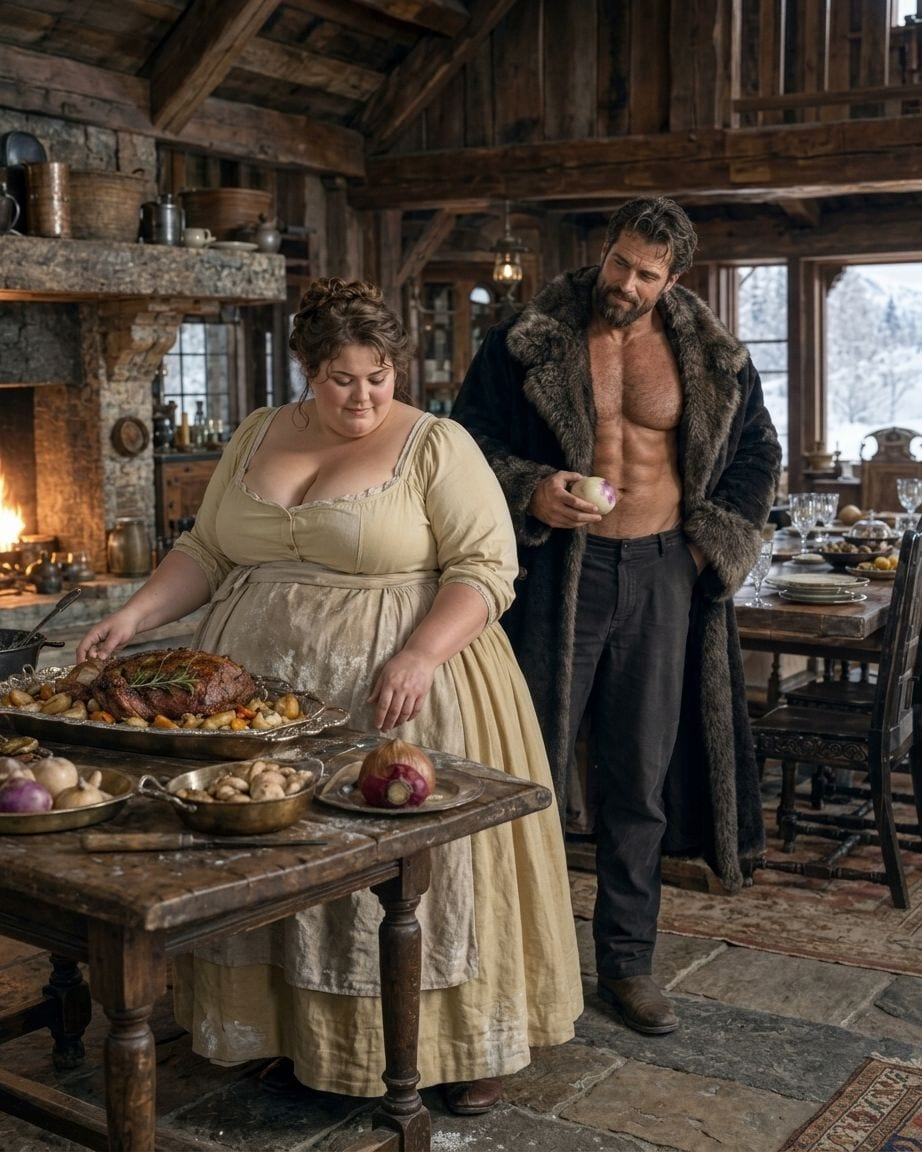
"Seventy-five dollars," Beatrice Gallagher said. "And I won't take a penny less."
Caleb Whitmore, the richest silver-mine owner in Oakhaven, stood in her doorway holding a folded banknote.
Across its face, someone had written three words in black ink.
One night only.
Beatrice looked at the note, then at the powerful man holding it.
This wasn't an ordinary job offer.
And Caleb Whitmore wasn't accustomed to hearing the word no.
"Did you hear what I said?" Beatrice asked.
Caleb's jaw tightened.
"I offered you fifty."
"And I told you seventy-five."
"For one evening of cooking?"
"For one evening of saving your reputation, Mr. Whitmore. There's a difference."
The tall, broad-shouldered millionaire stared at her as though she had just suggested purchasing his entire mining company for the price of a loaf of bread.
Behind Beatrice, the little iron stove crackled in her cramped cabin. Three loaves of bread rested on a wooden counter. A patched curtain covered the single window, and a bucket caught the slow drip from a leaking roof.
Everything in that cabin told the story of a woman who had spent years surviving on almost nothing.
Everything about Caleb Whitmore suggested a man who had forgotten what survival cost.
Yet neither of them looked away.
Finally, Caleb folded the banknote.
"Seventy-five dollars," he said. "You cook, serve the dinner, and leave before midnight."
"And you'll provide a wagon."
His eyebrows rose.
"A wagon?"
"For my cast-iron pans, spices, flour, and anything else your kitchen doesn't have."
"My kitchen has everything."
"Does it have a cook?"
The silence that followed was almost satisfying.
Caleb drew a long breath through his nose.
"No," he admitted.
"Then perhaps we shouldn't make assumptions about what else it has."
For the first time since arriving, something shifted behind his cold blue eyes.
It wasn't warmth.
Not quite.
But it might have been respect.
"Ten minutes," he said.
Beatrice shook her head.
"Twenty. My bread needs wrapping."
"Miss Gallagher—"
"And if you intend to stand there arguing, make it thirty."
Caleb Whitmore, a man who commanded hundreds of miners and negotiated contracts worth hundreds of thousands of dollars, found himself stepping backward from the doorway.
"Twenty minutes," he muttered.
Then he turned toward his horse.
Beatrice closed the door.
Only when his footsteps faded did she allow herself to lean against the wood.
Her hands were trembling.
Seventy-five dollars.
She had just demanded seventy-five dollars from the most feared man in Oakhaven.
And he had agreed.
She looked around her cabin.
The roof needed repairing. Her winter firewood was almost gone. The flour merchant had refused to extend her credit another week.
And three days earlier, she had discovered a notice nailed to her door.
Payment overdue.
The land beneath her cabin had once belonged to her father, Patrick Gallagher, a hardworking Irish immigrant who had spent his life hauling timber through the mountains.
After his death, a disputed debt had left Beatrice fighting to keep the only home she had ever known.
Seventy-five dollars wouldn't make her wealthy.
But it could keep her from freezing.
She pushed herself away from the door.
"Well, Bee," she murmured, "you'd better cook the finest supper of your life."
She began packing.
Her best cast-iron skillet went into a wooden crate, followed by two heavy pots, a rolling pin, a sharp kitchen knife, and the little tin containing her mother's handwritten recipes.
She added dried rosemary, thyme, sage, black pepper, and a small jar of preserved peaches.
Then she wrapped the fresh bread in clean linen.
She worked quickly, but her thoughts kept returning to the man outside.
Caleb Whitmore.
The Beast of Ridge View.
That was what the townspeople called him.
Ten years earlier, he had arrived in Oakhaven with a battered rifle, a mule, and enough money to buy one small mining claim.
Then he had struck silver.
Within five years, he owned three mines.
Within seven, he controlled the richest mineral deposits in the surrounding mountains.
Now, in 1888, his fortune was said to exceed two million dollars.
But wealth hadn't made him beloved.
People said he had driven away every woman who tried to marry him.
They said he trusted no one.
They said his enormous mansion had twenty bedrooms and not a single soul who wanted to sleep beneath its roof.
Beatrice had never cared much for gossip.
People in Oakhaven had plenty to say about her, too.
They called her Big Bee.
Sometimes affectionately.
More often cruelly.
They laughed about her size, her unmarried status, and the way she walked through town carrying baskets of bread that seemed small against her broad frame.
Some women whispered that no man would ever want her.
Some men made jokes when they thought she couldn't hear.
Beatrice had learned to hear everything.
She had also learned that answering every insult was a waste of breath.
Her mother used to say, "A person who measures your worth by your waistline doesn't have enough sense to measure flour."
Beatrice smiled faintly at the memory.
Then she lifted the crate.
Outside, wagon wheels rattled over the frozen ground.
Caleb had returned with a team of horses and a sturdy mountain wagon.
He jumped down and approached the cabin.
"Ready?"
"Almost."
He glanced at the heavy crate in her arms.
"Give me that."
"I can carry it."
"I didn't say you couldn't."
Before she could argue, he took the crate from her.
Their fingers brushed.
Beatrice noticed the rough calluses on his hands.
They weren't the hands of a gentleman who had inherited his fortune.
They were the hands of a man who had dug it out of the earth.
Caleb noticed her looking.
"What?"
"Nothing."
"You have something to say, Miss Gallagher?"
"Only that you don't look like a man who spends his days counting money."
His expression hardened.
"I didn't make my fortune sitting behind a desk."
"I can see that."
Something in her tone seemed to surprise him.
Most people either feared Caleb Whitmore or flattered him.
Beatrice did neither.
He loaded the crate into the wagon.
When he returned for the second, he noticed a small stack of split firewood beside her stove.
There wasn't enough to last three nights.
His gaze moved toward the patched roof.
Then toward the thin blanket folded over the only chair.
Beatrice saw him looking.
"Don't."
Caleb turned.
"Don't what?"
"Don't look at my home as though it's something to pity."
He studied her for a moment.
"I wasn't."
"Good."
She lifted the final bundle.
"Because I need work, Mr. Whitmore. Not charity."
Caleb nodded once.
"Understood."
They left Oakhaven shortly afterward.
The road toward Ridge View climbed through dense stands of pine and spruce.
Snow lay in uneven patches beneath the trees, and the November wind cut through Beatrice's wool shawl.
Caleb rode beside the wagon on his powerful black horse.
For the first twenty minutes, neither spoke.
Then Beatrice asked, "Why did your servants leave?"
Caleb kept his eyes on the road.
"They were dissatisfied."
"With their wages?"
"No."
"The food?"
"No."
"Then I imagine they were dissatisfied with you."
His horse snorted.
Caleb turned his head.
"You're remarkably comfortable insulting the man paying you."
"I'm remarkably comfortable telling the truth."
"Truth can be expensive."
"So can arrogance."
He stared at her.
Then, unexpectedly, he laughed.
It was a short, rough sound, as though the muscles responsible hadn't been used in years.
Beatrice looked at him in surprise.
"What?"
"Nothing," he said.
But the corner of his mouth remained lifted.
A few minutes later, his expression grew serious.
"Three investors are coming from Boston. Josiah Abernathy and Arthur Pendleton are leading the negotiations."
"Railroad men?"
"Yes."
"I've heard their names."
"Then you understand what's at stake."
"Not entirely."
Caleb hesitated.
"My mines produce more silver than I can transport efficiently. The mountain roads close during heavy snow. A railroad spur would change everything."
"And without it?"
He looked toward the distant peaks.
"Men lose jobs. Families lose wages. And the company begins to die."
Beatrice studied him.
For the first time, she heard something beneath his harshness.
Fear.
Not for himself, perhaps.
But for something he had built.
"Then we'd better feed those men well," she said.
Caleb nodded.
"We'd better."
By the time they reached Ridge View, the sun was sinking behind the mountains.
Beatrice stepped down from the wagon and stared.
The mansion was enormous.
Dark timber beams crossed towering stone walls. Tall windows reflected the snow-covered peaks. A broad staircase led to heavy oak doors beneath a covered entrance.
It was beautiful.
And strangely lifeless.
No smoke rose from most of the chimneys.
No lamps glowed in the upper windows.
No voices drifted through the halls.
Beatrice followed Caleb inside.
Her footsteps echoed across cold stone.
The entrance hall was grand enough to accommodate an entire church congregation, yet it contained almost nothing that suggested anyone actually lived there.
A few expensive paintings hung on the walls.
A massive staircase curved toward the upper floor.
And everywhere there was silence.
Beatrice rubbed her arms.
"Good heavens."
Caleb glanced back.
"What?"
"Do you always keep it this cold?"
"The fireplaces are being lit."
"By whom?"
He stopped.
She raised an eyebrow.
"Exactly."
He sighed.
"I'll see to them."
"Start with the dining room."
He turned toward the kitchen.
"I need you to inspect the provisions first."
"And I need your guests to have feeling in their fingers when they pick up their forks."
Caleb opened his mouth.
Then closed it.
Without another word, he walked toward the woodpile.
Beatrice watched him go.
"Well," she whispered, "there may be hope for the man yet."
The kitchen was enormous.
Copper pots hung from iron hooks. A long preparation table stood beneath the windows. Shelves held fine porcelain and imported spices that had clearly been neglected.
The pantry contained flour, butter, cream, potatoes, onions, carrots, mushrooms, and several excellent cuts of meat.
Beatrice inspected everything.
Then she rolled up her sleeves.
For the next hour, the kitchen came alive.
She chopped vegetables, kneaded dough, seasoned venison, and stirred a rich blackberry reduction.
The hearth roared.
Butter hissed.
Rosemary filled the air.
By the time Caleb returned, carrying an armful of firewood, Beatrice had transformed the silent kitchen into a place that smelled like Sunday dinner.
He stopped in the doorway.
For several seconds, he said nothing.
Beatrice looked up.
"Something wrong?"
Caleb shook his head.
"No."
"Then why are you staring?"
He glanced toward the stove.
"My mother used to cook with rosemary."
Beatrice's hands slowed.
"Did she?"
He nodded.
"Every winter."
There was a strange softness in his voice.
"She died when I was seventeen."
"I'm sorry."
Caleb looked away.
"It was a long time ago."
Beatrice returned to her work.
"Time doesn't always make people stop missing someone."
He didn't answer.
But he didn't leave, either.
Instead, he placed another log on the fire.
For a moment, they worked in companionable silence.
Then Beatrice handed him a wooden spoon.
"Taste this."
Caleb looked offended.
"What is it?"
"Gravy."
"I know what gravy is."
"Then you'll have no trouble tasting it."
He obeyed.
The moment the sauce touched his tongue, his expression changed.
He swallowed.
Then looked at her.
"How did you do that?"
"Do what?"
"Make it taste like..."
He stopped.
"Like what?"
Caleb stared into the spoon.
"Like home."
Beatrice's expression softened.
Before she could answer, a distant bell rang from the front entrance.
The investors had arrived.
Caleb straightened immediately.
The warmth vanished from his face.
"That's them."
Beatrice took the spoon from his hand.
"Go welcome your guests."
He moved toward the door.
Then stopped.
"Miss Gallagher?"
"Yes?"
"Thank you."
She looked up, surprised.
But Caleb had already turned away.
A moment later, Beatrice heard men's voices echoing through the entrance hall.
One was Caleb's.
The other belonged to a stranger with a polished Eastern accent.
"Whitmore, I trust you've prepared the documents exactly as discussed."
"Everything is ready," Caleb replied.
"Excellent," the stranger said. "Because tonight, I intend to leave this mountain with precisely what I came for."
Beatrice paused.
There was something in the man's voice she didn't like.
Then she heard the rustle of papers.
A leather folder snapped shut.
And the stranger spoke again, much more quietly.
"Arthur, make certain Whitmore never sees the original final page."
Beatrice froze.
Someone was standing just beyond the kitchen door.
And the next voice she heard was—






Comments 0