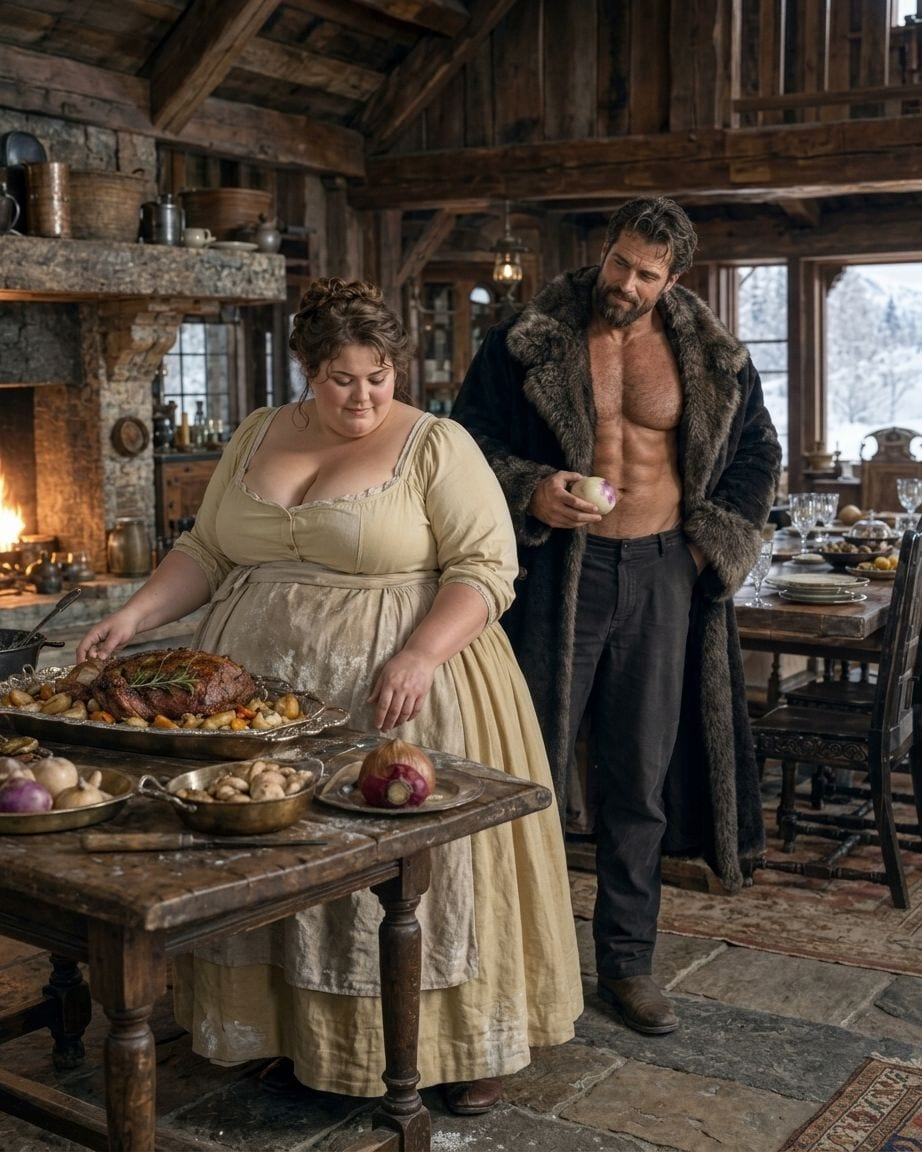
"That final page is worth more than Whitmore's entire fortune," a man whispered. "Make certain he signs it."
Beatrice Gallagher stood motionless beside the kitchen door, a wooden spoon in one hand and a dish towel in the other.
The voice belonged to Arthur Pendleton.
She knew because Caleb had introduced his guests loudly enough for half the mansion to hear.
The second man answered in a lower voice.
"Keep your voice down, Arthur. Someone might be listening."
"Who? The servants abandoned him. Whitmore has nobody left."
Beatrice looked toward the crack beneath the door.
Two pairs of polished leather shoes stood on the other side.
Then one pair moved away.
"Come along," Pendleton said. "We have a hungry millionaire to entertain."
Their footsteps faded.
Beatrice remained still until she heard the dining-room doors close.
Only then did she release the breath she had been holding.
Something was wrong.
Terribly wrong.
She had spent enough years bargaining with merchants, examining invoices, and arguing over debts to recognize the sound of men discussing a dishonest transaction.
But she had no proof.
And proof mattered.
Especially when a poor woman accused a wealthy gentleman of wrongdoing.
She returned to the stove, lifted the lid from the simmering potatoes, and stirred them with more force than necessary.
"Not my business," she whispered.
The words sounded reasonable.
She was being paid to cook.
Not to investigate railroad contracts.
Not to rescue a millionaire from his own associates.
Certainly not to make enemies of men who could purchase her cabin, her land, and every possession she owned without noticing the expense.
Yet something about Pendleton's confidence troubled her.
Whitmore has nobody left.
The words had been spoken with such satisfaction.
Beatrice remembered Caleb standing beside the kitchen hearth, tasting her gravy and looking suddenly younger when he mentioned his mother.
For a moment, he hadn't seemed like the Beast of Ridge View.
He had seemed like a lonely man who had forgotten how to be anything else.
She shook her head.
"Don't be foolish, Bee."
Then she returned to work.
The venison needed another fifteen minutes.
The mushroom tart was browning beautifully.
Fresh bread rested beneath a clean cloth, and the potatoes were ready to be whipped with butter and cream.
Whatever was happening in the dining room, her supper would not suffer for it.
She had given Caleb Whitmore her word.
And unlike some people, Beatrice Gallagher considered a promise worth keeping.
A few minutes later, the kitchen door opened.
Caleb stepped inside.
"How much longer?"
"Ten minutes."
"The gentlemen are waiting."
"Then the gentlemen can continue waiting."
His eyes narrowed.
"Miss Gallagher—"
"Mr. Whitmore, would you rather serve a perfect roast ten minutes late or a ruined one precisely on time?"
He looked at the oven.
Then at her.
"Perfect."
"Excellent. We're making progress."
He rubbed his forehead.
"You have an answer for everything."
"Only when people keep asking questions."
For a moment, his mouth twitched.
Then his expression darkened.
"These men aren't ordinary guests."
"I gathered that."
"They control financing for several major railroad projects."
"And that makes them incapable of waiting for supper?"
"It makes them capable of ruining me."
The admission surprised her.
Caleb seemed equally surprised that he had spoken it aloud.
He turned toward the window.
Beyond the glass, the mountains were disappearing beneath a curtain of falling snow.
"I have nearly four hundred men working my mines," he said. "Most have families. Some came west with nothing. They trusted me when I promised there would be work."
Beatrice set down her spoon.
"And there has been."
"Until now."
She waited.
Caleb continued reluctantly.
"The ore is there. More than enough. But hauling it down those roads costs a fortune. Every winter we lose weeks of production. Sometimes months."
"So the railroad changes that."
"It saves us."
He faced her.
"Without it, I may have to close two mines before spring."
Beatrice thought of the men who came to her cabin each Saturday to purchase bread.
Men with cracked hands and exhausted faces.
Men who counted pennies before buying an extra loaf for their children.
"Then I hope your investors are honest men," she said.
Caleb's expression sharpened.
"Why wouldn't they be?"
She hesitated.
This was the moment.
She could tell him what she had heard.
But she imagined his reaction.
A cook he had known for barely two hours accusing powerful financiers of plotting against him.
He might dismiss her.
Worse, he might confront Pendleton immediately and destroy whatever chance remained of discovering the truth.
"I've dealt with merchants who weren't," she answered carefully.
Caleb studied her.
"Pendleton and Abernathy are respected businessmen."
"So were the men who sold my father worthless timber rights."
The words escaped before she could stop them.
Caleb frowned.
"What happened to your father?"
Beatrice looked away.
"Nothing that concerns tonight's supper."
"Miss Gallagher."
She turned back.
"My father worked himself into an early grave trying to pay a debt he never understood. A man in a fine suit told him where to sign, and he trusted him."
Caleb said nothing.
"After he died, I found papers with numbers that didn't agree. But by then the man who arranged the loan had disappeared."
"Did you challenge the debt?"
"With what money?"
Caleb's jaw tightened.
"Who was the lender?"
Beatrice shook her head.
"That was years ago."
"Who?"
She met his gaze.
"Mr. Whitmore, my potatoes are burning."
He looked toward the stove.
They weren't burning.
They both knew it.
But after a moment, he stepped aside.
"Very well."
He reached the doorway, then stopped.
"For what it's worth, Miss Gallagher, I don't believe a man should lose his home because someone tricked him into signing a paper."
Beatrice stared at his back.
"Neither do I."
He left.
She stood alone in the kitchen, thinking about the strange irony of his words.
Then she opened the oven.
The roast was ready.
And so was she.
The dining room looked different when Beatrice entered carrying the first platter.
The fireplace now roared with a healthy blaze.
Candles flickered along the long oak table.
Crystal glasses caught the warm light, and the polished silverware gleamed against white linen.
Caleb sat at the head of the table.
Josiah Abernathy occupied the chair to his right.
Arthur Pendleton sat opposite, one hand resting beside his wineglass.
Both investors looked up when Beatrice appeared.
Abernathy was a broad-faced gentleman with silver hair, a neatly trimmed beard, and a surprisingly cheerful expression.
Pendleton was thinner, with a narrow mustache, a monocle, and the sort of smile that never seemed to reach his eyes.
Beatrice carried the massive venison roast toward the table.
The platter was heavy, but she held it steadily.
The rich aroma of rosemary, roasted meat, and blackberry sauce filled the room.
Abernathy leaned forward.
"Good heavens, Whitmore. Now that is a proper supper."
Caleb looked toward Beatrice.
"Miss Gallagher prepared everything."
Pendleton's gaze traveled slowly over her figure.
His smile widened.
"Indeed? I can certainly see that your cook has never suffered from a shortage of meals."
The room fell quiet.
Beatrice had heard worse.
Much worse.
She could have ignored him.
She could have lowered her eyes and pretended not to understand.
That was what people expected from women like her.
Poor women.
Large women.
Women who earned their living serving people who believed money gave them the right to be cruel.
Instead, she placed the platter in the center of the table.
"In Colorado, Mr. Pendleton," she said pleasantly, "we believe a person ought to be strong enough to survive the winter."
Abernathy's eyebrows rose.
Beatrice continued.
"I've prepared the venison with a blackberry reduction. It requires a strong jaw, so I do hope yours is up to the task."
For one magnificent second, nobody moved.
Then Abernathy burst into laughter.
It was a deep, booming laugh that shook his considerable stomach.
"By thunder! She's got you there, Arthur!"
Pendleton's face reddened.
Caleb lowered his eyes.
But Beatrice caught the unmistakable movement at the corner of his mouth.
He was trying not to smile.
"Will there be anything else, gentlemen?" she asked.
Abernathy wiped his eyes.
"Only a generous helping, my dear. And perhaps another of those observations."
Beatrice smiled.
"One comes complimentary with the supper, sir. Additional remarks cost extra."
Abernathy laughed even harder.
Caleb finally surrendered.
A low chuckle escaped him.
Beatrice looked toward him.
For an instant, their eyes met.
Something passed between them.
Not affection.
Not yet.
But recognition.
He had seen her refuse humiliation without surrendering her dignity.
And she had seen him enjoy it.
Pendleton cleared his throat.
"Shall we eat?"
"By all means," Beatrice replied.
She returned to the kitchen.
Only after the door closed did she allow herself a satisfied smile.
"Strong jaw," she muttered.
Her mother would have been proud.
The next hour transformed Ridge View Estate.
Abernathy praised the roast.
Pendleton, despite his wounded pride, requested a second serving.
The potatoes disappeared almost immediately.
The mushroom tart received such enthusiastic approval that Abernathy demanded to know whether Beatrice would consider moving to Boston.
"Not unless Boston has mountains," she replied.
"Only mountains of paperwork," he said.
"Then I'll stay where I am."
Even Caleb seemed to relax.
He ate more than Beatrice suspected he had eaten in weeks.
His shoulders gradually lost their rigid tension.
He spoke about the mines, the railroad route, and the possibility of bringing steady employment to dozens of families who had struggled through the previous winter.
Beatrice listened while serving.
She noticed that Caleb never exaggerated his accomplishments.
He spoke proudly of the miners.
He mentioned men who had worked beside him before he became wealthy.
He remembered their names.
Their injuries.
Their children.
It was an unexpected kindness from a man whose reputation suggested he possessed none.
She also noticed something else.
Whenever Caleb spoke about the railroad, Pendleton watched him with the patient expression of a man waiting for a trap to close.
Abernathy appeared genuinely interested in the project.
He asked practical questions about freight capacity, winter maintenance, and construction expenses.
Pendleton asked different questions.
Who owned the mineral rights?
Were the mining claims registered under Caleb's personal name or the Whitmore Mining Company?
Could those rights be transferred without the approval of other shareholders?
Each question sounded reasonable.
Together, they made Beatrice uneasy.
She remembered the whisper outside the kitchen.
Make certain he signs it.
She carried away the empty plates.
When she returned with coffee, the men had begun discussing the contract.
Pendleton opened a leather folder.
"Now, Caleb, I believe we're very close to an agreement."
Caleb leaned forward.
"Provided the financing remains as discussed."
"Naturally."
Abernathy reached for his spectacles.
"The railway company will fund the construction, and Whitmore Mining will guarantee a minimum freight volume for the first five years."
"Correct," Caleb said.
"With a negotiated shipping rate," Abernathy added.
"Correct."
Pendleton smiled.
"And certain additional protections for the investors."
Caleb frowned.
"What protections?"
"Standard provisions."
"Be specific."
Pendleton gave a small laugh.
"Always the mountain man, aren't you? Straight to the point."
"I didn't become wealthy by signing papers I couldn't understand."
Beatrice nearly smiled.
Then she remembered her father.
He had said something similar once.
Before the debt.
Before the foreclosure notice.
Before everything had gone wrong.
Pendleton removed several pages from the folder.
"Nothing unreasonable, I assure you."
Caleb reached for them.
But Pendleton held up a hand.
"After coffee, perhaps. We should enjoy Miss Gallagher's remarkable hospitality first."
He turned toward Beatrice.
His expression changed.
The contempt was still there.
But now she saw something colder beneath it.
Calculation.
"Tell me, Miss Gallagher," he said, "have you worked for Mr. Whitmore long?"
"Since this afternoon."
Abernathy laughed.
"Then he has made an excellent investment."
Pendleton ignored the remark.
"And before that?"
"I baked bread."
"How quaint."
"For miners, mostly."
"I see."
He adjusted his monocle.
"Then I imagine contracts and corporate finance are somewhat beyond your experience."
Beatrice met his eyes.
"I imagine many things are beyond my experience, sir."
His smile grew.
"Quite."
"But I learned to read numbers before I learned to bake bread."
Abernathy looked interested.
"Did you?"
"My father kept accounts for the timber crews. When he was injured, I helped him with the ledgers."
Pendleton's fingers stopped moving.
Beatrice noticed.
Only for an instant.
Then he smiled again.
"How industrious."
She poured his coffee.
"One learns what one must."
Caleb watched the exchange without speaking.
Pendleton closed his folder.
A little too quickly.
After dessert, Caleb followed Beatrice into the kitchen.
She was washing a copper saucepan when he appeared.
"You handled Pendleton well."
She didn't turn.
"I handled his supper."
"You know what I mean."
"Do I?"
He leaned against the doorframe.
"He was insulting."
"Yes."
"I should have said something."
"Yes, you should."
Caleb blinked.
Most people would have rushed to assure him that no offense had been taken.
Beatrice continued scrubbing.
"But you laughed when I answered him. I'll accept that as a beginning."
He studied her.
"You're not afraid of me."
She rinsed the saucepan.
"Should I be?"
"Most people are."
"Most people don't have seventy-five dollars riding on the quality of their potatoes."
He laughed.
This time, openly.
The sound filled the kitchen.
Beatrice turned.
For a moment, she saw what Caleb Whitmore might have looked like before the years had hardened him.
His blue eyes were brighter.
His face seemed less severe.
He was still an imposing man.
But no longer quite so unreachable.
Then his expression grew serious.
"Pendleton's behavior was unacceptable."
"Then don't invite him back."
"I may have to do business with him."
"Business doesn't require friendship."
"No," Caleb agreed. "It doesn't."
Beatrice dried her hands.
"Mr. Whitmore, may I ask you something?"
"Of course."
"Have you read every page of that contract?"
He frowned.
"Most of it."
"Most?"
"My attorney reviewed the preliminary agreement."
"Is the document in your dining room the same agreement?"
Caleb hesitated.
"Pendleton says it is."
Beatrice held his gaze.
"That's not what I asked."
A muscle tightened in his jaw.
"Why?"
She chose her next words carefully.
"Because I've learned that a man's word and a man's handwriting aren't always the same thing."
Caleb straightened.
"Are you suggesting something?"
Before she could answer, a voice called from the dining room.
"Whitmore! We have one final matter to settle."
Pendleton.
Caleb looked toward the doorway.
Then back at Beatrice.
"We'll finish this conversation later."
She wanted to stop him.
She wanted to tell him everything.
But all she had was a whispered conversation and an instinct sharpened by years of hardship.
"Read the final page," she said.
Caleb paused.
"What?"
"Whatever else you do tonight, read the final page."
His expression changed.
For several seconds, he studied her face.
Then he nodded.
"I will."
He left.
Beatrice stood motionless until his footsteps faded.
Then she reached beneath her apron.
Her fingers found the small brass key hanging from a cord around her neck.
It had belonged to her father.
The key opened a battered wooden box containing his surviving account books, old letters, and the documents from the debt that had destroyed their family.
She had kept it for years.
Not because she expected justice.
But because throwing it away would have felt like admitting that the men who ruined him had won.
She pressed the key between her fingers.
"Not again," she whispered.
Then she picked up the coffee pot.
When Beatrice returned to the dining room, the atmosphere had changed.
Abernathy was studying a railway map.
Caleb sat with a pen beside his hand.
Pendleton had reopened the leather folder.
Several sheets lay across the table.
"Ah, Miss Gallagher," Pendleton said smoothly. "More coffee?"
"Of course, sir."
She approached from his left.
He shifted in his chair.
A movement so small that most people wouldn't have noticed.
But Beatrice noticed everything now.
His right hand disappeared beneath the tablecloth.
A faint rustle followed.
Then the leather folder moved.
She poured Abernathy's coffee first.
Caleb looked up at her.
Their eyes met.
For the briefest instant, she glanced toward Pendleton's lap.
Caleb followed her gaze.
But Pendleton was already smiling.
"One last signature, Whitmore, and we'll have ourselves a railroad."
Caleb reached for the papers.
"Let me see the final page."
Pendleton's smile faltered.
Only slightly.
"Certainly."
He lifted a sheet.
Beatrice moved behind his chair.
And there, beneath the edge of the tablecloth, she saw it.
A second page.
Folded once.
Held between Pendleton's fingers.
At the bottom, written in neat black ink, were the words:
Transfer of fifty-one percent mineral rights upon completion of the rail line.
Beatrice's heart struck hard against her ribs.
Fifty-one percent.
Not a shipping agreement.
Not an ordinary investor protection.
Control.
Whoever held that percentage would command Caleb's mining empire.
Pendleton was preparing to steal it with a signature.
She looked toward Caleb.
He was examining the page Pendleton had handed him.
The harmless page.
The one Pendleton intended to replace.
Beatrice understood immediately.
He was waiting for the right moment.
A distraction.
A turned head.
A misplaced document.
Then the false page would appear beneath Caleb's pen.
She stepped backward.
Pendleton's eyes flicked toward her.
For a second, neither moved.
Then he smiled.
It was a small, unpleasant smile.
The smile of a man who had realized someone knew too much.
"Miss Gallagher," he said softly, "would you be so kind as to fetch some water?"
Beatrice returned his smile.
"Certainly, Mr. Pendleton."
She walked toward the sideboard.
Her hands remained steady.
Her breathing remained calm.
But her thoughts were racing.
She needed a way to expose the page without giving Pendleton time to destroy it.
She reached for the heavy pitcher of iced water.
Behind her, Caleb said, "Arthur, why are there two versions of this agreement?"
The room fell silent.
Beatrice turned.
Pendleton was standing.
And in his hand was the folded page.
"Because," he said quietly, "there is something your cook has neglected to tell you."
He looked directly at Beatrice.
Then he reached into his coat.
A small, yellowed document emerged from his inside pocket.
Beatrice recognized the handwriting before he unfolded it.
Her father's handwriting.
Pendleton smiled.
"Perhaps we should begin with Patrick Gallagher's debt."
Beatrice's fingers tightened around the pitcher.
Caleb rose slowly from his chair.
"What debt?"
Pendleton unfolded the document.
And beneath her father's signature, Beatrice saw a second name.
A name she had spent eleven years trying to discover.
Pendleton turned the paper toward Caleb.
"Ask your cook who signed this."
Caleb looked down.
His face changed.
Then he whispered—






Comments 0