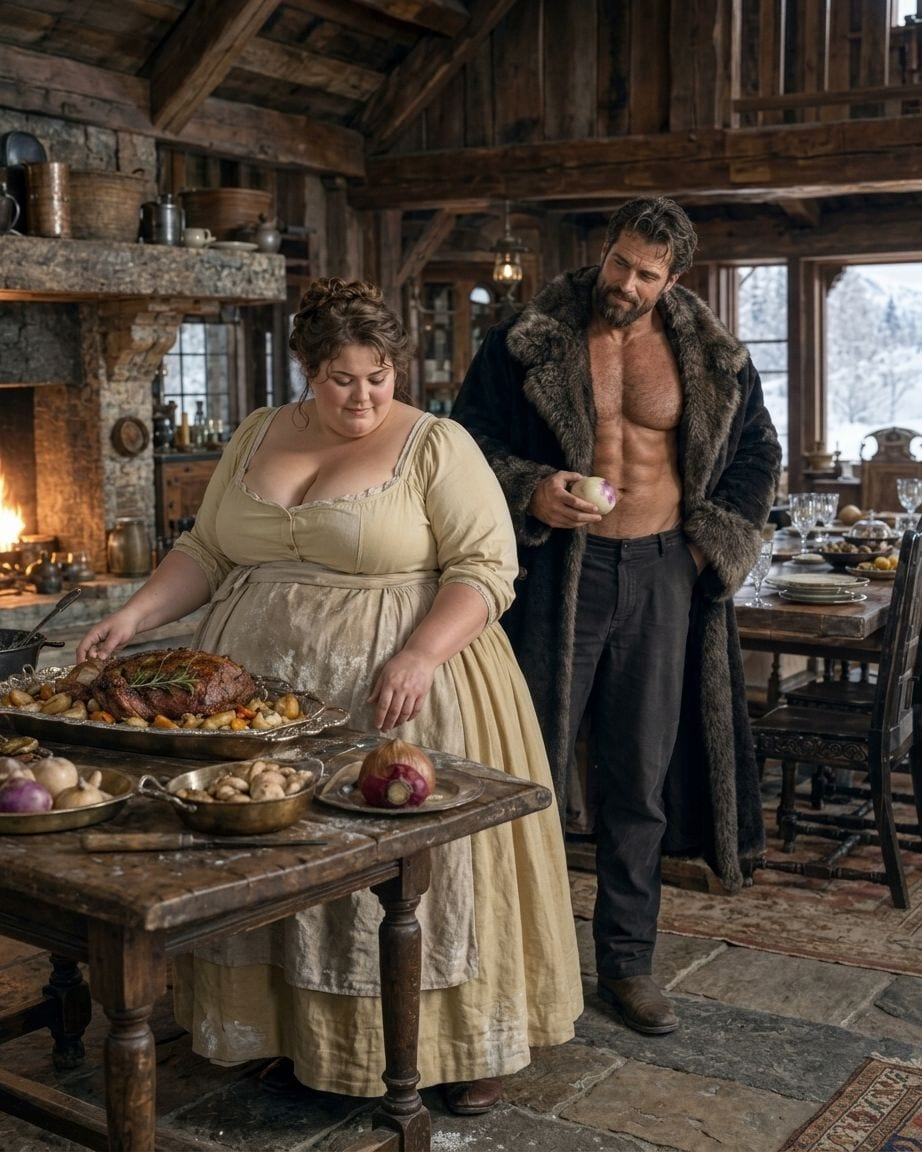
"Beatrice, get down!"
Caleb Whitmore's shout cracked through the dining room just as the heavy pitcher slipped from Beatrice Gallagher's fingers.
Cold water exploded across the polished oak floor.
Arthur Pendleton stumbled backward, clutching the burning contract against his chest. His expensive leather shoes slid across the wet stone beside the fireplace, and for one terrifying instant, he seemed certain to fall directly into the flames.
Caleb lunged forward.
He seized Pendleton by the collar and dragged him away from the hearth.
The burning paper slipped from the investor's fingers.
Beatrice dropped to one knee, grabbed the soaked dish towel hanging from her apron, and slammed it over the smoldering document.
A sharp hiss filled the room.
Then silence.
For several seconds, nobody moved.
Pendleton stood trembling in Caleb's grip.
Josiah Abernathy stared at the wet floor.
Beatrice remained kneeling beside the fireplace, one hand pressed firmly against the ruined paper.
And Caleb Whitmore looked as though he had finally discovered something more dangerous than the mountain storms outside his windows.
"Let go of me," Pendleton demanded.
Caleb released his collar.
The financier staggered backward, straightening his waistcoat with shaking hands.
"Have you lost your mind, Whitmore?"
Caleb didn't answer.
His eyes were fixed on the document beneath Beatrice's hand.
"Miss Gallagher," he said quietly, "is it still readable?"
She lifted the towel.
The upper corner had burned away, and water had blurred several lines of ink.
But the bottom half remained intact.
Beatrice carefully lifted the paper by its edges.
"I believe so."
Pendleton moved toward her.
"Give me that."
Caleb stepped between them.
"Don't."
"That document belongs to the railroad syndicate."
"Then you should have taken better care of it."
Pendleton's face darkened.
"You have no idea what you're interfering with."
Caleb's voice dropped.
"Then enlighten me."
The two men faced each other.
Behind them, the fire snapped in the enormous stone hearth.
Outside, wind battered the windows hard enough to make the glass tremble.
Beatrice rose slowly.
Her knees ached from striking the floor, and water had soaked the hem of her cream-colored dress.
But she hardly noticed.
She was staring at the surviving lines of the contract.
There, beneath a blackened paragraph, remained the words she had glimpsed earlier.
Transfer of fifty-one percent mineral rights upon completion of the rail line.
Her stomach tightened.
She looked toward Caleb.
"Mr. Whitmore."
He turned.
She held out the paper.
"You need to read this."
Pendleton reached for it.
Caleb caught his wrist.
"One more step, Arthur, and you'll regret it."
The financier froze.
Caleb released him and accepted the document.
He moved toward the nearest candle.
His eyes traveled down the page.
Then stopped.
The color drained from his face.
For a long moment, he said nothing.
Abernathy approached cautiously.
"Whitmore? What is it?"
Caleb turned the paper toward him.
"Read the final clause."
Abernathy adjusted his spectacles.
His lips moved silently as he examined the damaged writing.
Then his eyebrows rose.
"Good Lord."
Pendleton cleared his throat.
"It's a standard security provision."
Abernathy looked at him.
"Standard?"
"Naturally."
"Arthur, this transfers controlling interest in Whitmore's mineral rights."
"Only upon completion of the railway."
"That makes it worse!"
Pendleton's expression hardened.
Caleb placed the document on the table.
"Explain."
Pendleton drew himself upright.
"The investors require protection. We're committing substantial capital to a dangerous mountain project. If the railway is completed, the mineral assets provide security for our investment."
Caleb stared at him.
"Security?"
"Yes."
"You intend to take control of my mines."
"Temporarily, under certain conditions."
"Where does it say temporarily?"
Pendleton hesitated.
Caleb stepped closer.
"Show me."
Silence.
"Show me the word temporarily, Arthur."
Pendleton's jaw tightened.
"The legal interpretation—"
"I asked you a question."
Abernathy took the paper.
"There is no temporary provision."
Caleb turned toward him.
"Did you know about this?"
Abernathy looked genuinely offended.
"Absolutely not."
"You're his partner."
"In the railway financing, yes. Not in whatever this is."
Pendleton laughed bitterly.
"Don't pretend innocence, Josiah. You knew we needed leverage."
"Leverage is not ownership."
Caleb's hands curled into fists.
For a moment, Beatrice feared he might strike Pendleton.
Instead, he walked to the head of the table and placed both palms against the polished wood.
His shoulders rose and fell.
When he spoke, his voice was terrifyingly calm.
"Four hundred men depend on those mines."
Nobody answered.
"Four hundred men. Their wives. Their children. Their homes."
He looked at Pendleton.
"And you planned to steal their livelihood with a hidden paragraph."
Pendleton's eyes narrowed.
"Don't be sentimental, Whitmore. Business is business."
"No," Caleb replied. "This is theft."
Beatrice watched the exchange with a strange mixture of satisfaction and dread.
She had stopped the signing.
The fraudulent clause had been exposed.
But she knew men like Pendleton rarely surrendered simply because someone caught them cheating.
They had too much pride.
Too much money.
And too many ways to make ordinary people suffer.
Pendleton seemed to prove her right.
He turned toward Beatrice.
"This entire misunderstanding began because of that woman."
Caleb straightened.
"Careful."
"She eavesdropped on private conversations, interfered with confidential documents, and nearly caused a serious injury."
Beatrice folded her arms.
"I also prevented you from burning evidence."
Pendleton sneered.
"You spilled water because you couldn't walk across a carpet."
"That may be true," she replied. "But I can read a contract."
Abernathy coughed into his hand.
Caleb's mouth twitched despite his anger.
Pendleton noticed.
His face turned crimson.
"You find this amusing?"
"No," Caleb said. "I find it remarkable that the only person in this room who noticed your deception was the woman you considered beneath you."
Pendleton's expression changed.
The anger remained.
But something colder appeared behind it.
Hatred.
Beatrice recognized it immediately.
She had seen that look before.
On the face of the merchant who refused to sell her flour on credit.
On the face of the land agent who laughed when she challenged her father's debt.
On the faces of men who could tolerate a poor woman only as long as she remembered her place.
Pendleton slowly buttoned his coat.
"Very well."
He reached for his leather folder.
"We shall consider tonight's negotiations concluded."
Caleb moved the folder away from him.
"Not yet."
Pendleton stopped.
"Excuse me?"
"There's still the matter of Patrick Gallagher's debt agreement."
Beatrice felt her breath catch.
Pendleton's expression remained controlled.
"An unrelated historical document."
"Then you won't mind explaining why you brought it here."
"I thought Miss Gallagher might appreciate seeing it."
"Why?"
"Because her family was involved."
"How did you know she would be here?"
The question struck the room like a gunshot.
Beatrice turned toward Caleb.
She hadn't considered that.
Pendleton had arrived at Ridge View carrying an eleven-year-old document concerning her father.
But Caleb had hired her only that afternoon.
How could Pendleton have known she would be present?
For the first time, the financier appeared genuinely uncomfortable.
"I didn't."
Caleb watched him.
"Then why carry the document?"
Pendleton adjusted his cuffs.
"It was among several old financial records I brought west."
"Records from 1877?"
"Yes."
"Connected to a timber worker in Oakhaven?"
"Correct."
"On the same evening I happened to hire that timber worker's daughter?"
Pendleton's mouth tightened.
"Coincidences occur, Whitmore."
Beatrice looked at the old agreement lying beside the damaged railroad contract.
Two documents.
Eleven years apart.
Both involving disputed ownership.
Both connected to men who used complicated paperwork to gain control of something that belonged to someone else.
And both somehow linked to Arthur Pendleton.
She felt an unpleasant chill.
Caleb turned toward Abernathy.
"Josiah, did you know Pendleton possessed that document?"
Abernathy shook his head.
"No."
"Did you know he had altered the railroad agreement?"
"Absolutely not."
Pendleton laughed.
"How convenient that everyone suddenly knows nothing."
Abernathy's face reddened.
"Arthur, I have spent thirty years building a respectable business. I will not allow you to drag my name into fraud."
"Then perhaps you should reconsider your loyalties."
"My loyalties are to lawful agreements."
Pendleton's smile disappeared.
"Be very careful, Josiah."
Caleb moved between them.
"That's enough."
He pointed toward the dining-room doors.
"Arthur, you'll leave my house."
Pendleton glanced toward the windows.
Snow was driving sideways across the glass.
"The road is impassable."
"Then you'll remain in the east guest room until morning."
"And afterward?"
"Afterward, you'll leave my property and never return."
Pendleton's eyes narrowed.
"You think you can dismiss me like a stable hand?"
"I think I've been remarkably patient."
The financier looked from Caleb to Abernathy.
Then his gaze settled on Beatrice.
"You've made a powerful enemy tonight, Miss Gallagher."
She held his stare.
"I've survived powerful enemies before."
"Not one like me."
Caleb stepped forward.
"Threaten her again, Arthur, and the storm outside will be the least of your concerns."
Pendleton's face went rigid.
For a moment, Beatrice thought he might say something reckless.
Instead, he smiled.
It was a terrible smile.
"Very well, Whitmore."
He gathered his coat.
"But remember something. A man can own every silver vein in Colorado and still discover that his fortune isn't truly his."
Then he turned and walked toward the doors.
His footsteps echoed across the stone floor.
A moment later, he disappeared into the hallway.
Abernathy remained standing beside the table.
He looked exhausted.
"Caleb, I owe you an apology."
Caleb shook his head.
"Not unless you knew."
"I didn't."
"Then help me understand how this happened."
Abernathy studied the burned contract.
"Arthur has handled most of the legal correspondence. I trusted him to prepare the final documents."
"That trust was misplaced."
"Clearly."
The older man removed his spectacles.
"But there's something you should understand."
Caleb looked up.
"What?"
"The railway syndicate is under financial pressure."
"How much pressure?"
"More than Arthur has admitted."
Beatrice began collecting the overturned glasses, but she listened carefully.
Abernathy continued.
"Several investors withdrew after the Kansas freight collapse last spring. We need profitable routes, and quickly."
Caleb's expression darkened.
"So Pendleton decided my mines would solve the problem."
"Possibly."
"Possibly?"
Abernathy sighed.
"I cannot prove his intentions. But controlling your mineral rights would give him tremendous leverage with the remaining investors."
Caleb looked toward the doorway.
"Then he never intended a fair partnership."
"I fear not."
The room fell silent.
Beatrice set the last glass upright.
Then she spoke.
"Mr. Abernathy?"
The older man turned.
"Yes, my dear?"
"Can the railway still be built without Mr. Pendleton?"
Abernathy considered the question.
"Potentially."
Caleb looked sharply at him.
"Explain."
"The syndicate could negotiate a revised agreement. But I would need approval from the other directors."
"How long?"
"Several weeks."
Caleb's face tightened.
"I don't have several weeks."
"I know."
"The winter shipments—"
"I understand."
Beatrice looked between them.
"What if the railway construction began in spring instead?"
Caleb shook his head.
"Too late."
"Why?"
He hesitated.
"Because I have a payment due in January."
Abernathy looked surprised.
"What payment?"
Caleb's expression closed.
"A private obligation."
"How large?"
"Large enough."
Beatrice noticed the change immediately.
He had spoken openly about his miners.
About his transportation problems.
About the risk of closing two mines.
But now he seemed unwilling to discuss something that frightened him more than any of those things.
She didn't press him.
Not yet.
Abernathy rubbed his forehead.
"I need to review the syndicate's accounts."
Caleb nodded.
"Tomorrow."
"If the road opens."
"It will eventually."
The older man glanced toward Beatrice.
"Miss Gallagher, I must say, tonight's supper was extraordinary."
"Thank you, sir."
"And your intervention may have saved this man from a catastrophic mistake."
Caleb looked toward her.
"She did."
Beatrice felt her cheeks warm.
"I'm glad I noticed."
Abernathy smiled.
"More than noticed, I think."
Then he gathered his spectacles and moved toward the door.
"I believe I'll retire. This evening has given me more excitement than I require."
Caleb directed him toward the west guest room.
When the door closed, the dining room became quiet.
Only the fireplace remained alive.
Beatrice looked at the ruined supper table.
A few hours earlier, she had arranged the plates with such care.
Now the tablecloth was stained.
Water covered part of the floor.
The roast had grown cold.
And the contract that might have saved hundreds of jobs lay damaged beside a document connected to her father's death.
She reached for a plate.
Caleb stopped her.
"Leave it."
She looked up.
"The dishes won't wash themselves."
"They can wait."
"I was hired to cook and clean."
"You were hired to prepare dinner."
"And I did."
"Then your work is finished."
Beatrice glanced toward the clock.
It was nearly eleven.
She had earned seventy-five dollars.
Enough to pay the overdue account at the flour merchant.
Enough to purchase firewood.
Perhaps even enough to repair the worst section of her roof.
She should have felt relieved.
Instead, she felt as though she had stepped into something far larger than herself.
Caleb approached the table.
He picked up the damaged contract and placed it inside a clean leather portfolio.
Then he added the old debt agreement.
Beatrice watched him carefully.
"Where are you taking those?"
"To my study."
"I'd prefer to keep my father's document."
Caleb paused.
"Of course."
He handed it to her.
She accepted it with both hands.
The paper felt strangely heavy.
Eleven years of unanswered questions rested between her fingers.
"Thank you," she said.
Caleb nodded.
Then he reached into his coat and withdrew a small leather purse.
He placed it on the table.
"Your payment."
Beatrice opened it.
Inside were gold and silver coins.
She counted them.
Seventy-five dollars.
Exactly.
She looked up.
"You kept your word."
Caleb's expression softened.
"I try to."
She tied the purse securely.
"Then I suppose our arrangement is finished."
Something changed in his face.
It happened so quickly she almost missed it.
A flicker of disappointment.
Then the familiar sternness returned.
"The road is closed," he said.
"I know."
"You'll need to stay until morning."
"I can sleep in the kitchen."
"Absolutely not."
Beatrice raised an eyebrow.
"Mr. Whitmore—"
"There are twenty bedrooms in this house."
"And how many are occupied?"
He hesitated.
"Three."
"Then perhaps you should consider a smaller house."
Caleb stared at her.
Then he laughed.
A real laugh.
Deep and unexpected.
Beatrice smiled despite herself.
For a brief moment, the mansion no longer felt quite so empty.
Caleb shook his head.
"You are an impossible woman."
"So I've been told."
"There's a room beside the south staircase. It has a fireplace."
"That sounds more comfortable than my cabin."
His smile faded.
He remembered the leaking roof.
The nearly empty woodpile.
The thin blanket folded over her chair.
Beatrice saw the concern forming in his expression.
"Don't," she warned.
He lifted both hands.
"I haven't said anything."
"You were about to."
"Perhaps."
She folded her arms.
"Then save your breath."
Caleb nodded.
But he didn't look away.
"Miss Gallagher, I would like to ask you something."
She waited.
"Would you consider staying another day?"
Beatrice blinked.
"To cook?"
"Among other things."
"What other things?"
He glanced toward the portfolio.
"I need someone I can trust."
The words settled between them.
Beatrice felt an unexpected ache in her chest.
Trust.
Such a small word.
Such a dangerous gift.
"Mr. Whitmore," she said carefully, "you barely know me."
"I know you refused to flatter me."
"That's hardly a qualification."
"I know you stood up to Pendleton."
"Someone needed to."
"I know you noticed a fraudulent clause that three wealthy businessmen overlooked."
"Two overlooked it," she corrected. "The third wrote it."
Caleb smiled faintly.
"And I know you could have walked away with your seventy-five dollars."
Beatrice looked down.
"But you didn't."
She considered his words.
Then she said, "I didn't do it for you."
"I know."
"I did it because I couldn't bear watching another man lose everything to a dishonest contract."
Caleb's expression became serious.
"That makes what you did even more important."
For a moment, neither spoke.
Then Beatrice asked, "How much would you pay me?"
Caleb's eyebrows rose.
She smiled.
"Surely you didn't think I'd work for free."
He laughed again.
"Name your price."
"Twenty dollars a day."
"Done."
"And I won't be treated like a servant."
"Agreed."
"And I want access to the records concerning my father's debt."
Caleb hesitated.
Then nodded.
"If they're connected to my business, you'll have them."
Beatrice extended her hand.
"Then we have an agreement."
Caleb looked at her hand.
It was broad, capable, and marked by years of honest labor.
He took it.
His grip was warm and firm.
For an instant, neither released the other.
Then Beatrice withdrew her hand.
"Well," she said briskly, "I suppose I'd better see this room."
Caleb opened the door.
"Allow me."
She followed him into the hallway.
The south staircase led to a quieter wing of the mansion.
Caleb carried a brass lamp.
Beatrice followed, holding her father's document and the purse containing her wages.
Their footsteps echoed against the wooden walls.
Portraits hung along the corridor.
Stern-faced men.
Women in expensive dresses.
People who looked as though smiling might have been considered a moral weakness.
Beatrice stopped before one painting.
A woman with dark hair and gentle blue eyes sat beside a window, holding a small book.
"Your mother?" she asked.
Caleb turned.
"Yes."
"She's beautiful."
"She was."
Beatrice studied the portrait.
"She looks kind."
Caleb's expression softened.
"She was the kindest person I ever knew."
"What was her name?"
"Margaret."
Beatrice smiled.
"My mother's name was Mary."
Caleb looked at her.
"Did she teach you to cook?"
"Everything I know."
He glanced toward the painting.
"Mine taught me to make biscuits."
Beatrice turned in surprise.
"You?"
He nodded.
"I was terrible at it."
She laughed.
"I find that difficult to imagine."
"My first batch could have been used as ammunition."
Her laughter echoed down the hallway.
Caleb smiled.
Then, almost shyly, he said, "It's been a long time since anyone laughed in this house."
Beatrice looked at him.
There was no bitterness in his voice.
Only a quiet admission.
She glanced toward the dark corridor.
"Then perhaps the house has been waiting for someone to give it a reason."
Caleb said nothing.
But something in his expression changed.
They continued toward the guest room.
At the end of the hallway, Caleb opened a heavy oak door.
Inside stood a large four-poster bed, a carved wardrobe, a writing desk, and a stone fireplace.
The room was beautiful.
And cold.
Beatrice stepped inside.
"Does anyone ever use this room?"
"No."
"Then why keep it ready?"
Caleb hesitated.
"My mother believed a home should always have room for someone who needed shelter."
Beatrice looked toward him.
"She sounds like a wise woman."
"She was."
He placed the lamp on the desk.
"I'll have more firewood brought up."
Beatrice raised an eyebrow.
"By whom?"
Caleb looked at her.
Then sighed.
"By me."
She smiled.
"You're learning."
He shook his head.
But he was smiling when he left.
Beatrice stood alone in the guest room.
For the first time in years, she was surrounded by luxury.
A thick mattress.
Clean linen.
A fireplace large enough to heat her entire cabin.
Yet she found herself thinking about the man who owned it all.
He had built a mansion that could shelter dozens of people.
Then filled it with silence.
She placed her purse on the desk.
Beside it, she unfolded her father's debt agreement.
The paper crackled softly.
She studied the signatures again.
Patrick Gallagher.
Caleb Whitmore.
The date.
The amount.
Then she noticed something she hadn't seen in the dining room.
Near the bottom, beneath the faded ink, was a small embossed mark.
A circle surrounding three letters.
R.V.C.
She frowned.
Ridge View Company?
No.
Caleb hadn't built Ridge View Estate until years after the agreement was signed.
She brought the paper closer to the lamp.
The mark was partially hidden beneath the dark stain.
She tilted it toward the light.
And suddenly she recognized the design.
She had seen that same mark before.
On the back of a brass token her father had kept hidden in his wooden box.
He had once told her never to lose it.
"It's the only proof I have," he had said.
But he had died before explaining what it proved.
Beatrice felt her pulse quicken.
She needed that token.
She needed her father's ledgers.
And she needed to understand why Arthur Pendleton had brought an eleven-year-old document into Caleb Whitmore's dining room.
A knock sounded at the door.
She quickly folded the paper.
"Come in."
Caleb entered carrying an armful of firewood.
He knelt beside the hearth and began arranging the logs.
Beatrice watched him.
"Mr. Whitmore?"
"Yes?"
"Have you ever heard of a company with the initials R.V.C.?"
His hands stopped.
For a moment, he remained perfectly still.
Then he slowly turned toward her.
"Where did you hear that name?"
She held up the document.
"There's a mark on my father's agreement."
Caleb rose.
His face had changed completely.
The warmth was gone.
In its place was something Beatrice had not seen before.
Fear.
"Let me see."
She handed him the paper.
He examined the embossed circle.
Then he closed his eyes.
"Dear God."
Beatrice stepped closer.
"What is it?"
Caleb looked toward the door.
Then back at her.
"Miss Gallagher, I need you to listen very carefully."
She felt cold despite the growing fire.
"All right."
"Do not mention those initials to Pendleton."
"Why?"
"Because if that seal is genuine, your father's debt wasn't an ordinary loan."
Beatrice stared at him.
"What was it?"
Caleb opened his mouth.
Then stopped.
A faint sound came from the hallway.
Footsteps.
Slow.
Careful.
Someone was approaching the guest room.
Caleb immediately lowered his voice.
"Put the document away."
Beatrice slipped it beneath her apron.
The footsteps stopped outside the door.
For several seconds, nobody spoke.
Then a shadow moved beneath the threshold.
Caleb reached for the brass lamp.
The door handle turned.
Once.
Slowly.
Beatrice backed toward the fireplace.
Caleb stepped in front of her.
The handle turned again.
Then a man's voice whispered from the other side.
"Mr. Whitmore, I know what happened at Red Valley Creek."
Caleb went pale.
The door began to open.
And the man standing outside was holding—






Comments 0