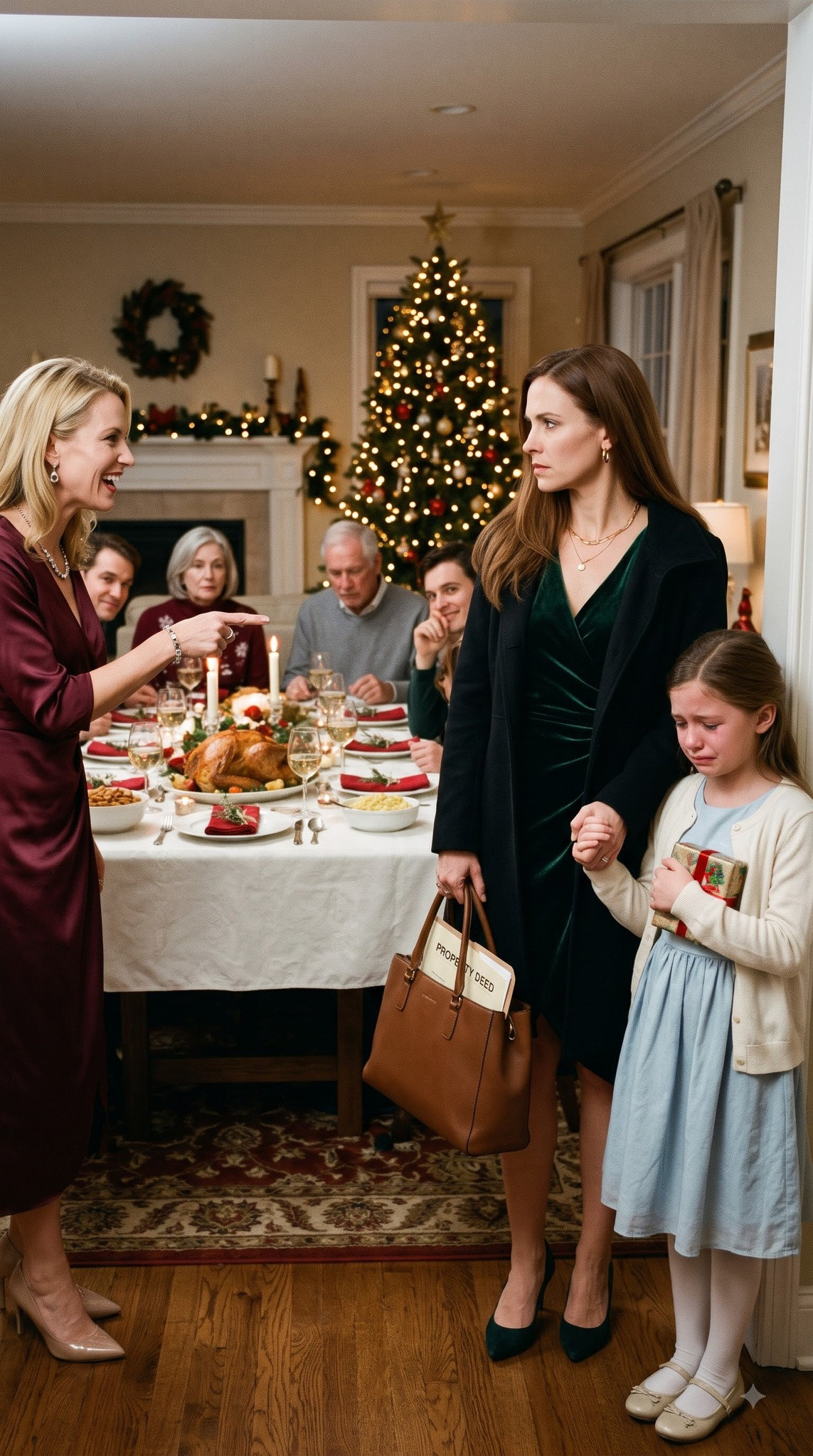
The name on the second deed was Vanessa Collins.
My sister.
The same woman who had laughed while my eleven-year-old daughter struggled not to cry at Christmas dinner.
The same woman who had lived in my five-bedroom house without paying rent for five years.
And now, according to the document Mark had photographed, she was preparing to become its legal owner.
I stared at my phone until the letters blurred.
GRANTEE: VANESSA COLLINS.
Below her name was the address of the house I had purchased with my grandfather's inheritance, my savings, and a mortgage I had been paying every month since the closing.
My stomach tightened.
I enlarged the photograph.
The document looked official. It had the familiar formatting of a property deed, a legal description, and spaces for signatures and notarization.
But something was wrong.
The signature at the bottom looked like mine.
Again.
Only this time, the document wasn't merely claiming that Vanessa had some kind of interest in the property.
It appeared to be transferring ownership directly from me to her.
I checked the date.
December 26.
Tomorrow.
For a long moment, I couldn't hear anything except the faint hum of my refrigerator and the ticking clock above my desk.
Then my phone vibrated.
A message from Vanessa.
Vanessa: Mom says you can't do this.
The same six words.
Again.
I read them slowly.
Twenty minutes after I had left Christmas dinner, she had sent that message.
At the time, I hadn't understood it.
I hadn't threatened to evict her.
I hadn't mentioned the house.
I hadn't demanded money.
I had simply taken my daughter's hand and walked away.
Now I wondered whether Vanessa had been afraid of something entirely different.
Maybe she hadn't been worried that I would punish her.
Maybe she had been worried that I would discover what she was doing before she finished it.
I placed the phone on my desk and took a deep breath.
My first instinct was to call her.
I wanted to ask how she could possibly believe she had the right to take my property.
I wanted to demand an explanation for the forged-looking signature.
I wanted to ask whether our parents knew.
But Rebecca Shaw's warning echoed in my head.
Don't confront anyone tonight.
I picked up my phone again.
Instead of calling Vanessa, I saved Mark's photograph.
Then I emailed it to myself.
Then I uploaded a copy to a secure folder.
I had spent years working with financial records. I knew the difference between an accusation and evidence.
And I knew that if someone was willing to put my name on documents I had never signed, I needed to be very careful about what happened next.
I opened the photograph one more time.
At the bottom of the deed was a notary section.
The name was partially obscured by another sheet of paper.
I zoomed in.
I could make out the first name.
Patricia.
The last name was hidden.
I frowned.
The document was dated for the following day, yet the signature already appeared on it.
Was it a draft?
Had someone prepared it in advance?
Was Vanessa planning to submit it somewhere?
I didn't know.
And that uncertainty frightened me more than I wanted to admit.
Because if the document was fraudulent, the problem wasn't simply that my sister wanted my house.
It was that someone had apparently helped her create paperwork designed to make the transfer look legitimate.
I checked the time.
1:26 a.m.
Lily was asleep.
The apartment was quiet.
And somewhere across town, my sister was sitting inside my house, possibly holding documents that could threaten everything I had worked for.
I opened a blank document on my laptop.
At the top, I typed:
PROPERTY TIMELINE — EMILY CARTER
Then I began writing.
Five years earlier, I had purchased the house.
The deed was recorded in my name.
I paid the down payment.
I signed the mortgage.
I made every mortgage payment.
I paid the property taxes and insurance.
Vanessa and Mark moved in with my permission.
There was no agreement to transfer ownership.
There was no promise that the property would eventually belong to them.
There was no sale.
There was no gift.
And I had never signed the documents now appearing in front of me.
I read the list twice.
Then I added one more sentence.
I did not authorize Vanessa Collins, my parents, or anyone else to sign property documents on my behalf.
Seeing those words on the screen made the situation feel painfully real.
My sister wasn't merely being ungrateful.
She appeared to be trying to turn my generosity into a legal claim.
And I had no idea how far she had already gone.
At 6:42 the next morning, my mother called.
I was awake.
I hadn't slept much.
Every time I closed my eyes, I saw the deed with Vanessa's name printed beneath the word grantee.
I let the phone ring twice before answering.
"Merry Christmas, Mom."
There was a pause.
"Christmas was yesterday, Emily."
"I know."
She sighed.
"Are you going to be difficult about everything now?"
I looked toward Lily's bedroom.
The door was still closed.
"Why are you calling?"
"Your sister is very upset."
I closed my eyes.
Of course she was.
"Mom, I'm not discussing Christmas dinner again."
"Well, somebody has to."
"No. Somebody needed to speak up when Vanessa was humiliating Lily. Nobody did."
"Vanessa didn't mean anything by it."
"Then she should have no trouble apologizing."
My mother made a small impatient sound.
"You know how Vanessa is."
I had heard those words my entire life.
You know how Vanessa is.
They had excused broken promises, borrowed money, ruined holidays, and cruel remarks.
They had become a family rule.
Vanessa could behave however she wanted.
Everyone else was responsible for understanding her.
"Yes," I said. "I know exactly how Vanessa is."
"Emily, please don't start."
"Then tell me why you called."
Another pause.
"Your father says you've been looking into the house."
I stared at the wall.
"Did he?"
"He's worried you're going to do something rash."
"Like what?"
"Don't play games."
"I'm asking a question."
My mother lowered her voice.
"Vanessa has lived there for five years."
"I'm aware."
"It's her home."
"It's a house I own, Mom."
"See? That's exactly the attitude I'm talking about."
I almost laughed.
"Stating a fact is an attitude now?"
"You always have to remind everyone that you paid for things."
"No, Mom. I almost never remind anyone. That's part of the problem."
She went quiet.
I continued.
"I paid for that house because Vanessa needed help. I didn't do it so she could insult my child and pretend I don't exist."
"Nobody is pretending you don't exist."
"Then why did you sign an affidavit about my property without telling me?"
The silence was immediate.
Complete.
For several seconds, I thought the call had disconnected.
"Mom?"
"Where did you hear about that?"
Her voice had changed.
The irritation was gone.
Something else had replaced it.
Fear.
"I found the recorded document."
She inhaled sharply.
"Emily—"
"Why did you sign it?"
"It's not what you think."
"Then explain it."
"Your father handled most of that."
"Your signature is on it."
"We were trying to help Vanessa."
I stared at the phone.
"By claiming I agreed to give her my house?"
"Nobody said that."
"The document says she has an ownership interest."
"That's legal language."
"Yes, Mom. It is."
She became defensive.
"You don't understand how much money Vanessa and Mark have put into that place."
"I paid for the roof."
"That was years ago."
"I paid for the windows."
"Emily—"
"I paid the property taxes every year. I paid the mortgage every month. I paid for the plumbing repairs when the upstairs bathroom flooded."
"Vanessa has made improvements, too."
"She replaced a chandelier."
"That's not fair."
"Neither is signing a property document behind my back."
My mother lowered her voice again.
"Your sister was afraid you'd eventually make her leave."
I stared at the kitchen counter.
"Why?"
"Because you've never been married as long as she has. You don't understand what it's like to have a family settled in one place."
I felt something inside me go cold.
"Mom, I have a family."
"You know what I mean."
"No. I don't think I do."
"Emily, please."
"Lily and I are a family. We live in a two-bedroom apartment while I pay for Vanessa's five-bedroom house. And last night, you watched her mock my daughter for not having expensive clothes."
My mother didn't answer.
I waited.
Then she said quietly, "You always make things sound worse than they are."
That sentence settled something in me.
I had spent years trying to find the right words.
The right tone.
The right moment.
I had believed that if I explained myself clearly enough, my mother would finally understand.
But understanding wasn't the problem.
She understood perfectly well.
She simply didn't want to take my side.
"Mom," I said, "I'm meeting with an attorney this morning."
Her breathing changed.
"An attorney?"
"Yes."
"Emily, don't do that."
"Why?"
"Because lawyers make everything worse."
"Someone signed my name to a document I never authorized."
"Your sister would never do anything to hurt you."
I looked at the photograph of the second deed on my laptop.
"Then she has nothing to worry about."
My mother became suddenly urgent.
"Wait. What document are you talking about?"
I froze.
There it was.
A small difference in her voice.
She knew about the affidavit.
But perhaps she didn't know about the second deed.
I chose my next words carefully.
"Why don't you tell me what you signed?"
"Emily, I don't like this conversation."
"Neither do I."
"Your father will call you."
"That's fine."
"Please don't do anything until we can all sit down together."
I looked at the clock.
7:03 a.m.
My appointment with Rebecca was in less than two hours.
"I'll speak to my attorney first."
"Emily—"
"Goodbye, Mom."
I ended the call.
Then I stood at the kitchen counter for a long moment, staring at the dark screen.
My mother had admitted that she signed the affidavit.
She had said they were trying to help Vanessa.
But she had sounded genuinely confused when I mentioned another document.
That meant one of two things.
Either she was a better liar than I had ever realized.
Or Vanessa had been keeping secrets from the very people who were helping her.
Lily woke at seven-thirty.
She came into the kitchen wearing her pajamas, her hair tangled from sleep.
"Mom, are we having pancakes?"
I turned toward her.
"Absolutely."
She smiled.
"With chocolate chips?"
"Is there another kind?"
She laughed and climbed onto a stool.
I put my phone facedown.
Whatever was happening with the house, Lily didn't need to carry it.
She had already carried enough.
While I mixed the batter, she told me about a dream involving a talking snowman and a dog that could drive a car.
I listened.
I asked questions.
I laughed when she laughed.
For twenty minutes, I was simply her mother.
Not a property owner.
Not Vanessa's sister.
Not the daughter who had disappointed her parents by refusing to stay quiet.
Just Mom.
When we finished breakfast, Lily looked at me.
"Are we going to see Grandma today?"
I hesitated.
"Not today, sweetheart."
She nodded.
Then she asked, "Is it because of what happened?"
I sat beside her.
"Partly."
"Are they mad?"
"Maybe."
She looked down at her plate.
"I don't want everybody fighting because of me."
I reached for her hand.
"Lily, listen carefully. You are not responsible for the way adults choose to behave."
"But if I hadn't cried—"
"No."
My voice was firmer than I intended.
She looked up.
I softened it.
"Sweetheart, you didn't do anything wrong. You wore a dress you loved. You went to Christmas dinner. You were kind to everyone. The people who hurt your feelings are responsible for what they said."
She considered that.
"Even Grandma?"
I swallowed.
"Grandma should have helped."
Lily was quiet for a moment.
Then she said something that hurt more than any insult Vanessa had thrown at me.
"I thought she liked me."
I pulled her into my arms.
"Oh, honey."
I held her for a long time.
I wanted to tell her that Grandma loved her.
I believed she did, in her own complicated way.
But I also knew that love without protection could leave a child feeling terribly alone.
So I chose my words carefully.
"Sometimes people love us and still make bad choices. But you deserve to be treated kindly, no matter who you're with."
Lily nodded against my shoulder.
Then she whispered, "I'm glad we left."
I closed my eyes.
"Me too."
At eight-thirty, my friend Claire arrived.
Claire and I had worked together for almost ten years.
She was practical, direct, and incapable of pretending something was fine when it wasn't.
I had called her early that morning and explained that I needed someone to stay with Lily for a couple of hours.
I hadn't told her everything.
Not yet.
But Claire knew my family.
She knew Vanessa.
And she knew enough to understand that if I was asking for help the morning after Christmas, something serious had happened.
She walked into my apartment carrying a paper bag.
"I brought cinnamon rolls," she announced.
Lily appeared immediately.
"From the bakery?"
"The good bakery."
Lily grinned.
Claire winked at me.
"Go do whatever grown-up thing you need to do. We've got this."
I pulled her aside near the kitchen.
"Thank you."
She studied my face.
"Emily, you look terrible."
"Good morning to you, too."
"I'm serious."
"I didn't sleep."
"What happened?"
I glanced toward Lily.
Claire understood.
"Later?"
I nodded.
She squeezed my arm.
"Whatever it is, you're not handling it alone."
Those words nearly made me cry.
Not because they were dramatic.
Because I hadn't realized how badly I needed to hear them.
I kissed Lily goodbye.
Then I picked up the blue property folder and left.
Rebecca Shaw's office occupied the second floor of a modest brick building near downtown.
There was nothing flashy about it.
No marble lobby.
No enormous reception desk.
Just a quiet waiting room, a bookshelf filled with legal reference materials, and a receptionist who offered me coffee.
Rebecca came out at exactly nine.
She was in her early fifties, with shoulder-length brown hair and the calm expression of someone who had spent years listening to people describe the worst days of their lives.
"Emily?"
I stood.
She shook my hand.
"Come in."
Her office was simple.
A wooden desk.
Two chairs.
A framed photograph of a mountain lake.
Stacks of carefully organized files.
She closed the door and sat across from me.
"Before we begin," she said, "I want to clarify something. I spoke with Mark last night only to receive information. I haven't agreed to represent him or anyone in your family. If you retain me, my duty will be to you."
I nodded.
"I understand."
"Good. Now tell me what happened."
So I did.
I told her about the purchase.
The inheritance.
The mortgage.
The agreement allowing Vanessa to live there without rent.
The five years of payments.
The Christmas dinner.
The insults directed at Lily.
My father's warning.
The affidavit.
The signature that wasn't mine.
And finally, Mark's photograph of the second deed.
Rebecca listened without interrupting.
Occasionally, she made notes.
When I finished, she sat quietly for a moment.
Then she asked, "Did you ever sign a written lease with your sister?"
"No."
"Did you ever execute a purchase agreement with her?"
"No."
"Did you ever promise her ownership in writing?"
"Absolutely not."
"Did you authorize either parent to act on your behalf concerning the property?"
"No."
"Did you sign a power of attorney?"
"No."
She nodded.
"All right."
I leaned forward.
"Can she take my house?"
Rebecca looked directly at me.
"Not simply because she recorded an affidavit or prepared a deed. A document claiming an interest doesn't automatically establish that the claim is valid. But a forged signature or fraudulent filing can create a serious title problem, and we need to move quickly."
I exhaled.
"What do we do?"
"First, we verify every recorded document. Then we determine whether the second deed has been submitted anywhere. We'll also need to contact the title company named in the photograph and determine whether it has an active transaction involving your property."
I nodded.
"And Vanessa?"
"Don't confront her yet."
I looked down.
"That's getting harder."
"I imagine it is."
Rebecca leaned back slightly.
"But right now, your strongest position is the one supported by evidence. You have the original purchase documents. You have payment records. You have communications showing that your sister understood you were allowing her to live there."
I opened the folder.
"I brought everything."
For the first time that morning, Rebecca smiled.
"I can see that."
We spent nearly an hour reviewing the documents.
She examined the original deed.
The closing statement.
The mortgage history.
The tax records.
The repair invoices.
Then she looked at the affidavit.
Her expression became serious.
"This is concerning."
I felt my stomach tighten.
"How concerning?"
"The statement attached to the affidavit appears to represent that you acknowledged an ownership arrangement. If you didn't sign it, that needs to be investigated."
"I didn't."
"I believe you. But we'll need to establish that through evidence."
She studied the signature.
Then she looked at the date.
"November twelfth."
"I was at Lily's school all day."
"Can you document that?"
"Yes."
"Good."
She wrote something down.
Then she opened the photograph Mark had sent.
The second deed filled her computer screen.
She examined it for several seconds.
"Interesting."
I leaned forward.
"What?"
"This appears to be a proposed quitclaim deed."
"What does that mean?"
"It would generally be used to transfer whatever interest the grantor has in the property. But preparing one doesn't make it effective, and a forged signature doesn't become valid merely because someone puts it on a form."
I nodded slowly.
"Then why would Vanessa do this?"
Rebecca didn't answer immediately.
"Sometimes people misunderstand their legal rights. Sometimes they're badly advised. And sometimes they know exactly what they're doing."
She enlarged the lower portion of the photograph.
"There's something else."
My pulse quickened.
"What?"
"The notary section appears incomplete."
"Is that good?"
"It means we shouldn't assume this document was properly executed. But I want to know who prepared it, who intended to notarize it, and why the date is December twenty-sixth."
She pointed toward the title company name.
"Hartwell Title Services."
I had never heard of it.
Rebecca wrote down the name.
"Let's start there."
She picked up her office phone.
I sat silently while she called.
A receptionist answered.
Rebecca identified herself and asked to speak with someone handling a possible transaction involving my property.
She gave the address.
There was a pause.
Then the receptionist transferred her.
Rebecca waited.
"Good morning. This is Rebecca Shaw, attorney for Emily Carter, the record owner of the property at that address."
I watched her expression.
"I'm calling because my client has reason to believe an unauthorized transfer document may have been prepared."
Another pause.
"Yes, I understand you have confidentiality obligations. I'm asking you to preserve any relevant records and refer this immediately to your legal department. My client disputes any purported signature or authorization attributed to her."
Rebecca listened.
Then she sat straighter.
"There's an active file?"
My heart stopped.
She looked at me.
"Who opened it?"
A longer pause.
"I understand. Please don't disclose information you're not authorized to share. I will send written notice of the dispute and proof of my client's identity and ownership."
She wrote something down.
"Thank you."
Then she ended the call.
I leaned forward.
"Rebecca?"
She looked at her notes.
"Hartwell has an active file associated with your property."
I felt cold.
"An active transfer?"
"They wouldn't confirm the nature of the transaction over the phone. But they acknowledged that a file exists and that it has been flagged for review."
I stared at her.
"So Vanessa really is trying to do something."
"Someone has initiated a process involving the property. We need to establish exactly what."
I looked at the photograph again.
The deed.
The signature.
My sister's name.
"How could she think she'd get away with this?"
Rebecca folded her hands.
"That's a question we may eventually be able to answer."
Then she added, "But there's something I want you to consider."
"What?"
"Your sister may not be acting alone."
I thought about my parents' signatures.
My father's warning.
My mother's sudden panic.
"I know."
Rebecca shook her head slightly.
"I don't just mean your parents."
I stared at her.
"What do you mean?"
She turned the computer screen toward me.
At the bottom of the deed, beneath the legal description, was a small reference number.
I hadn't noticed it before.
Rebecca pointed to it.
"This appears to be a transaction or preparation reference. I want to know who generated it."
I leaned closer.
The number meant nothing to me.
But Rebecca's expression suggested she had seen something familiar.
"Do you recognize it?" I asked.
"Not specifically. But it may help us trace the document."
She picked up her pen.
"Emily, I need you to tell me whether your sister has ever had access to your personal identification documents."
I thought about it.
"Probably."
"When?"
"Years ago. Before I bought the house, she stayed with me for a few weeks. And she's been inside my apartment plenty of times."
"Did she ever have access to your tax returns?"
"I don't think so."
"Your driver's license?"
"She might have photographed it once when we were booking a family trip."
Rebecca nodded slowly.
"All right."
I felt sick.
"Are you saying she could have used my information?"
"I'm saying we should review what information may have been available to her."
I stared at the desk.
For years, I had treated Vanessa like family.
Because she was family.
I had never imagined that the same person who borrowed my sweaters as a teenager might someday use my trust to threaten my home.
Rebecca closed the folder.
"Here's what we're going to do. I'll send formal notice disputing any unauthorized transfer and request preservation of relevant records. We'll review the title history and consider appropriate legal action based on what we find. In the meantime, don't sign anything, don't make threats, and don't discuss the details with your family."
I nodded.
"And the house?"
"Continue making your normal payments. Keep records of everything. And don't attempt to remove your sister or change locks without following the law."
"I wouldn't."
"Good."
She looked at me carefully.
"One more thing. Do you have any reason to believe your sister might destroy evidence if she learns you're investigating?"
I thought about Mark's whispered phone call.
Vanessa demanding his phone.
The photograph he had sent.
"Yes," I said.
Rebecca's expression hardened.
"Then we need to move quickly."
When I left Rebecca's office, my phone showed twenty-three unread messages.
I didn't open them immediately.
I sat in my car with both hands resting on the steering wheel.
For the first time since Christmas dinner, I felt something other than anger.
Grief.
Not for the house.
Not for the money.
For the family I had spent years believing I had.
I had always known Vanessa was selfish.
I had always known my parents favored her.
But there was a difference between knowing someone would disappoint you and discovering they might be willing to take something you had spent years building.
I thought about Grandpa Arthur.
He had worked with his hands his entire life.
He had saved carefully.
He had left me money because he wanted me to have security.
And now the house I had purchased partly with that inheritance was at the center of a scheme involving the very people who were supposed to love me.
I took out my phone.
There was a message from Claire.
Claire: Lily is fine. We're baking cookies. Take your time.
I smiled faintly.
Then I opened the family messages.
My father had sent four.
Dad: Your mother says you're seeing a lawyer.
Dad: This is completely unnecessary.
Dad: We need to settle this privately.
Dad: Call me before you make a terrible mistake.
Vanessa had sent seven.
The first was angry.
Vanessa: I can't believe you're doing this to me.
The second was more aggressive.
Vanessa: After everything I've done for this family, you're going to punish my children?
The third made me stare.
Vanessa: You don't even need that house. You already have somewhere to live.
I read it twice.
She was right about one thing.
I had somewhere to live.
A modest apartment.
One I paid for.
But the idea that owning a home meant I was obligated to give it away because someone else wanted it was so absurd that I almost couldn't process it.
The next message was worse.
Vanessa: Grandpa would be ashamed of how selfish you've become.
I closed my eyes.
That one hurt.
Not because I believed it.
Because Vanessa knew exactly where to aim.
Grandpa Arthur had been the person who believed in me when I was younger.
He had told me I was capable.
He had encouraged me to go to college.
He had helped me understand money.
He had never made me feel that being quiet meant being weak.
Vanessa knew how much he meant to me.
And she was using his memory to manipulate me.
I scrolled down.
Vanessa: Mom and Dad agree with me.
Then:
Vanessa: You can't undo five years of family understanding just because you're angry.
And finally:
Vanessa: If you contact anyone about the property, you'll regret it.
I stared at the last message.
A threat.
Not subtle.
Not disguised as concern.
A direct warning.
I took a screenshot.
Then I forwarded it to Rebecca.
I didn't respond.
Instead, I called Mark.
It rang once.
Twice.
Three times.
Then voicemail.
I left a short message.
"Mark, it's Emily. I got the photographs. Thank you. Please don't put yourself in a difficult position trying to get more. Call me when you can."
I ended the call.
Then I drove home.
Claire was standing in my kitchen when I arrived.
Lily was at the table decorating cookies.
There was flour on the counter and frosting on the floor.
For one wonderful second, the apartment felt normal.
"Mom!" Lily called.
She held up a cookie shaped like a Christmas tree.
"I made this one for you."
It was covered in crooked green frosting and far too many sprinkles.
I smiled.
"It's perfect."
She beamed.
Claire watched me carefully.
"Everything okay?"
I glanced toward Lily.
"Can we talk for a minute?"
Claire nodded.
We stepped into my bedroom.
I closed the door.
Then I told her everything.
The affidavit.
The forged-looking signature.
The second deed.
The title company.
The messages.
My parents' involvement.
By the time I finished, Claire was staring at me.
"Emily."
"I know."
"No. I don't think you do."
She sat on the edge of my bed.
"Your sister is trying to steal your house."
I swallowed.
"That's what it looks like."
"And your parents helped her?"
"They signed the affidavit."
Claire shook her head.
"I knew Vanessa was entitled. I didn't know she was capable of this."
"Neither did I."
She looked toward the bedroom door.
"Does Lily know?"
"No."
"Good."
I sat beside her.
"I don't want her involved."
"She shouldn't be."
For a moment, neither of us spoke.
Then Claire asked, "What are you going to do?"
I looked at the blue folder on my dresser.
"I'm going to let Rebecca handle the legal side."
"And Vanessa?"
I thought about Christmas dinner.
The laughter.
Lily's red face.
My father's silence.
My mother's lowered eyes.
"I don't know yet."
Claire studied me.
"Emily, you've spent years making sure Vanessa never had to face consequences."
I looked down.
"She was struggling."
"Five years ago."
"She had kids."
"So do you."
The words landed hard.
Claire continued.
"You bought a house for your sister to live in while you raised your daughter in an apartment. You paid for repairs. You paid taxes. You gave her time to get back on her feet."
I nodded.
"And now she's acting like you're stealing something from her."
I stared at my hands.
Claire's voice softened.
"You can love someone and still stop letting them use you."
I felt tears rise.
For the first time since Christmas dinner, I let them fall.
Not many.
Just enough to release the pressure I'd been carrying.
Claire put an arm around me.
I wiped my face.
"I feel stupid."
"Why?"
"Because I kept believing she'd appreciate it."
Claire shook her head.
"Being generous wasn't stupid."
I looked toward the door.
From the kitchen, Lily laughed at something on television.
I took a slow breath.
"She asked me last night if I was mad at her for ruining Christmas."
Claire's expression changed.
"Oh, Emily."
"She thought it was her fault."
"Of course she did. She's eleven."
I nodded.
"And my parents just sat there."
Claire squeezed my shoulder.
"Then you did the right thing by leaving."
I looked at her.
For the first time, I believed it without hesitation.
At 2:17 that afternoon, Mark finally called.
I was sitting at the kitchen table while Lily watched a movie with Claire.
I stepped into my bedroom and answered.
"Mark?"
"Emily."
His voice sounded exhausted.
"Are you okay?"
He hesitated.
"Not really."
"What happened last night?"
A long silence.
Then he said, "Vanessa found out I sent you the photographs."
My stomach tightened.
"How?"
"She saw my phone."
"Mark, I'm sorry."
"Don't be. I should have told you sooner."
I sat down.
"Told me what?"
He exhaled.
"She's been talking about the house for months."
"Talking about it how?"
"She says your parents promised it to her."
I closed my eyes.
"They didn't own it."
"I know."
"Then why would she believe them?"
"Because she wanted to."
His voice sounded bitter.
"Emily, I tried to tell her this was wrong."
"What did she say?"
"That you were never going to use the house. That you didn't need it. That your grandfather's money should have benefited both sisters."
I stared at the wall.
"She knows I paid for most of it with my own savings and a mortgage."
"I know."
"She knows I'm still paying for it."
"I know."
"Then how could she—"
"Emily."
Something in his voice stopped me.
"There's more."
I gripped the phone.
"What?"
"Vanessa has been telling people your parents gave us the house."
"I know."
"No. I mean people outside the family."
I frowned.
"Who?"
"Friends. Business contacts. People from Madison's school."
"Why?"
"Because she wanted everyone to believe we owned it."
I thought about Vanessa's social media posts.
The photographs.
The captions about her dream home.
The way she always described the house as something she and Mark had worked hard to achieve.
"Mark, did you know about the affidavit?"
"Not until last week."
"And the deed?"
"I found it Christmas Eve."
"Why didn't you tell me?"
His voice broke slightly.
"Because I was afraid."
I didn't speak.
He continued.
"Vanessa said it was just paperwork to protect the family. She said your parents had worked everything out with you."
"That's a lie."
"I know that now."
"Mark, did you sign anything?"
"No."
"Are you sure?"
"Yes."
I heard him take a breath.
"But Vanessa asked me to."
My stomach dropped.
"What?"
"She wanted me to sign a statement saying we'd spent more than two hundred thousand dollars improving the property."
I stared at the wall.
"Two hundred thousand?"
"That's what she said."
"Mark, that's not true."
"I know. That's why I refused."
I thought about the renovations.
The chandelier.
The guest bedroom.
The landscaping.
Vanessa had made improvements, but nowhere near that amount.
And many of the major repairs had been paid for by me.
"Why would she need that statement?"
"I think she wanted to make it look like we'd invested so much money that we deserved ownership."
I closed my eyes.
"Mark, this is serious."
"I know."
"Have you told Rebecca?"
"Not yet."
"You need to."
"I will."
He hesitated.
Then said, "Emily, there's something else about the deed."
My heartbeat quickened.
"What?"
"Vanessa didn't prepare it herself."
I sat straighter.
"Who did?"
"I don't know his full name."
"His?"
"She met with a man twice. Once at the house and once at a coffee shop."
"Was he an attorney?"
"I don't think so."
"Then who was he?"
"She called him Mr. Mercer."
I wrote the name down.
"Mercer."
"Yes."
"What did he do?"
"I don't know. But I heard her talking to him about getting the paperwork accepted before the end of the year."
I felt cold.
"Accepted where?"
"She didn't say."
"Mark, did you see him?"
"Once."
"What did he look like?"
"Maybe fifty. Dark hair. Gray coat. Expensive watch."
I wrote everything down.
Then I asked, "Why are you telling me this now?"
Mark was silent for several seconds.
When he spoke again, his voice was different.
Quieter.
Ashamed.
"Because I watched what happened to Lily last night."
My throat tightened.
He continued.
"I sat there while Vanessa and Madison laughed at her. I didn't say anything. I should have."
I closed my eyes.
"Mark—"
"No. Let me finish."
I waited.
"That little girl looked like she wanted the floor to swallow her. And I sat there because I didn't want another fight with my wife."
His voice shook.
"I've been doing that for years."
I didn't know what to say.
He continued.
"When you walked out, I thought about how many times you've helped us. How many times you've paid for things without asking for anything back. And I realized that Vanessa wasn't just taking advantage of you."
He paused.
"She was teaching Madison to do the same."
I looked toward the living room.
Lily was laughing again.
The sound made my chest ache.
"Thank you for telling me," I said.
Mark exhaled.
"Emily, please be careful."
"Why?"
"Vanessa is desperate."
"Desperate for what?"
"To make the house hers before you can stop her."
I stared at the notebook in my lap.
"She can't just take it."
"I know."
"Rebecca is already investigating."
"Good."
Then Mark said something that made my blood run cold.
"Because Vanessa told your father this morning that if the transfer doesn't go through, she's going to make sure you lose the house anyway."
I sat completely still.
"What does that mean?"
"I don't know."
"Mark."
"I swear, Emily. I don't know."
A door opened in the background.
He lowered his voice.
"I have to go."
"Wait. Can you send me anything else?"
"I'll try."
"Don't put yourself at risk."
He hesitated.
Then whispered, "There's one more thing I haven't told you."
I gripped the phone.
"What?"
"Vanessa has a folder with Grandpa Arthur's name on it."
My heart stopped.
"Grandpa's name?"
"Yes."
"What kind of folder?"
"I don't know. But she keeps it locked in her desk."
I stared at the wall.
"Why would she have documents about Grandpa?"
Mark didn't answer.
Then I heard Vanessa calling his name.
He whispered, "I'll call you back."
The line went dead.
I sat there for a long moment.
Grandpa Arthur.
The inheritance.
The house.
The affidavit.
The deed.
And now a locked folder bearing my grandfather's name.
I had believed this was about Vanessa wanting something she didn't own.
But suddenly, I wondered whether there was something else behind it.
Something that had started long before Christmas dinner.
Something my parents knew.
Something they had never told me.
At 4:36 p.m., Rebecca called.
I answered immediately.
"Did you find something?"
"Yes."
My stomach tightened.
"What?"
"We confirmed that the affidavit was recorded. The second deed, however, does not appear in the current county index."
I exhaled.
"So she hasn't transferred the house."
"Not according to the records we've checked. But that doesn't mean the document hasn't been submitted for processing or presented elsewhere."
I nodded.
"Okay."
"I've also sent written notice to Hartwell Title Services disputing any unauthorized transaction."
"Good."
"Emily, I need to ask you something."
"What?"
"Did your grandfather ever establish a trust?"
I frowned.
"I don't think so."
"Did he leave a will?"
"Yes."
"Do you have a copy?"
"Somewhere."
"Find it."
My heartbeat quickened.
"Why?"
Rebecca paused.
"Because the affidavit refers to a family understanding connected to his estate. I want to determine whether someone is misrepresenting the inheritance documents."
I thought about Mark's call.
The locked folder.
Grandpa's name.
"Rebecca, Mark just told me Vanessa has a folder labeled with my grandfather's name."
There was silence.
Then Rebecca said, "That's interesting."
"He said she keeps it locked in her desk."
"Do not try to retrieve it yourself."
"I wasn't going to."
"Good. But if Mark has lawful access to documents and wants to provide information, he should speak with his own attorney about how to proceed."
I nodded.
"Rebecca, do you think my parents have been planning this for a long time?"
"I don't know."
"But they signed the affidavit."
"Yes."
"And my father warned me not to contact the recorder."
"Yes."
I swallowed.
"What if they've been lying to me for years?"
Rebecca's voice softened.
"Then we'll deal with the facts as we establish them."
I closed my eyes.
She continued.
"One thing at a time, Emily."
I took a breath.
"Okay."
"Find your grandfather's will. We'll review it tomorrow."
"I will."
We ended the call.
I sat at my desk and stared at the blue folder.
Then I opened the bottom drawer.
Behind old tax returns and school records was a small cardboard box.
I hadn't opened it in years.
Inside were photographs.
Birthday cards.
A few letters.
And a sealed envelope containing copies of documents from Grandpa Arthur's estate.
I took it out.
My hands trembled slightly.
I remembered receiving the envelope after the estate was settled.
At the time, I had been too overwhelmed by grief to study every page.
I knew the inheritance amount.
I knew the money had been distributed.
I knew Grandpa had wanted me to have something that would help Lily and me build a secure future.
That had been enough.
Now I wasn't so sure.
I opened the envelope.
The first document was a copy of his will.
The second was an estate accounting.
The third was a letter from the attorney who had handled the probate process.
I read the will carefully.
Grandpa had left specific personal items to several family members.
A watch to my father.
Jewelry to my mother.
A collection of books to Vanessa.
And the remainder of his estate was divided according to instructions I remembered only vaguely.
I scanned the pages.
Then stopped.
There was a handwritten notation on the copy.
Not part of the will itself.
A note in the margin.
Three words.
See separate letter.
I frowned.
I turned the page.
There was no letter.
I checked the envelope.
Nothing.
I looked through the box.
Photographs.
Cards.
Receipts.
No separate letter.
I stared at the notation.
Then I remembered something.
At Grandpa's funeral, my mother had taken me aside.
She had told me that Grandpa had left a personal message for me.
But she said the attorney would send it later.
I had asked about it once.
She told me it was probably just a sentimental note.
Then life became busy.
Lily was young.
I was working.
Vanessa was having financial problems.
And eventually, I stopped asking.
Now, five years later, I wondered what that letter had said.
And why I had never received it.
My phone vibrated.
A message from my father.
Dad: We need to meet tonight. Just you, me, and your mother.
I stared at it.
Another message appeared.
Dad: Vanessa won't be there.
Then a third.
Dad: There's something about your grandfather's estate you don't understand.
My heartbeat quickened.
I read the message again.
Grandpa's estate.
The missing letter.
The affidavit.
The deed.
I typed:
What don't I understand?
My father replied almost immediately.
Dad: Not over text. Come to our house at seven.
I looked at the clock.
5:12 p.m.
I had less than two hours.
I considered ignoring him.
Rebecca had warned me not to confront anyone.
But this wasn't just about the house anymore.
My father was claiming there was something I didn't know about my grandfather's estate.
And I needed to understand what that meant.
I called Rebecca.
She answered after two rings.
"Emily?"
"My father wants to meet tonight."
"About what?"
"He says there's something about Grandpa's estate I don't understand."
She was silent for a moment.
"Do you want to go?"
"I don't know."
"Then don't rush."
I looked at the missing-letter notation.
"What if he finally tells me the truth?"
Rebecca's voice remained calm.
"Then he can tell you in writing or with counsel present. You don't need to walk into a private family meeting to obtain information."
I knew she was right.
But another part of me wanted to look my parents in the eyes.
To ask why they had signed documents behind my back.
To ask whether they had known about the forged signature.
To ask whether Grandpa Arthur's memory was being used to justify something he would never have wanted.
Rebecca continued.
"If you decide to speak with them, don't sign anything. Don't agree to anything. And don't let them pressure you into making a decision."
"I understand."
"Would you like me to contact your father?"
I hesitated.
Then said, "Not yet."
She didn't argue.
"All right. But keep me informed."
I promised I would.
Then I ended the call.
I sat quietly for several minutes.
Finally, I texted my father.
Me: I'll come at seven. I'm not signing anything.
His reply came immediately.
Dad: We just want to talk.
I stared at those words.
For years, we just want to talk had been the opening line to every family conversation in which I was expected to surrender something.
My time.
My money.
My boundaries.
My peace.
But this time, I wasn't the same woman who had quietly agreed to everything.
And I wasn't going to let them decide what happened to my daughter's future.
At six-thirty, I told Claire where I was going.
She looked concerned.
"Are you sure?"
"No."
"Then why go?"
"Because I need answers."
She studied me.
"Emily, people who lie don't always tell the truth just because you ask them."
"I know."
"Then be careful."
I nodded.
Claire agreed to stay with Lily.
Before I left, I went into my daughter's bedroom.
She was sitting on the floor, building a little house out of colorful blocks.
"Hey, sweetheart."
She looked up.
"Hi, Mom."
"I'm going out for a little while."
"Where?"
"To talk to Grandma and Grandpa."
Her expression changed.
"Are you going to get in trouble?"
My heart squeezed.
"No."
"Promise?"
I knelt beside her.
"Promise."
She looked at the block house.
Then she picked up a small blue piece and placed it carefully on top.
"Mom?"
"Yeah?"
"Can we have Christmas at our apartment next year?"
I smiled sadly.
"Of course."
"Just us?"
I brushed a strand of hair away from her face.
"We'll make sure it's somewhere you feel happy and safe."
She nodded.
Then she hugged me.
"Love you."
"I love you more."
I kissed her forehead.
And I left.
My parents lived fifteen minutes away in a quiet neighborhood of older homes.
I had driven that route hundreds of times.
Birthdays.
Holidays.
Family dinners.
Emergencies.
The familiar streets should have felt comforting.
Instead, every turn made my stomach tighten.
I parked in front of their house at 6:58.
The porch light was on.
Christmas decorations still hung around the front door.
I sat in the car for a moment.
Then I checked my phone.
No new messages from Rebecca.
Nothing from Mark.
Nothing from Vanessa.
I picked up my handbag and walked toward the porch.
Before I could ring the bell, the door opened.
My father stood there.
He looked older than he had the night before.
His face was pale.
His shoulders were tense.
"Emily."
"Dad."
He stepped aside.
"Come in."
I entered.
My mother was sitting in the living room.
A folder rested on the coffee table.
She looked up when she saw me.
Her eyes were red.
I stopped.
"What's going on?"
My father closed the door.
"Sit down."
"I'd rather stand."
He sighed.
"Emily, please."
I looked at the folder.
Then at my mother.
"Is this about the house?"
My father exchanged a glance with her.
"It's about your grandfather."
I felt my pulse quicken.
"What about him?"
My mother wiped her eyes.
"Emily, there are things we should have told you years ago."
I stared at her.
"Then tell me now."
My father walked toward the coffee table.
He picked up the folder.
For a moment, he simply held it.
Then he said, "Your grandfather left instructions that weren't included in the will you received."
My mouth went dry.
"What instructions?"
My mother began crying quietly.
I looked between them.
"Dad."
He opened the folder.
Inside was a yellowed envelope.
Across the front, in handwriting I recognized immediately, was my name.
Emily.
My grandfather's handwriting.
I felt the room become very still.
"Where did you get that?"
My father didn't answer.
I stepped closer.
"That's the letter Mom told me about after the funeral."
My mother covered her mouth.
I looked at her.
"You had it?"
She nodded.
"For five years?"
Another nod.
I felt anger rise.
"Why?"
My father raised one hand.
"Emily, before you read it, you need to understand—"
"No."
My voice was quiet but firm.
"No more explanations before the truth. Give me the letter."
He hesitated.
Then placed the envelope on the coffee table.
I reached for it.
The paper felt old beneath my fingers.
My name was written in Grandpa Arthur's familiar uneven script.
I remembered sitting beside him in his workshop.
I remembered the smell of sawdust.
I remembered his hands.
I remembered the way he always told me to trust what I could prove.
I turned the envelope over.
The flap had already been opened.
Someone had read it.
Someone had kept it.
Someone had decided I didn't deserve to know what my grandfather wanted to tell me.
I looked at my parents.
"Who opened this?"
Neither answered.
I took out the folded pages.
The first line read:
My dear Emily,
My eyes filled with tears.
Then I unfolded the second page.
And saw a name I never expected to find in my grandfather's final instructions.
I looked up at my father.
"Why is Vanessa's name here?"
His face went white.
My mother began shaking her head.
"Emily, please don't read the next paragraph."
I stared at her.
Then back at the letter.
My grandfather had underlined one sentence three times.
I lowered my eyes to read it.
And the first words were—






Comments 0