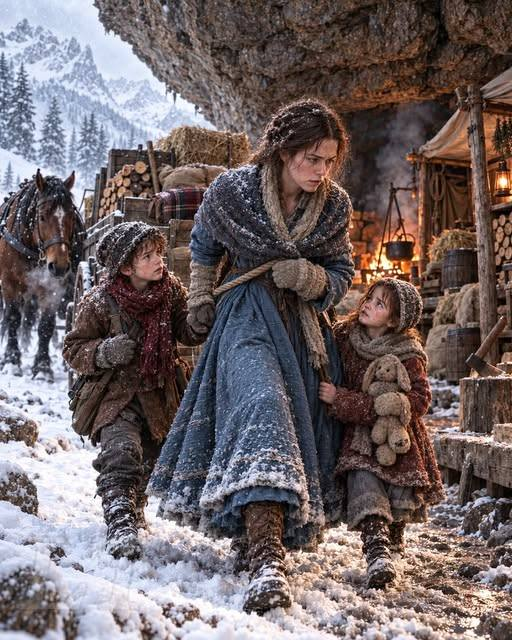
A wooden spoon slipped from Ruth Calder's hand and struck the kitchen floor.
"You're not taking our home!"
Nine-year-old Eli stood between his older sister and their uncle, his fists trembling.
Amos Calder placed a leather folder on the kitchen table.
One brass key hung from its clasp.
It was the missing key to their father's locked desk.
Ruth stared at it.
Then she looked at her uncle.
For the first time, she understood that something about this visit was terribly wrong.
"Move aside, boy," Amos ordered.
Eli didn't move.
Ruth stepped forward and gently placed a hand on her brother's shoulder.
"Go check on June."
"But—"
"Please, Eli."
The boy hesitated before disappearing into the adjoining bedroom.
Ruth waited until his footsteps faded.
Then she turned toward Amos.
"What do you want?"
Her uncle removed his gloves, folded them carefully, and placed them beside the leather folder.
"What I am owed."
He opened the folder.
Several sheets of paper lay inside. Some carried signatures. Others contained columns of numbers written in dark ink.
Ruth recognized her father's handwriting on one of the documents.
Thomas Calder had been a careful man. He wrote his letters evenly, never wasting ink, and always kept his financial records in the rolltop desk beside the kitchen.
But Ruth couldn't understand why her uncle possessed these papers.
"What are those?"
"Your father's outstanding obligations."
"Papa didn't owe you four hundred and twenty dollars."
Amos raised an eyebrow.
"Is that what he told you?"
"He told Mama that everything between you had been settled."
"Your mother knew very little about business."
Ruth felt heat rise in her cheeks.
"Don't speak about her that way."
Amos leaned back.
For a moment, he studied the eighteen-year-old girl as though she were an inconvenient object left in a room.
"Your father borrowed money. He failed to repay it. His property now belongs to me."
"Show me the original agreement."
His expression changed.
"What?"
"The original agreement. If Papa borrowed money, there must be a signed record. Show it to me."
Amos slowly closed the folder.
"You have no authority to question me."
"Then you have no reason to be afraid of showing me."
Silence settled over the kitchen.
The stove crackled.
Outside, wind rattled the wooden shutters.
Amos rose from his chair.
"Your father was a foolish man. He spent years chasing opportunities that never existed. He left debts, broken equipment, and a family that cannot support itself."
Ruth stared at him.
Her father had worked freight routes across the mountains for nearly twenty years. He had never been wealthy, but he had always paid his workers and settled his accounts.
He had taught Ruth to read numbers before she could write her name.
He had never borrowed money without explaining why.
Something was wrong.
"Where is the desk key?" she asked.
Amos glanced at the folder.
"What key?"
"The one that used to hang beside Papa's desk."
He picked up his gloves.
"That desk is part of the property."
"Why is it locked?"
"Because I said so."
Ruth's eyes returned to the brass key hanging from his folder.
She knew its shape.
She knew the small scratch near the round handle.
Her father had made that scratch himself when she was twelve.
He had dropped the key onto the floor while teaching her how to open the desk.
She remembered laughing as he blamed the uneven floorboards.
Now that same key was in her uncle's possession.
"Give it back."
Amos looked at her.
"Excuse me?"
"The key belongs to Papa."
"Your father is dead."
The words landed harder than Ruth expected.
She had heard them before.
From the doctor.
From the undertaker.
From neighbors who offered sympathy while avoiding her eyes.
But hearing them from Amos felt different.
It sounded like permission.
Permission to take everything Thomas Calder had left behind.
Amos walked toward the front door.
"You have until morning to remove your belongings."
Ruth followed him.
"Where are we supposed to go?"
"That is no longer my concern."
"Eli is nine. June is six."
"Then you should have thought about that before allowing your father to leave you with nothing."
Ruth looked at the man who had once sat at their Christmas table.
The man who had accepted her mother's cooking.
The man her father had trusted enough to let into the family home.
"Give me one hour."
Amos stopped.
"What?"
"One hour. To pack our things and get the children out."
He laughed.
It was not a pleasant sound.
"You think an hour will save you?"
"No."
Ruth looked directly into his eyes.
"But it will get us away from you."
For several seconds, neither moved.
Then Amos stepped outside.
"One hour. Not sixty-one minutes."
He closed the door.
Ruth stood motionless.
She could hear his boots crossing the porch.
Then she heard the unmistakable sound of his horse being mounted.
She had sixty minutes.
Sixty minutes to abandon the only home her younger siblings had ever known.
Sixty minutes to decide which pieces of their dead parents' lives they could carry.
And sixty minutes to accept that nobody was coming to save them.
Ruth moved first.
She grabbed two flour sacks from the pantry and began filling them with dried beans, potatoes, and flour.
She wrapped strips of bacon in cloth.
She took the salt, a small cooking pot, two tin cups, and the last of their candles.
Then she ran upstairs.
June was sitting on the bed, holding a stuffed rabbit against her chest.
The rabbit had been made by their mother from an old flour sack. One button eye was missing, and its left ear had been repaired with blue thread.
"Are we going somewhere?" June asked.
Ruth forced herself to smile.
"Just for a little while."
"Where?"
"Somewhere warm."
June looked toward the window.
Snow had begun falling.
"Will Mama come?"
Ruth stopped packing.
She knelt beside her sister.
"Oh, sweetheart."
June lowered her eyes.
"I miss her."
"I know."
"I miss Papa too."
Ruth pulled the little girl into her arms.
"So do I."
She held her tightly for a moment before standing.
"Pack your warmest things. And bring the rabbit."
June nodded.
She carefully wrapped the toy in their mother's red scarf.
Downstairs, Eli was already working.
He had found the old handcart and was loading it with firewood.
"I can take more," he announced.
"Not too much. We need room for blankets."
"I can pull it."
"You'll help me with the wagon."
Eli looked toward the door.
"Uncle Amos really means it?"
Ruth tied a sack closed.
"Yes."
"Can we ask the sheriff?"
She hesitated.
Their uncle was a respected businessman in Leadville. He owned property, knew the local merchants, and had connections with men who handled legal matters.
Ruth had no money for a lawyer.
No documents to prove her father had paid his debts.
No adult willing to stand beside them.
"Maybe later," she answered.
Eli lowered his head.
"I hate him."
Ruth placed both hands on his shoulders.
"You can be angry. But don't let anger make you careless. We have to stay together."
He nodded.
Then he lifted another bundle.
Their father's old horse waited in the stable.
Boon was a tall bay with a gray muzzle and a long winter coat.
At seventeen, he was older than most working horses.
His left hind leg sometimes stiffened when the weather changed, and his breathing had become heavier after long journeys.
But he knew the children.
When Ruth approached, he lowered his head and nudged her shoulder.
"Hello, old man."
She stroked his forehead.
"We're going on another trip."
Boon breathed against her coat.
Ruth checked his harness.
The wagon stood beside the stable, looking as though it might fall apart if anyone touched it.
One wheel had been repaired twice.
The left sideboard leaned outward.
The canvas covering had several holes.
Her father had promised to repair it in the spring.
He never got the chance.
Ruth swallowed.
She could almost hear his voice telling her to check the axle before loading anything heavy.
She knelt and inspected the wheel.
The wooden pin was loose.
She tightened it with a small hammer.
Then she placed the food, blankets, tools, and clothing inside.
Eli carried the firewood.
June brought the rabbit.
Their mother's sewing box went beneath the blankets.
Ruth hesitated before looking back toward the house.
The kitchen window glowed.
The curtains her mother had sewn were still hanging.
Her father's boots remained beside the stove.
A half-finished wooden toy rested on the shelf.
She wanted to take everything.
But the wagon was already nearly full.
There was one thing she could not stop thinking about.
Her father's rolltop desk.
She had never seen it open.
Not since the week he died.
Amos had locked it.
And now he carried the key.
Ruth walked back inside.
She approached the desk and examined the lock.
A small piece of paper was caught between the wooden frame and the wall.
She pulled it free.
It was an old receipt.
The writing was faded.
Most of the numbers had blurred.
But at the bottom, she recognized her father's signature.
Thomas Calder.
Beside it was a date from the previous spring.
Ruth folded the paper and slipped it into her coat.
She didn't know what it meant.
But she knew one thing.
She wasn't going to let Amos have every trace of her father's life.
When Ruth returned outside, Amos was waiting at the gate.
His horse was saddled.
He glanced at the wagon.
"That is everything?"
"Everything we can carry."
"Then go."
Eli stood beside Boon, gripping the reins.
June sat beneath the blankets.
Ruth climbed onto the wagon seat.
Before taking the reins, she looked toward her uncle.
"Papa trusted you."
Amos adjusted his coat.
"Your father made many mistakes."
"Did he owe you money?"
"I've already answered that."
"No. You showed me papers. You never answered."
His eyes narrowed.
"Be careful, Ruth."
She held his gaze.
"Of what?"
"Accusing people when you have nothing to support your words."
Ruth looked at the leather folder.
Then at the brass key.
"I'll remember that."
She gathered the reins.
The wagon creaked forward.
Behind her, June began crying quietly.
Eli walked beside Boon, keeping one hand against the horse's shoulder.
Ruth didn't look back again until they reached the end of the road.
Their little house stood against the pale winter sky.
The kitchen chimney still released a thin line of smoke.
Somewhere inside, Amos was already making himself comfortable.
Ruth tightened her grip on the reins.
"Keep walking," she told Eli.
"Where are we going?"
She looked toward the western mountains.
Her father had once shown her a cave near Half Moon Creek.
He had taken her there during a hunting trip when she was fourteen.
He had explained how hunters used natural limestone overhangs to escape storms.
She remembered the narrow entrance.
The flat rocks.
The enormous pine trees nearby.
And the way her father had told her that a mountain could protect a person if they understood how to live inside it.
"West," she answered.
Eli frowned.
"What's west?"
"A cave."
"Is it safe?"
Ruth looked toward the mountains.
She wanted to say yes.
She wanted to tell him there would be a warm fireplace, clean blankets, and enough food to last the winter.
But she had no idea what waited for them.
"We'll make it safe."
Eli nodded.
The wagon continued along the road.
By noon, the snow had grown heavier.
The trees became darker.
The mountain road narrowed.
Boon struggled against the weight of the wagon.
Ruth stopped twice to let him rest.
At the second stop, Eli climbed onto the wagon seat.
"Ruth?"
"Yes?"
"Do you think Papa knew this would happen?"
She turned toward him.
"What do you mean?"
"That Uncle Amos would take our house."
Ruth looked at the road.
"I don't know."
"Then why didn't Papa tell us where to go?"
She remembered her father's strange habit of disappearing for entire afternoons during the final months of his life.
He had sometimes returned with dirt on his boots and scratches on his hands.
Once, she had asked where he had been.
He had simply smiled.
"Checking on an old friend."
Ruth had assumed he meant a man from the freight company.
Now she wasn't so sure.
"Maybe he thought we'd never need it," she said.
Eli leaned back.
"Do you think we'll find it?"
Ruth tightened the reins.
"We have to."
By late afternoon, the storm had covered the road.
Their wagon wheel struck a buried rock.
The entire vehicle lurched.
June cried out.
Ruth jumped down.
The repaired wheel had shifted again.
She knelt in the snow and examined it.
The wooden pin was nearly out.
"We have to fix it before dark."
Eli climbed down immediately.
"I'll hold the wagon."
"No. Stand beside Boon."
He obeyed.
Ruth pulled out the hammer.
Her fingers were already numb.
The snow kept landing on her shoulders as she worked.
It took nearly twenty minutes to secure the wheel.
When she finally stood, her back hurt and her gloves were soaked.
But the wagon moved again.
The mountains grew closer.
The trees became thicker.
And the road began climbing toward the western slope.
Ruth searched for the landmarks her father had shown her.
A split pine.
A fallen boulder.
A narrow creek that disappeared beneath the rocks.
She found the first two.
The creek was almost completely frozen.
Then, just before sunset, she recognized the limestone formation.
A massive natural shelf extended from the mountainside.
Beneath it was a dark opening.
Ruth stopped the wagon.
For several seconds, she simply stared.
She had found it.
The cave.
Eli climbed down.
"Is this the place?"
Ruth nodded.
June peered from beneath the blankets.
"Is this our new house?"
Ruth looked into the darkness.
The entrance was partially blocked by fallen timber.
Snow had drifted across the floor.
The old wooden supports were rotten.
There was no visible fireplace.
No bed.
No proper door.
And no sign that anyone had lived there recently.
Still, it was shelter.
At least, she hoped it was.
"For tonight, sweetheart," Ruth answered, "it's enough."
She climbed down and took the lantern.
Then she approached the entrance.
The first thing she noticed was a long scratch across one of the wooden supports.
The second was a small metal object lying beneath the snow.
She brushed it clean.
It was an old horseshoe nail.
Her father used to carry them in his coat pocket.
Ruth looked toward the dark interior.
A strange feeling settled over her.
She remembered something Thomas had once told her.
"If you ever get lost in these mountains, look for the place where the rock bends like a roof. Some things are worth remembering, even when people forget."
She had never understood what he meant.
Now she stood beneath that very rock.
And for the first time, she wondered whether her father had known they might one day need this place.
Behind her, Boon suddenly snorted.
Eli turned toward the horse.
"What is it?"
The animal stared into the trees.
Ruth raised the lantern.
Between the snow-covered pines, something dark moved.
She couldn't tell whether it was a branch bending in the wind or something else.
Then a sound came from inside the cave.
Three slow knocks.
Ruth froze.
Eli grabbed her sleeve.
"Ruth..."
The knocks came again.
This time, they sounded as though they were coming from behind the stone wall.
And there was no one else supposed to be inside.






Comments 0