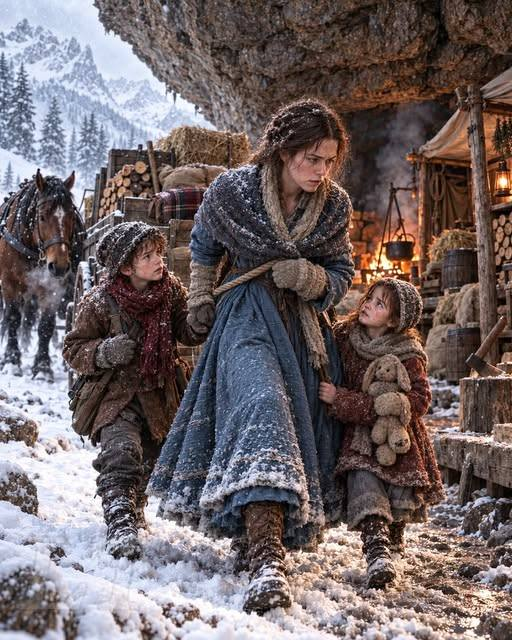
"Your uncle sent me."
The stranger's words hung in the freezing air.
Ruth stood between him and her younger siblings, gripping her father's hammer.
The man was tall and broad-shouldered, wearing a dark wool coat covered in snow. A black scarf concealed the lower half of his face. His boots were expensive, unlike those worn by the miners and freight workers Ruth remembered from Leadville.
He held a folded document in one gloved hand.
A familiar signature appeared at the bottom.
Thomas Calder.
Ruth's stomach tightened.
"Who are you?"
The stranger lowered his hand slightly.
"My name is Silas Whitcomb. I work for your uncle."
"What kind of work?"
"Business matters."
"Then you can take your business back to him."
Silas glanced past her toward the cave.
"I was instructed to deliver something."
"I don't want anything from Amos."
"This concerns your father's estate."
Ruth tightened her grip on the hammer.
"My father's estate belongs to his children."
Silas gave a small, humorless smile.
"That is precisely what your uncle disputes."
Behind Ruth, Eli pulled June closer.
The little girl was trembling.
Boon remained on the ground beneath the overhang, breathing heavily.
Ruth glanced at the horse before looking back at the stranger.
"You've frightened my brother and sister. Say what you came to say."
Silas unfolded the document.
"The property transfer was completed several months ago. Your uncle has been patient, but he wants the remaining matters settled."
"What matters?"
"Certain personal belongings. Records. Equipment. Anything that may have been removed from the house."
Ruth remembered the brass key.
The locked desk.
The papers Amos had shown her.
And the strange note she had found inside her father's toolbox.
DO NOT OPEN THE LOWER DOOR WITHOUT THE BRASS KEY.
She felt her fingers tighten around the hammer.
"What belongings?"
Silas studied her face.
"Your father kept several business records. Your uncle believes you may have taken them."
"I took blankets, food, and clothes."
"Did you take anything else?"
"No."
It was a lie.
She had taken the old receipt.
She had kept the compass.
And she now possessed the small brass key hidden inside it.
But none of those things belonged to Amos.
Silas stepped closer.
Ruth raised the hammer.
"Don't."
He stopped.
For a moment, the two stared at each other.
Then Silas looked toward Eli.
"You're the boy?"
Eli didn't answer.
"And the little girl?"
June buried her face against her brother's coat.
Silas sighed.
"Your uncle has offered to arrange suitable accommodation for the children."
Ruth stared at him.
"What?"
"He says the mountain is no place for young children. There are families in town who can provide proper care."
Ruth felt something cold settle inside her.
"Separate families?"
Silas didn't answer.
She understood.
Amos didn't want the children returning home.
He wanted them removed from her protection.
Perhaps permanently.
"No."
"You haven't heard the proposal."
"I heard enough."
"Your uncle is prepared to pay for their care."
"They are not for sale."
Silas folded the document.
"You're making this more difficult than necessary."
Ruth stepped closer.
"Then leave."
For several seconds, Silas appeared to consider arguing.
Instead, he placed the document on the snow-covered wagon.
"Read it carefully. It contains information you may find useful."
He turned toward the trees.
Ruth watched him walk away.
She didn't lower the hammer until his figure disappeared between the pines.
Eli waited until the stranger was gone.
Then he looked at his sister.
"Was he going to take us?"
Ruth placed the hammer against the wagon.
"No."
"But he said Uncle Amos wanted—"
"I know what he said."
Eli looked toward the trees.
"Can he come back?"
"Possibly."
The boy swallowed.
"Then what do we do?"
Ruth picked up the document.
"We stay together."
She unfolded it.
The paper was thick and official-looking.
Several paragraphs described the transfer of property from Thomas Calder to Amos Calder.
The house.
The stable.
The wagon.
Various tools and personal possessions.
At the bottom was her father's signature.
Thomas Calder.
Ruth stared at it.
The signature looked real.
The letters were shaped correctly.
The final stroke extended beneath the surname.
But something bothered her.
Her father had always written his full name with a small flourish beneath the C.
This signature lacked it.
She examined the date.
March 21, 1898.
Her father had died in April.
That meant the document had supposedly been signed only a few weeks before his accident.
Ruth folded it.
She needed to compare it with the receipt in her pocket.
"Come inside," she told the children.
Eli looked toward Boon.
"What about him?"
"We'll bring him more hay."
Ruth walked to the horse and knelt beside his head.
The animal opened one eye.
She stroked his muzzle.
"Come on, old friend. We aren't finished yet."
She didn't know whether he understood.
But she wasn't ready to lose him.
Inside the cave, June sat beside the fire.
Eli brought the remaining hay into the sheltered area.
Ruth placed the document on a crate.
She took out the old receipt she had found near her father's desk.
The paper was worn, but the signature was clear.
She placed it beside the transfer document.
Then she compared the handwriting.
The differences were subtle.
The first letters matched.
The spacing was almost identical.
But the signature on the transfer paper was too neat.
Her father had a slight tremor in his right hand after long days of work.
His signatures often showed it.
This one looked as though someone had copied it slowly.
Ruth leaned closer.
There was another problem.
The date.
March 21.
She remembered that day.
Her father had been away from Leadville.
He had left before sunrise with a freight wagon and returned three days later.
He had told her he was carrying equipment to a mining settlement.
Could he have signed the document before leaving?
Perhaps.
But why hadn't he mentioned the debt?
Why hadn't he told their mother?
Ruth rubbed her forehead.
She needed more evidence.
A single suspicious signature wouldn't be enough to challenge a legal transfer.
And Amos knew it.
That evening, Ruth prepared a small meal.
She divided the remaining potatoes and added a little bacon.
Eli ate slowly.
June barely touched her food.
"Are you sick?" Ruth asked.
June shook her head.
"Is the man coming back?"
Ruth looked at her sister.
"I don't know."
"Will Uncle Amos come too?"
Ruth put down her spoon.
"Why are you asking?"
June looked at her rabbit.
"Because he was mean to Mama."
Ruth went still.
"What did you say?"
June lifted her eyes.
"Before Mama died. Uncle Amos came to see her."
Ruth tried to remember.
Her mother had been ill for weeks.
Amos had visited several times, usually staying in the kitchen with Thomas.
But June had been younger.
She might have remembered something Ruth had forgotten.
"What did he do?"
June twisted the rabbit's blue-threaded ear.
"He made Mama cry."
Ruth leaned closer.
"Do you remember why?"
June shook her head.
"He said Papa had taken something. Mama told him to leave."
Ruth felt her heartbeat quicken.
"Did she say what Papa had taken?"
June shook her head again.
"He was holding a paper."
Ruth looked toward Eli.
He had stopped eating.
"Do you remember this too?" she asked him.
Eli nodded slowly.
"I remember Uncle Amos shouting in the kitchen."
Ruth felt her stomach tighten.
"What did he say?"
Eli looked at the fire.
"Something about a mine."
A mine.
Ruth repeated the word silently.
Her father had worked with freight companies, miners, and equipment suppliers.
He knew several men who owned claims in the surrounding mountains.
But Ruth had never heard of him owning a mine.
"Did Papa say anything?"
Eli shook his head.
"Not that I remember."
Ruth looked toward the hidden passage.
The sealed wall.
The tin box.
The locked lower door.
Her father had hidden something in this mountain.
Could it be connected to the mine Eli remembered?
She didn't know.
But she was beginning to understand that Amos's interest in the family home might have had nothing to do with money.
Later that night, Ruth examined the document again.
She placed it beneath the lantern and looked at the seal.
The paper bore the stamp of a local legal office.
A small embossed circle.
Inside it were the initials W.B.
Ruth recognized the name.
William Barlow.
He had been a lawyer in Leadville for years.
Her father had once consulted him about a freight contract.
If the document was genuine, Barlow might be able to confirm it.
If it was false, he might also know.
But getting to town would be dangerous.
The road was buried.
Boon could barely stand.
And Amos might be watching.
Ruth folded the paper and placed it inside her coat.
Then she remembered the note from the toolbox.
DO NOT OPEN THE LOWER DOOR WITHOUT THE BRASS KEY.
She removed the compass.
The tiny compartment was still open.
The key lay inside.
She turned it over.
The number 17 was visible near its handle.
Her father had used it for something.
Perhaps the lower door.
Perhaps something else.
Ruth approached the concealed passage.
The opening was still slightly ajar.
She entered with the lantern.
The first tin box remained on the shelf.
The larger wooden door stood at the back.
She examined the lock.
The keyhole was empty.
The brass key fit.
She knew that much.
But she had no idea what would happen when she turned it fully.
She looked at the floor.
A narrow metal track ran beneath the door.
Something heavy had once moved along it.
Perhaps a storage cabinet.
Perhaps a hidden compartment.
She bent down and brushed away the dust.
A small metal plate appeared.
It was engraved with the same initials.
T.C.
Beneath them was another number.
Ruth slowly stood.
The number was not accidental.
Her father had marked this place deliberately.
She returned to the tin box.
Perhaps it contained instructions.
She opened the latch.
Inside were several folded papers, a small photograph, and a brass token.
Ruth lifted the photograph.
It showed her father standing beside another man.
They were both younger.
Behind them stood a wooden structure surrounded by trees.
Ruth recognized the limestone ridge.
It was the mountain above Half Moon Creek.
She turned the photograph over.
A date was written on the back.
September 1891.
And beneath it were two names.
THOMAS CALDER.
AMOS CALDER.
Ruth stared.
Her uncle had been here.
Not recently.
Not by accident.
He had stood beside her father in this very place seven years earlier.
The following morning, the storm eased.
Ruth decided to inspect the area around the cave.
She needed firewood, and the children needed fresh air.
She tied the safety rope to the entrance.
Eli insisted on accompanying her.
June stayed with Boon.
They walked along the rocky slope, searching for dead branches.
The snow was deep, but several fallen trees lay beneath the pine canopy.
Ruth broke off dry limbs.
Eli gathered smaller pieces.
After several minutes, he stopped.
"Ruth."
She turned.
"What is it?"
He pointed toward the ground.
A line of footprints crossed the snow.
They were fresh.
Ruth crouched.
The prints were larger than hers.
Heavy boots.
The same pattern she had seen near the wagon.
Someone had returned.
She followed the tracks with her eyes.
They led toward a narrow section of forest above the cave.
Then they disappeared behind a group of trees.
Ruth stood.
"Let's go back."
Eli looked frightened.
"Was it the man?"
"I don't know."
"Could it be Uncle Amos?"
Ruth didn't answer.
They gathered the wood and returned quickly.
When they reached the cave, June was standing beside Boon.
Her face was pale.
"Ruth!"
"What happened?"
June pointed toward the entrance.
"Someone left something."
A small wooden package lay on the ground.
It was wrapped in brown paper.
A piece of red string held it together.
Ruth looked around.
No one was visible.
She approached cautiously.
The package was small enough to fit in one hand.
There was no address.
No name.
Only a single sentence written across the paper.
FOR THOMAS CALDER'S CHILDREN.
Ruth felt her throat tighten.
She picked it up.
The red string was tied in a complicated knot.
She carefully loosened it.
Inside was a folded piece of cloth.
And beneath it, a small metal object.
A pocket watch.
Her father's pocket watch.
Ruth recognized the crack across its glass.
She had seen it many times.
Thomas had worn it on a chain beneath his waistcoat.
It had disappeared after his funeral.
She lifted it.
The watch was stopped.
Its hands showed 8:17.
Eli approached.
"That's Papa's."
Ruth nodded.
She opened the back cover.
A small piece of paper had been folded inside.
She pulled it free.
The handwriting was unmistakable.
Her father's.
Only one sentence had been written.
IF AMOS HAS FOUND THE CAVE, THE CHILDREN ARE ALREADY IN DANGER.
Ruth's fingers went numb.
She read the sentence again.
Then she looked toward the forest.
Someone had known where they were.
Someone had known their father's secret.
And someone had delivered his watch without leaving a name.
That afternoon, Ruth decided they could no longer remain unaware of what was happening.
She needed to understand the hidden room.
She needed to know what her father had left behind.
And she needed to determine whether Amos had been telling the truth about the debt.
She brought the brass key into the passage.
Eli followed.
June remained near the fireplace.
Ruth inserted the key into the lower door.
This time, she turned it all the way.
A heavy mechanism clicked.
Then another.
The lock released.
She placed her hand against the wood.
The door did not move.
Ruth examined the metal lever beside the frame.
It had been pushed upward.
She tried pulling it down.
Nothing.
Then she noticed a small notch beneath the handle.
She inserted the edge of the brass key.
A second click sounded.
The door shifted.
A thin line of darkness appeared.
Ruth stepped back.
Eli held his breath.
The door began to open.
Behind it was not another empty storage room.
There was a narrow stone staircase descending into the mountain.
A cold current of air rose from below.
Ruth lifted the lantern.
The first three steps were visible.
Then darkness.
On the wall beside the staircase, someone had carved a warning.
Ruth recognized her father's handwriting.
She moved closer.
The words were simple.
DO NOT TRUST THE MAN WHO BRINGS THE DEED.
Ruth felt her blood run cold.
She turned toward Eli.
Before she could speak, a voice came from the cave entrance.
"Miss Calder?"
She spun around.
Silas Whitcomb stood beneath the limestone overhang.
But this time, he wasn't alone.
Behind him stood a second man.
And the second man was holding Amos Calder's brass desk key.






Comments 0