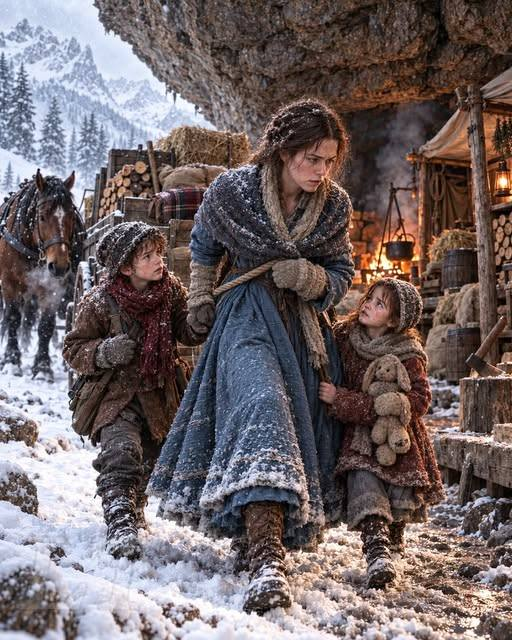
The third knock came from somewhere deep inside the mountain.
Ruth raised the lantern.
Eli grabbed her sleeve.
"There's someone in there."
"Stay behind me."
"But what if—"
"Behind me, Eli."
Her voice was quiet, but something in it made him obey.
Ruth stepped over a fallen timber and entered the cave.
The lantern cast a trembling circle of yellow light across the limestone walls. Water dripped somewhere in the darkness. The air smelled of wet stone, old wood, and something faintly metallic.
She took another step.
Nothing moved.
"Hello?"
Her voice echoed through the cave.
No answer.
She turned the lantern toward the left wall.
A few broken branches lay beneath a natural ledge. An old cooking pot rested upside down near the entrance. Someone had once arranged several flat stones into a crude fireplace, but the structure had collapsed.
Ruth moved closer.
There were no fresh footprints.
No discarded food.
No signs of recent occupation.
She exhaled slowly.
Perhaps the noises had come from the old wooden supports.
The temperature was dropping. Wood contracted in severe cold, and the rotten beams might have shifted under the weight of the snow above them.
It was a reasonable explanation.
She wanted to believe it.
Behind her, Eli called softly.
"Did you find anybody?"
"No."
"Then what made the noise?"
"The wood, probably."
He didn't look convinced.
Ruth turned toward him.
"Bring the blankets. We need to get settled before dark."
Eli nodded and hurried outside.
June was still sitting in the wagon, clutching her rabbit. Her cheeks were red from the cold, and her lips trembled.
Ruth approached and lifted her into her arms.
"Let's get you somewhere warmer."
June looked over her shoulder at the cave.
"Is it scary?"
Ruth glanced toward the darkness.
"Only until we make it ours."
The first problem was the entrance.
The natural limestone overhang protected most of the cave from direct snowfall, but the opening was partially blocked by fallen timber and broken branches.
A large support beam leaned diagonally against the entrance.
Ruth examined it.
The timber was rotten near the bottom. Its surface crumbled beneath her glove.
She couldn't simply pull it away. If the beam supported the weight of the rock above, moving it carelessly could bring part of the entrance down.
Her father had taught her enough about building repairs to understand the danger.
He had once spent an entire afternoon showing her how to distinguish a supporting beam from an ordinary wall brace.
She wished she had paid closer attention.
"Can I help?" Eli asked.
Ruth looked at him.
"Find the strongest pieces of wood in the wagon. We'll need them to support the opening."
He hurried away.
She placed June near the back of the entrance, where the ground was relatively dry.
"Stay here with the blankets. Don't go near the horses."
June nodded.
Ruth began removing smaller branches.
One by one, she carried them outside and placed them beside the wagon.
Then she dragged a broken plank away from the opening.
It made a scraping noise against the stone.
As the plank moved, Ruth noticed something unusual.
The rock beneath it was smooth.
Not naturally smooth.
Someone had worked on it with tools.
She knelt and brushed away the snow.
A shallow rectangular groove ran along the stone's surface.
It disappeared beneath a layer of dirt and frozen debris.
Ruth traced it with her fingers.
Perhaps it had once held a wooden threshold.
Or perhaps it was simply an old mark left by someone who had used the cave as a shelter.
She had no time to investigate.
Eli returned carrying two thick pieces of timber.
"These are from the wagon."
"Good. Put them here."
Together, they moved the first piece toward the entrance.
Ruth positioned it beneath the leaning beam.
Eli pushed from the opposite side.
"Harder," she instructed.
The timber slid into place.
For a moment, the entire structure creaked.
June covered her ears.
Ruth froze.
A small shower of dust fell from the limestone ceiling.
Then everything stopped.
"That's enough," she said.
They backed away.
The new support held.
It wasn't beautiful, and it certainly wasn't permanent, but it made the entrance safer than before.
Ruth inspected the remaining beams.
Two more needed reinforcement.
She looked toward the wagon.
There wasn't enough wood to replace all of them.
She would have to make do with what they had.
By the time the entrance was cleared, the light outside had begun to fade.
Ruth returned to the wagon.
Boon stood with his head lowered.
Snow had gathered along his back.
She approached slowly and rubbed his neck.
"Just a little longer, old man."
The horse shifted his weight.
Ruth examined his legs.
His left hind leg was stiff again.
She checked the harness and loosened the straps.
Then she brought a bundle of hay from the wagon.
Boon began eating.
Eli watched.
"Will he be all right?"
"He needs rest."
"How much?"
Ruth looked at the horse's thin sides.
"As much as we can give him."
"But we don't have much hay."
"I know."
Eli lowered his eyes.
Ruth crouched in front of him.
"Listen. We're going to ration everything. Food, firewood, hay. We cannot waste anything."
He nodded.
"How long do you think we'll stay here?"
"Until the roads become safe."
"And when will that happen?"
Ruth looked toward the mountains.
She didn't know.
Perhaps in spring.
Perhaps later.
"One day at a time," she answered.
Eli seemed disappointed, but he didn't ask again.
He went to help unload the remaining supplies.
Ruth took a moment to look at the sky.
The snowfall had become heavier.
The mountains were disappearing behind a curtain of white.
She knew they had made the right decision by stopping.
Traveling farther in the dark would have been dangerous.
But knowing they had nowhere else to go made the cave feel smaller than it really was.
They arranged their sleeping area near the back wall.
Ruth spread the thickest blanket across the driest patch of ground.
June sat on it and carefully placed her stuffed rabbit beside her.
Eli stacked the food sacks against a raised section of stone.
Ruth positioned the cooking pot near the entrance.
They had no proper bed.
No table.
No chairs.
Their only furniture consisted of two wooden crates and an old wagon cushion.
Still, they had shelter.
That was something.
Ruth collected several dry branches from beneath the limestone overhang.
She examined each piece carefully.
The outer surfaces were damp, but some of the inner wood remained dry.
She broke the branches into smaller pieces.
Eli helped arrange the stones for a fireplace.
They had built fires together before.
Their mother had taught them to prepare kindling, while their father had shown them how to keep a flame alive during long journeys.
But this was different.
The cave was enclosed.
The entrance was narrow.
The ceiling was uneven.
And the wind outside was beginning to howl.
Ruth placed the smallest pieces of wood between the stones.
She struck a match.
The flame caught.
For a moment, everyone watched it.
June moved closer.
"Is it working?"
"Yes."
The little girl held out her hands.
The warmth was weak, but it was something.
Ruth added another piece of wood.
The flame grew.
Eli smiled.
"We have a fire."
Ruth smiled faintly in return.
"Now we need to keep it."
Dinner consisted of boiled potatoes and a little dried bacon.
Ruth sliced the potatoes into a cooking pot.
She added water from their supply and placed it over the fire.
Eli sat beside June.
He tried to tell her a story about a freight driver who had once fallen into a muddy ditch.
June listened quietly.
When the food was ready, Ruth divided it into three portions.
She gave June the largest.
Eli noticed.
"Why does she get more?"
"Because she's younger."
"But you need food too."
"I ate while cooking."
He looked at her suspiciously.
Ruth handed him his bowl.
"Eat."
He did.
June held her spoon with both hands.
"Can we have bread tomorrow?"
Ruth looked at the flour sack.
"Perhaps."
"With butter?"
"We don't have butter."
June nodded.
She didn't complain.
That somehow made Ruth feel worse.
The little girl had stopped asking for things because she was beginning to understand that the answer was usually no.
After dinner, Ruth checked the remaining food.
Two sacks of flour.
A small quantity of dried beans.
Several potatoes.
Some bacon.
Salt.
A little coffee.
She made a list in her father's old notebook.
Then she calculated how many days the supplies might last.
The answer frightened her.
If they ate normally, perhaps two weeks.
If they rationed carefully, longer.
But the winter could last for months.
Ruth closed the notebook.
She would have to find more food.
Perhaps there were rabbits in the forest.
Perhaps someone had left hunting traps nearby.
Perhaps the road would become passable before their supplies ran out.
She refused to consider the alternative.
Night arrived quickly.
The fire cast long shadows across the cave.
Wind pushed snow against the entrance.
Occasionally, a branch struck the outer timber supports.
June curled beneath the blankets.
Eli sat beside the fire, trying to repair a tear in his glove.
Ruth examined the cave.
The ceiling was higher than she had remembered.
In some places, it rose nearly twenty feet above the floor.
A narrow opening ran along the upper rock formation, but she couldn't tell whether it connected to the outside.
She raised the lantern.
The opening disappeared into darkness.
"Ruth?"
She lowered the lantern.
"Yes?"
Eli looked toward the ceiling.
"Do you think the mountain could fall on us?"
Ruth considered her answer.
"The rocks have been here for a very long time."
"That doesn't mean they'll stay."
She almost laughed.
Her brother had become too observant for his own good.
"That's why we strengthened the entrance."
Eli looked at the wooden supports.
"Do you think Papa would have known what to do?"
Ruth sat beside him.
"Papa knew a lot about mountains."
"More than you?"
"Much more."
Eli stared into the fire.
"I wish he were here."
Ruth felt her throat tighten.
"So do I."
He rubbed his nose with the back of his sleeve.
"Do you think he would be proud of us?"
Ruth looked at the supplies, the blankets, the little fire, and the broken wagon visible through the entrance.
She thought about their father teaching her how to repair a wheel.
How he had lifted Eli onto his shoulders.
How he had carried June through the snow when she was too tired to walk.
Then she looked at her brother.
"I think he would be proud of you for helping."
Eli looked away.
His eyes were wet.
Ruth put an arm around him.
For several minutes, neither spoke.
Later, when the children were asleep, Ruth walked toward the entrance.
She needed to check the horse.
Boon was standing beneath the overhang.
The wagon canvas fluttered in the wind.
Ruth placed a fresh bundle of hay near his feet.
Then she inspected the ropes securing the wagon.
One had loosened.
She tightened it.
As she worked, she noticed something beneath the wagon bed.
A small wooden box was wedged between the frame and the axle.
She crouched.
It was one of her father's old toolboxes.
She recognized the faded initials burned into the lid.
T.C.
Her father had used it for carrying nails, small chisels, and metal fittings.
Ruth pulled it free.
The lid was swollen from moisture, and one hinge had nearly broken.
She opened it carefully.
Inside were several rusty nails, a short length of rope, two metal brackets, and an old hammer.
Beneath the tools lay a folded piece of cloth.
Ruth lifted it.
A small object fell into her palm.
It was a brass compass.
She recognized it immediately.
Her father had carried it during his freight journeys.
But she remembered something else.
He had once told her that the compass was unreliable.
The needle sometimes pointed slightly east of north.
He had laughed about it, saying that even a broken compass could be useful if a person understood its mistakes.
Ruth turned it over.
There was a small engraving on the back.
A single letter.
H.
She rubbed the brass with her thumb.
The letter looked older than the scratches around it.
She had never noticed it before.
Perhaps it had belonged to someone else.
She placed the compass in her coat pocket.
Then she carried the toolbox inside.
She would need the hammer and brackets.
When Ruth returned to the fire, June was awake.
The child sat beneath the blanket, watching her.
"Why aren't you sleeping?"
June shook her head.
"I heard something."
Ruth stopped.
"What did you hear?"
"A scratching sound."
"Where?"
June pointed toward the rear wall.
Ruth turned.
The firelight barely reached that section of the cave.
"What kind of scratching?"
"Like someone moving a chair."
Ruth listened.
Nothing.
She approached the wall.
The limestone was uneven and covered in patches of dark mineral stains.
A few stones had fallen near the base.
She touched the surface.
Cold.
Completely still.
"Maybe a small animal," she said.
June shook her head.
"It was too loud."
Ruth raised the lantern.
"Did you see anything?"
"No."
"Then it may have been the wind."
June looked at her.
"Can the wind scratch rocks?"
Ruth paused.
"Sometimes it moves things against them."
June seemed unconvinced.
Ruth tucked the blanket around her shoulders.
"Try to sleep. I'll stay awake a little longer."
June lay down.
Ruth remained beside her until her breathing became steady.
Then she turned toward the rear of the cave again.
She noticed a dark line between two sections of limestone.
It was almost invisible.
She moved closer.
The line ran vertically for several feet.
Ruth touched it with her fingertips.
A small amount of dust came away.
She raised the lantern.
The stones appeared unusually flat.
Unlike the surrounding natural rock, they had been shaped.
She looked at the ground.
Several pieces of mortar lay scattered beneath the wall.
Ruth picked one up.
It crumbled between her fingers.
Someone had built something here.
She was certain of it now.
But why?
A sudden gust of wind rushed through the cave.
The fire bent sideways.
Ruth turned.
A faint draft moved across her face.
She looked toward the entrance.
The outer supports were holding.
The blankets remained in place.
Nothing appeared disturbed.
Then the draft came again.
This time, it seemed to come from behind her.
Ruth turned slowly.
She raised the lantern toward the dark wall.
The flame leaned toward the narrow vertical line.
She brought her hand closer.
Cold air brushed her fingers.
There was a gap.
A hidden opening.
Ruth stepped backward.
She looked toward the sleeping children.
Eli had rolled onto his side.
June was clutching her rabbit.
Neither had noticed.
Ruth returned to the wall.
She pressed gently against one of the stones.
It didn't move.
She tried another.
Nothing.
Then she noticed a small indentation near the bottom.
It was circular.
Perhaps a place for a tool.
Perhaps a hole left by an old wooden peg.
She couldn't tell.
She wanted to investigate immediately.
But the light was fading, and the children needed rest.
Ruth decided to wait until morning.
She returned to the fire and added one small piece of wood.
The flames rose briefly.
Then she heard it.
Knock.
A single, deliberate sound.
Ruth turned.
Knock.
It came again.
Not from the entrance.
Not from the ceiling.
From behind the sealed stone wall.
She stood slowly.
Her hand tightened around the lantern handle.
Then a third knock sounded.
Three evenly spaced strikes.
Ruth stared into the darkness.
Her father's old brass compass shifted inside her coat as she moved.
She reached into her pocket and pulled it out.
The needle trembled.
Then it turned.
Not toward the north.
Not toward the entrance.
It pointed directly at the sealed wall.
Ruth stopped breathing.
She brought the compass closer to the stone.
The needle remained fixed.
And then, from somewhere behind the wall, a man's voice whispered her name.
"Ruth..."
She dropped the lantern.






Comments 0