"Caroline Mercer."
The detective spoke the name clearly.
Nobody moved.
For a moment, I thought I had misunderstood him.
Caroline stood beside Chester Alderman, her hands resting on the conference table. She had spent the entire day helping us preserve evidence, questioning suspicious documents, and explaining why the Apex Ridge transaction could not proceed without proper consent.
Now a police detective was asking her to step forward.
The detective looked at his notebook.
"Ms. Mercer, we'd like to speak with you about a letter recovered from Dwight Malone's storage unit."
Caroline stared at him.
"Me?"
"Yes, ma'am."
She looked toward the evidence bag.
Inside was the sealed packet marked with my wife's name.
SUSAN DOSS — ORIGINAL STATEMENT.
I felt my chest tighten.
"Why is Caroline's name in Susan's letter?"
The detective turned toward me.
"Mr. Doss, I'm Detective Nathan Cole. This is Detective Sarah Mitchell. We're investigating allegations involving unauthorized access to corporate records, possible document falsification, and related activity."
I nodded.
He continued.
"The letter appears to identify Ms. Mercer as someone who received information about the disputed ownership records."
I looked at Caroline.
She had gone pale.
"Caroline?"
She swallowed.
"Raymond, I can explain."
Those words were becoming the most frightening words in my life.
Everyone could explain.
Eventually.
After another document appeared.
After another person arrived.
After another piece of my family's history had been pulled out of a locked drawer.
I looked at her.
"Then explain."
She glanced toward the detectives.
"I'd prefer to review the letter with counsel present."
Detective Cole nodded.
"That's your right. We're asking for a voluntary interview."
Caroline looked at me.
"I'm not refusing to tell you the truth."
I didn't answer.
She continued.
"But I need to be certain we're talking about the same document."
I stared at her.
"You knew Susan."
"Yes."
"You knew she objected to the ownership schedule."
"Yes."
"You knew Walter preserved records."
"Yes."
"And now your name is in a statement that someone kept hidden in Dwight's storage unit."
Her eyes filled with tears.
"Raymond, there's a reason."
I looked down at the table.
"There's always a reason."
Detective Mitchell asked everyone to remain available while the letter was documented.
The detectives had obtained the packet during the storage-unit investigation and were reviewing whether it contained evidence relevant to suspected document tampering.
They did not read the entire statement aloud.
Instead, Detective Cole explained that Susan had addressed part of it to Caroline, who had been a junior legal researcher at the time.
Caroline requested counsel.
Nobody objected.
I watched her step into the hallway with her phone.
I didn't know whether to feel betrayed.
I didn't even know what she had done.
But I knew something had changed.
For two days, Caroline had seemed like one of the few people willing to confront the truth.
Now I had to consider the possibility that she had been carrying part of it all along.
Andrew sat beside me.
He looked exhausted.
Claire sat across the table with her attorney, Rebecca Sloan.
I glanced at Claire.
She was studying the photograph of Susan that she kept on her phone.
I wondered what it felt like to spend your entire life searching for your mother, only to discover that her name was connected to a corporate dispute worth hundreds of millions of dollars.
Then I realized I didn't have to wonder very hard.
I was experiencing the same thing from the other direction.
I had known Susan for more than twenty years.
I had married her.
Raised children with her.
Held her hand through chemotherapy.
Buried her.
And now I was discovering that people I had never met knew parts of her life she had never shared with me.
I looked toward the empty chair where Caroline had been sitting.
I wanted to trust her.
But trust was no longer something I could give simply because someone spoke gently.
I needed evidence.
At 12:31 a.m., Chester's phone rang.
He looked at the screen.
Then stood.
"It's Patricia Voss."
Daniel Price looked up.
"At this hour?"
Chester nodded.
"That can't be good."
He answered.
"Patricia."
Her voice came through clearly.
"Chester, we have a serious problem."
He closed his eyes.
"What happened?"
"Our board has received information concerning the Apex Ridge ownership restrictions."
Chester looked toward Daniel.
"What information?"
"A copy of the original Schedule R-14 language. A summary of the unresolved beneficial interest. And an allegation that Meridian knowingly concealed the restriction."
The room went silent.
I felt my stomach tighten.
"Who sent it?" Chester asked.
"We don't know."
"Was it anonymous?"
"Yes."
Patricia continued.
"The message also included photographs of the destroyed binder."
I stared at the table.
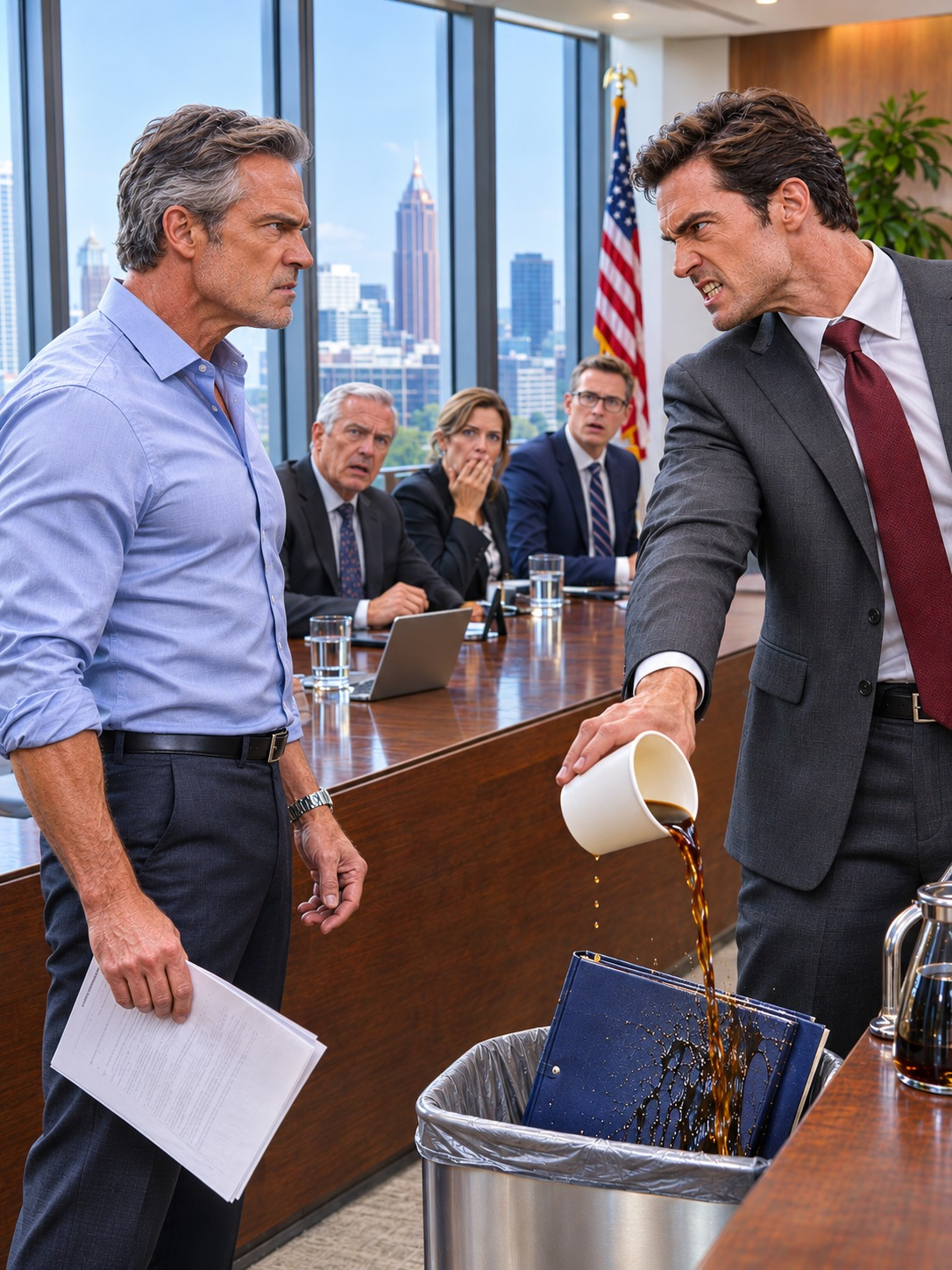
The photographs.
Dwight kicking the recycling bin.
Coffee spilling over the original documents.
My termination.
Someone had been collecting evidence.
And now that evidence was being used to threaten the transaction.
Chester spoke carefully.
"Patricia, we're conducting a formal investigation."
"I understand."
"We've preserved the relevant records."
"I appreciate that."
"But?"
Patricia exhaled.
"But Kellerman's investment committee has suspended approval."
Chester closed his eyes.
For several seconds, nobody spoke.
Then he asked, "Suspended pending clarification?"
"At minimum."
"What's the board's concern?"
"That Meridian may not possess the unrestricted rights it represented."
Chester nodded slowly.
"That's exactly what we're reviewing."
Patricia's voice hardened.
"Chester, this isn't a minor documentation issue. Our company was prepared to pay $285 million for a portfolio of licensing rights. If those rights are subject to an undisclosed third-party interest, the valuation may be wrong."
I looked at Daniel.
He was writing quickly.
Patricia continued.
"And if Meridian knew about the restriction before signing the purchase agreement, we may have contractual remedies."
Chester stared at the wall.
"I understand."
"We need a complete explanation."
"You'll get one."
"Not next week."
"I know."
"By nine tomorrow morning."
Chester looked at the clock.
12:34 a.m.
Less than nine hours.
He took a breath.
"We'll provide what we can verify."
Patricia paused.
Then her voice softened slightly.
"Chester, I want this transaction to work."
"So do I."
"But I won't ask my board to approve a deal built on records nobody can trust."
The call ended.
Chester placed his phone on the table.
For a long moment, he said nothing.
Then he looked at me.
"Raymond, the deal is beginning to collapse."
I nodded.
"I know."
He looked down.
"And you warned us."
I didn't answer.
Because that was the part that hurt most.
Not that the deal was in danger.
Not that executives were frightened.
But that the problem had been visible.
Fourteen pages.
Three notices.
One preservation request.
And a director who believed throwing a binder into the trash could make a legal restriction disappear.
At 1:02 a.m., Daniel received an urgent message from Meridian's finance department.
He read it.
Then frowned.
"Chester, we have another issue."
Chester looked up.
"What?"
"The transaction financing is tied to a closing deadline."
"Yes."
"If we miss the deadline, Kellerman's financing commitment may require reapproval."
Chester rubbed his forehead.
"How much exposure?"
Daniel hesitated.
"Potentially significant. We need treasury to confirm the numbers."
I watched Chester.
He looked tired.
Older than he had that morning.
The polished confidence of a CEO had disappeared.
In its place was a man confronting the possibility that years of corporate decisions had been built on incomplete information.
I almost felt sorry for him.
Then I remembered standing in the boardroom while Dwight poured coffee over the binder.
I remembered Harold Finch looking away.
Elaine Porter saying nothing.
Martin Shaw pretending the problem was administrative.
I remembered being told to collect my belongings.
And I reminded myself that sympathy didn't erase responsibility.
Chester looked toward Daniel.
"Get the finance team on a call."
Daniel nodded.
Then Chester turned toward me.
"Raymond, I need you to help us reconstruct the original document trail."
I looked at him.
"Why me?"
"Because you understand the archive better than anyone else."
I thought about it.
For eleven years, that had been true.
But nobody had considered it particularly valuable.
Now the company needed the very knowledge it had dismissed.
"I'll help preserve and explain the records," I said.
Chester nodded.
"But I won't approve anything I haven't verified."
"Understood."
"And I won't sign a statement saying the original restrictions were irrelevant."
His expression tightened.
"I wouldn't ask you to."
I looked at him.
"Someone already did."
He lowered his eyes.
"I know."
At 1:19 a.m., Caroline returned with an attorney on the phone.
She had agreed to a limited voluntary interview with the detectives.
I remained in the conference room.
I didn't ask to attend.
I wanted to hear what she had to say.
But I also understood that the investigation needed to proceed properly.
A few minutes later, Detective Mitchell returned.
She looked at me.
"Mr. Doss, may we ask you some questions?"
"Of course."
She sat across from me.
"Did Susan ever mention Caroline Mercer?"
I shook my head.
"Not by name."
"Did she mention a legal researcher who helped her preserve records?"
I thought back.
Susan had occasionally spoken about people at Harrison & Vale.
A woman named Margaret.
A supervisor who was difficult.
Someone who had helped her review documents.
But I couldn't remember a name.
"Possibly," I said. "But I can't identify the person."
Detective Mitchell nodded.
"Did Susan ever tell you she believed someone had falsified a document?"
I looked down.
"She told me something at work didn't make sense."
"When?"
"October 2009."
"Did she explain?"
"No."
"Why not?"
I swallowed.
"She said she wasn't ready."
The detective wrote something down.
Then asked, "Did Susan ever express concern about your employment at Meridian?"
I nodded.
"Yes."
"When?"
"After she left Harrison & Vale."
"What did she say?"
I thought carefully.
"She asked whether I trusted my supervisors."
Detective Mitchell looked up.
"What did you tell her?"
"I said I trusted the company."
The words sounded foolish now.
But they had been true at the time.
I continued.
"She asked whether I would report something if I thought it was wrong."
"What did you say?"
"I told her I would."
The detective paused.
"And did you?"
I looked at her.
"Seventeen years later, I did."
She studied me.
Then nodded.
At 2:07 a.m., the detectives completed their initial interviews.
Caroline returned to the conference room.
She looked exhausted.
I stood.
"Caroline."
She stopped.
"Raymond."
I looked at her.
"Can we talk?"
She nodded.
"Yes."
We moved to a smaller meeting room.
The lights were dim.
A cleaning cart stood in the hallway.
Somewhere down the corridor, a vacuum cleaner hummed.
For a moment, it felt like an ordinary late night at work.
Then Caroline sat across from me.
"I owe you an explanation."
I nodded.
"Yes."
She took a breath.
"Susan came to me after Margaret Vale rejected her exception."
I listened.
"She was frightened. She believed someone had altered the ownership schedule and wanted her signature to make the revised version appear legitimate."
I nodded.
"That matches her letter."
"Yes."
Caroline continued.
"I helped her prepare a preservation statement."
My chest tightened.
"The one found in Dwight's storage unit?"
"Possibly. I haven't seen the complete original yet."
"Why was it addressed to you?"
"Because Susan wanted me to retain a copy."
I looked at her.
"Did you?"
Caroline lowered her eyes.
"Yes."
"Where is it?"
She hesitated.
"In a private archive."
I stared at her.
"You've had a copy all this time?"
"Yes."
I felt anger rise.
"Then why didn't you bring it yesterday?"
She looked ashamed.
"Because I didn't know whether the copy was complete."
I shook my head.
"Caroline, that's not enough."
"I know."
"You knew Susan had objected. You knew the ownership records were disputed. You knew Walter had tried to preserve the original documents."
She nodded.
"Yes."
"And you waited until my director destroyed the binder before you came forward."
Her eyes filled with tears.
"I didn't know the current transaction was proceeding until the preservation notice reached my client's office."
I leaned forward.
"But you knew the historical problem existed."
"Yes."
I sat back.
She continued.
"Raymond, I was twenty-six when Susan came to me. I was a junior researcher. I had no authority over the transaction. I helped her prepare the statement and gave her the contact information for Walter Hensley."
I listened.
"After she left Harrison & Vale, I tried to follow up. She told me she had preserved what she needed."
"Did she tell you about Claire?"
Caroline shook her head.
"No."
I studied her face.
"Are you sure?"
"Yes."
"Did you know about the adoption?"
"No."
I wanted to believe her.
But I had learned to separate what I wanted from what I could prove.
"Then why did Susan address the statement to you?"
Caroline took a breath.
"Because she trusted me to tell the truth if the documents were ever challenged."
I stared at her.
"Then why didn't you?"
She lowered her head.
"Because I was afraid of making an accusation I couldn't prove."
I looked away.
For a long time, neither of us spoke.
Then I said quietly, "Susan was afraid too."
Caroline nodded.
"I know."
"But she still signed the exception."
Caroline closed her eyes.
"Yes."
I stood.
"I need to see your copy."
She looked up.
"I'll arrange it."
"Not tomorrow."
She nodded.
"Tonight."
At 2:41 a.m., Caroline contacted her office.
A secure archive technician retrieved the preservation statement.
The document arrived electronically twenty minutes later.
Caroline opened it on her laptop.
I sat beside her.
The first page contained Susan's witness certification.
The second described the missing beneficial interest.
The third contained a handwritten note.
I recognized Susan's handwriting.
The ownership schedule has been altered. The original beneficiary designation must be preserved.
Below it was another sentence.
I believe the alteration was requested by someone with authority over the transaction committee.
I felt my chest tighten.
"Richard."
Caroline shook her head.
"Possibly. But Susan didn't name him here."
I nodded.
She was right.
We couldn't turn suspicion into proof simply because the pattern seemed obvious.
Caroline scrolled to the next page.
A list of document references appeared.
AR-LH-2009.
AR-14-C.
Apex Ridge Original Development Agreement.
Thomas Doss Settlement File.
And one additional reference.
MVG-BOARD-EX-17.
I leaned closer.
"What's that?"
Caroline frowned.
"I don't know."
I stared at the code.
It looked like an internal board exhibit reference.
I had spent eleven years handling Meridian records.
I knew the naming conventions.
MVG.
Meridian Ventures Group.
BOARD.
Board records.
EX.
Exhibit.
Seventeen.
I looked at Caroline.
"That's a board exhibit."
She nodded.
"Can we retrieve it?"
"Possibly."
I took out my phone and called Daniel.
He answered immediately.
"Raymond?"
"Can you search for MVG-BOARD-EX-17?"
A pause.
"Where did you get that?"
"From Susan's preservation statement."
Daniel went quiet.
Then he said, "Give me a moment."
I waited.
Caroline watched the screen.
A minute passed.
Then Daniel returned.
"Raymond, that reference exists."
My heart began pounding.
"Can you open it?"
"No."
"Why?"
"It's marked as a restricted historical board exhibit."
"Who restricted it?"
Daniel hesitated.
"The board chairman's office."
Richard Alderman.
Again.
I closed my eyes.
"Can legal request access?"
"Yes. But there's a problem."
"What?"
"The exhibit was moved to an off-system archive."
I frowned.
"Where?"
Daniel paused.
"According to the index, it was transferred to a private records custodian."
"Who?"
He swallowed.
"Harrison & Vale."
I looked at Caroline.
Her face had gone pale.
"Caroline?"
She stared at the screen.
"I've never seen that reference before."
I believed she was surprised.
But I didn't know whether surprise meant innocence.
At 3:18 a.m., Chester convened an emergency call with Meridian's outside counsel, treasury director, and two independent board members.
I was not included.
That was appropriate.
I wasn't an executive.
I wasn't a lawyer.
I was a licensing coordinator who had found fourteen missing pages.
But twenty minutes later, Chester asked me to join.
I entered the conference room.
A large screen displayed several tired faces.
Chester introduced me.
"This is Raymond Doss. He identified the missing Schedule R-14 pages and submitted the preservation notices."
One of the board members, a woman named Judith Ellis, looked directly at me.
"Mr. Doss, thank you for coming."
I nodded.
"Of course."
She continued.
"Can you explain why the original pages were important?"
I took a breath.
"Because they restricted the transfer of certain licensing rights without written consent from the original rights holder or the legally authorized successor."
She nodded.
"Was that restriction disclosed in the closing binder?"
"No."
"Did you report the omission?"
"Three times."
"To whom?"
"Through the compliance system."
"Who rejected the notices?"
"Dwight Malone's office."
"Did you attempt to preserve the original records?"
"Yes."
"What happened?"
"The preservation hold was denied."
Judith looked toward Chester.
"And then?"
I looked down.
"Mr. Malone destroyed the original binder in the boardroom and terminated my employment."
Silence.
One of the attorneys leaned forward.
"Mr. Doss, are you certain the binder contained original documents?"
"Yes."
"How?"
"Because I handled the chain-of-custody record and verified the original classification markings."
"Did you retain copies?"
"I retained only records I was authorized to access and the incident report number. I did not remove company originals."
Judith nodded.
"Thank you."
Then she asked something I hadn't expected.
"Mr. Doss, in your professional opinion, was the omission accidental?"
I thought carefully.
"I can't determine intent."
She waited.
"But the restriction was referenced in the archive index. The original pages were preserved separately. The supporting attachment was accessed before my preservation request was denied. And the destruction authorization included the archive folder reference."
I paused.
"Those facts deserve investigation."
Judith looked at Chester.
"Agreed."
For the first time in eleven years, a board member had listened to my explanation without interrupting.
I should have felt satisfied.
Instead, I felt tired.
Because it had taken a collapsing $285 million transaction for anyone to ask.
At 4:06 a.m., the finance team delivered its preliminary exposure analysis.
Chester read the figures.
His expression darkened.
The immediate risk was not simply losing the sale price.
Meridian had already incurred substantial transaction expenses.
Outside counsel fees.
Advisory costs.
Financing arrangements.
Operational commitments based on the expected closing.
If Kellerman withdrew, Meridian could face additional costs and disputes over the representations made during negotiations.
But the larger concern was the value of the underlying portfolio.
If Meridian lacked unrestricted ownership, the company might need to revise its financial statements and reassess the value of the licensing assets.
Chester looked toward Daniel.
"How bad could this get?"
Daniel hesitated.
"We don't know yet."
"Give me the range."
"Without verified ownership, any valuation would be speculative."
Chester rubbed his forehead.
"That's not an answer."
"It's the only responsible answer."
I watched them.
For years, executives had treated licensing records as administrative details.
Now the entire financial value of the transaction depended on those details.
A missing schedule.
An unresolved consent requirement.
A beneficiary designation.
A disputed settlement.
And a signature someone had apparently tried to erase.
I looked at the clock.
4:12 a.m.
The city outside was dark.
Most people were asleep.
But inside Meridian, the consequences of seventeen years of silence were finally becoming impossible to ignore.
At 4:29 a.m., Angela entered the room.
She looked directly at Chester.
"We located Dwight Malone."
Chester stood.
"Where?"
"At a motel outside the city."
"Is he in custody?"
"Not at this time. Detectives have contacted him."
I leaned forward.
"Did he cooperate?"
Angela hesitated.
"He agreed to speak with them."
Caroline looked up.
"Did he say anything about the storage unit?"
Angela nodded.
"Yes."
"What?"
"He claims he was instructed to collect the documents."
I felt my chest tighten.
"By whom?"
Angela looked toward Chester.
"Someone from the board chairman's office."
Richard.
I looked down.
But Angela continued.
"There's something else."
Chester frowned.
"What?"
"Dwight says the destruction authorization wasn't his idea."
I almost laughed.
Of course it wasn't.
He had been arrogant enough to destroy the binder in front of witnesses.
But perhaps he had been following instructions.
Perhaps he believed someone more powerful would protect him.
Chester leaned forward.
"Did he identify the person?"
Angela shook her head.
"Not yet."
I looked at her.
"Why not?"
"He says he wants immunity before he names anyone."
Caroline spoke carefully.
"That's a matter for the authorities, not Meridian."
Angela nodded.
"Exactly."
I sat back.
Dwight had fired me because he believed I was powerless.
Now he was asking for protection because he was afraid of the people who had given him power.
I didn't feel triumphant.
I felt sad.
Because if he had simply listened to the first compliance notice, none of this needed to happen.
At 5:03 a.m., Daniel called again.
This time, his voice sounded different.
Urgent.
"Raymond, I found the board exhibit."
I sat forward.
"MVG-BOARD-EX-17?"
"Yes."
"Where?"
"In a backup index associated with the historical transaction system."
"Can you open it?"
"Not yet. But I recovered the description."
"What does it say?"
Daniel took a breath.
"Original ownership settlement exception and beneficiary disclosure."
I felt my heart pounding.
"Does it identify the beneficiary?"
"The description doesn't."
"Then what does it contain?"
He hesitated.
"According to the index, it includes a sworn statement from Thomas Doss."
I stared at the phone.
"My father?"
"Yes."
I closed my eyes.
My father had died in 1993.
The final settlement was marked completed in 1997.
Now a board exhibit apparently contained a sworn statement from him.
I didn't know whether the statement was genuine.
But if it was, it might explain what he had known before his death.
"Can you recover it?" I asked.
Daniel nodded.
"IT is working on it."
"How long?"
"Maybe an hour."
I looked at the clock.
5:07 a.m.
Kellerman wanted a formal update by nine.
The board wanted answers.
The police were interviewing Dwight.
And somewhere in the archive was a document my father had apparently signed decades earlier.
I felt exhausted.
But I couldn't stop now.
At 6:14 a.m., Caroline returned with coffee.
She placed a cup beside me.
I looked at it.
For a moment, neither of us spoke.
Then she said, "I know you don't trust me."
I looked up.
"I don't know what to think."
She nodded.
"That's fair."
I studied her.
"Did Susan ever tell you about Claire?"
"No."
"Did she ever mention a child born before Matthew?"
Caroline shook her head.
"No."
I looked down.
"Then why did she preserve the trust records?"
Caroline hesitated.
"Because she believed someone had removed a beneficiary's legal interest."
"Did she know who the beneficiary was?"
"Possibly."
I stared at her.
"Caroline, I need more than possibly."
She nodded.
"I understand."
She sat across from me.
"Raymond, there's something important about the trust language."
I waited.
"The protected interest may not have been a direct inheritance from Edward Alderman."
I frowned.
"What do you mean?"
"It may have been a settlement mechanism intended to preserve rights originally belonging to Thomas Doss."
My chest tightened.
"My father."
"Yes."
"And the child?"
Caroline looked at me.
"The child may have been designated as a successor because of the family settlement."
I thought about Claire.
Andrew.
Matthew.
The strange beneficiary declaration.
The names added years apart.
"Then why would Susan hide Claire's existence?"
Caroline lowered her eyes.
"I don't know."
I stared at her.
She continued.
"But I think the original board exhibit may explain why the records were structured that way."
I nodded slowly.
"Then we need it."
"Yes."
At 7:02 a.m., Chester received another call from Patricia Voss.
He answered in the main conference room.
Daniel joined by video.
I remained seated beside Caroline.
Patricia's voice was controlled.
Too controlled.
"Chester, Kellerman's board has reviewed the information available to us."
Chester closed his eyes.
"And?"
"We cannot proceed under the current agreement."
The room went silent.
Chester swallowed.
"Are you terminating?"
"Not yet."
He exhaled.
Patricia continued.
"But the transaction is suspended pending independent verification of title, consent, and the scope of the rights Meridian can transfer."
Chester nodded.
"Understood."
"We also require preservation of all relevant documents and communications."
"Already underway."
"And we need a written explanation of the destruction incident."
Chester looked toward me.
"You'll have it."
Patricia paused.
"Chester, I need to ask one direct question."
"Go ahead."
"Did anyone at Meridian know the ownership schedule was disputed before this transaction was approved?"
Chester looked toward the window.
Then he said, "We're investigating evidence that some individuals may have known."
Patricia's voice hardened.
"That's not reassuring."
"No," Chester said. "It isn't."
There was a long silence.
Then she spoke again.
"If we determine that Meridian knowingly misrepresented its rights, our board will consider all available remedies."
Chester nodded.
"I understand."
The call ended.
He placed the phone on the table.
Nobody spoke.
Then he looked at me.
"Raymond, the $285 million deal is officially suspended."
I nodded.
He sat down.
For the first time since I had met him, Chester Alderman looked defeated.
I wanted to say something reassuring.
But I couldn't.
Because the company had reached this point through choices.
Choices made by people who believed they could ignore warnings.
Choices made by people who believed documents were obstacles.
Choices made by people who believed a quiet employee earning $64,000 a year would disappear if they told him to leave.
I looked at the empty space where the original binder should have been.
And I realized the deal hadn't collapsed because I reported the missing pages.
It had begun collapsing when someone decided those pages didn't matter.
At 7:41 a.m., Daniel entered the room carrying his laptop.
His face was pale.
"Chester."
Chester looked up.
"What?"
"We recovered the board exhibit."
I sat forward.
"MVG-BOARD-EX-17?"
Daniel nodded.
"Yes."
Caroline stood.
"Is it complete?"
"Mostly."
"What does it contain?"
Daniel placed the laptop on the table.
A scanned document appeared.
The heading read:
CONFIDENTIAL SETTLEMENT DISCLOSURE — APEX RIDGE DEVELOPMENT RIGHTS.
Below it was a date.
1992.
One year before my father died.
I felt my chest tighten.
Daniel scrolled.
The document described a dispute between Thomas Doss and Edward Alderman concerning ownership of certain technical licensing rights.
It referenced an agreement that had never been fully executed.
It also described a proposed settlement.
I leaned closer.
Then I saw my father's signature.
Thomas Doss.
The handwriting was unmistakable.
I remembered watching him sign birthday cards.
He always made the T unusually large.
I felt my eyes fill with tears.
Daniel continued scrolling.
The next page contained a statement from my father.
I read it slowly.
I do not consent to the unrestricted transfer of the development rights until the family interest described in the original agreement has been properly documented.
I looked at Caroline.
"That's the same issue Susan found."
She nodded.
"Yes."
My father had raised the concern in 1992.
Susan had raised it in 2009.
And I had raised it seventeen years later.
Three generations of warnings.
Three people trying to preserve the same truth.
I stared at the document.
Then Daniel scrolled to the final page.
There was a handwritten annotation.
The ink was faded.
But the words were clear.
Original beneficiary designation to be preserved separately.
Below it was a reference number.
AR-LH-2009.
I felt my heart pounding.
"That's the trust."
Caroline nodded.
"Yes."
Daniel looked at us.
"There's another attachment."
"What?"
"A signed acknowledgment."
I leaned forward.
"By whom?"
Daniel hesitated.
"Edward Alderman."
Chester stood.
"My father?"
Daniel nodded.
He opened the attachment.
The document appeared.
It contained a statement acknowledging that Thomas Doss retained a protected interest in the Apex Ridge development rights.
It also required that any future transfer respect the original family settlement.
I stared at the page.
For decades, my father had been described in family stories as a hardworking technician who never quite got ahead.
Now I was looking at a signed acknowledgment showing he had possessed rights valuable enough to become part of a $285 million transaction.
I felt anger.
Grief.
And something else.
Pride.
My father had tried to protect what he believed belonged to his family.
And someone had buried the evidence.
At 8:06 a.m., Daniel opened the final attachment.
It was a short memorandum.
The subject line read:
BENEFICIARY DESIGNATION — CONFIDENTIAL.
Caroline leaned closer.
"That's what we need."
Daniel nodded.
He scrolled.
The first paragraph described a protected family interest.
The second referenced Thomas Doss's descendants.
The third contained a special provision.
I leaned forward.
Then I stopped.
Because the document included a sentence that changed everything.
The beneficiary designation shall not be disclosed to Raymond Doss until the conditions described in the sealed family statement have been satisfied.
I stared at the screen.
"What?"
Caroline read the sentence again.
Chester looked confused.
"Why would Raymond be excluded from disclosure?"
I shook my head.
"I don't know."
Daniel scrolled further.
There was a signature.
Susan Doss.
My wife.
Dated 2009.
I felt my heart pounding.
"She agreed to this?"
Caroline examined the page.
"It appears she acknowledged the confidentiality provision."
I stared at her.
"Why?"
She shook her head.
"We need the sealed family statement."
Daniel looked at the index.
Then his expression changed.
"There's a reference."
"What?"
"To a separate sealed document."
I leaned closer.
"Where?"
Daniel read the description.
"Family Statement — Original Beneficiary."
Caroline looked at him.
"Can you retrieve it?"
Daniel nodded slowly.
"I think so."
He clicked.
A warning appeared.
RESTRICTED ACCESS — AUTHORIZATION REQUIRED.
Chester frowned.
"Who can authorize it?"
Daniel checked.
Then his face changed.
"That's strange."
"What?"
"The authorization is assigned to someone outside Meridian."
I felt my chest tighten.
"Who?"
Daniel swallowed.
"Claire Bennett."
The room went silent.
I stared at him.
"Claire?"
He nodded.
"Yes."
I looked toward the hallway.
Claire was sitting with Rebecca Sloan.
She had spent her life searching for answers about her birth.
Now a corporate archive was identifying her as the person authorized to release a sealed family statement.
I stood.
"Get Claire."
Caroline raised a hand.
"Raymond, we need to proceed carefully."
I nodded.
"I know."
Daniel looked at the screen.
"There's another problem."
I turned toward him.
"What?"
"The authorization record was modified."
"When?"
He checked.
"Yesterday."
My stomach tightened.
"By whom?"
Daniel stared at the audit log.
Then he looked at me.
"Dwight Malone."
I felt cold.
"How?"
"He used an executive override."
Chester's face hardened.
"That should have been impossible."
Daniel nodded.
"It should have."
Caroline leaned closer.
"What did he change?"
Daniel scrolled.
Then stopped.
His expression changed.
"He changed the designated recipient."
I stared at him.
"From whom?"
Daniel swallowed.
"From Raymond Doss."
I couldn't move.
"To Claire Bennett?"
He nodded.
"Yes."
I looked at the screen.
The original authorization had named me.
Dwight had changed it yesterday.
After I reported the missing pages.
After he destroyed the binder.
After he fired me.
He had altered the access record to redirect the sealed family statement to Claire.
I looked at Chester.
"Why?"
Chester shook his head.
"I don't know."
Caroline stared at the audit log.
Then she whispered, "Because he wanted Claire to open it."
I felt my chest tighten.
"Why would he want that?"
She looked at me.
"Because the statement may contain something he wants her to see before you do."
I turned toward the hallway.
Claire was standing outside the conference room.
Rebecca Sloan beside her.
Andrew stood a few feet away.
Claire looked frightened.
"Raymond?"
I walked toward her.
"Claire, there's a document we need to discuss."
She nodded.
"I know."
I stopped.
"You know?"
She swallowed.
"Someone sent me a message."
My heart began pounding.
"When?"
"Just now."
"What did it say?"
She looked down at her phone.
Then slowly turned the screen toward me.
The message contained a photograph.
An old photograph.
Susan.
Thomas Doss.
Edward Alderman.
And a baby.
I stared at it.
Claire's voice trembled.
"The sender says the baby is me."
I couldn't speak.
Then she scrolled down.
There was another line.
Ask Raymond why Susan signed the document that kept you from him.
I felt my chest tighten.
"Claire, I never knew about you."
Her eyes filled with tears.
"I want to believe that."
I nodded.
"It's true."
She looked at me.
"Then why does the document have your signature?"
I froze.
"What document?"
Claire opened a second attachment.
A scanned page appeared.
The heading read:
CONFIDENTIAL FAMILY ACKNOWLEDGMENT.
Below it was a signature.
Raymond Doss.
My name.
My handwriting.
I stared at it.
I had never seen the document before.
But the signature looked exactly like mine.
Claire whispered, "Raymond, did you sign this?"
I shook my head.
"No."
She stared at me.
"Then who did?"
Before I could answer, Daniel called from inside the conference room.
"Raymond!"
I turned.
He was standing beside his laptop.
His face had gone white.
"What?"
He looked at me.
"The audit system just recovered the original version of the acknowledgment."
I felt my heart pounding.
"Does it show who signed it?"
Daniel nodded.
"Yes."
"Who?"
He swallowed.
"Not you."
I stepped toward him.
"Then who?"
Daniel turned the laptop around.
The original document appeared.
The signature line had been altered in the copy sent to Claire.
The authentic version contained a different name.
A name I recognized.
A name that explained why the ownership records had been hidden for decades.
I leaned closer.
Then the conference room lights flickered.
The screen went black.
A security alarm sounded.
Angela's radio crackled.
"Security alert. Restricted archive access."
Chester stood.
"What happened?"
Angela listened.
Then her expression changed.
"Someone just entered the historical records room."
I stared at her.
"Who?"
She looked at the access log.
Her face went pale.
"The system says it's Dwight Malone."
I felt my stomach tighten.
"He's here?"
Angela nodded.
"Yes."
"Where?"
"Twenty-ninth floor."
Chester reached for his phone.
"Call security."
Angela was already moving.
Then another message came through her radio.
She stopped.
Listened.
And slowly turned toward me.
"Raymond, the archive door was opened with a second credential."
I felt my heart pounding.
"Whose?"
Angela looked down.
Her voice dropped.
"The credential belongs to someone who died seven years ago."
I couldn't move.
"Who?"
Angela swallowed.
Then she whispered, "Susan Doss."
The room went silent.
I stared at her.
"That's impossible."
She nodded.
"I know."
Then the security camera feed appeared on Daniel's backup monitor.
The historical archive door was open.
A figure stood inside.
The person wore a dark coat.
Their face was hidden.
In one hand was a sealed folder.
In the other was a small silver pendant.
Susan's necklace.
I stepped closer.
The figure turned toward the camera.
For one second, I saw part of the face.
My heart stopped.
Because the person standing inside the archive looked exactly like someone I had buried seven years earlier.
Then the figure raised the sealed folder toward the camera.
Across the front were five handwritten words.
THE ORIGINAL BENEFICIARY IS ALIVE.
The camera image froze.
A new message appeared on the screen.
Raymond, come to the archive. There's someone here who has waited seventeen years to tell you what really happened to...






Comments 0