The elevator doors opened.
And standing inside was someone I had trusted with my family's future.
Harold Finch.
For several seconds, I couldn't move.
Harold had been Meridian's senior finance executive for years. He had approved budgets, reviewed licensing valuations, and signed off on transaction schedules. He had also been the man who helped Dwight Malone move the original archive folders toward destruction.
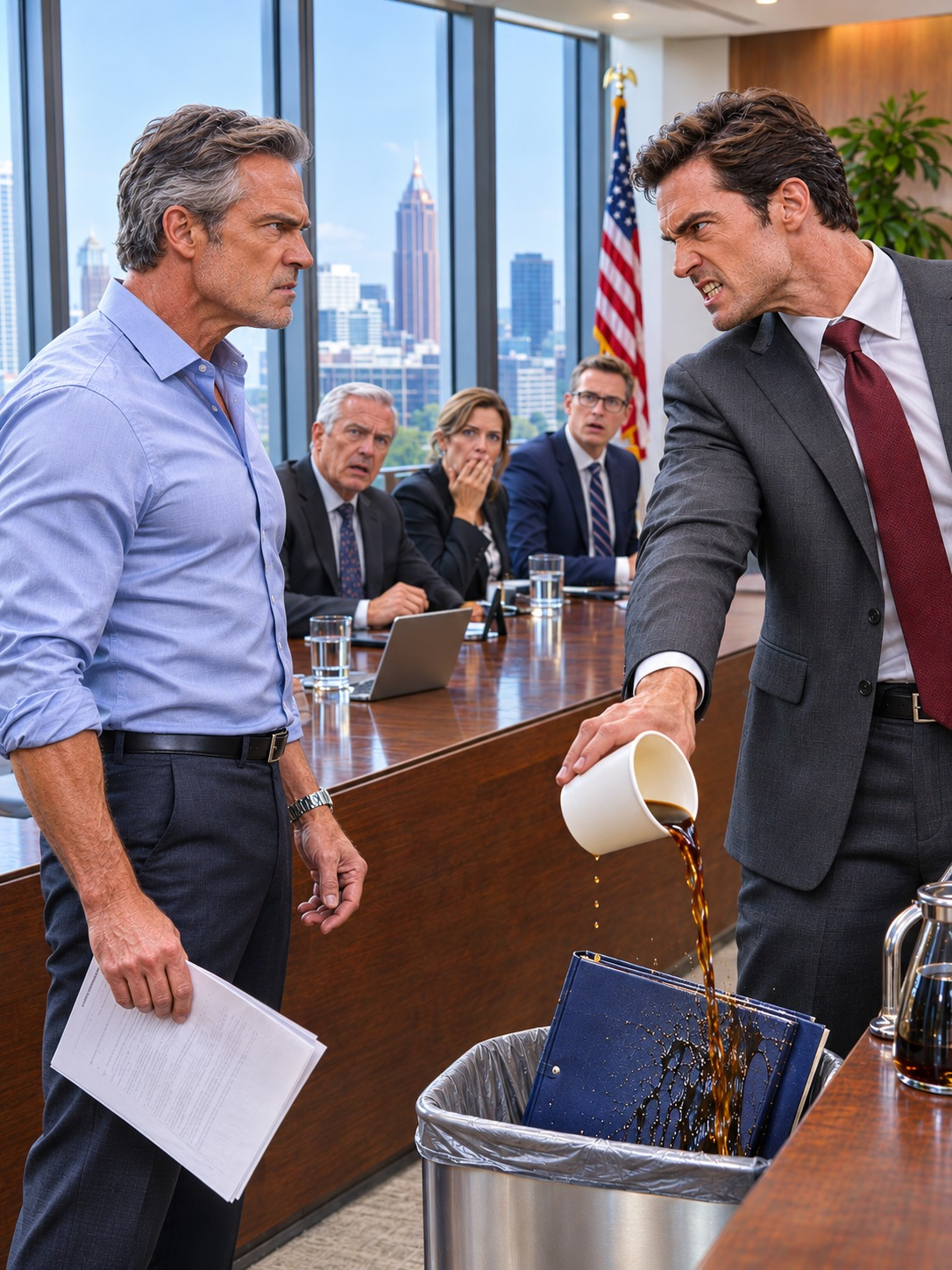
I had watched him avoid my eyes when Dwight threw the $285 million binder into the trash.
I had believed Harold was another executive who cared more about protecting his career than protecting the truth.
Now he stood inside the elevator carrying a battered brown leather briefcase.
His face was pale.
His hands were shaking.
"Raymond," he said.
I stared at him.
"Harold?"
He stepped out.
Angela Brooks moved between us.
"Mr. Finch, security needs to examine that case before you enter the boardroom."
Harold nodded.
"I understand."
He placed the briefcase on a nearby table.
Then he looked directly at me.
"I owe you an apology."
I didn't answer.
He continued.
"I should have listened when you reported the missing pages."
I looked at the briefcase.
"What's inside?"
Harold swallowed.
"The original Apex Ridge development agreement."
My heart began pounding.
"The 1988 agreement?"
He nodded.
"Yes."
"How did you get it?"
He looked down.
"Susan gave it to me."
The hallway seemed to become smaller.
I stared at him.
"My wife?"
"Yes."
"When?"
"October 2009."
I took a step closer.
"You've had it for seventeen years?"
Harold's eyes filled with tears.
"Yes."
I felt anger rise so quickly that I had to force myself to remain still.
"Seventeen years?"
He nodded.
"And you never told me?"
"No."
I looked at him.
"You worked in the same building as me. You saw me every week. You knew Susan died. You knew my sons."
His face crumpled.
"I know."
"You watched Dwight fire me."
"Yes."
"And you had the original agreement?"
He lowered his head.
"Yes."
For a moment, I wanted to shout.
I wanted to demand how many people had known about my family's history while I spent my days checking licensing schedules and worrying about paying the electric bill.
But then I remembered Susan's letter.
Make them answer to the documents.
I took a breath.
"Harold, why did Susan trust you?"
He looked up.
"Because I promised her I would protect the original until it could be safely released."
"And why didn't you?"
His voice broke.
"Because I was a coward."
Angela arranged for the briefcase to be examined and documented before anyone opened it.
Detective Sarah Mitchell arrived from the conference room.
Harold agreed to provide a formal statement with counsel present.
He also agreed that the agreement could be transferred into independent evidence custody.
I stood beside the window while they worked.
Outside, the city was dark.
Somewhere below, people were leaving restaurants, waiting for buses, and returning to homes where their families were sleeping.
Ordinary lives.
I wondered how many of those people were carrying secrets they believed they had to keep.
Finally, Detective Mitchell approached.
"Mr. Doss, the agreement appears to be intact. We'll need forensic authentication, but the seals and historical markings are consistent with the records we've recovered."
I nodded.
"Can I see it?"
She looked toward the attorneys.
A few minutes later, a documented copy appeared on the conference room screen.
I sat down.
Harold remained near the door.
Chester Alderman stood beside Judith Ellis.
Caroline Mercer sat across from me.
Daniel Price opened the file.
The first page contained a title.
APEX RIDGE DEVELOPMENT AND LICENSING AGREEMENT.
Dated June 14, 1988.
Two names appeared beneath it.
Thomas Doss.
Edward Alderman.
My father.
Chester's father.
I stared at the signatures.
My father's handwriting was unmistakable.
The oversized T.
The slightly uneven final s.
The same signature I remembered from school permission slips and birthday cards.
Daniel turned the page.
The agreement described a joint development arrangement.
Edward Alderman had provided financing, commercial contacts, and facilities.
Thomas Doss had contributed technical designs, licensing methods, and original development work.
The agreement divided their respective interests.
It allowed commercial licensing.
But it did not give Edward Alderman unrestricted ownership of everything Thomas had created.
I leaned forward.
"Page six."
Daniel enlarged it.
There was the original family protection clause.
Thomas retained a protected interest in specified development rights, including a share of proceeds from future assignments and certain consent rights over unrestricted transfers.
The rights could pass to his designated successors.
I felt my chest tighten.
My father hadn't been asking for a favor.
He had been protecting something he helped build.
Something valuable.
Something legally documented.
Chester read the clause.
Then slowly sat down.
"My father signed this."
I nodded.
"Yes."
Chester looked toward me.
"And Meridian should have honored it."
I didn't answer.
Because the agreement said more than either of us could.
Harold began explaining how he had received the document.
In 2009, Susan discovered that the original Apex Ridge ownership schedule had been replaced with a revised version that removed Thomas Doss's protected interest.
She contacted Walter Hensley.
Walter contacted Evelyn Brooks.
Evelyn located the original settlement materials.
Caroline helped Susan prepare a preservation statement.
But Susan worried that the original agreement itself could be destroyed.
She wanted someone outside the legal archive to hold it.
Someone whose ordinary work would not draw attention.
Harold had been a finance manager then.
He had access to transaction records but no authority over the original legal file.
Susan approached him because she believed he would understand the significance of the missing ownership provision.
"She told me to keep the agreement separate," Harold said.
I looked at him.
"Why?"
"Because she believed someone was monitoring the legal archive."
"Did she name anyone?"
"Margaret Vale and Martin Malone."
I nodded.
"And Richard?"
Harold hesitated.
"She believed Richard was responsible for the settlement changes. But she wanted documentary proof before making a formal accusation."
I looked down.
That sounded like Susan.
Careful.
Methodical.
Unwilling to confuse suspicion with certainty.
Harold continued.
"She gave me the agreement and a sealed instruction letter. She told me to deliver both to you if the company ever attempted another unrestricted transfer without verifying the protected interest."
I stared at him.
"Then why didn't you deliver them when the Kellerman transaction began?"
He closed his eyes.
"Because Dwight found out I had them."
My stomach tightened.
"When?"
"About six months ago."
"How?"
"During an internal audit of historical asset records. I had listed the agreement in a private preservation inventory."
I shook my head.
"You put it in an inventory?"
"Yes. I thought that would establish custody."
"And Dwight found the reference?"
Harold nodded.
"He confronted me. He said the document was obsolete. He told me Richard Alderman's office had already resolved the ownership issue."
I looked toward Chester.
His face hardened.
Harold continued.
"I knew that wasn't true."
"Then why didn't you report it?"
He swallowed.
"Because Dwight threatened to accuse me of improperly retaining corporate property."
I stared at him.
"You could have called me."
"I know."
"You could have called the general counsel."
"I know."
"You could have gone to the board."
His voice broke.
"I know, Raymond."
For a moment, I said nothing.
Then I asked, "Why did you help move the archive boxes?"
Harold looked ashamed.
"Because Dwight ordered it. He told me the records had already been approved for disposal."
"But you knew they were important."
"Yes."
"And you did it anyway."
He nodded.
"Yes."
I leaned back.
There was nothing left to argue.
Harold had made a terrible decision.
He had also preserved the one document that could finally establish the truth.
Both things could be true.
I looked at him.
"Your cooperation matters. But it doesn't erase what you did."
He nodded.
"I understand."
At 1:46 that morning, Daniel opened the final section of the 1988 agreement.
It contained the original succession provision.
Thomas Doss had designated his estate as the initial successor to his protected interest.
The agreement also allowed the estate to establish a family trust for future descendants.
That explained why the later records referred to children who had not yet been born in 1988.
It also explained why the 1992 proposed settlement and the 1997 trust documents had become so important.
The rights had never depended on a single child's name appearing in the original agreement.
They depended on a valid succession process.
Caroline leaned forward.
"The original agreement establishes Thomas's interest. The later trust documents should show how that interest was allocated."
Daniel nodded.
"And whether anyone had authority to release it."
I looked toward Rebecca Sloan, who had joined by secure video.
"Does this resolve Claire's claim?"
Rebecca shook her head.
"Not by itself. We still need to establish the authenticity of the later designation and determine who qualified under the trust terms."
I nodded.
"Then that's what we do."
Claire sat beside her.
She looked tired.
But she was listening carefully.
I turned toward her.
"Claire, I want you to know something."
She looked up.
"Yes?"
"Whatever the ownership documents say, you deserve the truth about your birth."
Her eyes filled with tears.
"I know."
"And I don't want you to feel that you have to prove a financial claim before you're allowed to know Susan."
She nodded.
"Thank you."
I swallowed.
"She was a wonderful woman."
Claire smiled through tears.
"I'd like to hear everything about her."
I nodded.
"You will."
By the following afternoon, the investigation had reached a turning point.
The independent forensic team confirmed that the recovered 1988 agreement was consistent with the original signatures, paper, and archival references.
The original fourteen Schedule R-14 pages matched the restrictions in that agreement.
The purported 1997 release contained a signature page that did not match the preserved originals.
And the beneficiary release register contained no verified consent extinguishing Thomas Doss's protected interest.
The conclusion was unavoidable.
Meridian could not substantiate its claim of unrestricted ownership.
Chester called an emergency meeting with Kellerman Pacific.
Patricia Voss attended with her legal team.
I was invited to explain the document history.
This time, nobody told me to be quiet.
Nobody interrupted when I described the missing pages.
Nobody dismissed the archive references.
I explained the original agreement.
The disputed settlement.
The preservation notices.
The destruction authorization.
And the recovered Schedule R-14.
When I finished, Patricia looked toward Chester.
"Your company has a serious ownership problem."
Chester nodded.
"Yes."
She continued.
"But you've also identified the problem before closing."
"Yes."
"That matters."
I looked at her.
She turned toward me.
"Mr. Doss, if you hadn't reported the missing pages, this transaction might have closed under representations that could not be supported."
I nodded.
"That's why I submitted the notices."
Patricia studied me.
"Three times."
"Yes."
She looked toward Chester.
"Your employee tried to prevent a very expensive mistake."
Chester nodded.
"He did."
For a moment, I thought about Dwight.
The man who had laughed when I told him the binder was incomplete.
The man who believed a licensing coordinator had no right to question a $285 million transaction.
I wondered what he would say if he could hear this conversation.
Then I realized I didn't care.
The investigation into Dwight and Richard continued over the following months.
It wasn't resolved in a single dramatic confession.
There were interviews.
Subpoenas.
Forensic examinations.
Financial records.
And testimony from people who had remained silent for years.
Dwight eventually admitted that he had removed the fourteen pages from the closing binder and concealed them in his office safe.
He acknowledged that he had directed the destruction of the physical binder and attempted to dispose of supporting archive records.
He also admitted using his father's defunct records company to create false administrative accounts.
Those accounts had been used to impersonate Caroline Mercer and manipulate document access logs.
The security footage showing a figure resembling Susan had been part of that deception.
Investigators established that the person in the archive was Margaret Vale, wearing a dark wig and clothing chosen to resemble Susan in old photographs.
The credential bearing Susan's name was a cloned identifier.
The silver pendant was Susan's necklace, taken from our home during an unauthorized entry arranged by Dwight's associates.
The detectives recovered it from Margaret's belongings.
When Angela returned the pendant to me, I held it in my palm for a long time.
The blue stone was scratched.
The clasp was slightly bent.
But it was Susan's.
I recognized the tiny mark near the back where I had once tried to repair it with a pair of pliers.
I closed my hand around it.
For the first time since the strange photographs began arriving, I felt that one small piece of my home had been returned.
The investigation also established that Margaret had not died in the highway accident twelve years earlier.
She had survived, left the country under an assumed identity, and allowed the mistaken public reports of her death to remain uncorrected.
She later returned and resumed contact with Richard through private intermediaries.
Her false death had helped conceal her continued involvement in the historical records.
But it hadn't erased the evidence.
Nothing could erase the original agreement.
Nothing could erase Susan's exception.
And nothing could erase the fourteen pages.
Richard Alderman resigned as Meridian's board chairman after the independent committee referred its findings to authorities.
The financial investigation traced the payment to Martin Malone through Alderman Family Holdings.
Contemporaneous correspondence showed that Richard had approved the preparation of replacement settlement documents despite receiving warnings that Thomas Doss had never executed the release.
Richard denied intending to defraud anyone.
But the evidence contradicted his claim that the ownership dispute had been properly resolved.
The authorities pursued the matter through the applicable legal process.
Dwight faced criminal charges relating to document destruction, unauthorized access, and falsification.
Margaret faced charges connected to forged records and the concealment of evidence.
Richard faced proceedings concerning his role in the historical alterations and subsequent concealment.
I attended several hearings.
Not because I enjoyed watching them suffer.
I didn't.
I attended because I wanted the record to be accurate.
I wanted the court to hear what my father had written.
I wanted Susan's certification preserved.
I wanted the fourteen pages entered into evidence.
And I wanted the people who had spent decades controlling the story to understand that they no longer controlled the facts.
Harold Finch cooperated with investigators and accepted the professional consequences of his role.
He resigned from Meridian.
Before leaving, he came to see me.
We sat in a small conference room.
No lawyers.
No cameras.
Just two men who had worked in the same building for years.
He looked at me.
"Raymond, I know you may never forgive me."
I thought about it.
Then I said, "I don't know whether I can."
He nodded.
"I understand."
I continued.
"But I'm glad you finally brought the agreement."
His eyes filled with tears.
"I should have done it sooner."
"Yes."
He lowered his head.
"I'm sorry."
I looked at him.
"I believe you."
That was all I could give him.
It was enough for the conversation.
The hardest part of the investigation had nothing to do with Meridian.
It was Claire.
Her birth records.
Susan's history.
The adoption.
And the question of who her biological father was.
Rebecca Sloan arranged for independent review of the hospital records.
Claire voluntarily participated in genetic testing.
I did too.
The results established that Claire was Susan's biological daughter.
They also established that I was not Claire's biological father.
A separate comparison, conducted with appropriate consent and documentation, confirmed that Richard Alderman was her biological father.
I sat with Claire when her attorney explained the results.
She stared at the report for a long time.
Then she looked at me.
"So Susan really was my mother."
I nodded.
"Yes."
Her eyes filled with tears.
"And Richard..."
She couldn't finish.
Rebecca gently closed the report.
"The results establish biological parentage. They don't tell us everything about the circumstances surrounding your birth or adoption."
Claire nodded.
I looked at her.
"Do you want to talk about it?"
She shook her head.
"Not yet."
"Okay."
She stared at the table.
Then whispered, "Does this change how you see me?"
My chest tightened.
I looked at her.
"Claire, I didn't know you existed until a few days ago."
She nodded.
"I know."
"But Susan loved you. She searched for you. And you came here because you wanted to know her."
Claire looked up.
I continued.
"None of that changes because of a test."
Her eyes filled with tears.
"Thank you."
I nodded.
"And if you want to be part of our lives, Matthew, Andrew, and I would like that."
She began crying.
I moved closer.
She stood.
Then she hugged me.
I held her carefully.
Not as a replacement for the father she had never known.
Not as a way to erase what had happened.
But as someone who had loved her mother.
Someone who could tell her about the woman whose eyes she had inherited.
The complete adoption investigation took longer.
The records showed that Susan had given birth to Claire in 1996 under circumstances involving serious pressure from Richard Alderman and the people controlling the private placement.
Susan had been told that the baby died following medical complications.
The adoption agency's file had then been altered to support a false account of the child's origins.
The false death certification had been signed by Margaret Vale.
Martin Malone had assisted in replacing records.
The forged acknowledgment bearing my signature had been used to create the appearance that I knew of and accepted the arrangement.
I hadn't.
Susan hadn't.
The hospital's surviving records, witness testimony, and financial evidence eventually established that Susan had been deceived.
She had not voluntarily abandoned Claire.
She had believed her daughter was dead.
Years later, when she discovered Claire might be alive, she tried to find her.
But the records had been sealed, altered, and routed through people determined to keep the truth hidden.
I read the final investigative report twice.
Then I put it down.
For years, I had wondered why Susan sometimes seemed sad without explanation.
Now I knew.
She had been grieving a child.
A child she had been told was gone.
A child she had later discovered might still be alive.
I thought about how much pain she had carried while still loving Matthew, Andrew, and me.
I wished I could go back.
I wished I could sit beside her at our kitchen table and tell her she didn't have to face it alone.
But I couldn't.
All I could do was make sure Claire knew her mother had never stopped caring.
And that was what I did.
The financial resolution came after months of independent review and negotiation.
The original 1988 agreement established Thomas Doss's protected interest.
The invalid settlement documents had not extinguished it.
The family trust had been created to administer the interest for qualifying descendants and beneficiaries.
After the forged records were removed from consideration, the trustees and independent counsel established the valid succession structure.
My father's estate had retained rights that should have been recognized decades earlier.
Claire's protected designation was also confirmed under the later trust documents.
The final settlement respected those interests separately.
It did not require anyone to pretend that Claire's adoption records were accurate.
It did not require my family to surrender valid claims.
And it did not allow Meridian to proceed as though the missing pages had never existed.
The company negotiated a comprehensive resolution with the authorized rights holders.
The settlement included compensation for past use of the protected rights, recognition of the family's continuing interests, and a properly documented consent arrangement for future transfers.
I won't pretend the process was easy.
There were difficult meetings.
Disagreements about valuation.
Independent appraisals.
Tax questions.
And long conversations with attorneys who insisted that every sentence mattered.
But this time, I had lawyers representing my family's interests.
This time, the documents were complete.
And this time, nobody told me to stop asking questions.
The settlement gave Matthew and Andrew meaningful financial security.
It established a protected share for Claire.
And it provided enough compensation for me to retire comfortably if I wanted.
I thought about Susan.
She had spent years worrying about medical bills.
About whether the boys would be able to afford college.
About whether I was working too many hours.
I wished she could have seen the day the settlement was signed.
Not because of the money.
Because she would have known our family was safe.
The Kellerman Pacific transaction did not close under the original $285 million agreement.
That contract had been based on an incomplete description of the rights Meridian could transfer.
Instead, the parties negotiated a revised transaction after the ownership issues were resolved.
Kellerman obtained properly documented rights.
Meridian received a substantial, independently supported purchase price.
The protected family interests were recognized and compensated.
The revised transaction was smaller than the original headline figure, but it was legally supportable.
There were no hidden schedules.
No missing consent requirements.
No secret beneficiary designations.
Every material restriction was disclosed.
Every required approval was documented.
And every original page was preserved.
Patricia Voss attended the final signing.
So did Chester.
I was invited as an observer.
When the documents were placed on the table, Patricia looked toward me.
"Mr. Doss, would you like to review the binder?"
I smiled faintly.
"Only if it has all the pages."
She laughed.
"So would I."
I opened it.
I checked the index.
The attachments.
The signatures.
The consent records.
And Schedule R-14.
All fourteen pages were there.
I closed the binder.
"Complete," I said.
Chester exhaled.
For a moment, nobody spoke.
Then Patricia signed.
Chester signed.
The authorized rights holders completed their approvals.
And the transaction closed.
Not because someone had ignored a problem.
Because someone had finally corrected it.
Meridian's board formally reversed my termination.
Dwight's disciplinary record was corrected to reflect the investigation's findings.
My personnel file was amended.
The company paid the wages and benefits I had lost.
It also adopted new controls requiring independent review of material document discrepancies, preservation requests, and transaction-related employee complaints.
No director could unilaterally destroy original transaction records.
No employee could be terminated for raising a good-faith compliance concern without independent review.
And historical ownership restrictions had to be verified before any major licensing transfer.
Chester asked me to return to Meridian.
Not as a licensing coordinator.
As Director of Records Integrity and Transaction Assurance.
I stared at the offer letter.
The salary was more than twice what I had earned before.
The position reported independently to the board's audit committee.
I looked at Chester.
"Why me?"
He smiled sadly.
"Because you understood something the rest of us forgot."
I waited.
"Documents aren't paperwork. They're promises."
I looked down.
For a moment, I thought about my father.
Susan.
Walter.
Evelyn.
Caroline.
Harold.
All the people who had tried, in different ways, to preserve the truth.
Then I looked at Chester.
"I'll accept under one condition."
He raised an eyebrow.
"Only one?"
I smiled.
"For now."
He laughed.
"What's the condition?"
"I want the department to have real authority. Not a title. Not a ceremonial review. If someone identifies a material discrepancy, the transaction stops until it's resolved."
Chester nodded.
"Agreed."
"And I want the people doing the work to be heard."
His expression softened.
"Agreed."
I held out my hand.
He shook it.
And just like that, the man who had been fired for finding fourteen missing pages was given the authority to make sure it never happened again.
Six months later, I stood in my new office.
It was larger than Dwight's old office.
That still felt strange.
There were windows overlooking the city.
A bookshelf.
A small conference table.
And a desk that was almost too large for me.
But the thing I cared about most sat near the edge.
A brass compass paperweight.
ALWAYS KNOW WHERE YOU STAND.
Susan's gift.
I turned it slowly in my hand.
Then I placed it beside a framed photograph.
Susan.
Matthew.
Andrew.
And me.
Taken on a summer afternoon years before her diagnosis.
We were standing in the backyard.
The boys were laughing.
Susan had her arm around my waist.
I remembered the day.
The grill had stopped working.
Matthew had spilled lemonade.
Andrew had insisted on wearing a superhero cape.
Susan had laughed so hard she could barely stand.
It was an ordinary day.
One of hundreds.
And now it was one of the most valuable memories I owned.
There was another photograph beside it.
Taken three weeks earlier.
Matthew.
Andrew.
Claire.
And me.
We were standing outside our house.
Claire was smiling.
Matthew had his arm around her shoulders.
Andrew was making a ridiculous face.
I was laughing.
For the first time, the picture didn't feel like evidence.
It felt like family.
Claire had become part of our lives slowly.
We didn't pretend the past hadn't happened.
We didn't force a relationship.
We let it grow.
She came over for dinner.
She listened to stories about Susan.
She asked about her favorite books.
Her favorite songs.
The way she decorated the house at Christmas.
I showed her the old photo albums.
The birthday cards.
The handwritten recipes.
And the little notebook Susan kept in the kitchen drawer.
Claire cried when she saw the handwriting.
Then she laughed when she read Susan's instructions for pancakes.
If the first batch burns, tell the boys they're supposed to look like that.
I laughed too.
"She actually did that."
Claire smiled.
"I would have loved her."
I looked at her.
"She would have loved you."
Claire nodded.
Then she asked if she could keep a copy of the recipe.
I told her she could have the original.
She shook her head.
"No. I want you to keep it."
I smiled.
"Then we'll make copies."
And we did.
On the anniversary of Susan's death, Matthew, Andrew, Claire, and I went to the cemetery.
The morning was cool.
The sky was clear.
I carried flowers.
Claire carried a small photograph.
We stood beside Susan's grave.
For a while, nobody spoke.
Then Claire stepped forward.
"Hi, Mom."
My throat tightened.
She knelt beside the stone.
"I wish we'd met."
She placed the photograph near the flowers.
It was the picture of Susan from the charity event.
The one Claire had kept beside her bed.
"I found Raymond," she whispered.
I closed my eyes.
"And Matthew and Andrew."
The boys stood beside me.
Claire continued.
"They told me about you."
Her voice trembled.
"They said you were kind. And funny. And stubborn."
Matthew smiled through tears.
"Very stubborn."
Andrew nodded.
"Especially about vegetables."
Claire laughed softly.
Then she looked at the stone again.
"I wish you could see us."
I stepped closer.
I placed my hand on her shoulder.
For a moment, we stood together.
Then I knelt beside her.
"Susan," I whispered, "we found her."
The words broke something inside me.
But this time, the pain was different.
It wasn't the sharp pain of discovering another secret.
It was grief finally being allowed to meet the truth.
I looked at the name carved into the stone.
Susan Elaine Doss.
Beloved Wife and Mother.
I touched the letters.
"You did everything you could," I whispered.
Then I stood.
Claire took my hand.
Matthew stood on my other side.
Andrew put his arm around my shoulders.
And we stayed there together until the wind grew cold.
That evening, we had dinner at my house.
Matthew brought dessert.
Andrew fixed the kitchen light that had been flickering for months.
Claire helped me prepare Susan's favorite roast chicken.
We talked.
We laughed.
We argued about whether Matthew had cheated during a family board game when he was twelve.
He insisted he hadn't.
Andrew insisted he had.
Claire listened with delight.
Then she looked at me.
"Raymond?"
"Yeah?"
"Can I ask you something?"
"Of course."
She hesitated.
"Do you ever wish none of this had happened?"
I thought about it.
Then I looked around the table.
At my sons.
At Claire.
At the photographs on the wall.
At the home Susan and I had built.
"I wish the lies hadn't happened," I said.
Claire nodded.
"I wish Susan hadn't been hurt. I wish my father had received what he was owed. I wish you hadn't spent your life searching for answers."
I paused.
"But I don't wish I hadn't found you."
Her eyes filled with tears.
"Really?"
I smiled.
"Really."
Matthew raised his glass.
"To Mom."
Andrew raised his.
"To Mom."
Claire lifted hers.
"To Susan."
I looked at the empty chair beside me.
The chair where Susan used to sit.
Then I raised my glass.
"To the woman who never stopped protecting us."
We drank.
And for the first time in years, the empty chair didn't feel quite so lonely.
A year after Dwight threw my binder into the trash, Meridian held its annual employee recognition meeting.
Chester asked me to speak.
I almost refused.
I had never enjoyed standing in front of large groups.
But then I thought about the people who worked quietly behind the scenes.
The coordinators.
The analysts.
The administrative assistants.
The records clerks.
The employees who checked details nobody else wanted to examine.
I agreed.
The auditorium was full.
Chester introduced me.
He spoke about the revised transaction.
The reforms.
The independent review process.
And the importance of listening to employees.
Then he stepped aside.
I walked to the podium.
For a moment, I looked at the audience.
Hundreds of faces.
Some familiar.
Some new.
People who had probably heard the story in pieces.
The missing binder.
The suspended deal.
The director who was fired.
The licensing coordinator who had been reinstated.
I took a breath.
"One year ago," I began, "I found fourteen missing pages in a closing binder."
The room became quiet.
"I didn't know those pages were connected to my father."
I paused.
"I didn't know my wife had spent years trying to preserve the same records."
I looked toward the front row.
Matthew, Andrew, and Claire sat together.
They smiled at me.
"I didn't know the investigation would change my life."
I took a breath.
"But I knew the binder was incomplete."
A few people nodded.
I continued.
"That's all I knew."
I looked around the room.
"And sometimes, that's enough to ask another question."
I paused.
"Not because you're trying to stop a deal. Not because you want to embarrass someone. Not because you think you're smarter than the people above you."
I looked toward Chester.
"But because the work matters."
The room remained silent.
I continued.
"Every document represents something. A promise. An obligation. A person's rights. A family's future."
I swallowed.
"My father spent years trying to protect his work. My wife spent years trying to preserve the truth. And I spent eleven years believing that if I did my job carefully, the records would speak for themselves."
I looked down at my notes.
Then I set them aside.
"I was wrong about one thing."
The room was completely quiet.
"Records don't speak for themselves."
I looked up.
"People have to be willing to listen."
For a moment, nobody moved.
Then someone began clapping.
Another person joined.
Then another.
Soon the entire auditorium was standing.
I looked toward my family.
Matthew was smiling.
Andrew was clapping.
Claire was crying.
And I thought about Susan.
How she would have teased me for getting emotional in front of so many people.
How she would have squeezed my hand afterward.
How she would have told me I did fine.
I smiled.
And for the first time, I believed her.
That night, I returned home later than usual.
The house was quiet.
I hung my coat by the door.
Set my keys on the kitchen counter.
And walked into the living room.
The brass compass sat on the mantel.
I picked it up.
Turned it over.
Read the engraving.
ALWAYS KNOW WHERE YOU STAND.
I smiled.
For years, I had believed those words meant knowing when to stand firm.
Knowing when to say no.
Knowing when to refuse an order that felt wrong.
They did mean that.
But now they meant something more.
They meant knowing where I belonged.
With my family.
With the people who trusted me.
With the truth my father had tried to preserve.
With the memory of the woman who had loved me through every ordinary day of our marriage.
I placed the compass beside Susan's photograph.
Then I opened the drawer beneath the mantel.
Inside was the original letter she had written to me in 2009.
The detectives had returned it after the evidence process was complete.
I had read it many times.
But tonight, I read the final lines again.
I love you, Ray.
I love Matthew and Andrew.
If Claire is alive, please tell her I never stopped looking.
I folded the letter carefully.
Then I looked toward the photograph of our family.
The one with Claire.
I smiled through tears.
"I told her, Susan."
My voice was quiet.
"I told her everything."
I placed the letter back in its envelope.
Then I turned off the living room light.
Upstairs, the guest room was ready for Claire's next visit.
Matthew and Andrew were coming over on Sunday.
And tomorrow morning, I would return to Meridian.
Not to prove anyone wrong.
Not to chase another secret.
But to do work I believed in.
The same work I had always tried to do.
Only now, people listened.
I paused at the bottom of the stairs.
For a moment, I remembered Dwight Malone standing in the boardroom, holding my binder above the trash.
I remembered the coffee spilling across the pages.
The laughter.
The humiliation.
The cardboard box containing eleven years of my working life.
I had walked out of Meridian believing my career was over.
I hadn't known that the missing pages would lead me to my father's legacy.
I hadn't known they would reveal Susan's courage.
I hadn't known they would bring Claire into our lives.
And I certainly hadn't known that the company that fired me would one day ask me to protect its most important records.
I looked toward the mantel one last time.
The brass compass caught the light.
I smiled.
Then I went upstairs.
For the first time in a long time, I wasn't afraid of what tomorrow might bring.
My father had been heard.
Susan's truth had been preserved.
Claire had found her family.
Matthew and Andrew had their futures.
The company had corrected its mistakes.
And I had finally come home to a life that belonged to me.






Comments 0