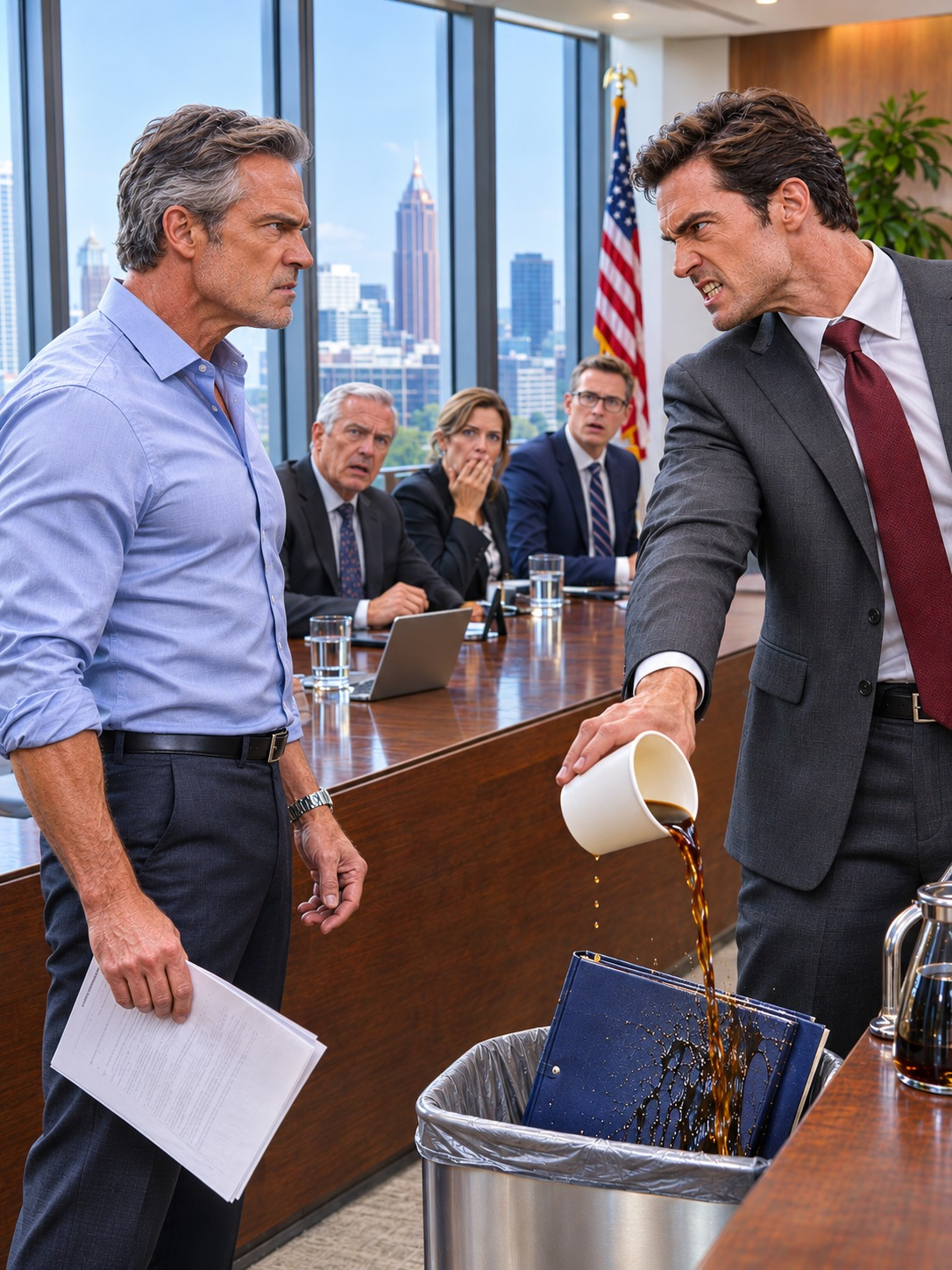
"He's carrying the missing archive folder. And he says he won't give it to anyone until Raymond hears what happened to Walter Hensley."
Melissa Grant's voice trembled.
Chester Alderman stood so quickly that his chair rolled backward and struck the conference room wall.
"What happened to Walter?"
Melissa looked toward the open door.
"Harold wouldn't explain. He said the police needed to hear it first."
I remained seated.
The name Walter Hensley had been spoken so many times that morning it had begun to feel like a warning.
Six years earlier, Walter had retired from Meridian Ventures Group after a career that helped turn the company into a major licensing business.
There had been speeches.
A retirement cake.
A framed photograph.
Chester had thanked him publicly for his service.
I remembered because I had been there.
I also remembered something nobody else seemed to consider important.
Walter hadn't looked happy that afternoon.
He had looked frightened.
At the time, I assumed he was simply uncomfortable with retirement.
Now I wasn't so sure.
Chester turned toward Daniel Price.
"Call building security. Nobody touches that folder until legal has documented its condition."
Daniel nodded.
Caroline Mercer gathered the papers on the table.
"I want to be present."
Chester looked at me.
"Raymond?"
I stood.
"I'm coming."
Dwight Malone had fired me less than twenty-four hours earlier.
My building badge had been deactivated.
My personal belongings were still sitting in a cardboard box beside the conference table.
And now the CEO was waiting for me to accompany him downstairs because a senior finance manager refused to surrender a missing corporate document without speaking to me.
I had spent eleven years being invisible.
That morning, I was beginning to wish I still was.
We took the executive elevator to the lobby.
Nobody spoke during the ride.
Chester stared at the floor numbers.
Daniel checked his phone.
Caroline held the old ownership acknowledgment inside a protective folder.
I stood near the back wall, trying to remember the last conversation I'd had with Walter Hensley.
It had been six years earlier.
Two days before his retirement.
He had come to my desk shortly after five.
Most of the floor was empty.
I was organizing licensing records when he stopped beside my filing cabinet.
"Raymond, do you have a minute?"
"Of course, Mr. Hensley."
He pulled up a chair.
That surprised me.
Executives rarely sat at my desk.
They usually stood while giving instructions.
Walter looked tired.
His silver hair was uncombed, and the collar of his shirt was open.
He placed a small envelope on my desk.
"Would you mind keeping this until tomorrow?"
I looked at it.
"What is it?"
"Something I don't want to forget."
I smiled.
"You could leave it with your assistant."
He didn't smile back.
"I'd rather leave it with you."
I took the envelope.
It was sealed.
There was no name on the front.
The following morning, Walter returned and collected it.
He thanked me.
Then he said something I hadn't thought about in years.
"Raymond, the most dangerous documents aren't the ones people hide."
I looked at him.
"What do you mean?"
He glanced toward the executive offices.
"They're the ones people convince everyone else don't matter."
At the time, I assumed he was talking about corporate bureaucracy.
Now, standing in the elevator beside Meridian's CEO, I wondered whether Walter had been trying to tell me something.
The elevator doors opened.
Two uniformed police officers stood near the reception desk.
Harold Finch sat in a chair between them.
His face was gray.
His hands trembled around a paper cup of water.
A dark document bag rested on the floor beside his feet.
When he saw me, he stood.
"Raymond."
One of the officers raised a hand.
"Sir, please remain seated."
Harold ignored him.
"Raymond, I'm sorry."
I stopped a few feet away.
"Sorry for what?"
He looked at Chester.
Then at Caroline.
Finally, he looked back at me.
"For what happened yesterday."
I glanced at the document bag.
"Did you take the archive folder?"
"Yes."
"Did Dwight tell you to?"
Harold swallowed.
"Yes."
"Why did you use credentials assigned to me?"
His eyes filled with tears.
"I didn't know they were yours."
I stared at him.
"Harold, someone used my identity to enter a restricted area after I was fired."
"I know."
"Then tell me what happened."
He looked toward the officers.
"I came here because I couldn't live with what they were asking me to do."
Chester stepped forward.
"Who is they?"
Harold shook his head.
"Not here."
Caroline spoke calmly.
"Mr. Finch, I'm counsel for Apex Ridge Legacy Holdings. The missing folder may contain documents relevant to my client's rights. We need to establish exactly what happened."
Harold looked at her.
Then his eyes returned to me.
"Raymond, Walter Hensley didn't retire because he wanted to."
I felt something tighten in my chest.
"What?"
Harold's voice dropped.
"He was forced out."
Chester frowned.
"That's a serious accusation."
Harold gave a bitter laugh.
"You think that's the serious part?"
One of the officers stepped closer.
"Mr. Finch, you told us you had information about possible document tampering. If you're making allegations about other conduct, we need you to explain them clearly."
Harold nodded.
Then he looked at me.
"Walter discovered something about the Apex Ridge acquisition. Something involving the original ownership records."
I waited.
"He tried to bring it to the board."
"What happened?" I asked.
Harold looked down.
"They made sure the board never saw it."
The police moved us into a private conference room beside the lobby.
The officers explained that Harold had approached building security claiming he possessed corporate records that had been improperly removed from storage.
Security had contacted the police because Harold also alleged someone had used another employee's credentials to access a restricted area.
No one had been arrested.
The officers were there to document the complaint and determine whether a criminal investigation was warranted.
Caroline made that distinction clear before anyone opened the document bag.
"We need a proper inventory," she said. "And Mr. Finch should have the opportunity to consult independent counsel before making further statements."
Harold nodded.
"I understand."
Chester looked impatient.
"We have a $285 million transaction waiting upstairs."
Caroline turned toward him.
"And that's exactly why we cannot mishandle the evidence."
Chester sat back.
For the first time that morning, he looked less like a CEO and more like a man who had discovered that the company he controlled contained rooms he had never entered.
Olivia Chen arrived with a chain-of-custody form.
She photographed the document bag.
Harold identified it as the same bag shown on the security footage.
He stated that Dwight had instructed him to remove the Apex Ridge archive folder from box AR-1179.
He also stated that he had not destroyed or altered the folder after taking possession.
Olivia recorded his statement.
Then she opened the bag.
Inside was the familiar gray archive folder.
AR-14-C.
The handwritten label was exactly as I remembered.
The upper corner was bent.
The old adhesive seal had separated from the paper.
And across the front, in dark blue ink, were four words.
ORIGINALS RETAINED. DO NOT SUBSTITUTE.
I felt a strange wave of relief.
The folder existed.
The documents hadn't disappeared forever.
At least, not yet.
Olivia opened it.
The separate sleeve was inside.
So was the historical acknowledgment.
But there was something else.
A thin yellow envelope.
I leaned forward.
"That wasn't there when I examined the folder."
Harold looked at me.
"I know."
Caroline turned toward him.
"Where did it come from?"
Harold hesitated.
"Walter gave it to me."
I stared at him.
"When?"
"Six years ago."
The room went silent.
Harold continued.
"He told me not to open it unless the Apex Ridge rights were being transferred again."
Chester leaned forward.
"You've had that envelope for six years?"
"Yes."
"Why didn't you disclose it?"
Harold looked at him.
"Because I was afraid."
"Of whom?"
Harold glanced toward the door.
Then he said, "The same people who made Walter leave."
I wanted to be angry with Harold.
Part of me was.
He had stood in the boardroom while Dwight destroyed the binder.
He had watched me lose my job.
He had approached my desk afterward and pretended to be concerned.
Then he had helped remove the archive folder.
But as I looked at him across the table, I saw a man who had spent years carrying a secret he didn't know how to escape.
His hands shook.
His face was exhausted.
He looked older than he had the previous afternoon.
"Harold," I said, "why did you come back?"
He looked at me.
"Because you did something I should have done years ago."
"What?"
"You refused to pretend the documents didn't matter."
I didn't answer.
He wiped his forehead.
"Yesterday, when Dwight poured coffee over that binder, I knew what he was trying to accomplish."
Chester leaned forward.
"Then why didn't you stop him?"
Harold looked ashamed.
"Because I've spent six years telling myself that keeping quiet was the safest thing to do."
He turned toward me.
"I watched you stand there while he humiliated you. And I realized I had become exactly the kind of man Walter warned me about."
I looked down at the folder.
"That doesn't explain why you took it."
"Dwight told me to remove the folder before facilities collected the archive boxes."
"Why?"
"He said it contained outdated documents that could confuse the closing process."
"And you believed him?"
Harold shook his head.
"No."
"Then why did you do it?"
He looked at the yellow envelope.
"Because I knew what was inside."
Caroline spoke.
"Mr. Finch, you should be careful about answering questions that could expose you to legal liability."
Harold nodded.
"I know."
He looked at the police officers.
"I'll provide a formal statement with counsel. But I need Raymond to understand one thing."
I waited.
"When Dwight told me to remove the folder, he didn't know I still had Walter's envelope."
Chester frowned.
"Then why bring it here?"
Harold looked directly at him.
"Because Walter told me that if anyone ever tried to sell the Apex Ridge rights without the original ownership acknowledgment, the company could be transferring property it didn't own."
Daniel Price, who had been listening quietly, finally spoke.
"That sounds like the issue we're facing."
Harold nodded.
"It is."
Caroline opened the historical acknowledgment.
"Mr. Finch, did Walter explain the beneficial ownership structure?"
"Some of it."
"What did he tell you?"
Harold looked toward me.
"He said the original transaction had been structured to protect a family interest."
I felt my chest tighten.
"A family interest?"
"Yes."
"Whose family?"
Harold looked down.
"I think the answer is in that envelope."
At 10:02, the signing ceremony was officially postponed.
The announcement came through an email from Meridian's corporate communications department.
I saw it on Daniel's phone.
The message described an administrative documentation issue.
It said both parties remained committed to completing the transaction.
It offered no new date.
That was probably the safest language the company could use.
But everyone in our conference room understood the situation was far more serious than a paperwork delay.
Kellerman Pacific had not received proof that Meridian could transfer all the rights included in the agreement.
The original binder had been destroyed.
The archive folder had been removed without authorization.
And now a six-year-old envelope might contain information that changed the ownership history of the entire portfolio.
Chester looked toward Caroline.
"Can we open it?"
Caroline examined the envelope.
"Not until we establish who has the right to authorize its disclosure."
Harold nodded.
"Walter said it was for the original rights holder."
Caroline looked at the front.
There was no recipient's name.
Only a reference number.
AR-LH-2009.
She went still.
I noticed.
"Does that number mean something?"
She looked at me.
"Possibly."
"What's LH?"
"Legacy Holdings."
I nodded.
Then I looked at the final four digits.
2009.
That was the year Meridian acquired the Apex Ridge portfolio.
It was also the year my wife, Susan, began working part-time as an administrative assistant for a small legal services company.
I remembered because our sons were still young, and she wanted a schedule that allowed her to be home when they returned from school.
I didn't know why that memory came back to me.
It seemed unrelated.
But then I noticed the handwriting on the envelope.
The capital R.
The way the final stroke curved beneath the number.
I had seen that handwriting before.
Not in the archives.
At home.
On birthday cards.
Shopping lists.
Notes taped to the refrigerator.
My wife had written numbers in exactly that way.
I stared at the envelope.
Caroline noticed.
"Raymond?"
I didn't answer.
She leaned closer.
"Are you all right?"
I swallowed.
"Where did Walter get that envelope?"
Harold looked confused.
"I don't know."
"Did he prepare it himself?"
"I don't think so."
"Why?"
"Because he told me someone else had entrusted it to him."
My heart began beating faster.
"Who?"
Harold hesitated.
"He never said."
I looked at the handwriting again.
It couldn't be Susan's.
There were thousands of people who wrote numbers that way.
I was making connections because I was exhausted.
Because I had lost my job.
Because the morning had turned into something I didn't understand.
Still, I couldn't stop looking at the envelope.
Caroline placed it inside a protective sleeve.
"Raymond, if you recognize something, you need to tell us."
I shook my head.
"I'm not certain."
"About what?"
"The handwriting."
She studied me.
"Whose handwriting?"
I took a breath.
"My wife's."
Nobody spoke.
Then Harold closed his eyes.
And that frightened me more than anything he had said.
Susan Doss had died seven years earlier.
She was forty-six.
Cancer had taken her after fourteen months of treatments, hospital visits, and promises that the next appointment might bring better news.
For most of our marriage, Susan had been the practical one.
She remembered birthdays.
She kept emergency cash in an envelope above the refrigerator.
She could tell when one of our sons was lying before he finished the sentence.
And she never trusted a document that didn't clearly explain what someone was signing.
"Read the small print, Ray," she used to say.
I would laugh.
She never did.
"People don't hide the important things in big letters."
When she became ill, I handled most of the paperwork.
Insurance forms.
Medical authorizations.
Prescription claims.
Disability applications.
There were days when I felt as though our entire life had been reduced to signatures and account numbers.
Susan hated that.
One evening, after a difficult treatment, she asked me to bring her the old family photo album.
We sat on the couch looking at pictures of the boys when they were little.
She stopped at a photograph from a company picnic.
I was standing beside Walter Hensley.
Susan was holding Andrew, who couldn't have been more than three.
Walter had one hand on Matthew's shoulder.
I remembered the day.
Walter had invited several employees from the licensing department to the event.
He had spent nearly an hour talking to Susan about the boys.
At the time, I thought he was simply being kind.
Susan studied the photograph for a long time.
Then she closed the album.
"Ray, promise me something."
"What?"
"If anyone ever tells you that something important is just paperwork, don't believe them."
I smiled.
"You sound like me."
She didn't smile.
"Promise."
I took her hand.
"I promise."
I had forgotten that conversation until the moment I saw the yellow envelope.
Now I could hear her voice as clearly as if she were sitting beside me.
Caroline asked the police officers for a few minutes.
They agreed, provided the documents remained under supervision.
She turned toward Harold.
"Mr. Finch, did Walter ever mention Susan Doss?"
Harold's expression changed.
He looked at me.
Then at Caroline.
Finally, he nodded.
"Yes."
I felt the air leave my lungs.
"What did he say?"
Harold looked miserable.
"Raymond, I didn't know how to tell you."
"Tell me what?"
He rubbed his hands together.
"Walter knew Susan before she became ill."
"Of course he did. They met at company events."
Harold shook his head.
"Not just company events."
I stared at him.
"What are you saying?"
"He knew her through the original Apex Ridge transaction."
For several seconds, I couldn't speak.
Susan had never worked for Meridian.
She had never been involved in my licensing department.
She had worked part-time for a legal services company and later helped a local nonprofit with administrative records.
At least, that was what I knew.
"How?" I asked.
Harold looked toward Caroline.
"I don't know all the details."
"Then tell me what you do know."
He swallowed.
"Walter said Susan helped identify a problem with the original ownership documents."
I stared at him.
"When?"
"During the acquisition."
"That was seventeen years ago."
"I know."
"Why didn't she tell me?"
Harold shook his head.
"I don't know."
I felt anger rising.
Not at Susan.
Not even at Harold.
At the possibility that people in this building had known something about my wife that I hadn't.
"Harold, don't give me another half-answer."
He looked at me.
"I'm sorry."
"Then tell me the truth."
He lowered his eyes.
"Walter believed Susan had been pressured to sign a confidentiality acknowledgment."
I went still.
"By whom?"
Harold shook his head.
"I don't know."
"Was it Meridian?"
"I think so."
Chester leaned forward.
"Harold, are you saying a third party was pressured into signing documents connected to our acquisition?"
Harold looked at him.
"I'm saying Walter believed the original transaction had been handled improperly."
Daniel spoke carefully.
"Belief isn't proof."
"No," Harold said. "It isn't."
He pointed toward the yellow envelope.
"That's why Walter kept the documents."
By 10:27, Caroline had obtained authorization from her client to review the envelope under the supervision of the police and both companies' legal representatives.
The officers documented the condition of the seal.
Olivia photographed every side.
Daniel recorded the reference number.
Harold watched from the far end of the table.
I sat with my hands folded.
I didn't want to touch the envelope.
I didn't want to damage it.
And I didn't want to discover that my wife had spent years carrying a secret she had never shared with me.
Caroline carefully opened the flap.
Inside were three folded sheets.
The first was a copy of a historical rights acknowledgment.
The second was a letter from Walter Hensley.
The third was a document bearing an old legal services company letterhead.
I recognized the company name.
Harrison & Vale Administrative Services.
Susan had worked there.
My throat tightened.
Caroline unfolded Walter's letter.
It was dated six years earlier.
Three days before his retirement.
She read the opening paragraph silently.
Then she looked at me.
"Raymond, I think you should hear this."
I nodded.
She began reading.
"To the person responsible for reviewing the Apex Ridge Legacy Holdings records: I am preserving these documents because I believe the original transaction file contains material omissions concerning the identity of the beneficial rights holder."
She paused.
Then continued.
"During the acquisition review, an administrative witness raised concerns regarding the transfer conditions and the accuracy of the ownership acknowledgment."
My hands tightened.
Caroline read the next sentence.
"That witness was Susan Doss."
I closed my eyes.
For a moment, the room disappeared.
I saw Susan sitting at our kitchen table.
Her reading glasses halfway down her nose.
A cup of tea beside her.
A stack of papers spread across the table.
I remembered coming home one evening in 2009 and finding her unusually quiet.
She had been reviewing documents for work.
When I asked what was wrong, she said she had seen something that didn't make sense.
I asked if she wanted to talk about it.
She shook her head.
"Not yet."
I never asked again.
I had assumed it was a routine workplace problem.
Now I wondered whether that conversation had been the beginning of everything.
Caroline continued reading.
"Witness concerns were reported through the appropriate channels. However, the final transaction package did not reflect those concerns."
Daniel leaned forward.
"Does Walter identify who removed them?"
Caroline scanned the page.
"Not in this paragraph."
She continued.
"I attempted to preserve the original records. My efforts were opposed by individuals who argued that reopening the ownership review would jeopardize the acquisition."
Chester's face tightened.
"Who?"
Caroline read the next line.
"Walter states that a separate memorandum was prepared identifying the individuals involved."
She stopped.
Daniel looked at her.
"Where is it?"
Caroline examined the remaining pages.
"It's not here."
Harold shook his head.
"Walter never gave me a memorandum."
I stared at the letter.
"Then where is it?"
Nobody answered.
Caroline turned to the final paragraph.
Her expression changed.
She read it twice before speaking.
"There's a personal note."
I looked at her.
"To whom?"
"To you."
My chest tightened.
She handed me a copy of the letter.
I read the final lines.
Raymond, if this document ever reaches you, I owe you an apology. I knew Susan was trying to protect something important, and I should have listened when she asked me to keep the original acknowledgment safe. I believed I could correct the record without involving your family. I was wrong.
I stopped reading.
My vision blurred.
Not because I was crying.
Because I couldn't understand why Walter had written to me six years earlier and never delivered the letter.
I read the next sentence.
I hope one day you will understand why she insisted that the truth be preserved.
I lowered the paper.
Chester looked at me.
"Raymond?"
I shook my head.
"I need a minute."
He nodded.
"Take whatever time you need."
I stood and walked toward the window.
Outside, people crossed the street carrying coffee cups and briefcases.
Cars moved through the intersection.
A delivery truck stopped beside the curb.
The city continued as though nothing had happened.
I pressed one hand against the back of a chair.
For seven years, I had believed I knew everything important about Susan's life.
I knew how she liked her coffee.
I knew which songs made her cry.
I knew she hated driving on highways.
I knew she always checked the locks twice before bed.
And now I was discovering that she had been involved in a corporate transaction worth hundreds of millions of dollars.
A transaction connected to documents someone had deliberately destroyed.
I didn't know what to feel.
Grief.
Confusion.
Anger.
Fear.
All of it arrived at once.
Then I remembered her words.
Read the small print, Ray.
I turned back toward the table.
"There's another page."
Caroline looked up.
"What?"
"The third document."
She nodded.
"Yes."
"Can we read it?"
She examined the page.
Then she looked at Daniel.
"This appears to be a witness certification."
Daniel leaned closer.
"Signed?"
"Yes."
"By Susan?"
Caroline nodded.
I returned to my chair.
She placed the document in front of me.
The signature was unmistakable.
Susan Doss.
The same looping S.
The same careful D.
The same slight upward stroke at the end.
My wife had signed it seventeen years earlier.
Beneath her name was a short statement.
I certify that the attached ownership schedule was presented to me as a complete and accurate record of the beneficial interests associated with the Apex Ridge licensing portfolio.
I read the sentence twice.
Then I noticed something.
A handwritten addition beneath the certification.
Four words.
Subject to attached exception.
I looked up.
"Where's the exception?"
Caroline checked the envelope.
"There isn't one."
Daniel frowned.
"Was it a separate attachment?"
"Apparently."
I stared at the page.
Susan had signed the certification.
But she had added a qualification.
She had not accepted the ownership schedule without reservation.
She had specifically referenced an exception.
And that exception was missing.
Again.
Another missing document.
Another record someone didn't want us to see.
At 11:06, Chester received a call from the chairman of Meridian's board.
He stepped outside to answer.
Daniel began reviewing the ownership documents with Caroline.
Harold remained seated near the officers.
I looked at the witness certification.
The more I studied it, the more one detail bothered me.
The date.
Susan had signed it on October 14, 2009.
I remembered that week.
Matthew had been ten.
Andrew was seven.
We had gone to a school fundraiser on the following Saturday.
Susan had seemed distracted all evening.
She kept checking her phone.
At one point, she stepped outside to take a call.
When she returned, she told me she was considering leaving her job.
I asked why.
She said the work had become uncomfortable.
I didn't press her.
Three weeks later, she resigned.
For years, I had believed she left because she wanted more time with the boys.
Now I wasn't so sure.
I looked at Harold.
"Did Walter know why Susan left Harrison & Vale?"
Harold looked up.
"I don't know."
"Did he ever mention the company?"
"Only once."
"What did he say?"
Harold hesitated.
"He said someone there had tried to change the ownership records."
Daniel stopped typing.
Caroline looked at Harold.
"Who?"
Harold shook his head.
"He didn't give me a name."
I leaned forward.
"Harold, you've been carrying this secret for six years. You know more than you're telling us."
His eyes filled with tears.
"Raymond, I'm trying."
"Then stop protecting people who don't deserve it."
He looked down.
For a long moment, nobody spoke.
Then he whispered, "Walter was afraid someone would hurt Susan's reputation."
I stared at him.
"Why?"
"Because the original transaction records could make it look as though she had approved something improper."
I looked at the certification.
Subject to attached exception.
Susan had known.
She had written those words to protect herself.
And someone had removed the explanation.
I felt a cold anger settle inside me.
Not the kind that made me want to shout.
The kind that made every detail suddenly important.
I turned toward Daniel.
"Can you search the historical document system for that phrase?"
"What phrase?"
"Subject to attached exception."
He nodded.
"I can try."
He opened the archive search.
Entered the words.
Waited.
Several results appeared.
Most were unrelated.
Then one record caught his attention.
He leaned closer.
"That's strange."
"What?"
"There's a document index entry dated October 15, 2009."
"The day after Susan signed?"
"Yes."
"What's the title?"
Daniel read it aloud.
"Exception Memorandum — Apex Ridge Beneficial Ownership."
Caroline sat forward.
"Can you open it?"
Daniel clicked.
A warning appeared.
ACCESS RESTRICTED.
He tried again.
Same result.
Chester returned to the room.
"What's happening?"
Daniel looked up.
"We found an index entry for the missing exception memorandum."
Chester stepped closer.
"Good. Open it."
"I can't."
"Why not?"
"The document is restricted."
"By whom?"
Daniel checked the access settings.
Then his expression changed.
"That's unusual."
Chester's voice hardened.
"Daniel."
"The restriction was applied recently."
"How recently?"
Daniel swallowed.
"Yesterday afternoon."
I felt my stomach tighten.
"What time?"
He checked.
"3:52 p.m."
Five minutes after I returned to my desk following the destruction of the binder.
Chester looked toward me.
"Raymond, where were you at 3:52?"
"At my desk."
"Did you access this memorandum?"
"No."
Daniel shook his head.
"The restriction wasn't applied using Raymond's credentials."
Chester leaned closer.
"Whose credentials?"
Daniel stared at the screen.
Then he looked at Chester.
"Dwight Malone."
At 11:18, Chester ordered Dwight's executive access suspended pending investigation.
Daniel contacted IT security.
Caroline requested that the historical memorandum be preserved under legal hold.
Harold asked to speak privately with the officers.
And I sat at the table staring at my wife's signature.
The morning had started with a missing binder.
Now it had become a question about what Susan knew seventeen years earlier.
I wondered whether she had tried to tell me.
Whether I had been too distracted by work, bills, and raising two boys to notice.
I remembered the envelope Walter had asked me to keep before his retirement.
I remembered Susan's warning about paperwork.
I remembered the night she left her job.
Pieces of my life were beginning to look different.
But I didn't know how they fit together.
At 11:26, Daniel received a message from IT.
He read it.
Then he stood.
"We have a problem."
Chester looked at him.
"What now?"
"The restricted memorandum wasn't merely locked."
"What do you mean?"
"Someone attempted to delete the underlying file."
Caroline stood.
"When?"
Daniel checked the message.
"At 11:14 this morning."
Four minutes before Dwight's access was suspended.
Chester's expression darkened.
"Was the deletion successful?"
"No. The preservation hold blocked it."
I exhaled.
For the first time, the system had done what it was supposed to do.
Daniel continued.
"But the attempted deletion triggered a recovery process."
Caroline leaned forward.
"Can we retrieve the document?"
"Possibly."
"How long?"
"IT says they can restore the archived version."
Chester looked at the clock.
"Tell them to do it."
Daniel nodded.
Then his phone rang.
He answered.
Listened.
His face changed.
"Are you certain?"
A pause.
"Send it directly to the secure legal repository."
He ended the call.
Chester looked at him.
"What?"
Daniel stared at me.
"Raymond, IT recovered a partial copy of the exception memorandum."
My heart began pounding.
"Does it identify the beneficial owner?"
Daniel nodded slowly.
"It appears to."
Caroline stepped closer.
"Then open it."
Daniel turned his laptop toward us.
The document loaded.
An old scanned page appeared.
The text was faded.
The lower half was partially obscured by a scanning defect.
But the heading was clear.
EXCEPTION MEMORANDUM
APEX RIDGE BENEFICIAL OWNERSHIP
OCTOBER 15, 2009
Below it was a paragraph describing a disputed ownership interest.
Then a reference to a protected beneficiary.
I leaned closer.
Daniel scrolled down.
A line of text appeared.
The undersigned administrative witness has identified a discrepancy between the recorded ownership schedule and the beneficial interest previously established for...
The rest of the sentence disappeared beneath the damaged portion of the scan.
Daniel tried adjusting the image.
Nothing.
Caroline looked toward the bottom of the page.
"There's another section."
Daniel scrolled.
A signature block appeared.
Susan Doss.
Walter Hensley.
And a third name.
The name was partly visible.
I leaned closer.
Then I stopped breathing.
Because the first name was one I recognized.
Not from Meridian.
Not from the archives.
From my own family.
I reached toward the screen.
"Daniel, enlarge that."
He did.
The letters became clearer.
I could make out the first name.
Then the beginning of the surname.
My hands went cold.
Before I could read the rest, Chester's phone rang.
He glanced at the caller ID.
His expression changed.
"It's the board chairman."
He answered.
Listened.
Then slowly turned toward me.
"Raymond, I need you to stay exactly where you are."
I stared at him.
"Why?"
Chester didn't answer immediately.
He listened for several more seconds.
Then he whispered, "That's impossible."
Caroline stepped closer.
"What is it?"
Chester lowered the phone.
His face was pale.
"The board chairman just received a message from Dwight Malone."
Daniel stood.
"What message?"
Chester looked directly at me.
"He says he has the original exception memorandum."
My heart pounded.
Chester continued.
"And he says the document proves that Raymond Doss has been hiding the true ownership of Apex Ridge for seventeen years."
I stared at him.
"That's a lie."
Chester nodded.
"I know."
Then his phone vibrated again.
A photograph appeared on the screen.
Chester opened it.
His expression changed completely.
He looked at the photograph.
Then at me.
Then back at the photograph.
"Raymond," he said quietly, "there's someone standing beside Dwight in this picture."
I stepped closer.
"Who?"
Chester turned the phone toward me.
The photograph showed Dwight inside a private office.
He was holding a document.
Beside him stood a woman.
Her face was partly hidden by the angle.
But I recognized the necklace around her neck.
A small silver pendant.
A gift I had purchased many years earlier.
A gift I had placed in a velvet box after my wife's funeral.
I stared at the screen.
My throat closed.
Because the woman beside Dwight was wearing Susan's necklace.
And beneath the photograph was a message.
If Raymond wants the original memorandum, tell him to come alone. The woman with me knows what Susan Doss was protecting.
I looked at Chester.
Before I could speak, another message appeared.
This one contained a name.
Caroline leaned over Chester's shoulder.
She read it.
Then she grabbed the edge of the table.
"Raymond," she whispered, "the woman in that photograph is supposed to be..."






Comments 0