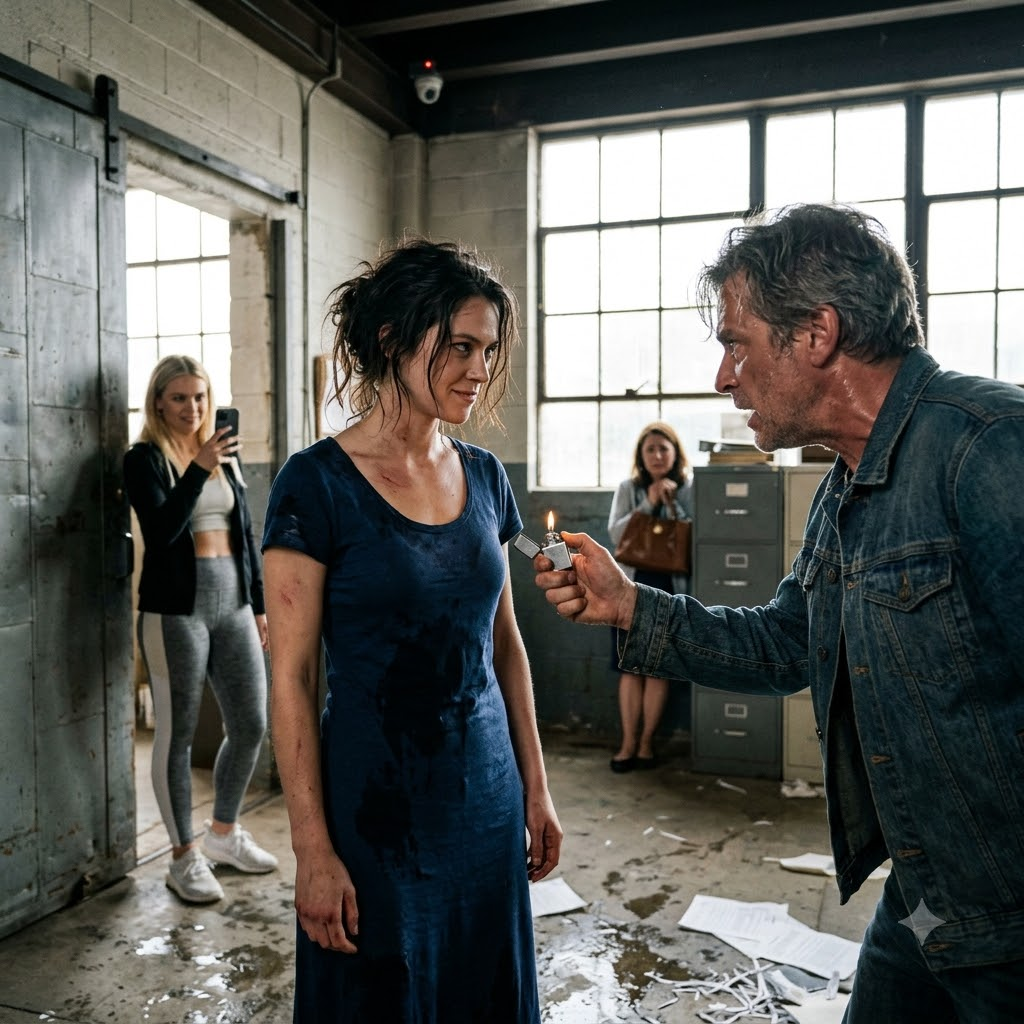
The three knocks came again.
Harder this time.
The steel warehouse door vibrated in its frame.
Alistair turned toward it, his silver lighter still burning between his fingers.
"Who the hell is that?"
Nobody answered.
Sloan lowered her phone.
For the first time since I had entered Warehouse Four, my half-sister looked genuinely uncomfortable.
"Maybe it's someone from the property office," she whispered.
Alistair shot her a furious look.
"Nobody from the property office knows we're here."
Another knock echoed through the building.
Three sharp impacts.
Then silence.
I stood beside the foreman's desk, my gasoline-soaked dress clinging to my skin. The torn transfer deed lay scattered across the concrete floor.
My stepfather looked at me.
"What did you do?"
I didn't answer.
His eyes moved toward the ceiling again.
That tiny red indicator light continued glowing above the black steel beams.
"What is that?"
Sloan followed his gaze.
Her face changed.
"Is that a camera?"
Alistair's expression hardened.
He looked back at me.
"You set this up?"
I remained silent.
He took a step forward.
"Marin, I'm asking you a question."
I glanced at the lighter.
Then at the scattered paperwork.
"You should put that down."
He laughed, but there was no confidence in it.
"Don't tell me what to do."
For a moment, I thought he might move closer.
Instead, he looked toward the door again.
Something about those knocks had unsettled him.
And I knew exactly why.
Three weeks earlier, when Declan had read my grandfather's will, Alistair had believed he was about to become a very rich man.
He had walked into that attorney's office expecting an inheritance.
He had walked out with nothing.
And he had never forgiven me.
The meeting had taken place in a quiet conference room on the second floor of Declan's law office.
My grandfather's attorney had known him for nearly twenty years.
He had handled business acquisitions, property disputes, investment arrangements, and the complicated paperwork that came with running three commercial warehouse complexes.
I trusted him because my grandfather had trusted him.
That morning, I arrived carrying the old notebook Thaddius had given me when I was sixteen.
I had no idea how important that little book would become.
Alistair arrived wearing a charcoal suit and an expensive watch.
Sloan came with him, dressed in a cream designer jacket and carrying a handbag that probably cost more than my monthly rent.
My mother followed quietly.
Nobody greeted me.
Alistair simply glanced at the notebook on my lap.
"Still carrying that old thing?"
I closed it.
"Yes."
He shook his head.
"Your grandfather filled your head with useless nonsense."
I didn't respond.
Declan entered a few minutes later.
He carried a thick leather folder and a smaller envelope.
"Thank you for coming," he said.
Alistair leaned back in his chair.
"Let's get this over with. Thaddius would have wanted the business handled quickly."
Declan gave him a polite nod.
"Of course."
He opened the folder.
The first pages contained administrative details about my grandfather's estate.
Then came the distribution provisions.
Declan explained that Thaddius had spent several years reviewing his succession arrangements.
He had considered selling part of the business.
He had considered bringing in outside management.
He had also considered offering certain relatives limited financial support.
But ultimately, he had made his decision.
"The primary beneficiary of the estate is Marin."
Alistair frowned.
"Meaning what?"
Declan looked directly at him.
"Meaning that Marin inherits the estate in accordance with the terms of the will."
"How much?"
Declan paused.
"The current estimated value is approximately $8.5 million."
Sloan stopped scrolling through her phone.
My mother looked down.
Alistair leaned forward.
"That includes the warehouses?"
"Yes."
"The investment accounts?"
"Yes."
"The liquid funds?"
"Yes."
Alistair's fingers tightened around the arms of his chair.
"And who manages all of that?"
Declan folded his hands.
"Marin will have the authority and responsibilities provided under the estate documents and applicable business arrangements."
Alistair stared at him.
"She's twenty-eight."
"Yes."
"She doesn't have the experience."
"She has been working in logistics and supply chain operations for several years."
"That's not the same thing as owning a commercial property empire."
"No one suggested it was."
The attorney's calmness seemed to irritate him more than an argument would have.
Alistair turned toward me.
"You knew about this?"
"No."
"You knew he was planning to leave you everything?"
"I didn't."
"Don't lie."
I looked at him.
"Why would I need to lie?"
His face reddened.
Sloan leaned forward.
"This is ridiculous. Grandpa wouldn't have wanted the family divided like this."
Declan opened another section of the folder.
"Your grandfather specifically addressed that possibility."
He read a paragraph explaining that the distribution was intentional and that the estate was not to be divided simply because relatives disagreed with the beneficiary.
I remember those words clearly.
They were written in a way that left very little room for interpretation.
Alistair pushed his chair backward.
"Well, I'm not accepting this."
Declan remained composed.
"You're not required to accept it emotionally. The legal document is what governs the distribution."
My stepfather looked at me.
His expression was unlike anything I had seen before.
It wasn't ordinary anger.
It was resentment mixed with disbelief.
He had imagined himself inheriting a fortune.
Instead, the money had gone to the daughter he had spent years treating like an inconvenience.
And he couldn't understand why.
In the days following the reading, I began learning what my grandfather had actually left me.
There were three commercial warehouse complexes.
Each contained multiple units leased to businesses involved in distribution, manufacturing, and storage.
There were investment portfolios, liquid accounts, and several business-related assets.
It wasn't simply a pile of money.
It was a functioning commercial operation.
The more I learned, the more I understood why my grandfather had been so careful about succession.
He had built something that required attention.
He wanted it protected.
Declan arranged meetings with financial advisers and estate professionals.
I began reviewing property records.
I asked questions about leases.
I studied operating expenses.
I learned which tenants had long-term contracts and which agreements were approaching renewal.
For the first time, I felt as if my grandfather had given me more than an inheritance.
He had given me a responsibility.
I didn't want to sell everything and disappear.
I wanted to understand what he had built.
That decision made Alistair furious.
He had assumed I would eventually become overwhelmed and ask him to take control.
He even offered to help.
His first proposal sounded reasonable.
"I can oversee the warehouses," he told me during a phone call. "You can concentrate on your regular job."
I asked what compensation he expected.
He laughed.
"We're family, Marin."
I waited.
Then he said a percentage of the operating income would be appropriate.
I declined.
His tone changed immediately.
"You don't know what you're doing."
"I know enough to hire qualified people."
"You need someone who understands construction."
"Then I'll consult a construction professional when necessary."
He ended the call.
Two days later, he sent another message.
YOU'RE MAKING A BIG MISTAKE.
I saved it.
The next week, he arrived at my workplace without an appointment.
My manager later told me that he had been asking questions about my schedule.
He wanted to know when I finished work.
He wanted to know whether I usually drove home alone.
I didn't confront him.
I simply documented the visit.
Then Sloan joined the campaign.
She posted a photograph of the family at my grandfather's funeral.
The caption suggested that some people only remembered their relatives when money was involved.
Several people commented.
One asked whether she was talking about me.
Sloan responded with a sad-face emoji.
I didn't reply.
I had more important things to do.
But the harassment continued.
And eventually, my mother called.
"Marin, you need to stop this."
I was sitting at my kitchen table reviewing a property lease.
"What exactly am I stopping?"
"Your stepfather is having a terrible time."
I looked at the phone.
"Because he didn't inherit my grandfather's money?"
"Don't say it like that."
"How else should I say it?"
She sighed.
"Alistair thought your grandfather would leave him something."
"Why?"
"He helped with things over the years."
"What things?"
There was a pause.
I knew she didn't have an answer.
My grandfather had occasionally hired Alistair's contracting company for minor work. But that was business, not an agreement to transfer an estate.
"Your stepfather feels humiliated," she finally said.
I closed the lease.
"Mom, he came to my workplace asking about my schedule."
"He's worried about you."
"No. He's angry."
"You know how he is."
I closed my eyes.
There it was again.
The sentence that had followed me through childhood.
You know how he is.
It was always an explanation.
Never an excuse.
I had spent years accepting it because I wanted my mother to defend me.
But that day, I realized she wasn't going to.
"Does he know where I live?" I asked.
"Of course he knows."
"Has he been there?"
Another pause.
"Marin, don't turn this into something it isn't."
I ended the call.
I sat quietly for several minutes.
Then I opened my laptop and created another folder.
I named it FAMILY CONTACTS.
Inside, I saved the messages, call records, photographs, and details of every unwanted visit.
I wasn't planning revenge.
I was protecting myself.
At least, that was what I told myself.
The memory faded as another metallic sound came from the warehouse door.
I looked toward Alistair.
He had moved away from the ceiling camera.
His lighter was still open, but his hand had lowered slightly.
Sloan was now staring at the red indicator.
"Alistair," she whispered. "Maybe we should leave."
He snapped at her.
"How?"
She looked toward the locked door.
He followed her gaze.
For the first time, he seemed to understand that the situation was no longer entirely in his hands.
My mother finally spoke.
"Marin, what have you done?"
I looked at her.
It was a strange question.
She had watched him pour gasoline over me.
She had watched him threaten me with an open flame.
She had watched Sloan record it.
And now she wanted to know what I had done.
"I came here because he asked me to discuss some paperwork."
"Don't play games with me."
"I'm not."
Alistair stepped between us.
"Enough."
He pointed the lighter toward me.
"You think a little camera is going to save you?"
I didn't answer.
"Who installed it?"
Silence.
"Who have you been talking to?"
I looked at the ceiling.
He followed my eyes again.
The tiny red light remained steady.
My grandfather had always believed that commercial properties needed proper security.
He had invested in surveillance systems, access logs, alarm monitoring, and documented safety procedures.
I had reviewed some of those systems after inheriting the estate.
But I hadn't expected to need them for something like this.
The surveillance setup in Warehouse Four was part of the existing security infrastructure.
The recording system had been configured to preserve activity inside the facility.
The concealed camera was connected to the monitored system.
And the footage was being transmitted.
Alistair had never bothered to learn how any of it worked.
He had assumed the warehouses were just buildings.
To me, they were records.
Systems.
Evidence.
And a responsibility.
I looked toward the steel door.
Whoever was outside had knocked three times.
Then waited.
I could hear distant movement beyond the wall.
Sloan seemed to hear it too.
She slowly lowered her phone.
"Maybe we should call someone."
Alistair turned on her.
"Put that phone away."
"But—"
"NOW."
She flinched.
My mother moved toward the filing cabinet.
"Alistair, please. Just let her go."
He stared at her.
"Stay out of this."
"She's your stepdaughter."
"She's the reason we're in this situation!"
I almost laughed.
Not because anything was funny.
But because he had managed to blame me for refusing to hand him money that had never belonged to him.
He stepped toward the desk and grabbed the torn document.
The paper pieces slipped through his fingers.
"You think tearing this changes anything?"
I looked at the scattered pages.
"It changes whether I sign it."
His expression twisted.
"You ungrateful little—"
He stopped.
A small electronic chime came from somewhere near the desk.
Everyone looked toward the sound.
A tablet screen had illuminated beside the legal folders.
It was connected to the warehouse security system.
I could see a notification appear.
The system had registered activity outside the main entrance.
Alistair reached for it.
I spoke before he could touch the screen.
"Don't."
He froze.
Then he turned slowly toward me.
"Why?"
I didn't answer.
His eyes narrowed.
"What else is connected to that thing?"
I could feel the gasoline-soaked fabric sticking to my legs.
My skin was cold.
My heart was still beating too quickly.
But I kept my voice steady.
"You're asking the wrong questions."
Sloan stepped closer to the desk.
The tablet displayed another notification.
Then another.
My mother looked at the screen.
"What does that mean?"
Alistair snatched up the tablet.
His face changed as he read the message.
I couldn't see the entire display from where I stood.
But I saw three words clearly.
EXTERNAL ACCESS DETECTED.
Alistair looked toward the camera.
Then toward the locked door.
He suddenly seemed much less interested in the inheritance papers.
"Marin," he said quietly.
I met his eyes.
"What?"
His fingers tightened around the tablet.
"Who did you send the footage to?"
I said nothing.
He took a step toward me.
Then another.
The lighter flickered.
A new sound came from outside.
Metal scraping against metal.
The locking mechanism on the warehouse door began moving.
Sloan backed away.
My mother whispered something I couldn't hear.
Alistair looked at the door.
The handle slowly turned.
And someone on the other side began opening it.






Comments 0