"Your grandfather's signature."
Detective Harris repeated the words, and I felt the room tilt around me.
I stared at the phone.
"Are you certain?"
"We're examining the original document, but the signature appears consistent with the samples we have on file."
I looked at Declan.
He had gone completely still.
"Detective," he said, leaning closer to the phone, "what kind of agreement are we discussing?"
Harris shuffled some papers.
"It's a financial authorization connected to the warehouse operating accounts. The document appears to permit transfers through an account registered under Orla's name."
I gripped the edge of the kitchen counter.
"Did Grandpa authorize those transfers?"
"That's what we're trying to determine."
"But you said his signature was on it."
"Having his signature on a document doesn't automatically establish that every transaction conducted under it was legitimate."
Declan nodded slowly.
"Has the document been authenticated?"
"Not yet. We're arranging a forensic examination."
I looked at the financial records scattered across the table.
My mother's name.
My grandfather's signature.
Nearly half a million dollars.
And a series of transactions that didn't match the warehouse inventory.
It was becoming increasingly difficult to believe that everything had happened by accident.
"Detective, can I see the document?"
"Not yet. It's evidence."
"Then can you tell me when it was signed?"
There was a pause.
"Four years ago."
I looked at Declan.
He immediately opened his briefcase and began searching through the estate records.
Four years ago.
I remembered that period.
My grandfather had still been actively managing the business.
Alistair had been visiting the warehouses regularly.
My mother had been receiving phone calls at strange hours.
And I had been working long shifts, trying to save enough money to move into my own apartment.
I had never paid attention to what was happening inside the family's financial arrangements.
I had assumed my grandfather knew what he was doing.
Now I wondered whether he had been betrayed by the very people he trusted.
"Detective," I said, "did you find anything else?"
"Yes. There's a second signature on the agreement."
My stomach tightened.
"Whose?"
"Your mother's."
I closed my eyes.
Harris continued.
"We also recovered an earlier version of the document. It appears to have been modified."
Declan looked up sharply.
"Modified how?"
"The account instructions were changed, and one of the authorization sections contains different wording."
"Who made the changes?"
"We're investigating."
I took a slow breath.
"Thank you, Detective."
"I'll contact you when we have the forensic results. And Marin, please don't confront anyone about this."
"I won't."
He ended the call.
For a long moment, neither Declan nor I spoke.
Then I looked at the photograph of my grandfather.
"Why would he sign something like that?"
Declan sat down.
"There's a possibility he signed an earlier version without knowing how it would later be used."
"Could someone have changed the document after he signed it?"
"That is one possibility the investigators will need to examine."
I stared at the papers.
"So his signature might be real, but the agreement might not be."
"Exactly."
I looked at the photograph again.
My grandfather had been careful with money.
He had built his business by checking every expense.
He wouldn't have authorized hundreds of thousands of dollars in unexplained payments without asking questions.
Unless somebody had given him a convincing reason.
Unless he had trusted the wrong person.
I thought about my mother.
Then I thought about Alistair.
And for the first time, I wondered whether the two of them had been working together long before my grandfather died.
The following morning, Declan and I met with Detective Harris at the police station.
He had arranged for us to review certain portions of the financial evidence.
The original documents remained secured, but the detective showed us certified copies and photographs.
I sat across from him with a notebook.
Declan sat beside me.
Harris placed the first document on the table.
"This is the authorization agreement we recovered."
I studied it.
The title described a temporary financial administration arrangement.
The wording was complicated.
It appeared to allow payments to be processed through a designated account for operational expenses.
My mother's name was listed as the account holder.
My grandfather's name appeared beneath the authorization section.
Alistair's company was identified as one of the approved contractors.
I read the page twice.
"Why would my mother be responsible for warehouse payments?"
Harris shrugged.
"That is one of the questions we're investigating."
Declan leaned forward.
"Was she employed by the business?"
"No."
"Did she hold an official financial position?"
"Not according to the records we've reviewed."
I pointed to the second page.
"Then why does this describe her as an administrative representative?"
Harris looked at the document.
"That description is part of the disputed wording."
I examined the signatures.
My grandfather's handwriting was familiar.
I had seen it on birthday cards, handwritten notes, and the old notebook he gave me.
The signature looked genuine.
But I noticed something else.
The date beside it had been typed.
The date beside my mother's signature was handwritten.
I pointed this out.
Harris nodded.
"Our forensic team has noticed that too."
"Could the signatures have been collected at different times?"
"Possibly."
I looked at Declan.
He was studying the bottom of the document.
"There is a witness section," he said.
Harris turned the page.
The witness name had been printed beneath the signatures.
I read it.
Then I stopped.
"That's impossible."
Declan looked at me.
"What?"
I pointed at the name.
It belonged to a man named Raymond Ellis.
I knew him.
He had worked as an administrative supervisor at one of my grandfather's warehouse complexes.
But he had died before the date printed on the agreement.
I looked at Harris.
"Raymond was dead."
The detective's expression changed.
"Are you certain?"
"Yes. I remember his funeral."
Declan checked his notes.
"Raymond Ellis passed away approximately six months before this document was supposedly witnessed."
Harris leaned back.
That was the first time I saw genuine surprise on his face.
"Then this document has a much bigger problem than we thought."
I stared at the page.
If the witness had already died, the agreement could not have been executed in the way it claimed.
Either the date was wrong.
Or the witness information had been added later.
Or someone had deliberately created a false record.
I looked at the authorization section again.
"Could the original have been signed earlier and then altered?"
Harris nodded.
"That's exactly what our forensic team is examining."
Declan folded his hands.
"Do you have any indication of who prepared it?"
"Not yet."
I looked down.
The signature might have been genuine.
But the document itself was becoming increasingly suspicious.
My grandfather might have signed something entirely different.
And somebody might have used his signature to justify years of questionable payments.
After the meeting, I called my mother.
She answered on the fourth ring.
"Marin?"
Her voice sounded tired.
"Mom, we need to talk."
"About what?"
"The financial account."
She went quiet.
I continued.
"Detective Harris found an agreement with your name and Grandpa's signature."
Her breathing changed.
"I don't know what you're talking about."
"Then explain why your name is on it."
"Your grandfather handled those things."
"Did you receive money from the warehouse accounts?"
She didn't answer.
"Mom?"
"I didn't steal anything."
I closed my eyes.
"I didn't say you did."
"That's what everyone is accusing me of."
"Then tell me what happened."
There was a long pause.
Finally, she spoke.
"Alistair said it was temporary."
"What was temporary?"
"The account."
I felt my heart begin beating faster.
"Why was it opened?"
"He told me your grandfather wanted a separate account for certain expenses."
"Did Grandpa tell you that?"
"Alistair said he had discussed it with him."
"Did you speak to Grandpa yourself?"
Another pause.
"Not about the details."
I gripped the phone.
"Mom, did you sign the agreement?"
"Yes."
"Did you read it?"
"I trusted Alistair."
The answer was so quiet that I almost missed it.
I looked toward the window.
"Did you know the account was receiving payments from the warehouses?"
"He said the money was for expenses."
"Which expenses?"
"I don't remember."
"How can you not remember four hundred and eighty thousand dollars?"
Her voice became defensive.
"It wasn't all at once!"
I went silent.
She had just confirmed that she knew about the amount.
"Then you do remember the transactions."
"I remember some money coming through the account."
"What happened to it?"
"Alistair handled everything."
"Did you keep any of it?"
"No."
"Did you transfer it to his company?"
"I don't know."
I pressed my fingers against my forehead.
"Mom, you need to understand how serious this is."
"I know!"
"Then tell the police everything."
She began crying.
"I can't."
"Why not?"
"Because you don't understand what will happen."
I sat straighter.
"What are you afraid of?"
She whispered something.
I couldn't hear it.
"Mom?"
Then she said it again.
"I'm afraid of Alistair."
The words landed heavily.
I closed my eyes.
For years, she had defended him.
She had explained his anger.
She had asked me to be patient.
And now she was admitting that she was afraid of him.
I wanted to ask why she had allowed him to threaten me.
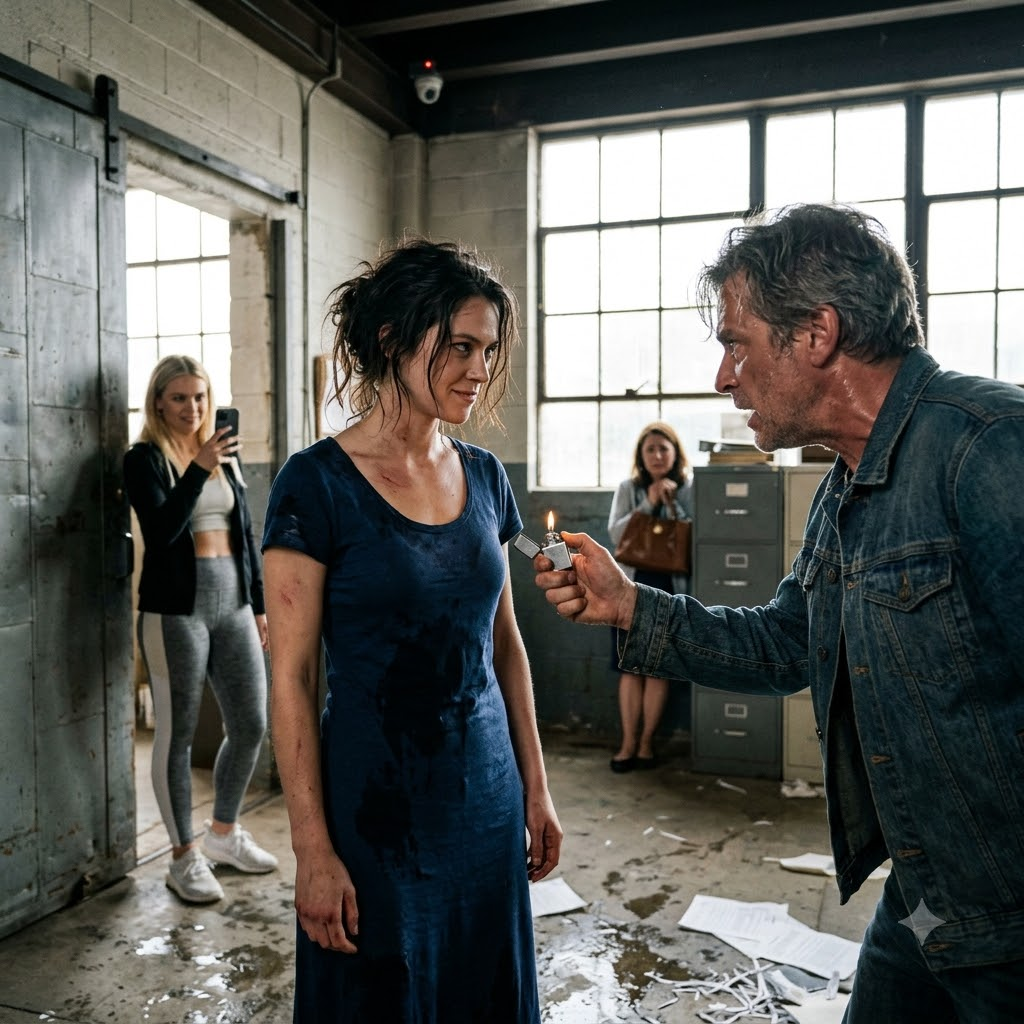
I wanted to ask why she had stood there while he poured gasoline on my dress.
Instead, I asked one question.
"Did you know he was going to hurt me at Warehouse Four?"
She began sobbing.
"No."
"Did you know the door would be locked?"
"I thought he just wanted you to stay until you signed."
I stared at the floor.
"Mom, that's not an answer."
She didn't speak.
Then she whispered:
"Alistair told me you would eventually agree."
I ended the call.
I couldn't listen anymore.
That evening, I returned to the main warehouse complex with Declan and a police investigator.
The property was still operating.
Employees were moving inventory.
Forklifts passed through the loading areas.
Delivery trucks waited near the entrances.
Everything looked ordinary.
That was the strange part.
I had spent years working in environments like this.
To me, warehouses represented order.
Every shipment had a destination.
Every inventory movement needed documentation.
Every payment needed a corresponding explanation.
Yet behind the ordinary activity of this business, somebody had apparently been moving money through accounts that didn't match the records.
Declan led us toward the administrative office.
"We'll begin with the original files."
The office was smaller than I remembered.
My grandfather's desk stood against the far wall.
A framed photograph of him sat beside a wooden clock.
I stopped.
He looked happy in the picture.
He was standing outside the first warehouse he had ever owned.
His sleeves were rolled up.
His hair was darker.
He was holding a set of keys.
I touched the frame.
"I remember this day."
Declan stood beside me.
"He was very proud of that building."
"He used to tell me that the first warehouse was almost impossible to afford."
"He told me that too."
I smiled faintly.
Then I looked at the desk.
"Where are the original financial records?"
The investigator opened a filing cabinet.
"Some are here. Others were transferred to secure storage."
We spent the next hour examining files.
There were invoices, purchase orders, maintenance agreements, and bank statements.
I recognized several transaction numbers from the documents Declan had shown me.
I began arranging them chronologically.
The pattern became clearer.
A purchase order would be created.
A contractor invoice would follow.
A payment would be authorized.
But the receiving records would either be incomplete or missing entirely.
I looked at one of the invoices.
"This delivery never happened."
The investigator leaned closer.
"How do you know?"
"The warehouse inventory doesn't show the materials arriving. There's no receiving confirmation. And the shipping reference doesn't match the carrier records."
Declan examined the page.
"Could the shipment have been redirected?"
"Then there should be a record of that too."
I turned another page.
"Someone was approving payments without the required delivery verification."
The investigator wrote something down.
"Can you identify who approved them?"
I pointed to the initials.
"Some of these belong to the old operations manager. But others are different."
Declan looked at the list.
"Could they belong to Alistair?"
"Possibly."
I checked the employee authorization records.
The initials were not listed among the official approvers.
That made the situation even more troubling.
I opened another folder.
Inside was a printed email.
The sender was Alistair.
The recipient was my grandfather.
The subject line read:
WAREHOUSE FOUR — URGENT PAYMENT APPROVAL.
I began reading.
Alistair claimed that a supplier needed immediate payment because a shipment was being held.
He asked my grandfather to approve the transfer without waiting for the usual receiving documentation.
The message was dated four years earlier.
I looked at the attached approval.
My grandfather had written a short note.
Hold until verified.
I read it again.
Then I found another email.
This one was dated several days later.
Alistair had written that the issue had been resolved.
But there was no supporting documentation.
I turned toward Declan.
"Grandpa refused the payment."
He nodded.
"Apparently."
"Then how did the money leave the account?"
The investigator took the email.
"We'll trace the transaction."
I looked at the filing cabinet.
There were dozens of similar records.
Some had been neatly arranged.
Others were missing.
It was beginning to look as though my grandfather had been trying to reconstruct something before his death.
I searched the remaining folders.
Then I found a small envelope tucked behind an old lease agreement.
My name was written on it.
I pulled it out.
Declan immediately noticed.
"Marin?"
I opened the envelope.
Inside was a single page.
It contained a handwritten list of dates and account references.
At the bottom was a sentence.
If they ask about the original contract, look beneath the old dispatch ledger.
I looked at Declan.
"What original contract?"
He read the note.
His expression became serious.
"The one we haven't found."
We searched the office.
There were several old ledgers in a cabinet near the desk.
Most contained shipping records from years earlier.
I recognized the format.
My grandfather had kept paper records long after the company moved to digital systems.
He believed physical documents were useful when computers failed.
I pulled out the oldest dispatch ledger.
It was thick and covered in dark green fabric.
I placed it on the desk.
Declan helped me examine the pages.
We found ordinary delivery entries.
Dates.
Vehicle numbers.
Supplier references.
Receiving signatures.
Nothing unusual.
Then I noticed that the back cover felt thicker than it should.
I ran my fingers along the edge.
There was a narrow gap.
"Declan."
He leaned closer.
I carefully opened the back cover.
A folded piece of paper was hidden inside.
I removed it.
It was a copy of a contract.
The heading identified an agreement between my grandfather's company and a supplier.
The supplier's name was familiar.
It appeared on several of the questionable invoices.
I read the first paragraph.
Then the second.
My eyes moved to the signature section.
There were three names.
Thaddius.
Orla.
And Alistair.
But the document had been dated more than a year before the financial authorization agreement.
I looked at the bottom.
There was a handwritten note in my grandfather's writing.
This is not the contract I approved.
I felt a chill.
Declan took the page.
He read it slowly.
Then he turned it over.
There was another note.
The original is held by the person who arranged the first transfer.
I looked at him.
"Who arranged it?"
He shook his head.
"I don't know."
I examined the supplier details.
The company address was listed at the bottom.
It was the same address that appeared on the questionable invoices.
I looked at the signature again.
My grandfather's name appeared genuine.
My mother's signature was different.
And Alistair's signature had been written in a heavier hand.
Something about the document bothered me.
I turned to the last page.
There was a small reference number.
W4-17.
The same number from the photograph.
I felt my pulse quicken.
This wasn't an ordinary contract.
It was the document my grandfather had been trying to find.
The one connected to the missing account.
The one somebody had hidden inside an old dispatch ledger.
I handed it to the investigator.
"Please secure this."
He placed it inside an evidence folder.
Declan looked at the page again.
"Marin, we need to find the original."
I nodded.
"How?"
He pointed to the handwritten note.
"By identifying the person who arranged the first transfer."
I looked at the three signatures.
Thaddius.
Orla.
Alistair.
My grandfather had been trying to expose something.
My mother had been involved.
My stepfather had threatened me to obtain control of the warehouses.
And somewhere, an original contract existed that could explain why.
I took out my phone.
A new message had arrived.
Unknown number.
I opened it.
There was a photograph of the original contract.
The signature section was visible.
But this time, there was a fourth name.
A name that did not appear on the copy we had just discovered.
Beneath the photograph was one sentence.
Your grandfather never knew who really owned the supplier company.
I stared at the screen.
Then another message arrived.
And neither does your mother.






Comments 0