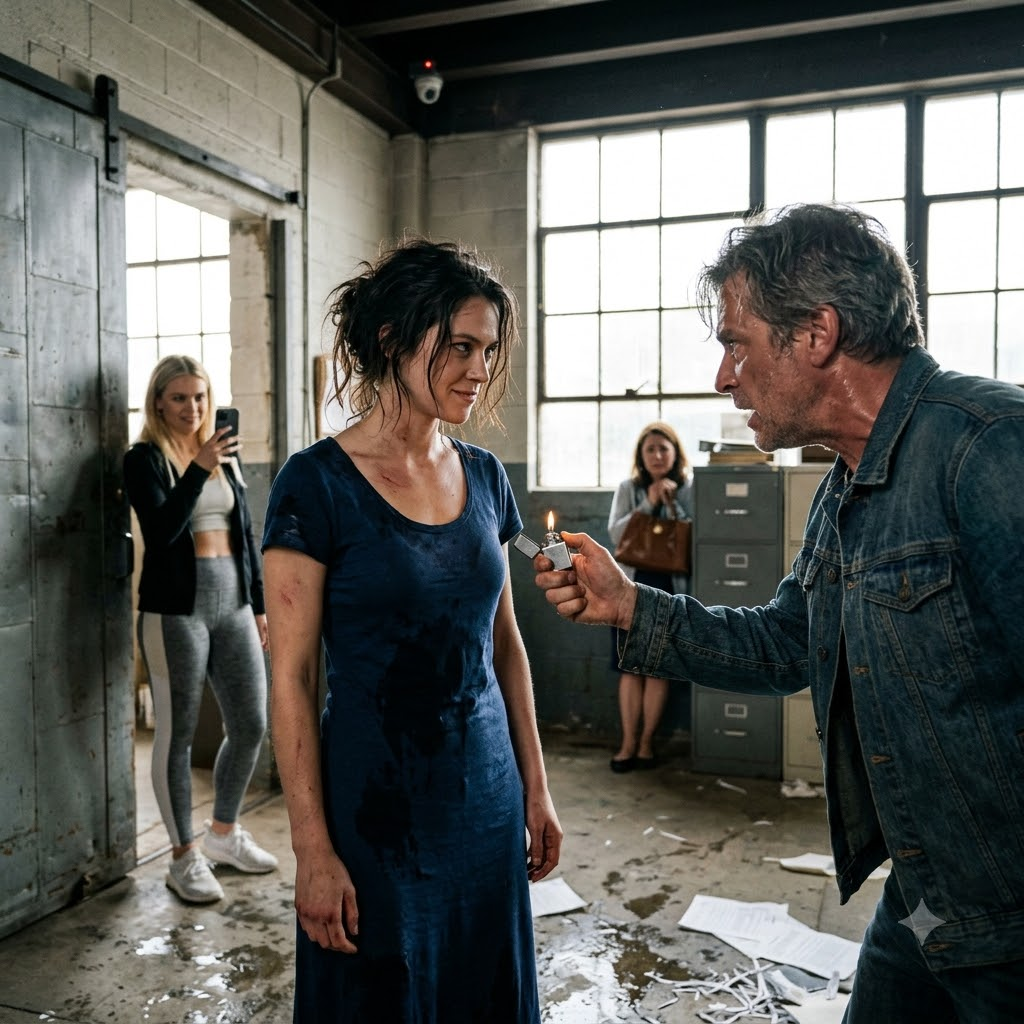
"Sign the papers, Marin, or I'll burn you alive!"
My stepfather pressed a lit silver Zippo toward my gasoline-soaked dress.
Three weeks after my grandfather's funeral, I was standing inside Warehouse Four, watching the man who had spent twenty years making my life miserable threaten to murder me for an inheritance.
And he was smiling.
Alistair believed he had finally won.
Behind him, my half-sister Sloan held her phone vertically, recording every second. My mother, Orla, stood beside a gray filing cabinet, her hands clasped tightly in front of her burgundy blouse.
Nobody moved.
Nobody spoke.
I looked at the little yellow flame dancing near my sleeve.
Then I looked at the man holding it.
"Are you going to sign?" Alistair demanded.
I glanced down at the transfer deed on the foreman's desk.
Then I smiled.
Not because I wasn't afraid.
But because he had absolutely no idea what was happening above his head.
My name is Marin, and until that afternoon, I had spent most of my life believing that being born into a family meant you were supposed to keep forgiving it.
I was twenty-eight years old.
I worked as a logistics supply chain coordinator, a job that required me to solve problems before anyone else noticed they existed. I managed shipments, negotiated delivery schedules, handled warehouse inventories, and spent more nights staring at spreadsheets than sleeping.
It wasn't glamorous.
But it paid my bills.
And I had earned every dollar myself.
My childhood had taught me that depending on other people was dangerous.
My biological father had disappeared when I was young. My mother eventually married Alistair, a contractor who spoke loudly, spent recklessly, and treated every disagreement like a personal attack on his authority.
He never liked me.
At first, I thought it was because I wasn't his daughter.
Later, I understood that he simply disliked anyone he couldn't control.
His daughter Sloan was different.
She could ask for a thousand dollars and receive it before finishing her sentence. She could destroy an expensive phone, blame somebody else, and have a replacement delivered the next morning.
At twenty-four, she had built a modest social media following by posting designer outfits, restaurant visits, and carefully staged photographs of a life she couldn't actually afford.
I knew about the debt.
I knew about the unpaid credit cards.
I knew about the money she borrowed from friends and never returned.
But I never mentioned any of it.
I had learned that speaking the truth in our family rarely changed anything.
It only made me the problem.
My grandfather, Thaddius, was the exception.
He had built a successful building-supply business from almost nothing. His first warehouse had been little more than a rented concrete building with a leaking roof.
Over the years, he turned that small operation into a commercial empire.
He owned three large warehouse complexes, maintained substantial investment portfolios, and had accumulated a fortune estimated at $8.5 million.
But money wasn't what made him important to me.
He was the only person in my family who ever asked how I was doing and actually waited for the answer.
When I was sixteen, he discovered that I was working late shifts to save for college.
Instead of lecturing me, he handed me an old notebook.
Inside were handwritten lessons about inventory management, transportation costs, commercial leases, and negotiating with suppliers.
"Learn how things move, Marin," he told me once. "The person who understands the movement of things will eventually understand where the money goes."
I kept that notebook.
I still had it when he died.
Three weeks before the confrontation at Warehouse Four, I attended his funeral.
Alistair arrived wearing an expensive dark suit and an expression of solemn importance.
Sloan posted a photograph of herself outside the church before the service even began.
My mother cried into a tissue.
I sat quietly in the front row, holding my grandfather's old notebook inside my handbag.
I didn't know that the reading of his will would destroy what remained of my family.
The attorney, Declan, had arranged a meeting several days after the funeral.
He was a professional, composed man in his early sixties who had handled my grandfather's legal affairs for years.
Alistair arrived early.
He even shook Declan's hand.
"Thaddius always knew I was the one capable of continuing his business," he said.
I remembered that sentence because of the confidence with which he delivered it.
He had spent years criticizing my grandfather's business decisions.
He had called the warehouse expansion a waste of money.
He had once suggested that Thaddius should sell everything and retire.
But apparently, in Alistair's imagination, he had always been the natural successor.
Declan opened the will.
He read through several paragraphs concerning charitable donations, personal possessions, and outstanding business arrangements.
Then he reached the inheritance distribution.
"The entire remaining estate, including liquid assets, investment portfolios, and ownership interests in the three commercial warehouse complexes, is bequeathed exclusively to Marin."
Nobody spoke.
I remember hearing the faint ticking of a clock on the wall.
Declan continued.
"The estimated total value of the estate is approximately eight million five hundred thousand dollars."
Alistair stared at him.
Then he laughed.
It wasn't a happy laugh.
It was the kind of sound a person makes when reality has personally insulted him.
"That's a mistake."
Declan adjusted his glasses.
"No, Mr. Alistair. The will is valid and has been properly executed."
"She doesn't know anything about running a business!"
"I am not here to evaluate the beneficiary's qualifications."
"She's a nobody!"
I looked at my grandfather's attorney.
I didn't answer.
Sloan's face had gone pale.
My mother looked at me as if I had somehow taken something directly from her hands.
Alistair stood so abruptly that his chair scraped against the floor.
"You're telling me he left everything to HER?"
Declan closed the folder.
"Yes."
That was the moment I understood that my inheritance would cost me something much more valuable than money.
It would cost me the illusion that my family loved me.
The following weeks were miserable.
Alistair called repeatedly.
At first, he tried to sound reasonable.
He suggested that I transfer the warehouses into a family trust.
Then he proposed that he manage the business while I received a monthly allowance.
When I refused, his voice changed.
He called me selfish.
He accused me of manipulating an old man.
Sloan posted vague messages about greedy relatives and betrayal.
My mother called late one evening and asked me why I was doing this to the family.
I asked her what exactly I had done.
She didn't answer.
Instead, she said, "You know how your stepfather gets when he's under pressure."
I looked at the phone in my hand.
I had heard that sentence since childhood.
It had always meant the same thing.
I was expected to make his behavior easier for everyone else.
I refused.
I began reviewing the commercial properties and arranging meetings with the estate's financial advisers.
I also discovered that Alistair had substantial financial problems of his own.
His contracting business had accumulated unpaid obligations.
Several projects had stalled.
Some suppliers had stopped extending credit.
Sloan's lifestyle was becoming increasingly expensive, and she had apparently been relying on Alistair to cover more than one outstanding debt.
The inheritance represented a solution to problems they had created themselves.
They didn't see it as something my grandfather had given me.
They saw it as money that had been stolen from them.
Then came the messages.
The first arrived from an unknown number.
YOU THINK YOU CAN KEEP EVERYTHING?
I deleted it.
The second was more direct.
YOUR GRANDFATHER IS DEAD. HE CAN'T PROTECT YOU.
I saved that one.
The third came through Sloan's social media account.
A photograph of me leaving work had appeared online with a caption about ungrateful daughters.
I didn't respond.
I documented everything.
I had spent years working in logistics. Documentation was second nature to me.
Dates.
Times.
Screenshots.
Call records.
Every message went into a folder.
I didn't know exactly what I would need it for.
But I knew better than to assume the threats would disappear.
The invitation to Warehouse Four arrived on a Thursday morning.
Alistair sent a short message.
WE NEED TO DISCUSS THE FINAL TRANSFER DOCUMENTS. COME ALONE.
I almost ignored it.
Then I noticed that he had attached a photograph of a legal deed.
It appeared to be a document concerning the ownership transfer of one of the commercial properties.
I knew it wasn't the final estate paperwork.
Declan had already explained that the inheritance couldn't simply be transferred through an informal agreement.
But I wanted to know what Alistair was planning.
I also wanted to end the constant harassment.
So I went.
I wore a simple ivory cotton dress and dark brown ankle boots.
I brought my handbag.
I did not expect a family meeting.
I expected an argument.
When I arrived, the warehouse door was partially open.
I walked inside.
The first thing I noticed was Sloan.
She was standing near the entrance, holding her smartphone.
The second thing I noticed was my mother.
She was standing beside an old filing cabinet.
Then I saw Alistair.
He was waiting near the foreman's desk.
There were papers spread across its surface.
"You're late," he said.
I looked at the large industrial clock on the wall.
I was three minutes early.
"What is this about?"
"The transfer."
"I already told you I'm not signing anything."
His jaw tightened.
"You're going to listen to me for once."
I placed my handbag on the desk.
"No. You're going to explain why you keep sending me documents that aren't part of the estate process."
He stepped toward me.
"Because your grandfather made a mistake."
"That's not a legal explanation."
His expression darkened.
Sloan lifted her phone.
"Just sign the papers, Marin. You're making this embarrassing."
I turned toward her.
"Are you recording?"
She smiled.
"Maybe."
I looked back at Alistair.
"Where's the attorney?"
He didn't answer.
Instead, he walked toward the heavy sliding door.
He pulled it shut.
The sound of steel moving against steel echoed through the warehouse.
Then Sloan stepped forward and drove the locking bolt into place.
The metallic thud seemed louder than it should have been.
I looked at the door.
Then at my mother.
She avoided my eyes.
Something inside me went cold.
"Open it," I said.
Alistair turned around.
"Not until we finish."
"Then we're finished."
I reached for my handbag.
He moved faster.
His hand closed around my wrist.
"Don't you dare walk away from me."
I pulled my arm free.
"Get your hands off me."
For a moment, nobody moved.
Then Alistair reached toward a container sitting near the desk.
I recognized the sharp chemical smell before I understood what he was doing.
Gasoline.
He poured it over my dress.
The cold liquid soaked through the fabric.
I stumbled backward.
"Alistair!"
He grabbed the front of my sleeve.
"Where are the papers?"
I stared at him.
Sloan continued recording.
My mother whispered his name, but she didn't approach.
Then Alistair reached into his jacket.
He pulled out a silver Zippo lighter.
I watched his thumb flick the lid open.
Click.
A small flame appeared.
He brought it closer.
"Sign the papers or burn alive!"
The gasoline stung my skin.
My heartbeat was so loud that I could barely hear anything else.
I was afraid.
Of course I was afraid.
I didn't want to die inside a warehouse because three people who shared my bloodline wanted access to money.
But fear wasn't going to make me give them what they wanted.
I looked toward the foreman's desk.
The legal transfer deed was lying there.
Alistair followed my eyes.
"Pick it up."
I didn't move.
"Pick it up, Marin!"
I slowly walked toward the desk.
The lighter followed me.
Sloan adjusted her phone to keep me in frame.
"Look at that," she said. "Finally doing what she's told."
I reached for the document.
The paper felt unusually heavy in my hand.
I looked at the signature line.
My name had already been printed beneath it.
All I had to do was sign.
Alistair leaned closer.
"Do it."
I raised my eyes.
For the first time that afternoon, I allowed myself to smile.
Then I tore the document in half.
The sound was sharp.
Clean.
Final.
I tore it again.
The pieces fell onto the desk and scattered across the concrete floor.
Alistair stared at me.
His mouth opened.
"What did you just do?"
I said nothing.
His lighter remained raised.
Sloan stopped smiling.
My mother took one step away from the filing cabinet.
I looked directly at Alistair.
"That document was never going to be signed."
His face turned red.
"You stupid little—"
He moved toward me.
But I wasn't watching his face anymore.
I was watching the ceiling.
Above the exposed black beams, near the far end of the warehouse, a tiny red indicator light was still glowing.
The concealed camera had been recording since before I arrived.
And somewhere beyond the locked steel door, people were watching.
People who had already heard his threats.
People who knew exactly what he had done.
Alistair followed my gaze.
His eyes moved upward.
For the first time, I saw uncertainty on his face.
Then a faint mechanical sound came from somewhere outside the warehouse.
A sound like a vehicle stopping.
Sloan lowered her phone.
"Alistair?"
He didn't answer.
The silver lighter was still burning in his hand.
And then somebody struck the steel warehouse door three times.
Hard.






Comments 0