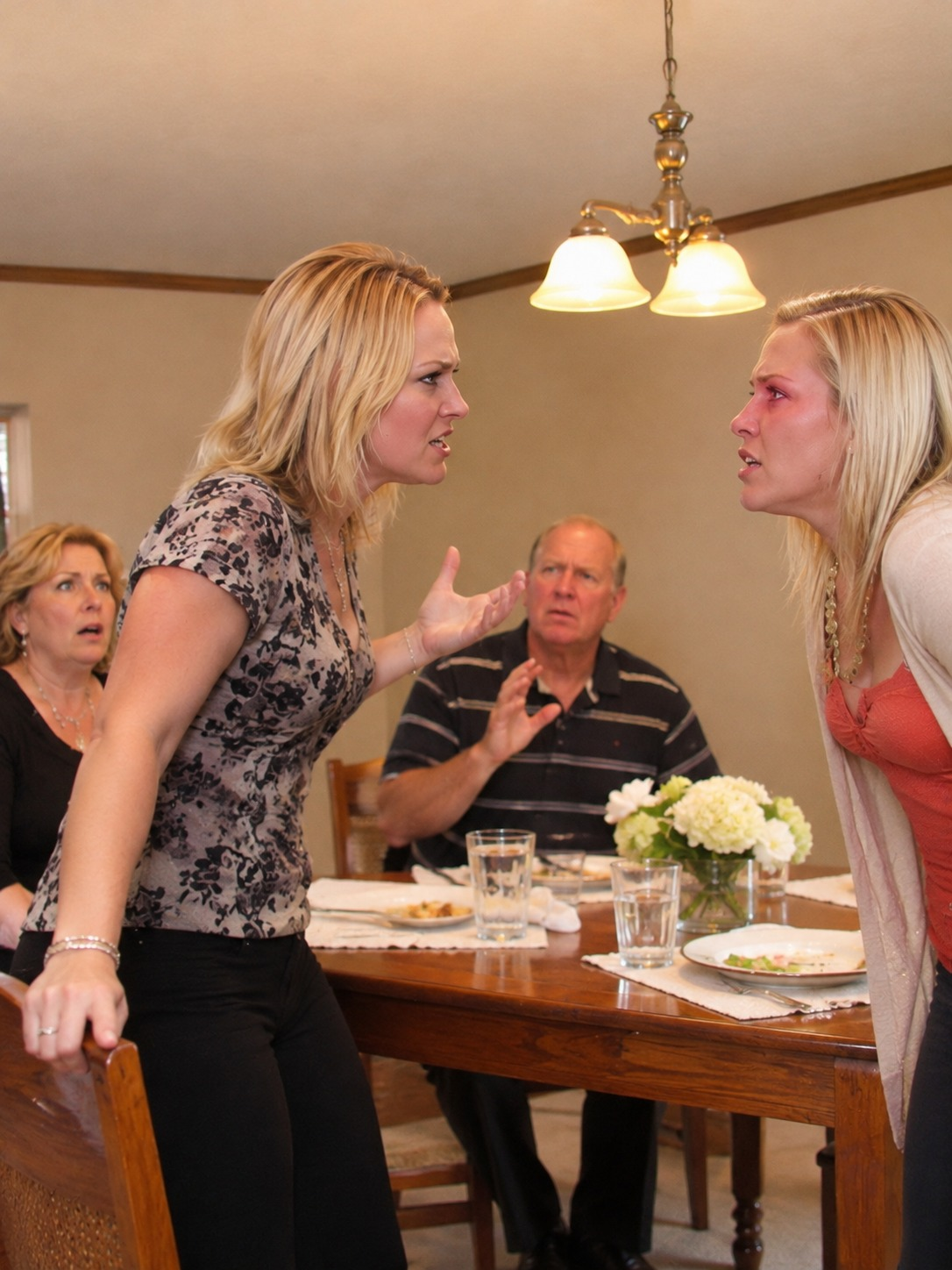
“Tell me what, Mom?”
For several seconds, the only sound coming through the phone was my mother's breathing.
I stood beside my kitchen counter, staring at the photograph Bonnie had sent.
The envelope looked ordinary.
Cream-colored paper. Black lettering. A slightly damaged corner.
Yet somehow, I knew whatever was inside had the power to change the way I remembered an entire period of my life.
“Your father and I made a decision,” Mom finally said.
“What decision?”
“We thought we were doing what was best for the family.”
I tightened my grip on the phone.
“What does that have to do with my application?”
“You were very young.”
“I was sixteen.”
“Exactly. You didn't understand everything that was happening at home.”
“Then explain it to me now.”
She sighed.
“Bonnie was having a difficult time.”
Of course.
Even before I understood what my mother was about to confess, my younger sister had already become the center of the conversation.
“What kind of difficult time?”
“She was struggling academically. Your father and I were concerned about her confidence.”
“And?”
“You were receiving so much attention from your teachers. There were awards, certificates, special programs. Bonnie felt overlooked.”
I stared at the kitchen wall.
“Are you telling me that my achievements were a problem?”
“No, sweetheart. That's not what I'm saying.”
“Then what are you saying?”
“We wanted both our daughters to feel equally valued.”
I almost laughed.
For years, Bonnie had been praised for her appearance, popularity, and ability to make friends.
Nobody had ever asked her to become less attractive so I could feel better about myself.
Nobody had suggested she turn down invitations to parties because I hadn't been invited.
But apparently, my academic achievements had required intervention.
“Did you know Bonnie took my folder?”
My mother didn't answer.
“Mom?”
“We found it eventually.”
“When?”
“After the deadline.”
“How long after?”
“I don't remember.”
“Try.”
Her voice became defensive.
“It was fifteen years ago. I can't remember every detail.”
I walked toward my living room window.
Outside, people were walking their dogs, carrying groceries, and returning home from work.
Ordinary people living ordinary lives.
Meanwhile, I was discovering that something I had believed was an unfortunate childhood accident might have been something entirely different.
“Why didn't you tell me you found it?”
“Because you were already upset.”
“I was upset because I thought I'd lost everything.”
“We didn't want to make things worse.”
“For whom?”
Another silence.
I already knew the answer.
“For Bonnie?” I asked.
“She's your sister.”
“And I'm your daughter.”
My mother began crying.
It was a familiar response.
Whenever a conversation became uncomfortable enough that she could no longer defend her decisions, tears usually appeared.
As a child, I had immediately apologized whenever she cried.
I couldn't stand the thought of hurting her.
As an adult, I was beginning to understand that her discomfort didn't automatically make me responsible for ending the conversation.
“What was inside the envelope?” I asked.
“Please don't do this tonight.”
“Tell me.”
“Your father should be part of this conversation.”
“Put him on the phone.”
“He's outside.”
“Then go get him.”
She hesitated.
Finally, she said something that made my knees feel weak.
“You were accepted.”
I sat down.
“What?”
“The leadership institute. You were accepted.”
For a moment, I couldn't speak.
I remembered the application deadline.
The panic.
The hours spent searching my bedroom.
The desperate conversation with Mrs. Sullivan, my guidance counselor, when I explained that my materials had disappeared.
I remembered sitting at her desk, trying not to cry while she helped me reconstruct what she could.
She had already submitted my teacher recommendations and preliminary application electronically.
The remaining documents were supposed to be delivered separately.
She encouraged me to submit replacement copies, even though the deadline had nearly passed.
I had done everything possible.
Then I had waited.
Every afternoon, I checked the mailbox.
Every evening, I asked my mother whether anything had arrived.
Eventually, she told me the institute must have selected other students.
I believed her.
For fifteen years, I believed her.
“You told me I wasn't accepted,” I whispered.
“I know.”
“Why?”
“Things were complicated.”
“No. They weren't.”
“Your father and I had concerns about sending you away for several weeks.”
“The program offered financial assistance.”
“It wasn't just about money.”
“Then what was it about?”
She began crying harder.
I felt something unfamiliar rising inside me.
Not sadness.
Not embarrassment.
Anger.
Real anger.
The kind I had spent most of my life swallowing because expressing it would have made everyone else uncomfortable.
“You let me believe I failed.”
“We thought there would be other opportunities.”
“You watched me cry.”
“Please.”
“You watched me blame myself.”
“I never wanted to hurt you.”
“But you did.”
She didn't respond.
I ended the call.
For several minutes, I remained seated on my couch.
My apartment suddenly felt unfamiliar.
The framed photographs on my shelves, the books I had collected, the furniture I had purchased with my own money—all of it belonged to a woman who had built a successful life.
Yet inside that woman was a sixteen-year-old girl who had just discovered that her parents had deliberately withheld something she had earned.
I opened my messages.
Bonnie had sent another photograph.
This time, it showed the letter itself.
I enlarged the image.
The first sentence was still perfectly readable.
Congratulations. We are pleased to offer you a place in this year's Summer Leadership Institute.
I covered my mouth.
Below that sentence were details about accommodation, educational workshops, and financial assistance.
Near the bottom was a deadline for accepting the offer.
My parents had received the letter in plenty of time.
They could have told me.
They could have allowed me to decide.
Instead, they had quietly let the opportunity disappear.
I read the letter three times.
Then I noticed a handwritten note near the bottom.
It wasn't part of the original document.
Someone had written four words in blue ink.
Do not tell her.
I recognized the handwriting.
It belonged to my father.
I put my phone down.
Then I picked it up again.
I wanted the words to change.
I wanted to discover that I had misread them.
I wanted there to be some reasonable explanation that would allow me to continue believing my father had always been the more neutral parent.
But the words remained exactly where they were.
Do not tell her.
My father had written them.
My mother had obeyed them.
And Bonnie had apparently benefited from the decision.
I couldn't understand why she had chosen to reveal everything now.
Was she trying to hurt me?
Was she angry with our parents?
Or did she simply enjoy reminding me that she had once possessed enough influence to interfere with my future?
I sent her a message.
Why did you take my folder?
Her response arrived almost immediately.
Seriously? We're still doing this?
Answer me.
I was fifteen.
That's not an answer.
Several minutes passed.
Then she replied.
You were always getting praised for something. It was annoying.
I stared at the screen.
Annoying.
That was the word she chose.
Three weeks of work.
A summer opportunity I had desperately wanted.
Months of disappointment.
All because my achievements had annoyed her.
Did you know I was accepted? I asked.
She didn't respond.
I waited.
Then I sent another message.
Did Mom and Dad tell you?
Finally, her answer appeared.
Mom said you weren't going. That's all I remember.
I wanted to believe she was telling the truth.
But Bonnie had spent years making it difficult to trust anything she said when the truth might make her look bad.
I opened the photograph of the letter again and saved it to my computer.
Then I saved the messages.
I wasn't planning revenge.
I wasn't preparing to embarrass anyone publicly.
I simply wanted proof.
For most of my childhood, whenever I remembered something painful, my family insisted that I remembered it incorrectly.
I had misunderstood.
I had exaggerated.
I had taken a joke too seriously.
This time, I wanted something they couldn't explain away.
That night, I barely slept.
Every time I closed my eyes, another memory surfaced.
A missing science worksheet.
An English essay that vanished from my backpack.
A history project I had completed early but couldn't find on the morning it was due.
At the time, I had blamed myself.
I became increasingly organized because I believed I was careless.
I purchased folders in different colors.
I labeled every notebook.
I checked my backpack before leaving for school and again before going to bed.
Yet somehow, things continued disappearing.
Sometimes they reappeared days later in places I knew I had already searched.
Sometimes they never returned.
I remembered one particular incident during my junior year.
My history teacher, Mr. Harrison, had assigned a research paper about the Great Depression.
It accounted for a significant portion of our semester grade.
I spent two weekends researching the subject.
I interviewed my grandmother about stories she remembered hearing from her parents.
I visited the public library.
I collected photographs, historical references, and newspaper excerpts.
By Sunday evening, the paper was finished.
I placed it inside a clear plastic binder and left it on my desk.
The following morning, it was gone.
I searched everywhere.
Bonnie was standing in the bathroom, applying mascara, when I asked whether she had seen it.
“No.”
“Are you sure?”
She looked at me through the mirror.
“Why would I want your stupid history paper?”
I arrived at school without the assignment.
Mr. Harrison looked disappointed.
“You're usually very reliable.”
“I finished it,” I insisted.
“Then bring it tomorrow.”
“I can't find it.”
He gave me an additional day.
I stayed awake until nearly two in the morning reconstructing the paper from my research notes.
The replacement wasn't as polished as the original, but I submitted it.
Two weeks later, while helping my mother clean the garage, I discovered several pages of the original paper inside a trash bag.
They had been torn in half.
I carried them into the house.
“Mom, look.”
She examined the pages.
“Where did you find these?”
“In the garage.”
“Maybe you accidentally threw them away.”
“I didn't.”
“Then how did they get there?”
I looked toward the staircase.
Bonnie was sitting halfway up, watching us.
She smiled.
It was barely noticeable.
But I saw it.
“Bonnie did it.”
My mother immediately frowned.
“Don't accuse your sister without evidence.”
“She was in my room yesterday.”
“That's not evidence.”
Bonnie stood.
“You're seriously blaming me because you're disorganized?”
I held up the torn pages.
“Why would I destroy my own assignment?”
“How should I know?”
Mom took the papers from my hands.
“You've already turned in another copy, haven't you?”
“Yes.”
“Then there's no reason to argue about it.”
She threw the pages away.
And that was the end of another conversation that should have mattered.
Looking back, I wondered how many times Bonnie had interfered with my schoolwork.
How many evenings had I spent reconstructing assignments she had deliberately hidden?
How many teachers had questioned my reliability because of something she had done?
How many opportunities had I missed without ever knowing why?
The next morning, I arrived at work exhausted.
My colleague and close friend, Natalie, noticed immediately.
She stopped beside my office door carrying two cups of coffee.
“You look like you spent the night arguing with somebody.”
I managed a weak smile.
“Something like that.”
She handed me a cup.
“Family?”
“Unfortunately.”
Natalie had known me for almost five years.
She knew enough about my childhood to understand that visiting my parents rarely left me feeling refreshed.
But I had never told her everything.
Some memories felt too humiliating to explain.
Others sounded so unreasonable that I worried people wouldn't believe me.
That morning, however, I needed someone to hear the truth.
I showed her the letter.
She read it carefully.
Then she looked at me.
“Your parents hid this from you?”
“Apparently.”
“And your sister took the application folder?”
“Yes.”
Natalie placed her coffee on my desk.
“That's awful.”
Two words.
No excuses.
No explanations about Bonnie's insecurity.
No reminders that my parents had probably meant well.
Just acknowledgment.
I felt tears gathering in my eyes.
Natalie pulled a chair closer.
“Did they apologize?”
“No.”
“What did they say?”
“That they were doing what was best for the family.”
She shook her head.
“Funny how what's best for the family always seems to involve you giving something up.”
I looked at her.
She wasn't wrong.
When Bonnie wanted something, I was expected to accommodate her.
When I wanted something, I was expected to consider how it might affect Bonnie.
That pattern had followed us into adulthood.
Even her wedding was becoming another example.
Natalie leaned back.
“Are you still going to the wedding?”
“I don't know.”
“You don't have to decide today.”
I appreciated that.
For once, someone wasn't telling me what I should do.
After she returned to her office, I opened my email and searched for Mrs. Sullivan.
My former guidance counselor had retired several years earlier, but I found an address through the school alumni directory.
I hesitated before writing.
Would she remember me?
Would she remember an application from fifteen years ago?
She had worked with hundreds of students.
There was no reason to expect her to remember my particular situation.
Still, I sent a short message explaining that I had recently discovered the acceptance letter and wanted to know whether she remembered anything about the program.
I attached a photograph.
Then I returned to work.
For several hours, meetings and deadlines kept my mind occupied.
By late afternoon, I had almost forgotten about the email.
Then my phone vibrated.
Mrs. Sullivan had replied.
Of course I remember you. I always wondered what happened with that program. Would you have time for a phone call this evening?
I read her message twice.
Then I agreed.
At seven that evening, my phone rang.
Her voice sounded older, but I recognized its warmth immediately.
“Well,” she said, “look at you. I hear you've built quite a career.”
I smiled despite everything.
“I'm doing well.”
“I knew you would.”
Those words brought unexpected tears to my eyes.
We talked briefly about college, Denver, and my work.
Then she mentioned the letter.
“I was surprised when you sent that photograph.”
“Why?”
“Because I remember how excited everyone was when you were selected.”
“Everyone?”
“Your teachers. The administration. You were one of the strongest applicants our school had submitted that year.”
I closed my eyes.
“I never knew.”
“What do you mean?”
“My parents didn't give me the letter.”
There was a long pause.
“Oh, dear.”
“Did you know they declined the offer?”
“I knew you weren't attending.”
“Did they tell you why?”
Mrs. Sullivan hesitated.
“I remember speaking with your mother.”
“What did she say?”
“She told me you had changed your mind.”
I stood up.
“What?”
“She said you'd decided the program wasn't right for you and preferred to spend the summer at home.”
“I never said that.”
“I understand that now.”
I pressed my hand against the kitchen counter.
“Why didn't anyone ask me?”
“The program took place during the summer. Your mother contacted us after classes had ended. At the time, I had no reason to believe she wasn't communicating your wishes.”
I couldn't blame her.
My mother had sounded believable.
Responsible.
Concerned.
Exactly the way she sounded whenever she explained my behavior to someone else.
“Was there anything else?” I asked.
Mrs. Sullivan became quiet.
“I don't want to upset you unnecessarily.”
“Please tell me.”
She sighed.
“There was another opportunity the following year.”
I frowned.
“What opportunity?”
“A statewide academic recognition program. You were nominated by two teachers.”
I searched my memory.
Nothing.
“I don't remember that.”
“I suspected you might not.”
“What happened?”
“Your parents contacted the school before we completed the nomination process.”
My heart began pounding.
“Why?”
“They expressed concerns about your workload and emotional well-being. They asked us not to encourage additional extracurricular commitments.”
I stared at the floor.
During my junior year, my parents had repeatedly complained that I spent too much time studying.
They insisted I should become more social.
They told me I needed to stop obsessing over grades.
I had assumed those comments were simply another form of criticism.
I hadn't realized they were contacting my school.
“Did they actually stop the nomination?”
“The teachers respected their request. You were still a minor.”
I felt sick.
There had been another opportunity.
Another decision.
Another part of my life quietly controlled without my knowledge.
Mrs. Sullivan spoke gently.
“I wish I had asked more questions.”
“You couldn't have known.”
“Perhaps not. But I'm very sorry.”
After we finished speaking, I sat alone in my living room.
I didn't cry immediately.
I was too angry.
I opened my messages and began typing to my mother.
Then I deleted everything.
I started again.
Deleted it again.
Finally, I decided I wasn't ready to speak with either of my parents.
Instead, I called Bonnie.
She answered while apparently watching television.
“What now?”
“Did you know Mom and Dad contacted my school?”
“What are you talking about?”
“The academic programs.”
She sighed.
“You're becoming obsessed.”
“Did you know?”
“No.”
“Did you steal other assignments?”
“Why does it matter?”
“Because they belonged to me.”
She turned down the television.
“You really want to know?”
“Yes.”
“Fine. Sometimes I took them.”
“How many times?”
“I don't know.”
“Why?”
“Because I was tired of hearing about how brilliant you were.”
Her answer was so casual that I almost dropped the phone.
“You destroyed my work because Dad praised me?”
“Sometimes.”
“Do you understand what that did to me?”
“Oh, come on. You still graduated. You went to college. You have your fancy job.”
“That doesn't make it acceptable.”
“You turned out fine.”
I looked around my apartment.
My career, my independence, and my accomplishments had apparently become evidence that nothing my family had done could have been particularly harmful.
Because I had survived their behavior, they believed their behavior didn't require accountability.
“Bonnie, you made my life miserable.”
She laughed.
“You were miserable before I did anything.”
I ended the call.
This time, I didn't cry.
I opened my laptop and created a folder.
Inside, I placed the photographs, the messages, and the email from Mrs. Sullivan.
Then I closed the computer.
I wanted to focus on my own life.
I had a career.
Friends.
Plans.
I had spent too many years allowing my family's opinions to determine how I felt about myself.
I didn't want another fifteen years to disappear the same way.
Just before going to bed, I received a message from my father.
Your mother is extremely upset. Call her tomorrow and apologize.
I stared at it.
He hadn't asked whether I was upset.
He hadn't acknowledged the letter.
He hadn't explained the handwritten instruction.
He wanted me to apologize.
I typed a response.
I spoke with Mrs. Sullivan tonight.
The message was marked as read.
No reply.
I continued.
She told me about the other academic nomination. I know you contacted my school.
Several minutes passed.
Then my father answered.
You don't understand the circumstances.
Then explain them.
He didn't.
Instead, he called.
I answered.
“Dad?”
His voice was unusually tense.
“You need to stop digging through things that happened years ago.”
“Why?”
“Because you're upsetting everyone.”
“Everyone except me, apparently.”
“Don't speak to me like that.”
“Did you write that note on my acceptance letter?”
Silence.
“Dad?”
“We made a decision as parents.”
“Why didn't you tell me?”
“You were too young to understand.”
“I wasn't too young to earn the opportunity.”
He exhaled sharply.
“This conversation is over.”
“No. It isn't.”
“You have a good life. What more do you want?”
“The truth.”
He disconnected.
I stood beside my bedroom window, looking at the lights of Denver.
I had imagined that confronting my parents would finally force them to acknowledge what had happened.
Instead, they seemed more concerned about protecting themselves.
My phone vibrated again.
I expected another message from Dad.
It was an email from Mrs. Sullivan.
The subject line read:
One more thing I found.
I opened it.
She explained that our conversation had prompted her to look through several old professional files she had kept after retirement.
Among them was a scanned letter concerning my academic nomination.
She had attached a copy.
I opened the document.
At the top was my high school's letterhead.
Below it was a date from my junior year.
The letter requested that I be removed from consideration for the academic program because my involvement was supposedly causing problems at home.
Near the bottom were my parents' signatures.
But there was another signature beneath theirs.
Mine.
I stared at it.
I had never seen that letter before.
I had never signed it.
Then a message from Bonnie appeared.
Mom just called me. What exactly did that counselor send you?
Before I could answer, another message arrived.
Whatever you do, don't show Dad the signature page.
I slowly reached for my phone.
Someone was already calling.
It was my father.






Comments 0