I enlarged the photograph until the blue folder filled my phone screen.
There was no mistake.
The faded cover, the crooked white label, and the small ink stain near the bottom belonged to something I had spent weeks searching for when I was sixteen.
My hands began to tremble.
I immediately called Bonnie.
She answered on the fourth ring.
“Wow,” she said. “Someone's sensitive tonight.”
“Where did you get that folder?”
“What folder?”
“Don't play games with me, Bonnie.”
She laughed.
It was the same laugh I remembered from high school. Light, careless, almost innocent to anyone who didn't know her.
“You seriously remember that thing?”
“Where did you find it?”
“Mom's basement. I was looking through some old boxes for pictures to use at the wedding.”
“Why do you have it?”
“Relax. It's just a bunch of stupid school papers.”
“They weren't stupid to me.”
“Oh, please. You're thirty-one years old. Are you really going to cry about homework?”
I closed my eyes.
Fifteen years had passed, yet she could still make me feel powerless with a single sentence.
“Don't throw anything away,” I said.
“Why? Planning to frame your old essays?”
“Just leave them alone.”
There was a brief silence.
Then her voice changed.
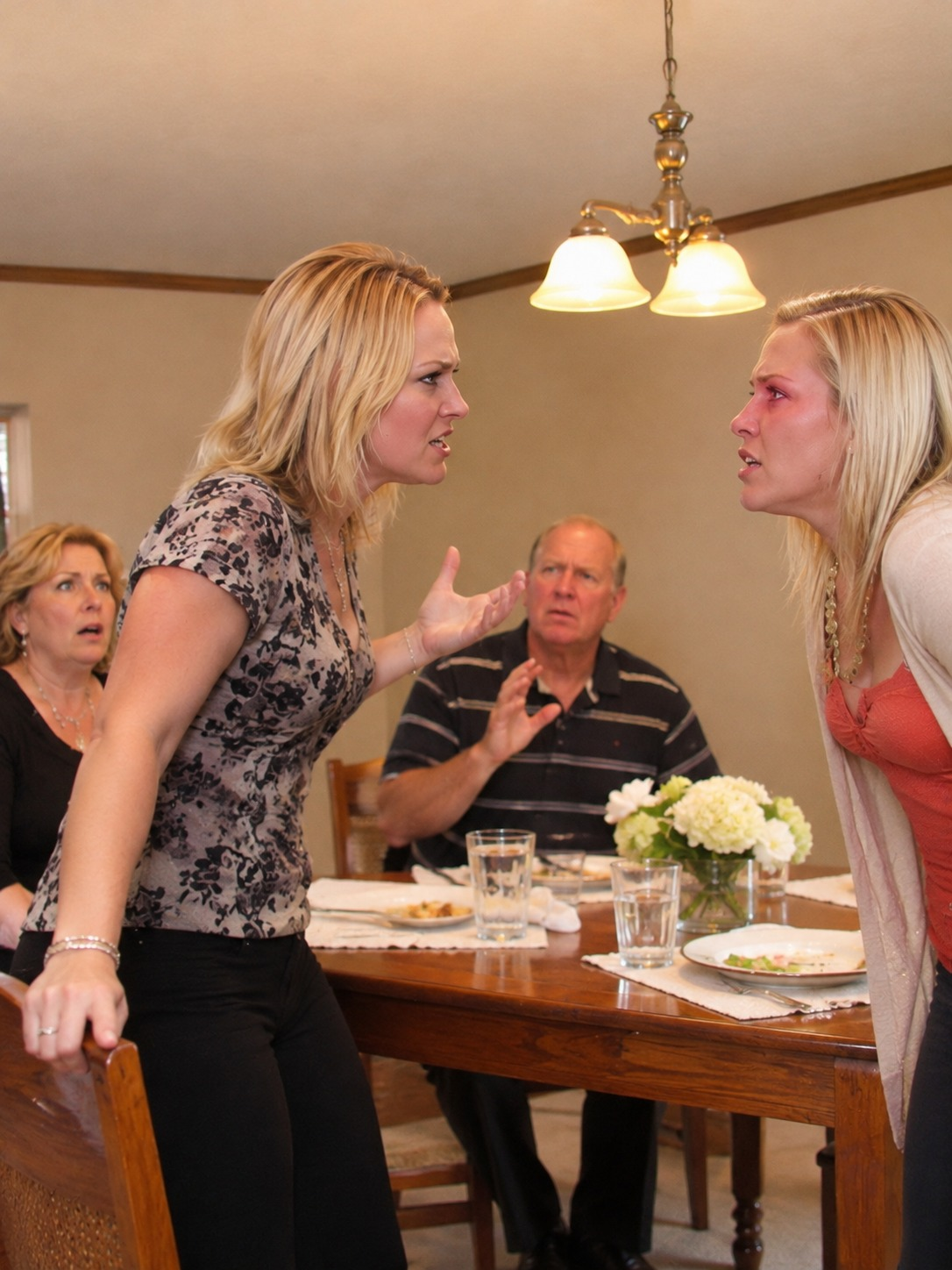
“You know, you really embarrassed me today.”
I almost couldn't believe what I was hearing.
“You insulted me in front of an entire restaurant.”
“I was trying to help you.”
“No, you weren't.”
“Whatever. Just don't show up at my wedding with that attitude.”
She disconnected before I could answer.
I sat on the edge of the hotel bed, staring at my phone.
The folder had brought back something I had worked very hard to forget.
Not just the missing assignments.
Everything.
The years of being compared to Bonnie. The humiliation disguised as jokes. The way my parents always seemed to find an explanation for her behavior while expecting me to apologize for mine.
People who met my family as adults usually thought Bonnie and I had enjoyed a wonderful childhood.
Our parents owned a comfortable suburban home. We attended good schools. We celebrated birthdays, took summer vacations, and posed for Christmas photographs in matching sweaters.
From the outside, there was nothing unusual about us.
But photographs never captured what happened after the camera was put away.
Bonnie was only a year younger than me.
For as long as I could remember, people had described us as opposites.
She was blonde.
I was brunette.
She was outgoing.
I was quiet.
She enjoyed attention.
I preferred books, drawing, and spending time with the few friends I trusted.
None of those differences should have mattered.
In our house, however, they became categories.
Bonnie was the pretty daughter.
I was the smart daughter.
And my parents treated those identities as though they were permanent assignments neither of us was allowed to question.
I remembered being nine years old when my mother took us shopping for Easter dresses.
Bonnie found a pink dress with a white ribbon around the waist.
Mom immediately called a sales associate over.
“Doesn't she look adorable?”
The woman smiled.
“Absolutely.”
I had chosen a similar dress in blue.
When I stepped out of the fitting room, my mother looked me up and down.
Then she pulled gently at the fabric around my stomach.
“Maybe we should find something more flattering.”
I didn't understand the word at the time.
“What's wrong with this one?”
“Nothing, sweetheart. It just doesn't suit your figure.”
Bonnie stood beside the mirror, turning from side to side.
“Mine looks better.”
Mom laughed.
“Well, you two have different body types.”
I ended up wearing a loose floral dress that I hadn't chosen.
At church that Easter, three different women complimented Bonnie.
One told my mother she looked like a little model.
Mom beamed.
When someone complimented my dress, she answered for me.
“We had a little trouble finding something that fit properly.”
I was nine.
I still remember wishing I could disappear behind the church pew.
Those moments accumulated quietly.
There was no single dramatic event that explained why I grew up feeling inferior.
It was a thousand small ones.
When Bonnie wanted seconds at dinner, Mom told her she was a growing girl.
When I wanted seconds, Mom asked whether I was really hungry.
When Bonnie wore shorts during summer, nobody commented.
When I wore them, Mom suggested something that covered more of my legs.
When Bonnie complained about being bored, Dad offered to take her shopping.
When I complained about being lonely, he told me to stop feeling sorry for myself.
I learned early that the same behavior could produce entirely different reactions depending on which daughter was responsible.
The only place where I felt genuinely capable was school.
Teachers liked me.
I enjoyed mathematics, literature, history, and science. I loved the satisfaction of understanding something difficult after spending hours working on it.
My grades were consistently excellent.
By sixth grade, I was receiving academic awards.
My father displayed my certificates on the refrigerator.
My mother occasionally mentioned them to relatives.
For a little while, I believed I had found something that belonged entirely to me.
Something Bonnie couldn't take away.
I was wrong.
The first time I noticed how much she resented my academic success was during a family dinner.
I had received the highest score in my class on a mathematics examination.
Dad was unusually enthusiastic.
“That's my girl,” he said, giving my shoulder a squeeze.
I smiled.
Bonnie stared at her plate.
Mom asked whether I wanted to celebrate with ice cream.
Before I could answer, Bonnie interrupted.
“It's just a test.”
Dad looked at her.
“Your sister worked hard.”
“So?”
“There's nothing wrong with being happy for her.”
Bonnie pushed her vegetables around with her fork.
“She's good at school because she doesn't have any friends.”
My smile disappeared.
Mom gave Bonnie a warning look.
“That's not very nice.”
But then she turned toward me.
“You know your sister doesn't mean everything she says.”
I looked down at my dinner.
Nobody asked Bonnie to apologize.
Nobody told her that being intelligent and having friends weren't mutually exclusive.
And nobody noticed that I didn't want ice cream anymore.
That evening, Bonnie entered my bedroom without knocking.
She picked up the certificate sitting on my desk.
“You think you're so special.”
“No, I don't.”
“Dad wouldn't stop talking about you.”
“I didn't ask him to.”
She examined the certificate for another moment.
Then she dropped it on the floor.
“You're still ugly.”
She walked out.
I picked up the certificate and smoothed its bent corner.
I didn't tell my parents.
By then, I already knew how the conversation would end.
They would say Bonnie was jealous.
They would say sisters fought.
They would tell me that being older meant I should know better than to let her upset me.
And somehow, I would be expected to comfort the person who had hurt me.
Middle school made everything worse.
Children could be cruel, particularly when they discovered someone who reacted visibly to their insults.
I was that person.
I blushed easily.
My eyes filled with tears when I became angry.
I hated confrontation.
A group of boys started calling me names during physical education classes. Girls whispered when I walked past them in the hallway.
At lunchtime, I sometimes carried my tray around the cafeteria searching for an empty seat while pretending I wasn't looking for anyone.
The worst part wasn't always the insults.
It was the laughter.
The way people who had never spoken to me suddenly found something entertaining about my existence.
I began eating lunch in the library whenever a teacher allowed it.
Mrs. Bennett, the school librarian, never asked why I preferred spending lunch surrounded by books.
She simply cleared a small corner of her desk and told me I was welcome.
Sometimes she recommended novels.
Sometimes she helped me find research materials.
Sometimes we sat quietly.
Her kindness mattered more than she probably realized.
At home, Bonnie's social life was becoming increasingly exciting.
She attended birthday parties, sleepovers, school dances, and weekend gatherings.
Our mother drove her everywhere.
Whenever Bonnie returned home, Mom wanted to hear every detail.
Who had attended?
What had everyone worn?
Which boys had been there?
Meanwhile, when I came home with another excellent report card, my mother usually said something like, “That's wonderful, honey,” before returning to whatever she had been doing.
I didn't resent Bonnie for having friends.
I wanted friends, too.
I simply wished my family understood how lonely I felt.
One Friday evening, I heard Bonnie and several girls laughing downstairs.
They were having a sleepover.
I was sitting at my desk, reading a novel and eating popcorn.
Without warning, my bedroom door opened.
Bonnie entered with three of her friends.
“What are you doing?” she asked.
“Reading.”
One of the girls looked around my room.
“Wow. You really do have a lot of books.”
Bonnie grinned.
“I told you.”
Another girl pointed toward the popcorn.
“Is that your dinner?”
“No.”
Bonnie leaned against my dresser.
“It's probably her second dinner.”
The girls laughed.
I closed my book.
“Can you guys leave?”
“Oh, she's getting mad,” Bonnie announced.
“Please leave.”
One of her friends picked up a photograph from my desk. It showed me receiving an award at school.
“Look at this.”
Bonnie took the picture.
“She loves this stuff. It's the only thing she's good at.”
I reached for it.
“Give it back.”
She held it above my head.
For several seconds, they laughed while I tried to retrieve something that belonged to me.
Finally, Bonnie tossed the photograph onto my bed.
“Come on,” she told her friends. “This is boring.”
They left.
I locked my door and cried into my pillow.
The following morning, I told my mother what had happened.
She was making pancakes.
“Bonnie and her friends came into my room last night.”
Mom flipped a pancake.
“Did they wake you up?”
“No. They were making fun of me.”
“What did they say?”
I explained.
My mother sighed.
“Girls that age can be silly.”
“They wouldn't leave when I asked.”
“I'll remind Bonnie to respect your privacy.”
“Mom, they were laughing at me.”
She placed another pancake on the serving plate.
“Sweetheart, you have to develop thicker skin. You can't control what everyone says.”
I stood beside the kitchen counter.
“Why doesn't Bonnie have to learn to stop saying those things?”
Mom turned toward me.
“Because I can't have another argument before breakfast.”
That was the end of the conversation.
Bonnie received no punishment.
Her friends continued visiting our house.
And I began keeping my bedroom door locked whenever they were there.
When I entered high school, I hoped things would improve.
For one year, Bonnie attended a different school.
That year wasn't perfect, but it was better.
I joined the academic decathlon team. I participated in a writing competition. I became friends with a girl named Emily, who enjoyed reading as much as I did.
Emily was funny, observant, and completely uninterested in the social rankings that seemed to control everyone else.
We ate lunch together.
We studied after school.
Sometimes we went to the movies on Saturday afternoons.
For the first time in years, I felt like I belonged somewhere.
Then Bonnie entered high school.
I remember helping her choose an outfit the night before her first day.
She was nervous, although she would never have admitted it.
“Do people get lost there?” she asked.
“Sometimes. But the teachers are helpful.”
“Where's the cafeteria?”
“I'll show you tomorrow.”
She sat on the edge of my bed.
“Do you think I'll make friends?”
“Of course you will.”
For a few minutes, she seemed like the little sister I had always wanted.
Someone I could protect.
Someone who might eventually become my closest friend.
I even imagined us eating lunch together occasionally.
That hope lasted less than a week.
By Friday, Bonnie had already become friends with several popular girls.
One of them, Ashley, had spent much of the previous year making jokes about my weight.
I discovered their friendship when I walked into the cafeteria and saw Bonnie sitting beside her.
Bonnie noticed me immediately.
I smiled and waved.
She looked away.
Ashley whispered something into her ear.
Bonnie laughed.
I continued walking.
Emily was waiting at our usual table.
“Was that your sister?” she asked.
“Yeah.”
“She's hanging out with Ashley?”
“Apparently.”
Emily frowned.
“Does she know what Ashley's like?”
I nodded.
Bonnie knew.
I had told her about Ashley several times.
I had even cried in front of her after one particularly humiliating incident during my freshman year.
She knew exactly who Ashley was.
And she had chosen her anyway.
A few weeks later, I was carrying a lunch tray toward Emily when someone extended a foot into the aisle.
I stumbled.
My tray tilted.
A carton of milk fell onto the floor, and several students burst into laughter.
I managed to remain standing.
When I turned around, Ashley was smiling.
Bonnie sat beside her.
“Careful,” Ashley said. “We don't need an earthquake.”
More laughter.
I looked directly at Bonnie.
For one brief moment, I thought she might defend me.
Instead, she covered her mouth and laughed.
Something inside me changed that afternoon.
I wasn't surprised that Ashley had humiliated me.
I was surprised that my own sister could enjoy watching it happen.
Emily helped me clean up the spilled milk.
Then she accompanied me to the restroom, where I stood beside the sink trying desperately not to cry.
“You need to tell someone,” she said.
“What's the point?”
“The point is that they can't keep doing this.”
I shook my head.
“My parents will say it's teasing.”
“Your parents aren't here.”
I looked at her.
“Bonnie is.”
Emily understood immediately.
She knew I wasn't simply afraid of the girls.
I was afraid of what would happen at home if I reported my sister.
That evening, I finally confronted Bonnie.
She was sitting on the living room couch, painting her nails.
“Why did you laugh today?”
She didn't look up.
“At what?”
“The cafeteria.”
“Oh, that.”
“Your friend tried to trip me.”
“She was joking.”
“I could have fallen.”
“But you didn't.”
I stood in front of her.
“Why are you friends with people who treat me like that?”
She sighed dramatically.
“Because they're fun.”
“They bully me.”
“Maybe if you stopped acting so weird, they'd leave you alone.”
I stared at her.
“I'm your sister.”
“And?”
The simplicity of that response hurt more than anything else she could have said.
Our father entered the room.
“What's going on?”
I explained what had happened.
Bonnie immediately interrupted.
“She's exaggerating. Ashley accidentally stuck her foot out.”
“You laughed,” I said.
“Because it looked funny.”
Dad rubbed his forehead.
“Girls, come on. You're too old for this.”
“Dad, she keeps doing this.”
He looked at me.
“Bonnie can't be responsible for everything her friends do.”
“She could at least stop encouraging them.”
Bonnie rolled her eyes.
Dad pointed toward the stairs.
“Go finish your homework. We'll discuss this later.”
We never did.
Instead, I went upstairs and completed an essay about personal integrity for my English class.
The irony wasn't lost on me.
By sophomore year, I had become increasingly focused on earning a college scholarship.
I wanted independence.
I wanted distance.
Most importantly, I wanted to live somewhere nobody knew Bonnie before they knew me.
My guidance counselor, Mrs. Sullivan, encouraged me to apply for several academic programs.
One offered students the opportunity to participate in a competitive summer leadership institute.
Admission required excellent grades, teacher recommendations, and a substantial written application.
I spent nearly three weeks preparing mine.
Every evening, I worked at my desk while Bonnie watched television downstairs or talked to friends on the phone.
I kept the application materials in a blue folder.
My name was printed neatly across a white label.
Inside were essays, recommendation forms, research notes, and copies of my strongest school assignments.
I treated that folder like a ticket to another life.
One evening, my father stopped beside my bedroom door.
“What are you working on?”
I explained the program.
He looked genuinely impressed.
“That's ambitious.”
“I think I have a chance.”
“I'm proud of you.”
Those four words meant everything to me.
I didn't notice Bonnie standing in the hallway until Dad walked away.
She looked at the folder on my desk.
“What's that?”
“An application.”
“For what?”
I told her.
She folded her arms.
“So now you're going away for the summer?”
“Only if I get accepted.”
“Mom and Dad are going to spend money on that?”
“There's financial assistance.”
She stepped closer.
“Why do you need to do all this extra stuff?”
“Because I want to.”
Bonnie stared at me.
“You always have to make everything about how smart you are.”
I returned to my work.
“It's not about you, Bonnie.”
She didn't answer.
But when I looked up again, she was still watching the blue folder.
Two days before the application deadline, I came home from school and discovered that it was missing.
I searched my desk.
My backpack.
My closet.
Under my bed.
I emptied every drawer.
Nothing.
When I asked Bonnie whether she had seen it, she shrugged.
“Maybe you lost it.”
I knew I hadn't.
But I couldn't prove anything.
That memory followed me all the way back to Denver the morning after Bonnie's engagement lunch.
During the flight, I kept thinking about the photograph she had sent.
For fifteen years, I had believed those papers were gone forever.
Now I knew at least some of them still existed.
And Bonnie had apparently kept them close enough to find.
After arriving home, I unpacked my suitcase, watered my plants, and tried to concentrate on the work waiting for me.
I had a meeting the following morning.
I needed to review several documents.
Instead, I opened the photograph again.
This time, I examined the papers protruding from the folder.
One corner displayed a familiar school letterhead.
Another sheet contained handwriting I recognized as my own.
Then I noticed something else.
A small cream-colored envelope was tucked beneath the folder.
It looked like an official letter from the summer leadership program.
I didn't remember ever receiving one.
I sent Bonnie a message.
Take a picture of everything inside that folder. Especially the envelope.
She read it almost immediately.
For several minutes, she didn't respond.
Then three words appeared.
Ask Mom first.
My stomach tightened.
I called my mother.
She answered cheerfully, asking whether I had arrived safely in Denver.
“Mom, do you remember that summer leadership program I applied for in high school?”
The cheerfulness disappeared.
“Why are you bringing that up?”
“Bonnie found my old folder.”
Silence.
“There's an envelope inside it,” I continued. “Do you know anything about that?”
My mother exhaled slowly.
“Some things are better left in the past.”
“Mom, what does that mean?”
Before she could answer, another message appeared on my screen.
It was from Bonnie.
This time, she had photographed the cream-colored envelope by itself.
My full name was printed across the front.
The return address belonged to the leadership institute.
The envelope had already been opened.
Beneath the photograph, Bonnie had written another message.
Go ahead. Ask her why she never gave it to you.
I stared at those words.
My mother was still on the phone.
“Please,” she whispered. “Before you read that letter, there's something your father and I need to tell you.”






Comments 0