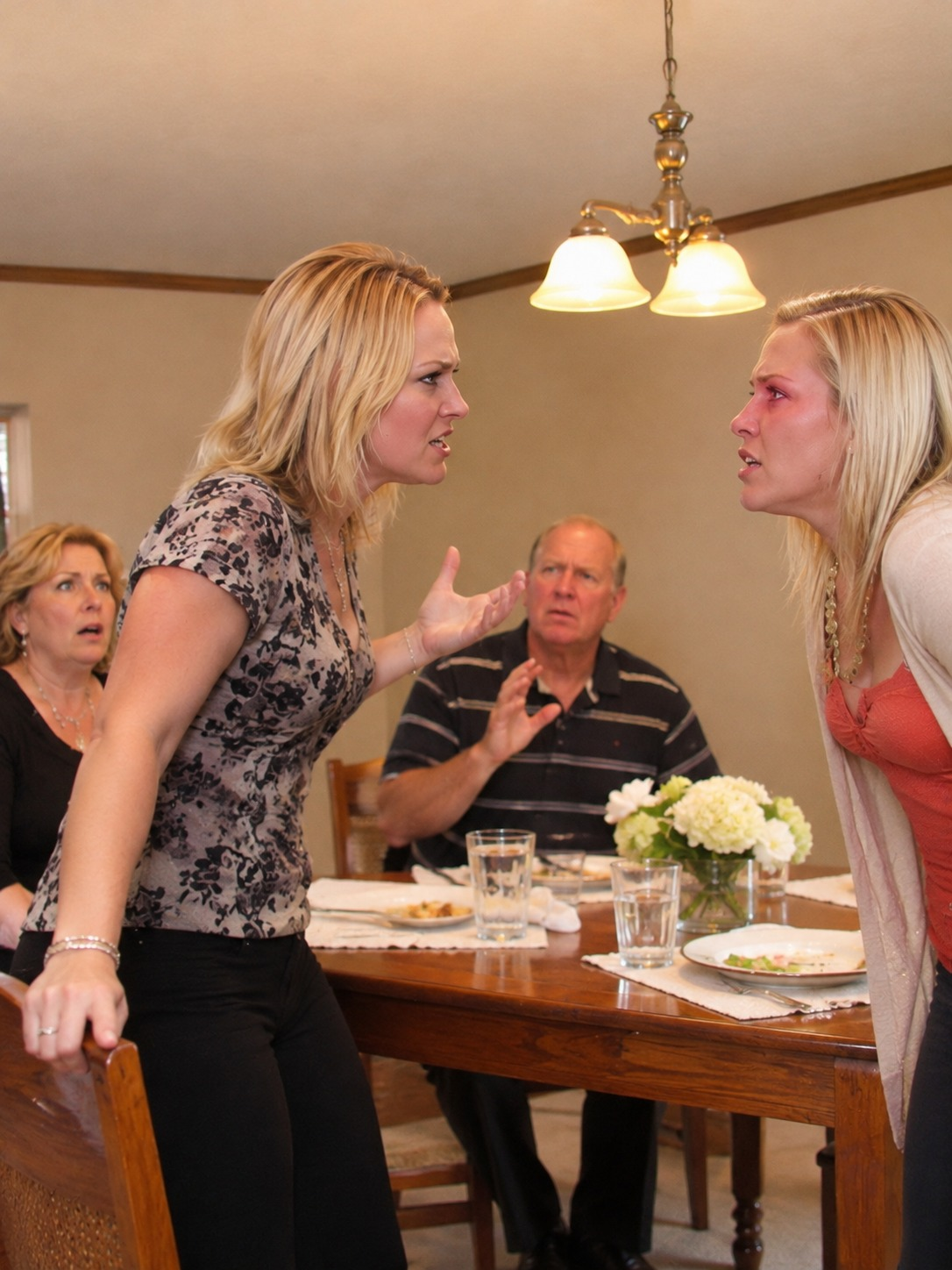
“You don't get to decide how I look.”
My voice was quiet.
I placed my fork beside my plate and looked directly at my father.
He seemed surprised.
Perhaps he had expected tears.
Perhaps he had expected me to excuse myself and disappear into the bathroom, just as I had done countless times during my childhood.
Instead, I remained seated.
Bonnie stopped smiling.
My mother looked nervously between us.
“Sweetheart,” she began, “your father didn't mean it like that.”
“Then how did he mean it?”
She opened her mouth.
Nothing came out.
I turned toward Dad.
“You just told me that Bonnie has always been the pretty sister.”
He frowned.
“Don't take everything so personally.”
“How else am I supposed to take it?”
“I'm simply explaining the situation.”
“What situation?”
“Your sister's wedding.”
I nodded slowly.
“And apparently, the situation requires me to be less attractive.”
Bonnie rolled her eyes.
“Nobody said that.”
“Dad just did.”
She leaned back in her chair.
“You're really enjoying this, aren't you?”
“Enjoying what?”
“Making everyone uncomfortable.”
I looked around the dining room.
The blue hydrangeas stood beneath the brass chandelier.
Four plates rested on the polished oak table.
Sunlight streamed through the windows.
Everything looked peaceful enough to belong in a photograph advertising the perfect American family.
Yet beneath that ordinary appearance was a conversation that revealed exactly why I had moved away.
“Bonnie,” I said, “do you remember stealing my school assignments?”
Her expression changed instantly.
“What?”
“My school assignments. The essays. The history paper. The blue folder.”
She glanced toward our parents.
“Why are you bringing that up?”
“Because this feels remarkably familiar.”
Mom lowered her glass.
“Please. We agreed not to discuss those things today.”
“I didn't agree to anything.”
Bonnie pushed back her chair.
“That was years ago!”
Her voice was suddenly loud enough to fill the entire room.
Both my parents turned toward her.
I watched my father's expression change.
He had known about the forged signature.
He had known about the acceptance letter.
But apparently, he hadn't understood the extent of what Bonnie had done.
“What assignments?” he asked.
Bonnie froze.
My mother stared at her.
“Bonnie?”
I slowly stood.
“Tell them.”
She shook her head.
“I'm not doing this.”
“Why not?”
“Because it's ancient history.”
“Then it shouldn't be difficult to explain.”
My father looked confused.
“What exactly are you talking about?”
I turned toward him.
“Do you remember how often I came home upset because something I'd completed had disappeared?”
He hesitated.
“Vaguely.”
“Do you remember telling me I needed to become more organized?”
He nodded reluctantly.
“Bonnie was taking those assignments.”
My mother looked at my sister.
“Is that true?”
Bonnie threw her hands into the air.
“Oh, my God. I was a teenager!”
Dad straightened.
“How many assignments?”
“I don't know!”
“Bonnie.”
“I said I don't know!”
Her face was red.
Her breathing had become uneven.
For the first time that afternoon, nobody was rushing to defend her.
I continued.
“She admitted it when we spoke last summer.”
Mom looked at me.
“Why didn't you tell us?”
I stared at her in disbelief.
“I tried telling you when it happened.”
She looked away.
“You told me not to accuse Bonnie without evidence,” I continued. “You told me I was careless. You told me I probably misplaced everything.”
My mother folded her hands.
“I don't remember all of that.”
“I do.”
Bonnie suddenly laughed.
“This is unbelievable. You're seriously bringing up homework because I asked you to change your hair?”
I looked at her.
“No. I'm bringing it up because you still expect me to give up things whenever you feel threatened.”
She opened her mouth.
I continued before she could interrupt.
“When we were teenagers, you didn't like the attention I received for doing well in school. Now you don't like the attention I might receive because of how I look.”
“That's not true.”
“Then why does my hair matter?”
She didn't answer.
“Why does my dress matter?”
Nothing.
“Why did you arrange for someone to dye my hair without my permission?”
She looked toward our mother.
Mom immediately became interested in her napkin.
My father rubbed his forehead.
“This is getting out of hand.”
I shook my head.
“No, Dad. For once, we're discussing what actually happened.”
He looked at me sharply.
“Watch your tone.”
I almost smiled.
Even now, with Bonnie admitting that she had deliberately interfered with my education, my tone was apparently the most urgent problem.
I reached into my purse and removed my phone.
Bonnie immediately noticed.
“What are you doing?”
“Showing them something.”
“Don't.”
I looked at her.
“Why?”
She stood.
“Because you're being vindictive.”
I opened the folder containing the photographs and messages I had saved nearly a year earlier.
Then I placed my phone on the table.
My father picked it up.
The first photograph showed the blue folder.
The second showed the acceptance letter.
The third contained Bonnie's messages.
He read them slowly.
His expression became increasingly serious.
My mother leaned closer.
Bonnie began pacing beside her chair.
“This is ridiculous,” she muttered.
Dad continued reading.
Then he reached the messages in which Bonnie had dismissed my questions about the missing folder.
He looked up.
“You took this?”
Bonnie crossed her arms.
“I already said I was fifteen.”
“That's not what I asked.”
She looked toward Mom.
Mom didn't speak.
Finally, Bonnie answered.
“Yes.”
The word was barely audible.
My father placed the phone on the table.
“Why?”
Bonnie shrugged.
“I don't remember.”
I shook my head.
“You told me exactly why.”
She glared at me.
“Stop.”
“You said you were tired of hearing about how brilliant I was.”
My father's expression changed.
He looked at Bonnie as though he were seeing something unfamiliar.
“Is that true?”
She hesitated.
Then she exploded.
“Yes! Okay? Yes!”
My mother flinched.
Bonnie continued.
“Every teacher loved her. Every report card was perfect. Every stupid award ceremony was about her. Do you have any idea how exhausting that was?”
I stared at her.
She was finally saying aloud what I had suspected for years.
“I couldn't do anything without hearing about how responsible she was,” Bonnie continued. “How intelligent she was. How much potential she had.”
Dad frowned.
“We were proud of both of you.”
Bonnie laughed bitterly.
“Sure.”
Mom reached toward her.
“Sweetheart, nobody expected you to be exactly like your sister.”
“That's not the point!”
I remained silent.
For once, I wanted Bonnie to finish speaking.
I wanted my parents to hear everything.
She turned toward me.
“You always acted like you were better than me.”
“When?”
“All the time.”
“Give me an example.”
She hesitated.
“You were always studying.”
I waited.
“You always had some competition or special project.”
“And that meant I thought I was better than you?”
She shook her head angrily.
“You don't understand.”
“Then explain it.”
She looked around the table.
For several seconds, nobody spoke.
Finally, she said, “You already had something that belonged to you.”
I frowned.
“What?”
“Being smart.”
She gestured toward herself.
“And I had something that belonged to me.”
My mother whispered her name.
Bonnie ignored her.
“I was the pretty one.”
The room became completely silent.
There it was.
Not hidden beneath wedding arrangements.
Not disguised as concern about photographs.
Not presented as a reasonable request from a nervous bride.
The truth.
Bonnie believed our family had assigned us separate identities.
And she believed I had violated hers.
I looked at my parents.
“Do you hear what she's saying?”
My father stared at the table.
Mom's eyes were filling with tears.
Bonnie continued.
“You had your grades. Your scholarships. Your career. Everybody always talked about how successful you were going to be.”
She pointed toward my hair.
“And now you have to do this, too?”
I felt an unexpected sadness.
Not because her accusation was fair.
Because she genuinely seemed to believe it.
Somewhere during our childhood, Bonnie had learned that another woman's beauty could diminish her own.
And instead of challenging that belief, our parents had encouraged it.
They had praised her appearance so consistently that she had apparently built her entire identity around being more attractive than me.
I wondered what would happen when she encountered someone prettier at work.
Or at a party.
Or simply walking down the street.
Would she expect those women to change their appearance, too?
Or was I the only person she believed she had the right to control?
“Bonnie,” I said, “being attractive isn't something that belongs exclusively to you.”
She looked furious.
“Don't lecture me.”
“I'm not competing with you.”
“That's easy for you to say.”
“Because it's true.”
She shook her head.
“You knew exactly what would happen when you showed up looking like this.”
“I expected my family to say hello.”
My mother began crying.
“Please stop. Both of you.”
I turned toward her.
“Mom, why did you tell Bonnie she was the pretty sister?”
She wiped her eyes.
“I never meant anything harmful.”
“You said it for years.”
“You were both special in different ways.”
“Why couldn't we both be smart?”
She looked confused.
“Of course you could.”
“Why couldn't we both be beautiful?”
She didn't answer.
I waited.
“Mom?”
She looked toward Dad.
He remained silent.
I continued.
“Do you understand what you taught us?”
My mother shook her head.
“We were trying to build your confidence.”
“By comparing us?”
“We didn't realize you took it so seriously.”
I laughed quietly.
“How else would children take something their parents told them every day?”
She covered her face.
My father stood and walked toward the window.
For several moments, he looked outside.
Then he turned around.
“Whatever happened when you were children, it doesn't change the fact that your sister is getting married next week.”
I stared at him.
After everything Bonnie had admitted, he was still returning to the wedding.
Still searching for a reason to avoid dealing with the past.
Still expecting me to surrender.
“You're right,” I said.
He nodded, apparently relieved.
Then I continued.
“And her wedding doesn't change what happened when we were children.”
His relief disappeared.
I picked up my phone.
“There are things you both need to understand.”
Bonnie groaned.
“Here we go again.”
I ignored her.
I opened the photograph of my acceptance letter.
“Do you remember this?”
Dad looked at it.
His expression hardened.
“We've already discussed that.”
“No. You told me I didn't understand the circumstances.”
Mom began shaking her head.
“Please don't.”
I placed the phone in front of him.
“Tell me what those circumstances were.”
He didn't move.
“Why did you write 'Do not tell her' on my acceptance letter?”
Bonnie stopped pacing.
My father looked toward Mom.
She whispered, “We thought it was the right decision.”
“For whom?”
“For the family.”
I closed my eyes briefly.
That answer again.
I had heard it so many times that it barely sounded like an explanation anymore.
“Was Bonnie upset because I had been accepted?”
My mother looked down.
That was enough.
I turned toward my sister.
“Did you know?”
Bonnie hesitated.
Then she said, “Not at first.”
My heart sank.
“What does that mean?”
She looked toward Mom.
My mother immediately interrupted.
“Bonnie, you don't have to answer that.”
I stared at her.
“Why not?”
“Because this is becoming cruel.”
I almost couldn't believe it.
My mother was protecting Bonnie from having to describe something that had happened to me.
“Let her answer.”
Bonnie crossed her arms.
“Fine. Mom told me you got accepted.”
“When?”
“Before the summer.”
“And?”
She shrugged.
“I was upset.”
“Why?”
“Because you were going away to some special program, and I wasn't.”
I swallowed.
“What did you say to Mom?”
Bonnie looked uncomfortable.
“I don't remember exactly.”
“Try.”
She sighed.
“I told her it wasn't fair.”
My mother began crying again.
I turned toward her.
“And you decided I shouldn't go?”
Mom shook her head.
“It wasn't that simple.”
“Then explain it.”
She took a trembling breath.
“Bonnie had been struggling. She felt like she couldn't accomplish anything compared to you. Your father and I thought spending the summer together might help you girls become closer.”
I stared at her.
I remembered that summer.
Bonnie had spent most of it with her friends.
She attended parties, went swimming, and visited shopping malls.
I had spent weeks wondering why I hadn't been accepted into the leadership institute.
I had blamed myself for losing the folder.
I had wondered whether my application simply wasn't good enough.
And my parents had watched all of it happen.
“Did we become closer?” I asked.
Mom didn't answer.
“Did Bonnie spend the summer with me?”
She wiped her cheeks.
“No.”
“Did anyone tell me the truth?”
Nothing.
I looked toward my father.
“Were you really concerned about our relationship, or did you just want Bonnie to stop complaining?”
His face tightened.
“You have no idea how difficult things were back then.”
“Neither did I, apparently.”
I picked up my phone again.
My hands were trembling now.
Not because I was frightened.
Because I was angry.
Years of questions were finally receiving answers, and every answer seemed to reveal another decision that had been made without me.
I opened the letter containing the forged signature.
Dad immediately recognized it.
“We're not discussing that again.”
“Why not?”
“Because your mother explained what happened.”
I looked at Bonnie.
“Did you sign my name?”
She rolled her eyes.
“Yes.”
My mother whispered, “Bonnie.”
“What? She already knows!”
I nodded.
“And you knew the letter was going to my school?”
Bonnie hesitated.
“Yes.”
“You knew it would remove me from consideration?”
She looked away.
“Probably.”
“Probably?”
“I was sixteen!”
I stared at her.
“You were old enough to understand what you were doing.”
She shook her head.
“You still got everything you wanted.”
“No, Bonnie. I built a life despite what happened.”
“Same difference.”
“It isn't.”
She laughed.
“You have a great job. You live in a beautiful apartment. You travel. You have friends. And now you're standing here acting like I destroyed your entire life.”
I looked directly at her.
“You didn't destroy my life.”
She seemed surprised.
“But that doesn't mean you didn't hurt me.”
For a moment, her expression softened.
I thought perhaps something had finally reached her.
Then she said, “Well, I'm sorry you feel that way.”
I closed my eyes.
Not an apology for taking my assignments.
Not an apology for signing my name.
Not an apology for deliberately humiliating me.
Just regret that I had feelings about it.
My father returned to his chair.
“That's enough. She apologized.”
I looked at him.
“No, she didn't.”
Bonnie threw her napkin onto the table.
“What do you want from me?”
“The truth.”
“You have it!”
“And accountability.”
She laughed.
“What does that even mean?”
“It means admitting that what you did was wrong without immediately explaining why I deserved it.”
My mother reached for her hand.
“Sweetheart, just tell your sister you're sorry.”
Bonnie looked at Mom.
Then at Dad.
Then at me.
“Fine. I'm sorry I took your stupid assignments.”
I remained silent.
She continued.
“I'm sorry I signed your name. I'm sorry you missed some summer program. Are you happy now?”
I shook my head.
“No.”
She looked furious.
“Then what else do you want?”
“I want you to stop treating me like your competition.”
She stared at me.
“I want to attend your wedding without being told to change my hair, hide my body, or wear something that makes me less noticeable.”
Mom lowered her eyes.
“I want to be your sister, Bonnie. Not someone you need to defeat.”
For several seconds, nobody spoke.
The refrigerator hummed in the kitchen.
A car passed outside.
Somewhere in the neighborhood, a dog began barking.
Ordinary sounds continued around us while something extraordinary was happening inside that dining room.
For the first time, I had said everything without apologizing.
Bonnie slowly sat down.
She stared at her engagement ring.
Then she looked at me.
“You don't understand how important this wedding is.”
I sighed.
“I'm trying to.”
“No. You're not.”
Her voice became quieter.
“People are coming from everywhere. Daniel's parents invited business associates. His relatives are staying at expensive hotels. Everyone's expecting this beautiful wedding.”
“And they'll have one.”
She shook her head.
“You don't know his family.”
“Then tell me.”
She looked toward our parents.
My mother immediately became tense.
Dad frowned.
“Bonnie, leave that out of it.”
I noticed the warning in his voice.
“What does Daniel's family have to do with this?”
Bonnie hesitated.
Then she said, “Nothing.”
I didn't believe her.
Something had changed.
Until that moment, I had assumed Bonnie's insecurity was entirely responsible for her behavior.
But the way my parents reacted suggested there was another complication.
Something involving Daniel.
Something they didn't want me to know.
“Has Daniel asked me to change my hair?” I asked.
Bonnie immediately shook her head.
“No.”
“Have his parents?”
“No.”
“Then why are you bringing them up?”
She looked down.
My father stood again.
“We're finished discussing this.”
I picked up my purse.
“For once, I agree.”
My mother hurried toward me.
“Where are you going?”
“Back to my hotel.”
“Please don't leave like this.”
I looked at her.
“How would you prefer I leave?”
She began crying harder.
I felt the familiar urge to comfort her.
To hug her.
To reassure her that everything would be fine.
But I couldn't promise that anymore.
Not while nothing had actually changed.
“I need some space,” I said.
Bonnie suddenly stood.
“If you walk out that door, don't expect everything to be normal next week.”
I turned toward her.
“Nothing about today has been normal.”
“You're making a huge mistake.”
“Maybe.”
I picked up my phone.
“But at least it'll be my mistake.”
I walked toward the hallway.
My father called my name.
I stopped.
He was standing beside the dining room table.
For a moment, I thought he might apologize.
His expression looked different.
Less angry.
Almost uncertain.
Then he said, “Think carefully about what you're doing to this family.”
I felt the last remaining hope of receiving an apology disappear.
“I've been thinking about this family my entire life, Dad.”
He didn't answer.
I continued toward the door.
Behind me, Bonnie began speaking rapidly to our mother.
I couldn't hear every word.
But I heard enough.
“She can't come looking like that.”
Mom whispered something.
Bonnie raised her voice.
“I already told them!”
I stopped walking.
Slowly, I turned around.
“Told who?”
Bonnie froze.
My mother looked horrified.
Dad closed his eyes.
I walked back toward the dining room.
“What did you already tell them?”
“Nothing.”
“Bonnie.”
She looked at our parents.
Neither of them spoke.
I felt an uncomfortable suspicion forming.
“Did you tell Daniel's family something about me?”
She shook her head.
“It's not important.”
“Then tell me.”
She grabbed her phone from the table.
“I'm not discussing this anymore.”
I watched her hurry toward the staircase.
My mother immediately followed.
“Bonnie, wait!”
I remained beside the dining room entrance.
Dad stared at the floor.
“What did she tell them?” I asked him.
He didn't answer.
“Dad?”
He rubbed his forehead.
“Your sister has said some things she probably shouldn't have.”
“What things?”
“It's complicated.”
I laughed bitterly.
Everything was always complicated when someone needed to explain why I had been treated badly.
“Does Daniel know?”
My father looked toward the staircase.
“I don't know exactly what he knows.”
I felt my stomach tighten.
Then I remembered something Daniel had said during a Christmas gathering several years earlier.
He had asked whether I still struggled with being around large groups of people.
At the time, I assumed Bonnie had told him I was introverted.
But perhaps she had told him something else.
Something that explained why he occasionally looked surprised whenever I spoke confidently about my career.
I reached for my phone.
Before I could do anything, Bonnie returned downstairs.
She was holding a large white envelope.
My mother followed closely behind her.
“Bonnie, don't.”
Bonnie ignored her.
She walked directly toward me.
“You want to know everything?”
I looked at the envelope.
“What is that?”
She placed it on the dining room table.
“Something Daniel's mother sent me.”
Dad stepped forward.
“Put that away.”
Bonnie shook her head.
“No. She wants the truth, right?”
My mother reached for the envelope.
Bonnie pulled it away.
I watched the three of them struggle over something I hadn't even seen.
Finally, Bonnie held it against her chest.
Then she looked directly at me.
“You have absolutely no idea what Daniel's family thinks about you.”
I felt cold.
“What did you tell them?”
She didn't answer.
Instead, she removed several printed pages from the envelope.
I recognized my own photograph on the first page.
It was an old picture.
One taken before I moved to Denver.
Beneath it was a paragraph of printed text.
Bonnie turned the page toward me.
My mother gasped.
Dad reached for the document.
But I had already seen the heading.
It contained my name.
And underneath it was a description of a woman I had never been.
I reached for the page.
Bonnie pulled it back.
“Before you read this,” she whispered, “you need to understand why I had to tell them you were mentally unstable.”






Comments 0