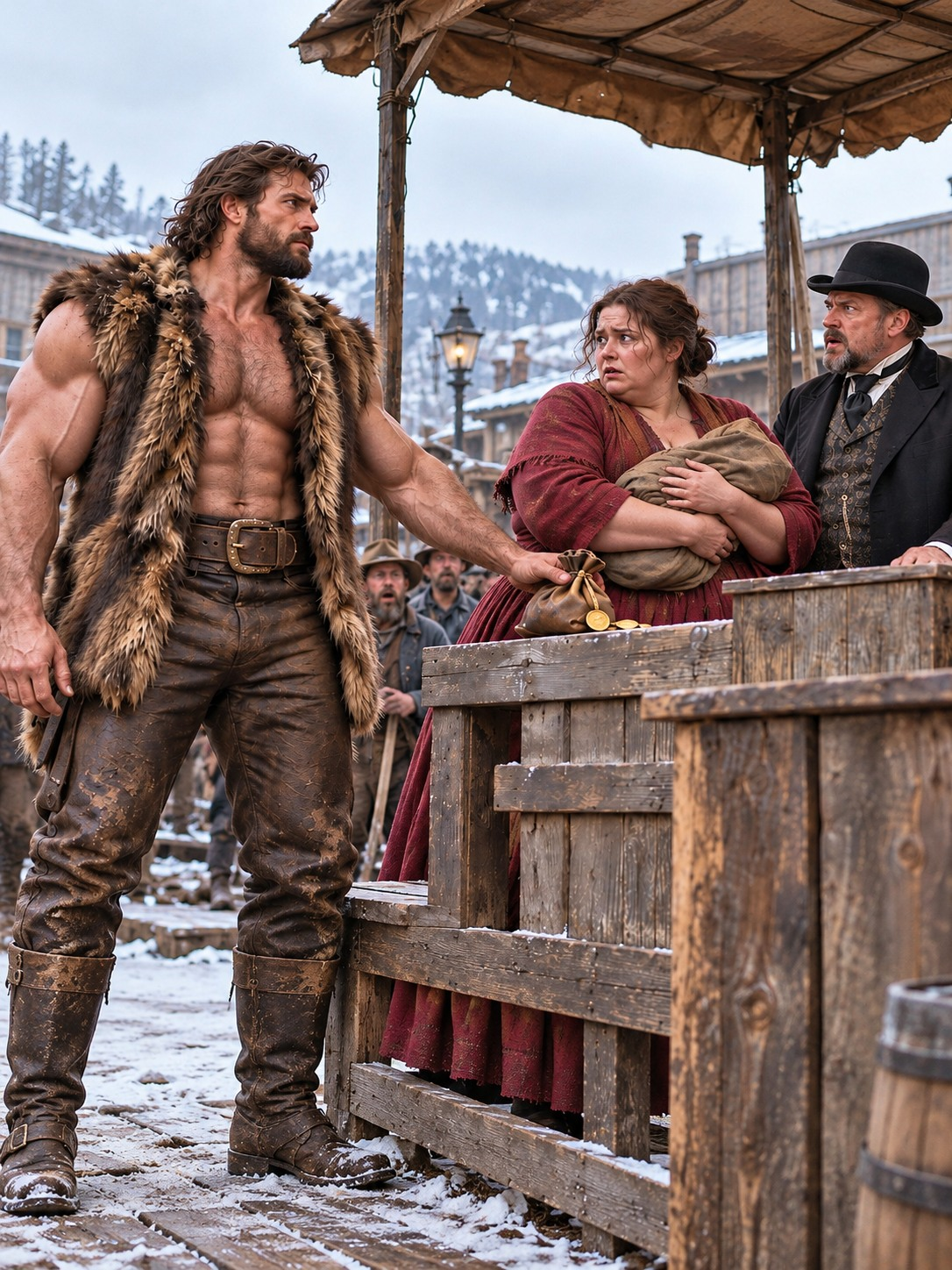
A fourteen-year-old boy was dragged toward the edge of the auction platform.
"Get your hands off my brother!" his little sister screamed.
Clinton Wells stepped out of the crowd and dropped a leather money pouch onto the auctioneer's table.
Inside was every dollar he owned.
And the man holding the cane suddenly stopped smiling.
The boy's name was Thomas Cook.
He was fourteen years old, though the hunger in his face made him look younger. A miner with blackened fingernails had grabbed him by the collar and was pulling him toward the edge of the wooden platform as if he were inspecting a horse.
Thomas fought to keep his boots planted.
His mother reached for him.
"Please! He's just a boy!"
The auctioneer struck his cane against the boards.
"Keep your hands to yourself, woman!"
The crowd laughed.
Not everyone laughed, but enough did to make Ashlyn Cook understand how little her family's suffering meant to the people gathered below.
She clutched her infant son against her chest. Her other four children pressed close to her skirt. The twins, Eleanor and Clara, had buried their faces in the folds of her faded dress. Six-year-old Samuel was crying openly. Thomas stood between them and the men who had come to buy them.
Ashlyn had spent the morning telling herself that someone would intervene.
A decent man would step forward.
A woman would speak up.
Perhaps the sheriff would remember that children were not livestock.
But no one had come.
Now a red-faced saloon owner was offering thirty dollars for her alone.
A mine foreman had offered twenty for Thomas.
The auctioneer, Josiah Flint, was already discussing how much the younger children might bring if they were sold separately.
Ashlyn felt the world narrowing around her.
"Thirty dollars for the widow," Flint announced. "Do I hear thirty-five?"
She looked at the faces below.
There were men she recognized from the mercantile. Men who had once stood beside her husband at the local church. Men who had accepted Arthur Cook's help when their wagons broke down or their horses went lame.
Not one of them met her eyes.
Then she noticed a stranger standing near the back of the crowd.
He was unusually tall, with broad shoulders beneath a weather-beaten leather coat. A thick beard covered his jaw. His dark auburn hair was visible beneath an old frontier hat.
He looked like a man who belonged in the mountains, not among the muddy streets of Oak Haven.
His eyes were pale gray.
He was watching the platform without expression.
Ashlyn did not know his name.
She did not know that he had come into town with sixty-four dollars in his pocket, intending to purchase enough provisions to survive six months of snow.
She did not know that he had already decided to walk away.
And she certainly did not know that the sound of her youngest son's crying would follow him for the rest of his life if he did.
His name was Clinton Wells.
He was thirty-four years old.
For ten winters, he had lived alone in a small cabin high in the Bighorn Mountains, trapping beaver, hunting elk, and surviving storms that could bury an entire settlement beneath snow.
He had learned not to depend on people.
People made promises.
People broke them.
People sometimes smiled while they took everything you had.
The mountains were different. A blizzard did not pretend to be your friend. A hungry wolf did not tell you it was protecting you.
Clinton preferred honest dangers.
That morning, he had ridden into Oak Haven with a list of supplies folded inside his coat.
Flour.
Salt.
Coffee.
Lead.
Black powder.
A new mule.
His old mule had broken its leg months earlier, and Clinton had been forced to carry everything himself. With winter approaching, another season without a pack animal would make survival considerably harder.
The sixty-four dollars in his pocket represented almost everything he had earned during the previous trapping season.
He had counted it twice before leaving his cabin.
He had no intention of spending a single unnecessary cent.
Then he heard the laughter.
At first, he ignored it.
Oak Haven was full of noise. Miners argued over whiskey. Horses kicked at their stalls. Wagon wheels groaned over uneven boards.
But the laughter near the livery stable had a different sound.
It was the kind of laughter men made when another human being had been reduced to something they believed they could purchase.
Clinton stopped outside the crowd.
He saw the wooden platform.
He saw the auctioneer.
And then he saw the children.
The youngest boy was crying so hard that his shoulders shook.
Clinton looked away.
He told himself it was none of his business.
He had no family. No wife. No children. No land beyond the mountain cabin he had built with his own hands.
He could barely keep himself alive through winter.
Getting involved in someone else's trouble was a good way to end up dead.
He turned toward Miller's Mercantile.
That was when he heard the boy's collar tear.
The miner had pulled Thomas forward.
Ashlyn lunged toward her son, nearly losing her balance as she tried to keep the infant secure.
"Stop! He's not a man! He's my child!"
The miner laughed.
"Strong enough to work, isn't he?"
Thomas twisted away.
His eyes found his mother's.
For a moment, neither spoke.
Ashlyn knew what he was thinking.
He was trying to tell her not to fight.
He was trying to tell her that he could endure whatever happened if it meant his sisters and brothers might be spared.
That was what broke her.
"Please," she whispered. "Take me instead."
Flint glanced down at his ledger.
"We have already established the bidding terms, Mrs. Cook."
"Then take the money from me when I can work. I'll clean houses. I'll wash clothes. I'll do anything."
"Your husband's debt is one hundred and twenty dollars."
"I know what he owed!"
"Then you understand the situation."
Ashlyn stared at him.
Her husband had been dead for a month.
Arthur had contracted cholera after helping a neighboring family whose father had fallen ill. By the time the fever reached him, there was little anyone could do.
He had died in their rented room with Ashlyn holding his hand.
His last words had been about the children.
Keep them together.
She had promised.
Now that promise was about to be taken from her.
Flint raised his cane.
"Twenty dollars for the boy. Thirty for the mother. The younger children will be handled separately."
"Those children are not property," a voice called from the crowd.
For half a second, Ashlyn thought someone had finally found the courage to speak.
Then she realized the voice belonged to a man who was simply complaining that the auction was taking too long.
Flint ignored him.
"Thirty dollars, going once!"
Clinton was still standing near the edge of the crowd.
His hand had disappeared into his coat pocket.
He felt the leather pouch against his fingers.
He could almost see the supplies waiting in the mercantile.
He imagined the cabin in January, when snow would cover the lower windows and the wind would push against the roof.
Without flour, he would have to stretch his dried meat.
Without salt, preserving another elk would become difficult.
Without ammunition, hunting would become a dangerous gamble.
And without a mule, he might not be able to bring enough firewood to the cabin.
He had survived ten winters because he made sensible decisions.
Buying six strangers was not sensible.
It was madness.
He turned away.
Then Samuel screamed.
The little boy had watched the miner drag Thomas forward, and he suddenly tried to run toward his brother.
One of the men blocked him.
Samuel stumbled and fell against his mother's legs.
His crying became a terrible, breathless wail.
Ashlyn bent down as far as she could.
"Samuel! Stay with Mama!"
Clinton closed his eyes.
The sound reminded him of something he had spent years trying not to remember.
A small voice.
A winter night.
A promise he had once been unable to keep.
He opened his eyes.
Then he turned around.
The crowd barely noticed him at first.
He walked slowly toward the platform, his heavy boots sinking into the mud.
A few men moved aside.
The miner released Thomas's collar.
Flint looked irritated.
"Do you have business here?"
Clinton stopped in front of the wooden table.
He reached into his coat.
The leather pouch came out.
He placed it on the table.
The sound of the coins drew several heads around.
"What is this?" Flint asked.
"Money."
"I can see that. Are you bidding?"
Clinton looked toward Ashlyn.
She was watching him with an expression he could not quite understand.
There was fear in her eyes, but something else had appeared beneath it.
A question.
Clinton looked at the children.
Five of them.
All huddled together.
All waiting for someone to decide what happened next.
He looked back at Flint.
"How much for all six?"
The auctioneer frowned.
"All six?"
"The woman and her children."
Flint glanced at his ledger.
"That is not how I intended to conduct the sale."
"Then change your intentions."
A few men chuckled.
The auctioneer's face darkened.
"Thirty dollars for the widow. Twenty for the eldest boy. The younger children will be assessed separately."
Clinton nodded once.
"Sixty-four."
Flint stared at him.
"Sixty-four what?"
"Dollars. Every cent I've got."
The crowd began murmuring.
A miner laughed.
"You're buying yourself a wife, mountain man?"
Clinton did not turn toward him.
"I'm buying the entire lot."
Ashlyn's fingers tightened around the infant's blanket.
The auctioneer leaned forward.
"Do you understand what you're offering?"
"Yes."
"That's your entire purse?"
"Yes."
"Where do you intend to take them?"
"Home."
"Where is home?"
"The mountains."
Flint gave a short laugh.
"You expect six people to survive in the mountains?"
Clinton's expression did not change.
"That's my concern."
He pushed the pouch farther across the table.
Flint opened it.
Silver dollars spilled onto the rough wood.
He counted them.
Once.
Then again.
Exactly sixty-four dollars.
The auctioneer looked at the money, then at Clinton.
For the first time that afternoon, he seemed uncertain.
"These are your final funds?"
"They are."
"You understand that the debt is one hundred and twenty dollars."
"I understand what you said."
"Your offer does not cover the debt."
Clinton leaned forward slightly.
"Then you can keep shouting numbers until someone else offers more."
Flint looked toward the crowd.
No one moved.
The saloon owner had already stepped back.
The mine foreman was studying Clinton's size and the knife hanging from his belt.
A few other men exchanged uncomfortable glances.
Clinton waited.
He did not threaten anyone.
He did not raise his voice.
He simply stood there.
Ashlyn could barely breathe.
She wanted to believe him, but she had spent too many hours watching men make promises they never intended to keep.
A stranger could be dangerous.
A stranger could be cruel.
A stranger could simply be another kind of prison.
Yet the five children were still beside her.
For the first time that day, no one was pulling them apart.
Flint finally lifted his cane.
"Very well. Sixty-four dollars for the entire family, subject to the terms of the indenture."
Clinton's eyes narrowed.
"Read them."
The auctioneer hesitated.
Then he opened the ledger and began reading.
The family would be bound to the purchaser for five years of labor, with the debt recorded against their names. Their work would be considered compensation for the unpaid estate balance.
Clinton listened without interrupting.
When Flint finished, he took a pen and pushed the ledger toward him.
"Sign here."
Clinton looked at the document.
Then he looked at Ashlyn.
"What are their names?"
She swallowed.
"Ashlyn Cook."
He nodded toward the children.
"Thomas. Eleanor. Clara. Samuel. And the baby is William."
Clinton repeated each name quietly.
He wanted to remember them.
Not as a lot.
Not as a debt.
As people.
He picked up the pen.
And signed.
The crowd erupted into conversation.
Some called him a fool.
Others laughed at the thought of a mountain trapper taking six people into the wilderness.
But Clinton ignored them.
He gathered the pouch, now empty, and put it away.
Then he stepped toward the platform.
Thomas immediately moved in front of his mother.
Clinton stopped.
He looked down at the boy.
"You're Thomas?"
The boy nodded.
"How old?"
"Fourteen."
"You know how to handle a horse?"
Thomas hesitated.
"A little."
"Good. We'll need to find you one that doesn't bite."
Thomas did not smile.
Clinton did not expect him to.
He looked toward Ashlyn.
"Can you walk?"
She nodded, though her legs were trembling.
"Then get your things."
Ashlyn glanced at the auctioneer.
"What about the children?"
Clinton's face hardened.
"They come with you."
He said it so plainly that she almost began crying.
Almost.
Instead, she gathered the twins closer and adjusted the blanket around the infant.
The youngest boy reached for her hand.
She took it.
Then something unexpected happened.
The auctioneer placed his cane across Clinton's path.
"Not so fast, Wells."
Clinton stopped.
Flint's eyes had returned to the ledger.
"You have paid the purchase price, but there's another matter."
"What matter?"
"The Cook estate owes more than money."
Clinton looked at the page.
Flint tapped a line near the bottom.
"There is a second claim against the family."
Ashlyn went pale.
She had never seen that line before.
"What second claim?" Clinton asked.
Flint slowly turned the ledger around.
"Your new family may have just become considerably more expensive."
And then he read the name written beneath Arthur Cook's debt.






Comments 0