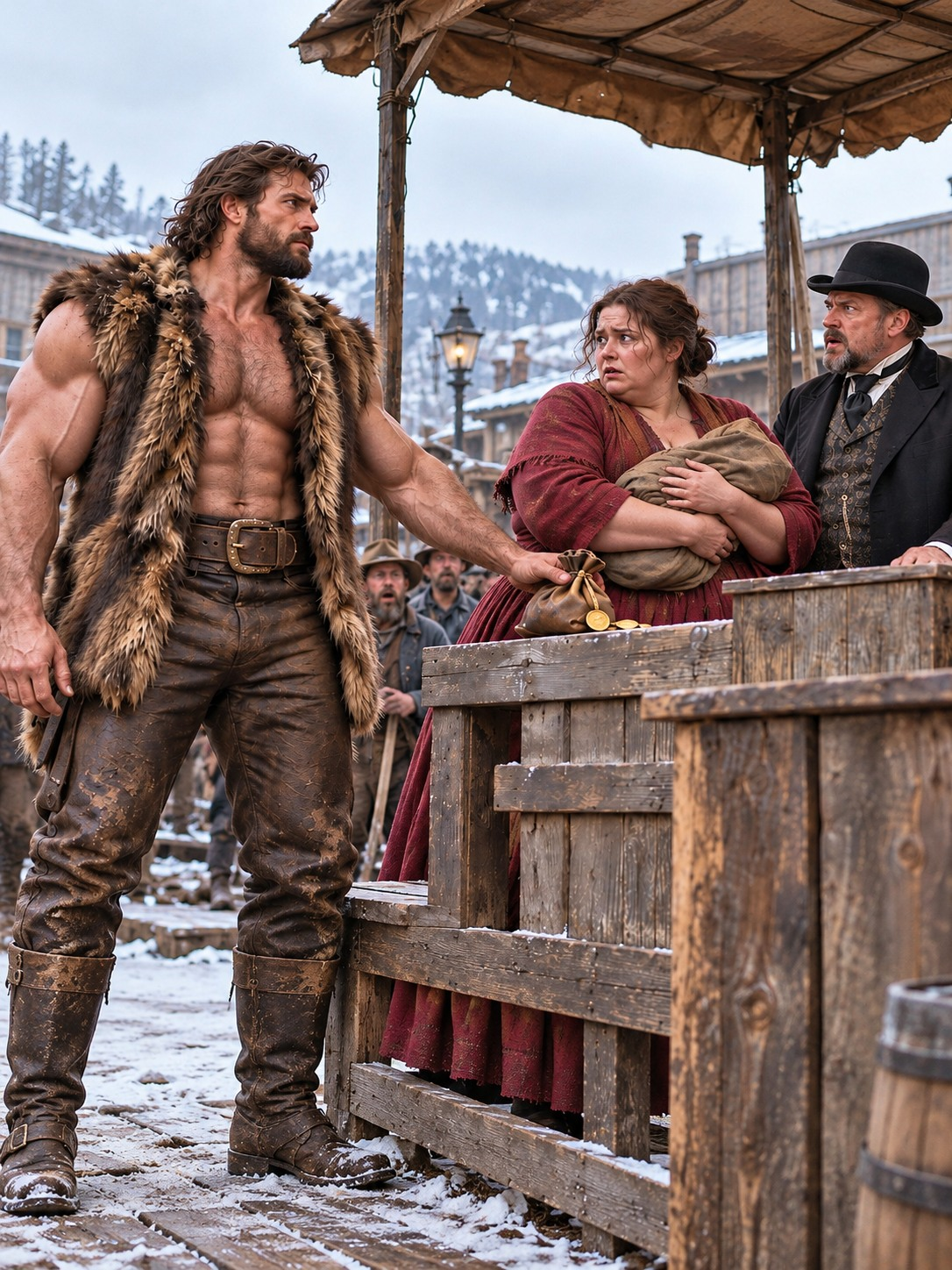
The name on the ledger was not Arthur Cook's.
It was Ashlyn's.
Clinton stared at the page.
Flint tapped the writing with the end of his cane.
"Your wife's signature," he said. "Or rather, the signature of the woman you have just purchased."
Clinton looked toward Ashlyn.
She had gone completely still.
"What does that mean?" he asked.
"It means the Cook estate carries an additional obligation."
"How much?"
"One hundred and eighty dollars."
A murmur passed through the crowd.
Clinton looked back at the ledger.
"You said the debt was one hundred and twenty."
"That was the principal owed to the bank. This is a separate obligation."
"Separate obligation for what?"
Flint smiled.
"An advance. Signed by Mrs. Cook."
Ashlyn shook her head.
"I never borrowed that money."
Flint did not look at her.
"Your signature is here."
"I can read my own name, Mr. Flint. I did not sign that paper."
The auctioneer sighed as though her objection bored him.
"Perhaps you have forgotten. Your husband was sick. You were managing a household. Such things happen."
"My husband never told me about any loan."
"Then perhaps he had his reasons."
Clinton closed the ledger.
"Show me the original."
Flint's expression changed.
"The document is held at the bank."
"Then we'll go to the bank."
"That is unnecessary."
"Didn't ask you."
For a moment, the two men stared at each other.
Clinton was accustomed to difficult men. He had negotiated with traders who cheated on weights, ranchers who refused to pay for hides, and hunters who believed a man alone in the mountains was an easy target.
He had learned that the quickest way to understand a dishonest man was to stop giving him room to speak.
Flint finally stepped aside.
But before Clinton could move, the saloon owner approached the platform.
"Hold on. I believe there's been a misunderstanding."
Clinton turned.
The man was stout, with a round red face and a black waistcoat stretched across his stomach.
"My offer for the widow was thirty dollars," he said. "I haven't withdrawn it."
"Your offer is finished," Clinton replied.
"I don't believe you understand how these matters work."
"I understand enough."
The saloon owner glanced at Ashlyn.
"She was promised to me."
Ashlyn flinched.
Clinton moved half a step between them.
"She wasn't promised anything."
The man laughed.
"You think paying sixty-four dollars makes you some kind of gentleman?"
"No."
"Then what makes you think you can take her?"
Clinton looked at him for several seconds.
"Because she and her children are leaving with me."
The saloon owner opened his mouth.
Then he noticed the expression in Clinton's eyes.
He stepped backward.
The crowd had grown quieter.
The auctioneer gathered his papers.
"Mr. Wells, I suggest you take your purchase and leave before this becomes more complicated."
Clinton glanced toward the children.
"That's exactly what I'm doing."
He turned to Ashlyn.
"Do you have anything besides what you're carrying?"
She looked toward the back of the platform.
A small canvas bag sat near the wooden railing.
"My husband's Bible. Some clothes. A photograph."
"Get them."
Thomas climbed down first.
He did not ask for help.
He simply placed his boots in the mud and reached up to assist his sisters.
The twins descended carefully.
Samuel remained beside his mother, holding her skirt.
Clinton reached toward the infant.
Ashlyn instinctively pulled back.
He immediately withdrew his hand.
"All right," he said. "You carry him."
It was the first time that afternoon anyone had given her a choice.
She looked at him carefully.
"Why did you do this?"
Clinton adjusted the strap of his coat.
"Your boy was being dragged around like a sack of grain."
"That isn't an answer."
He glanced toward the crowd.
"Maybe it is."
Ashlyn wanted to ask more.
But she was afraid of what the answers might be.
They had barely taken ten steps when Flint called after them.
"Mr. Wells!"
Clinton stopped.
The auctioneer held up a folded paper.
"You'll need to understand something before you leave Oak Haven. The bank has a lien against the Cook property, and the agreement gives us the right to recover any additional assets discovered after the sale."
Ashlyn turned sharply.
"There's nothing left."
"That is not your decision."
"My husband sold the last horse to pay for medicine."
Flint smiled.
"Then I suppose you have nothing to worry about."
Clinton noticed that the auctioneer was not looking at Ashlyn.
He was looking at the canvas bag.
Specifically, at the worn leather Bible inside it.
"What?" Clinton asked.
Flint shook his head.
"Nothing."
But the way he said it made Clinton remember the expression.
A man who had just seen something he wanted.
They left the platform.
The crowd opened a narrow path.
Some men looked ashamed.
Others shook their heads.
One miner muttered that Clinton would be begging for his money back before Christmas.
Clinton did not answer.
He led the family toward the mercantile.
His horse was still tied outside.
It was a strong chestnut gelding, old enough to be sensible and young enough to make the journey.
There was no mule.
There would be no mule.
And there would be no new ammunition unless someone in town was willing to extend him credit.
He stopped beside the horse and loosened the reins.
Thomas approached cautiously.
"Is that yours?"
"Yes."
"Are you taking us on that?"
"Not all at once."
Thomas looked at the five members of his family.
"How?"
Clinton studied the street.
"We'll find a wagon."
He looked toward the mercantile.
"First, we need food."
Ashlyn's cheeks reddened.
"We have no money."
"I know."
"I can work."
"I know that too."
"I don't want charity."
Clinton looked at her.
"Neither do I."
She frowned.
"Then what do you want?"
"To get out of this town before someone decides they want another argument."
For the first time, Thomas almost smiled.
Almost.
Clinton took the family inside Miller's Mercantile.
The bell above the door rang.
A middle-aged shopkeeper looked up from behind the counter.
His name was Henry Miller.
He had sold supplies to Clinton for years.
He knew the trapper was careful with money and difficult to impress.
When he saw the children, his eyebrows rose.
"Well, I'll be."
Clinton placed his empty leather pouch on the counter.
"I need flour, beans, salt, coffee, dried apples, and whatever blankets you can spare."
Miller looked at the pouch.
"How much?"
"Put it on my account."
The shopkeeper blinked.
"Your account?"
Clinton nodded.
Miller had never heard him ask for credit.
"Clinton, I thought you were paying cash this morning."
"I was."
"What happened?"
Clinton glanced toward Ashlyn.
"Plans changed."
Miller looked at the family again.
He understood more than he asked.
"All right. I'll see what I can do."
While Miller gathered supplies, Ashlyn stood near the door.
She kept the children close.
She had not relaxed.
Clinton noticed.
"Nobody's going to separate you here," he said.
She looked at him.
"You can't promise that."
He considered her words.
Then he nodded.
"You're right. I can't promise what other people will do."
He tightened the strap around a sack of flour.
"But I can promise what I'll do."
Ashlyn lowered her eyes.
She wanted to believe him.
She was terrified of believing him.
Because hope, after so much suffering, felt almost as dangerous as fear.
Miller returned with two sacks of flour, dried beans, coffee, salt, and several blankets.
He also brought a small wooden box.
"Your ammunition," he said to Clinton.
Clinton stared at it.
"How much?"
"Pay me when you can."
"I didn't ask for a favor."
"Neither did I. I don't want to hear that you starved on the mountain because you spent your money helping someone else."
Clinton looked at him.
Miller shrugged.
"Besides, I've known you ten years. You always pay."
Clinton placed a hand on the counter.
"Thank you."
It was a small exchange.
But Ashlyn noticed something important.
Clinton had not asked Miller to give the family anything for free.
He had accepted a loan, and he intended to repay it.
That mattered.
A man who expected to own people did not usually worry about what he owed.
They loaded the supplies into a borrowed wagon.
The horse was harnessed in front.
Thomas helped secure the sacks.
The twins sat together beneath a blanket.
Samuel climbed beside his mother.
The infant slept against her chest.
Clinton checked the wagon wheels.
Then he looked toward the road leading out of town.
A cold wind swept through the marketplace.
They were ready to leave.
But before Clinton could climb onto the wagon seat, a black carriage stopped beside the mercantile.
A man in an expensive dark coat stepped down.
His boots were polished.
His gloves were spotless.
He carried a silver-topped walking stick.
Flint hurried toward him.
The two men exchanged a few words.
Then the stranger looked directly at Ashlyn.
His expression was not one of surprise.
It was recognition.
He walked toward the wagon.
"Mrs. Cook," he said.
Ashlyn's face lost its color.
Clinton stepped between them.
"Who are you?"
The stranger removed his gloves one finger at a time.
"Silas Rourke. I represent the Oak Haven Bank."
Clinton's eyes narrowed.
"Then speak to me."
Rourke smiled.
"I would be delighted. But I believe your new family has something that belongs to me."
He looked past Clinton.
His gaze settled on the canvas bag containing Arthur Cook's Bible.
And then he said four words that made Ashlyn drop her hand from the wagon rail.
"Your husband stole it."






Comments 0