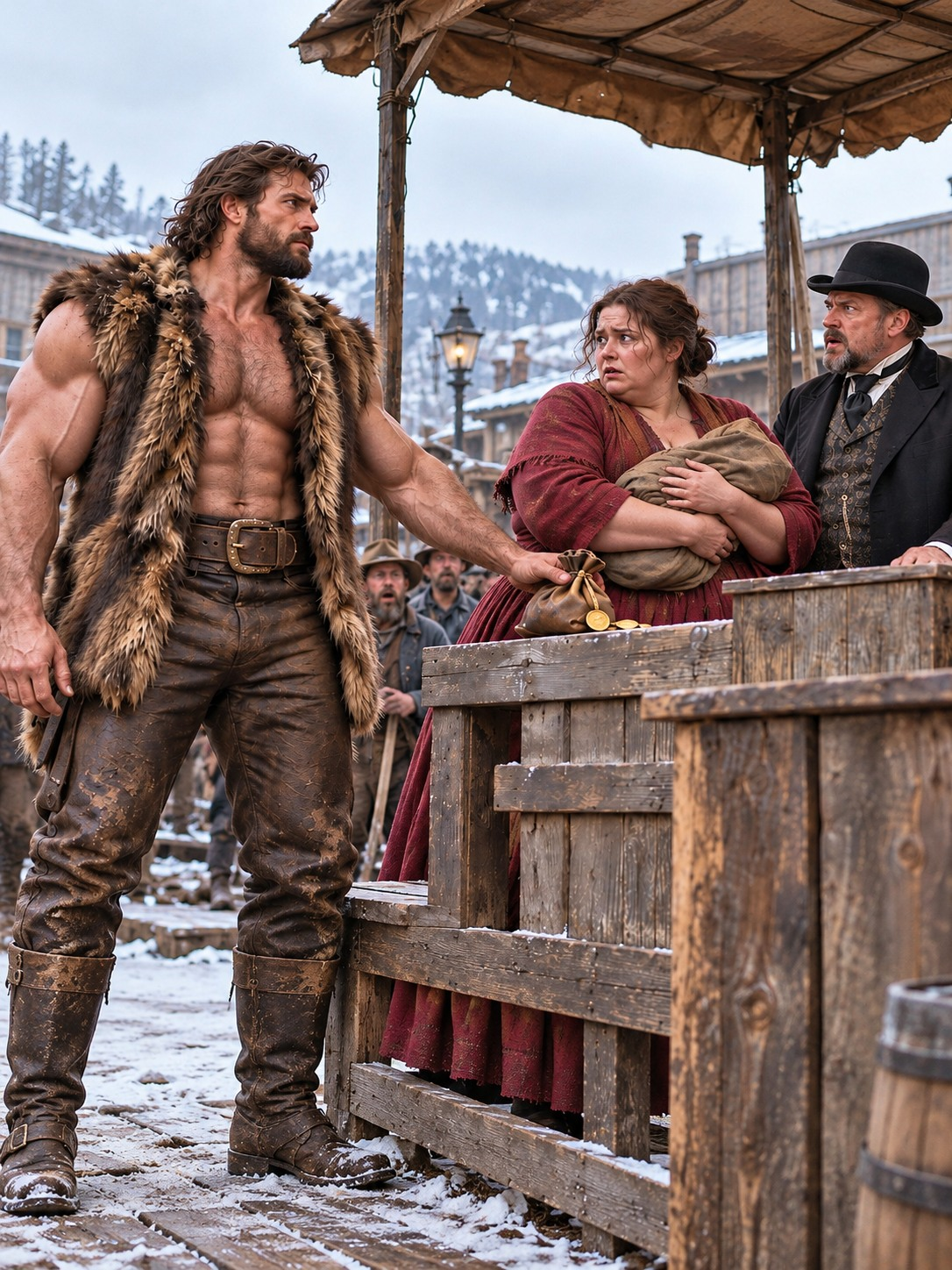
Clinton Wells stared at the deputy marshal.
"Say that again."
Nathaniel Price shifted his weight in the snow.
"Two men came into Oak Haven yesterday morning. They asked about Arthur Cook's grave. They wanted to know whether anyone had opened it since the burial."
Ashlyn stood behind Clinton.
Her fingers tightened around the blanket covering William.
"Why would anyone want to know that?"
Nathaniel glanced at her.
"I don't know, Mrs. Cook. But they had your husband's photograph. They were asking questions about the last few days of his life."
Clinton lowered his rifle slightly.
"Did they give their names?"
"One called himself Dawson. He's the mine foreman who bid on your boy at the auction. The other was older. He wore a black coat and carried a silver walking stick."
"Rourke?"
"I couldn't say. But Flint was with them."
Clinton looked toward the distant trees.
He knew the mountains well enough to recognize when trouble was coming.
The snow on the ground was thin, but the clouds gathering above the western ridge promised another storm. If men were following the trail, they would have to cross a narrow stretch of woodland before reaching the cabin.
That gave him time.
Not much.
But enough.
"How many horses?"
"Three."
"How many men?"
"Two that I saw. Flint rode into town separately."
Clinton nodded.
"How long ago?"
"Yesterday morning."
"Then they could be here by tomorrow."
Nathaniel looked toward the cabin.
"That's what I was afraid of."
Ashlyn stepped forward.
"Deputy, I need you to tell me something. Did you know my husband?"
Nathaniel removed his hat.
"Not personally."
"Then why are you helping us?"
The deputy hesitated.
"Because I have seen what happens when a powerful man decides the law belongs to him."
He looked at Clinton.
"And because I don't believe Arthur Cook was a thief."
Ashlyn's eyes filled.
For a moment, she could not speak.
Clinton noticed her expression and stepped away from the doorway.
"Come inside. You're freezing."
Nathaniel entered the cabin.
Clinton shut the door and placed a wooden bar across it.
The children had gathered near the stove.
Thomas stood in front of his sisters.
He had heard enough to understand that the men from Oak Haven were not coming to offer an apology.
"Are they coming here?" he asked.
Clinton nodded.
"Possibly."
"Are they going to take us back?"
"No."
Thomas looked at him.
"How do you know?"
Clinton placed another log on the fire.
"Because I said so."
It was not a complicated answer.
But the boy seemed to accept it.
Nathaniel sat at the table while Ashlyn poured him a cup of coffee.
He drank it quickly.
Then he opened his document case.
"There is something you should know about the Cook debt."
Clinton leaned against the wall.
"Go on."
"The original amount owed to the Oak Haven Bank was one hundred and twenty dollars. That's correct. But according to the bank's ledger, an additional one hundred and eighty dollars was advanced to Arthur three months before his death."
Ashlyn shook her head.
"He never received that money."
"That's what I suspected."
Nathaniel removed a small notebook.
"Arthur came to my office about two weeks before he died. He wanted to report an irregularity in the bank's records."
"What kind of irregularity?" Clinton asked.
"Several families had been charged for loans they never received. Their signatures appeared on documents, but the money had never passed through their accounts."
Ashlyn looked at the letter in her pocket.
"Did he mention Silas Rourke?"
Nathaniel nodded.
"He did."
The cabin became quiet.
"He told me that Rourke was using the bank to take property from struggling families. Small farms. Horses. Wagons. Sometimes entire businesses. When people couldn't pay debts they didn't even know they owed, Flint would arrange legal proceedings."
"And the labor auctions?" Clinton asked.
Nathaniel looked down.
"They were part of the same operation."
Ashlyn closed her eyes.
She remembered Flint reading the terms of the sale.
She remembered the men bidding on Thomas.
The saloon owner offering money for her.
She remembered the twins crying.
All of it had been arranged.
Not because Arthur had failed to pay his debts.
But because someone had decided the Cook family was worth more than the money they owed.
"Why didn't you arrest Rourke?" she whispered.
Nathaniel's expression became uncomfortable.
"Because I couldn't prove it."
"You knew what he was doing."
"I suspected."
"That is not the same as stopping him."
"No," Nathaniel admitted. "It isn't."
Clinton studied the deputy.
"Why come here now?"
Nathaniel closed his notebook.
"Because Arthur told me something else."
He reached into his coat and removed a folded piece of paper.
"He said that if anything happened to him, his wife would know where to find the evidence."
Ashlyn immediately looked toward the Bible.
Nathaniel followed her gaze.
"Does that book contain something?"
She hesitated.
Then she removed Arthur's letter from her pocket and placed it on the table.
Nathaniel read it.
His expression darkened.
"That's his handwriting."
"You recognize it?" Clinton asked.
"I saw it on the reports he brought me."
Nathaniel turned the letter over.
"Arthur was trying to protect someone."
"Who?" Ashlyn asked.
The deputy did not answer immediately.
Instead, he opened his notebook to a blank page and wrote a name.
"Samuel Hargrove."
Ashlyn frowned.
"Who is that?"
"The former bank clerk. He disappeared six months ago."
Clinton crossed his arms.
"Disappeared how?"
"His wife said he left town after an argument with Rourke. Nobody has heard from him since."
Nathaniel looked at the Bible.
"Arthur believed Hargrove had the original account books."
Ashlyn slowly sat down.
Her husband had been fighting something much larger than she had understood.
And now the men responsible knew she might possess the evidence.
That afternoon, Clinton began preparing the cabin.
He checked the windows.
He inspected the rear door.
He moved a heavy table against the wall and placed the rifle where he could reach it.
Thomas followed him from room to room.
"Are we expecting a fight?"
"Not if I can help it."
"But you think they'll come."
"I think men who want something badly enough eventually stop asking politely."
Thomas looked at the rifle.
"Can I help?"
Clinton considered the boy.
"Yes. You can keep the little ones away from the doors. If I tell you to take them upstairs, you do it immediately."
"What about Mama?"
"Your mother knows what to do."
Thomas nodded.
He seemed disappointed that Clinton had not offered him a weapon.
But the boy did not argue.
Clinton crouched slightly so they were at eye level.
"Listen to me. Being brave doesn't mean standing in front of every bullet."
Thomas looked down.
"Then what does it mean?"
"Knowing what matters enough to protect it."
The boy looked toward his sisters.
Clinton understood.
He had already decided.
While the men prepared, Ashlyn sat beside the stove with the Bible open across her lap.
She had read every page of it as a girl.
Arthur had given it to her on their wedding day.
She remembered the way he had smiled when he handed it over.
"Keep it close," he had told her. "A person needs something that cannot be taken away."
She had thought he meant faith.
Now she wondered whether he had meant the truth.
She turned the pages slowly.
Several sections contained small pencil marks.
Some verses had been underlined.
Others had tiny numbers written beside them.
She recognized the handwriting.
Arthur's.
She reached the Book of Psalms and found a small indentation in the paper.
It looked like a mark made by a pin.
She examined the opposite page.
There was another indentation.
Then another.
They formed a sequence.
Ashlyn counted the pages.
Twelve.
Twenty-seven.
Forty-one.
She looked at the numbers again.
They were not random.
They matched the page numbers in a small account book Arthur had once kept in their bedroom.
She remembered that book.
He had taken it to work every morning.
When the fever came, it disappeared.
She turned to the last marked page.
A sentence had been written in the margin.
Not a verse.
Not a prayer.
A message.
THE FIRST KEY IS WHERE THE RIVER BENDS.
Ashlyn stared at it.
She remembered Arthur taking her to a bend in the creek outside Oak Haven.
They had gone there during their first summer together.
He had shown her a flat stone where the water ran clear.
Beneath it, he had hidden a small tin box containing their wedding rings while they traveled.
The memory made her heart ache.
But why would Arthur connect that place to the bank?
She closed the Bible.
Then she noticed something else.
The back cover was thicker than it should have been.
A thin line ran along the leather.
Ashlyn pressed it gently.
A small section shifted.
She carefully lifted the lining.
Inside was a folded scrap of paper.
Her hands trembled as she opened it.
There were three columns of figures.
Dates.
Amounts.
Initials.
At the bottom was a signature.
Silas Rourke.
And beside it was a second signature.
Josiah Flint.
Ashlyn quickly covered the paper as she heard footsteps approaching.
It was Thomas.
"Mother?"
She looked up.
"Yes, sweetheart?"
"What are you reading?"
"Something your father left behind."
Thomas glanced at the Bible.
"Is it important?"
Ashlyn folded the paper and slipped it into her pocket.
"Very."
The boy hesitated.
"Will it help us?"
She looked at him.
"I hope so."
Near sunset, Nathaniel prepared to leave.
Clinton walked him outside.
"Where are you going?"
"Back to Oak Haven."
"That seems like a poor idea."
Nathaniel smiled faintly.
"I've been told that before."
"You should stay here until morning."
"I can't. If I disappear, Rourke will know I've chosen a side."
Clinton looked toward the trail.
"He's already going to know."
Nathaniel mounted his horse.
"There's something else."
Clinton waited.
"The men asking about Arthur's grave weren't just curious. They had a shovel and a lantern in their wagon."
Clinton's expression hardened.
"Did they open it?"
"Not while I was there."
"Why not?"
"Because the cemetery keeper refused to let them enter without an order."
"Will he keep refusing?"
Nathaniel looked toward the distant settlement.
"Not if Rourke gives him enough money."
Clinton nodded slowly.
"Then you need to find that keeper before they do."
"I'll try."
Nathaniel gathered the reins.
"If you discover anything in that Bible, don't bring it to the bank."
"Where should we take it?"
"The territorial judge in Cheyenne. He's the only man I know who might listen."
Clinton looked at him.
"How far?"
"Several days by wagon."
Clinton glanced back toward the cabin.
Several days with five children and a baby.
Through snow.
With men possibly following them.
It would not be easy.
Nathaniel seemed to understand.
"Whatever you do, don't let Rourke get that book."
He rode away.
Clinton watched until the deputy disappeared among the trees.
Then he returned inside.
That night, the family ate quietly.
Ashlyn had prepared the last of the dried meat.
Clinton divided it evenly.
Thomas noticed that the mountain man had taken the smallest portion.
He pushed half of his bread toward Clinton.
"You need it more than me."
Clinton looked at the boy.
"Eat."
"I can share."
"So can I."
Thomas hesitated.
Then he took the bread back.
Ashlyn watched the exchange.
She had begun noticing small things about Clinton.
He never took the first serving.
He checked the windows before going to bed.
He always placed extra wood near the stove.
And whenever William cried, he looked toward the baby before anyone else did.
He was not a gentle man in the usual sense.
But he paid attention.
That evening, after the children had settled, Ashlyn approached him.
"I found something."
Clinton looked up from his rifle.
She placed the folded paper on the table.
He examined the figures.
His eyes moved from the first column to the last.
"What are these?"
"I don't know everything. But those are Arthur's notes. The names are Rourke and Flint."
Clinton studied the numbers.
"These look like payments."
"That's what I thought."
"How many?"
"At least fourteen."
He looked up.
"Fourteen payments to whom?"
Ashlyn pointed to the initials.
"I recognize some of them. Miller. Dawson. Flint. But there are others."
Clinton leaned closer.
"Why would Arthur keep this hidden?"
"Because he knew someone was watching him."
Clinton placed the paper back on the table.
"We need the rest."
Ashlyn nodded.
"I think he hid it near the river."
"Then we'll look tomorrow."
She looked toward the children.
"What if they come tonight?"
Clinton reached for his rifle.
"Then they won't find an empty cabin."
It was shortly after midnight when the horse outside began to whinny.
Clinton opened his eyes.
He had been sleeping in the chair near the door.
He stood silently.
Another sound followed.
A branch breaking.
Then a faint metallic clink.
He moved toward the window and lifted the edge of the curtain.
Nothing.
The snow reflected enough moonlight to show the clearing.
The woodshed.
The wagon.
The trees.
Then he noticed a shape near the far edge of the clearing.
A man.
Standing beside a pine tree.
Clinton reached for his rifle.
Behind him, Ashlyn woke.
"Clinton?"
He raised one finger to his lips.
She understood immediately.
She moved toward the children.
Clinton watched the figure.
The man did not move.
Then another shape appeared near the wagon.
Two men.
Possibly three.
Clinton stepped away from the window.
He quietly moved the wooden bar across the door.
A moment later, something struck the cabin wall.
Not hard.
Just enough to make everyone inside freeze.
Then came a voice.
"Mr. Wells?"
Clinton recognized it.
Dawson.
The mine foreman.
"We know you're awake."
Clinton did not answer.
Dawson laughed.
"We're not here for trouble. Mr. Rourke simply wants to speak with Mrs. Cook."
Ashlyn clutched William.
Clinton moved toward the door.
"Tell Rourke to come himself."
A pause.
Then Dawson spoke again.
"He's not the one you need to worry about."
Clinton looked toward the window.
The man beside the pine tree had disappeared.
Something scraped across the snow behind the cabin.
Then a second voice spoke.
It was not Dawson.
It was a voice Ashlyn recognized.
A voice she had believed she would never hear again.
"Mrs. Cook?"
She stopped breathing.
Clinton turned toward her.
Her face had gone white.
The voice came again.
"Please. You have to open the door."
Ashlyn slowly stepped away from the children.
She knew that voice.
She knew it better than her own.
Because the man standing outside had been declared dead six months earlier.
It was Samuel Hargrove.






Comments 0