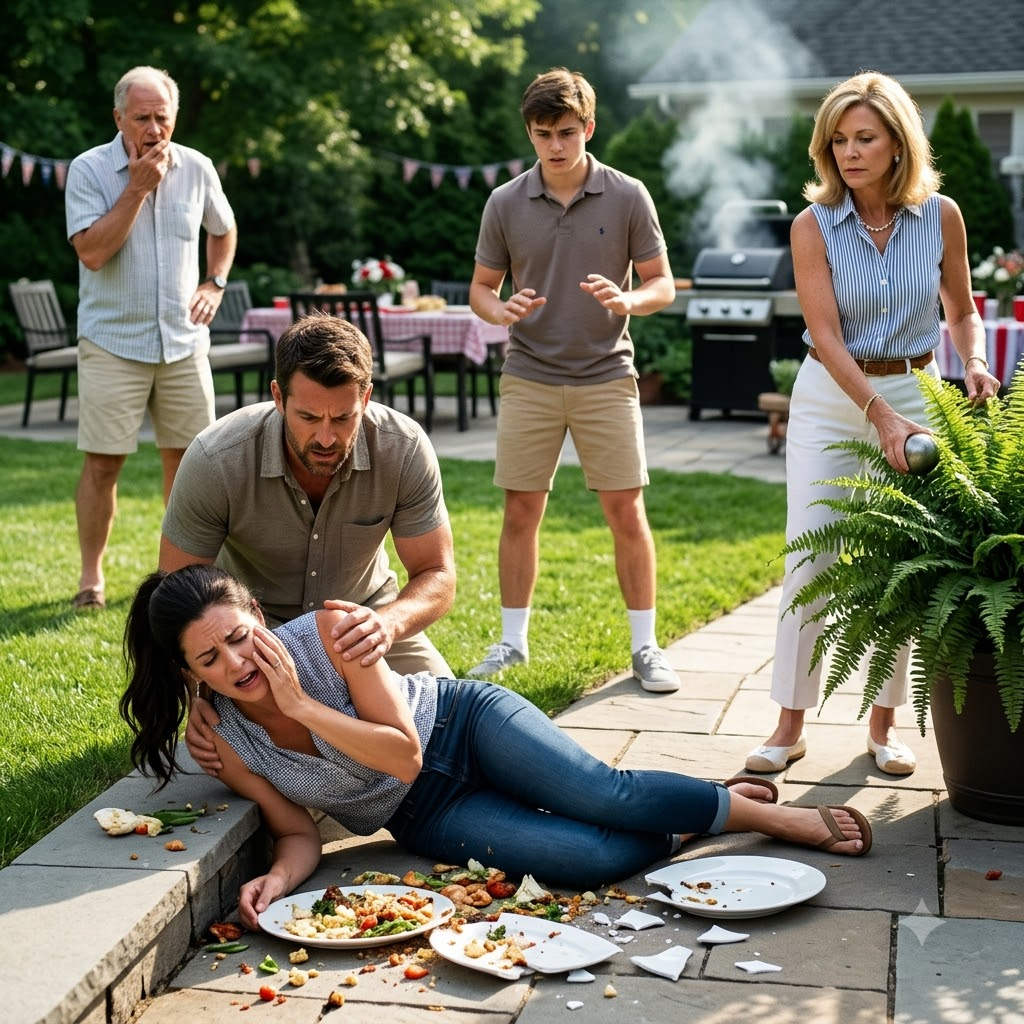
A steel ball flew toward my face as I turned away from the patio.
"Time to teach this blue-collar bitch a lesson!"
My husband Hayes found me beside a shattered ceramic platter.
A red smear marked the polished surface of the weapon.
This was not an accident.
For several seconds, I couldn't understand what had happened.
One moment, I had been carrying a stack of serving platters toward the patio table. The next, the world had exploded into white light and unbearable pain.
My knees buckled.
The platters slipped from my hands, crashing against the stone walkway. Food scattered across the ground. A glass shattered somewhere behind me.
Then I tasted blood.
I tried to scream, but the pain in my jaw made the sound come out as a strangled gasp.
Someone laughed.
That was the part I remembered most clearly.
Not the impact. Not the shattered dishes. Not even the terrible sensation spreading across my face.
The laughter.
Kale Mercer stood several feet away, his throwing arm still extended. He was nineteen years old, wearing a gray polo shirt, beige shorts, and expensive sneakers that probably cost more than some people's monthly rent.
His expression wasn't frightened.
It was satisfied.
"Look what you made me do," he muttered.
I stared at him through watering eyes.
I couldn't believe he had actually thrown it.
The object had been a solid-steel bocce ball, approximately two pounds of metal. It wasn't a toy. It wasn't something harmless that could accidentally bounce against someone's shoulder.
He had thrown it directly at my face.
And he had done it because I embarrassed him.
Ten minutes earlier, I had been standing beside the barbecue grill while the rest of the Mercer family relaxed in expensive lawn chairs.
It was their annual Fourth of July celebration.
The backyard was decorated with red, white, and blue bunting. A small American flag stood beside the outdoor dining table. Smoke drifted lazily from the grill, and several guests were laughing over drinks.
I had spent most of the afternoon preparing food.
Nobody had asked me to help.
Nobody had offered to take over.
But somehow, because I was married into the family, everyone assumed I would serve them.
I didn't mind working.
I had spent years building a company from almost nothing. Compared with negotiating freight contracts, handling angry truck drivers, and surviving business disputes, preparing a barbecue wasn't particularly difficult.
What bothered me was the way they treated me.
The Mercers were old money.
Their wealth came from inherited property, investments, and business interests that had passed through several generations.
They believed their surname opened doors.
They believed their social connections made them important.
And they believed my success was somehow less respectable because I had earned it myself.
To them, I wasn't Marin, the woman who had built a multimillion-dollar freight brokerage.
I was the woman who had once worked in a warehouse.
The woman who understood fuel invoices, loading schedules, and delivery delays.
The woman whose hands had become rough from years of work.
Kale had made sure I never forgot his opinion.
Earlier that afternoon, he had approached me while I was checking the grill.
"So, Marin," he said, leaning against the counter, "how's your little garage business doing?"
I kept turning the burgers.
"Busy."
He laughed.
"Still playing truck driver?"
"I run a freight brokerage."
"Whatever. Same thing."
I looked at him.
"How's college?"
His smile widened.
"Great. Dad takes care of everything."
"I can tell."
His expression changed.
"What does that mean?"
I placed the serving tongs down.
"It means your father's money seems to be doing more work than you are."
A couple of relatives nearby suddenly became very interested in their drinks.
Kale's cheeks reddened.
"You think you're better than everybody because you made some money?"
"No," I replied. "I think people should contribute something before criticizing everyone else."
His eyes narrowed.
"My family built everything."
"Then you should be proud of them instead of pretending you built it yourself."
He walked away without answering.
I should have recognized the warning.
But I was busy finishing lunch.
Now, lying on the stone patio, I understood that Kale hadn't forgotten a single word.
My cheek throbbed.
My jaw felt wrong.
I tried moving my mouth and immediately regretted it.
Hayes appeared beside me.
"Marin!"
His voice sounded distant.
He dropped to his knees and carefully slid one arm behind my shoulders.
"Baby, look at me."
I tried.
His face blurred.
"What happened?"
I attempted to answer, but the pain stopped me.
Kale stepped forward.
"She slipped."
Hayes looked up.
"What?"
"She dropped everything and fell. It was an accident."
I watched Hayes's expression change.
He looked at the broken plates.
Then at the food scattered across the patio.
Then at Kale.
"Why is there a metal ball over there?"
Nobody answered.
Vesta suddenly moved.
She was Hayes's aunt, Kale's mother, and the kind of woman who could turn an ordinary conversation into a competition about family wealth.
She wore a sleeveless blue-and-white striped blouse, white trousers, and a pearl necklace.
Without saying anything, she hurried toward the grass.
I watched her bend down.
She picked up the steel ball.
Then she glanced around.
Her eyes briefly met mine.
Instead of calling for help, she hurried toward a large potted fern beside the patio and shoved the weapon behind it.
I couldn't believe what I was seeing.
The woman had just hidden the object that had struck me.
"Vesta!" Hayes shouted.
She turned.
"What?"
"Call an ambulance!"
Her expression hardened.
"Hayes, don't be ridiculous. Marin slipped."
I tried to speak.
Nothing came out except a painful breath.
Hayes looked down at me again.
"Don't talk. Just stay with me."
Vesta crossed her arms.
"She's always been dramatic. Kale didn't mean anything by it."
I wanted to laugh.
Not because anything was funny.
Because I had spent years listening to these people explain why their behavior was acceptable.
When they insulted me, I was supposed to ignore it.
When they excluded me, I was supposed to understand.
When they treated me like hired help, I was supposed to be grateful that they included me at all.
But now I was lying on the ground with a badly injured face, and Vesta was still protecting her son.
Hayes carefully placed his hand against my shoulder.
"Look at me, sweetheart."
I forced my eyes open.
"I'm getting you to the hospital."
He looked toward Kale.
"Don't move."
Kale gave a nervous laugh.
"Come on, Hayes. You're acting like I shot her."
Hayes slowly stood.
For the first time since I had known him, I saw something in his expression that frightened even me.
Not anger alone.
Something colder.
"You threw a solid piece of steel at my wife's face."
Kale shrugged.
"She deserved it."
The backyard went silent.
Even Orson, who had been standing near the outdoor dining table, finally looked uncomfortable.
"That's enough, Kale," he said.
But his voice lacked conviction.
Hayes turned toward him.
"Your son just admitted what he did."
Orson raised both hands.
"He was upset. They're both adults. We can handle this privately."
"Privately?"
Hayes stared at him.
"My wife is bleeding on your patio."
Vesta stepped closer.
"Watch your tone. You're talking about your family."
Hayes looked at her.
"No. I'm talking about the people who watched my wife get attacked and decided protecting a nineteen-year-old boy was more important than helping her."
A distant siren became audible.
Someone had finally called emergency services.
I felt Hayes kneel beside me again.
He held my hand while the paramedics approached.
One of them asked questions about my injuries. Another checked my breathing and carefully stabilized my head.
I could hear fragments of their conversation.
Facial trauma.
Possible jaw fracture.
Immediate hospital transport.
Hayes climbed into the ambulance with me.
As the doors closed, I caught one final glimpse of the backyard.
Kale stood beside his mother.
Orson was speaking to someone on the phone.
And Vesta was looking toward the potted fern.
She thought the weapon was hidden.
She thought the family could make the entire incident disappear.
She was wrong.
At the hospital, everything became a blur of bright lights, medical questions, and hurried footsteps.
Doctors examined my face and ordered imaging.
I was eventually informed that my injuries were serious and would require specialist treatment and reconstructive dental work.
Hayes remained beside me.
He held my hand whenever the medical staff allowed it.
When a nurse finally stepped away, he leaned closer.
"Marin, I need you to listen to me."
I looked at him.
His eyes were red.
"I should have stopped them a long time ago."
I tried to shake my head, but the movement hurt.
He continued.
"My family has treated you like an outsider since the day we got married. I kept telling myself they would change."
He swallowed.
"They won't."
For the first time that day, I saw tears in his eyes.
"Hayes..."
He squeezed my fingers.
"I'm going to make sure they never hurt you again."
I wanted to believe him.
But Hayes had grown up inside that family.
He knew how they operated.
He knew how much influence his parents and relatives had.
He also knew that the Mercers didn't respond well when someone challenged their authority.
Several hours later, after the doctors had stabilized my condition, Hayes left the trauma bay.
He said he needed to make a few phone calls.
I watched him walk down the corridor.
Then I closed my eyes.
I was exhausted.
My face hurt.
My mouth was swollen.
And I couldn't stop thinking about the sound of Kale laughing after he threw that metal ball.
I wondered whether the family would actually apologize.
Whether Orson would admit what his son had done.
Whether Vesta would tell the truth about hiding the weapon.
I had no idea what Hayes was planning.
But something had changed.
When he returned, he wasn't alone.
A middle-aged attorney walked beside him carrying a thick leather document folder.
Hayes held several papers in his other hand.
His expression was different now.
Calm.
Focused.
Almost frighteningly certain.
He pulled a chair beside my bed.
"Marin," he said quietly, "I need you to understand something before I sign these."
I looked at the papers.
At the top of the first page was the name of the Mercer family estate.
And beneath it was a section bearing Hayes's full legal name.
The attorney opened the folder.
Then Hayes picked up the pen.
He looked directly into my eyes.
"I'm choosing you."
And as he lowered the pen toward the signature line, his phone suddenly began vibrating with an incoming call from his father.






Comments 0