The photograph lay on the table.
Ethan stared at the words written across its back.
"THE BOY DOES NOT BELONG TO LYDIA."
Hayes stood beside him, his jaw clenched.
I reached for the photograph and examined it carefully.
Someone wanted us to believe Ethan wasn't Lydia's biological son.
After everything we had uncovered, I refused to accept another accusation without evidence.
"Daniel, we need the original records," I said. "Not another photograph. Not another anonymous message. I want the truth established legally."
Daniel nodded.
"Samuel Whitmore's daughter has agreed to meet us. She has the original trust agreement and the supporting documentation."
For the first time in weeks, I felt we were approaching the end of something.
But there was still one question.
Who was Ethan's biological father?
And why had Orson spent eight years hiding the truth?
The following morning, we met Samuel's daughter, Caroline Whitmore, at her attorney's office.
She was a composed woman in her early forties who carried a thick leather briefcase.
After introductions, she placed several documents on the table.
"My father trusted Eleanor Mercer," she explained. "He believed she was the only member of that family who genuinely understood the purpose of the original trust."
Hayes leaned forward.
"What was the purpose?"
Caroline opened the first document.
"Your grandfather established the trust to protect his grandchildren and future descendants from financial exploitation. He had become concerned that Orson was using inherited properties to secure personal business debts."
She showed us the original agreement.
It was dated several years before Lydia disappeared.
The document established an independent trust, with Ethan named as the primary beneficiary once his identity and parentage were verified.
I examined the next page.
There was a separate provision concerning guardianship.
Eleanor had initially selected Vesta as temporary guardian because she believed Vesta could protect the child from Orson's influence.
However, that appointment was conditional.
If Vesta failed to protect Ethan, the guardianship would automatically become invalid.
The document then named an independent protector.
Me.
I looked up.
"Why?"
Caroline smiled faintly.
"Your grandfather-in-law admired your business. He believed you understood the difference between earning money and inheriting power. Eleanor agreed with him."
Hayes took my hand.
Caroline continued.
"The final provision was especially important. If Lydia returned and her son's identity was verified, the estate would remain protected for Ethan. You would serve as independent trustee until he became an adult and could make his own decisions."
Daniel carefully examined the signatures.
"Is this the complete agreement?"
"Yes. My father preserved every original page."
I felt tears forming.
For months, the Mercers had treated me like an outsider.
Yet the people who understood the family's history had trusted me with its most important responsibility.
Not because I had married into their family.
Because they believed I would protect someone who couldn't protect himself.
Caroline then opened another folder.
Inside were copies of medical records, birth documentation, and correspondence between Eleanor and Lydia.
The documents established that Lydia had given birth to Ethan.
There was no evidence that Orson was his biological father.
Instead, the records identified a man named Thomas Bennett.
Hayes frowned.
"Who was Thomas?"
Lydia, who had joined us by video call, answered.
"He was the man I loved before everything happened."
Her voice was gentle.
"Thomas worked in transportation logistics. He met me when I was volunteering at a community center. He knew nothing about the Mercer fortune, and he never wanted anything from my family."
Hayes looked surprised.
"Why didn't you tell us?"
"Because Father threatened him."
Lydia explained that Thomas had died in a highway accident shortly before Ethan was born.
His family had been unable to challenge the Mercer family's influence, and Orson had used the circumstances to convince everyone that Lydia's child should be raised under his control.
But the original medical and legal records established the truth.
Ethan was Lydia and Thomas's son.
He was not Orson's child.
The photograph showing Orson holding the newborn had been deliberately used to create confusion about the baby's identity.
Hayes closed his eyes.
"My father turned a tragedy into an opportunity."
Lydia nodded.
"That's exactly what he did."
Caroline placed the final document on the table.
It was a letter from Eleanor.
The first sentence read:
"If my children are ever allowed to read this together, I hope they understand that love was never the weakness of this family. Greed was."
Hayes began crying.
I held his hand while he read the remaining paragraphs.
The legal proceedings began within days.
The original trust agreement was submitted for independent verification.
The financial records from my company were examined by forensic accountants.
Gordon Pike's involvement was established through correspondence, payment records, and his connections to the fraudulent transactions.
Richard Cole's access logs and electronic approvals provided further evidence of the financial scheme.
The investigators also obtained the original recording Vesta had preserved.
It contained a conversation between Orson, Gordon, and Vesta discussing the plan to intimidate me into abandoning my claim.
The recording confirmed that the Fourth of July attack had been anticipated.
It also established that Orson had instructed Vesta to make sure I signed the settlement documents afterward.
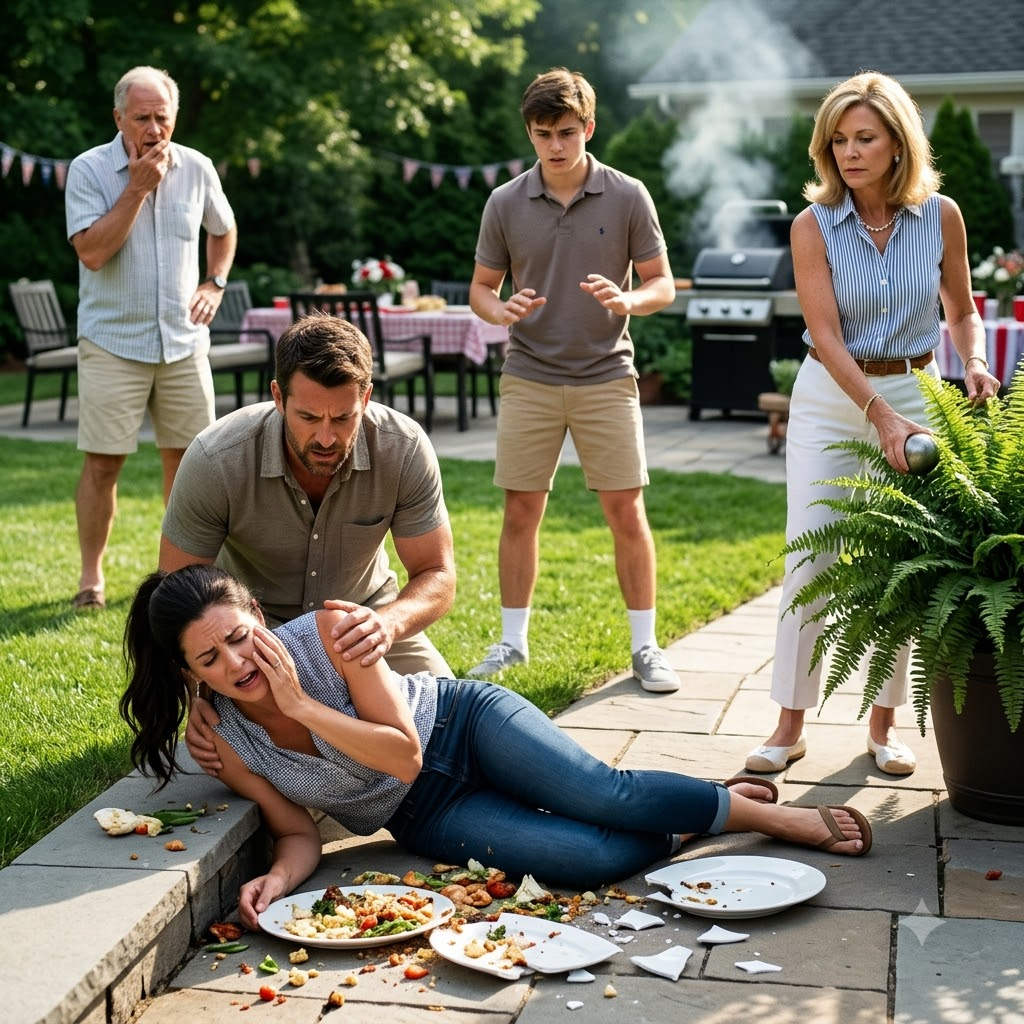
Vesta admitted that she had concealed the steel ball.
She cooperated with the investigation and provided additional correspondence.
Her cooperation did not erase what she had done.
But it helped establish the full sequence of events.
Kale also provided a formal statement.
He admitted that he had thrown the steel ball deliberately after hearing his parents discuss how they intended to frighten me.
He had wanted to impress them.
He had believed that his family would protect him from any consequences.
But when he saw the injuries he had caused, he realized the situation had gone far beyond what he had imagined.
His testimony helped confirm the family's efforts to conceal the weapon.
For the first time, the people who had always escaped responsibility faced the consequences of their actions.
Orson was eventually confronted with the financial records, the recordings, and the original estate documents.
He denied the allegations initially.
He claimed that Eleanor had been confused, that Lydia had manipulated the family, and that my company had voluntarily entered into the disputed financial arrangements.
But the evidence contradicted his explanations.
The investigation established that money had been diverted through shell companies, my executive credentials had been misused, and false documents had been created to claim ownership of my brokerage.
The fraudulent ownership transfer was invalidated.
My company recovered the funds that had been improperly moved, and the financial restrictions were lifted after the independent review.
Gordon faced serious legal consequences for his role in the scheme.
Richard was removed from his position and held accountable through the appropriate legal proceedings.
Orson lost control of the family office.
His authority over the trust was permanently revoked.
The courts also determined that the attempted manipulation of Ethan's guardianship had no legal validity.
Vesta's temporary appointment was terminated because she had failed to protect the child.
She was required to answer for her role in the conspiracy and the concealment of the assault.
The family could no longer use inherited wealth to silence people.
And for the first time, Ethan's future belonged to him.
My own recovery took longer.
The injuries to my face required several procedures and months of careful rehabilitation.
There were difficult mornings when the pain returned.
There were moments when I avoided mirrors.
But I refused to allow the Mercers to take away my confidence.
My medical team helped restore much of my facial function, and with time, the swelling gradually disappeared.
Hayes never left me to face those days alone.
He attended appointments, helped me through difficult nights, and learned how to prepare meals that I could comfortably eat during recovery.
One evening, several months after the barbecue, I stood in front of the bathroom mirror.
The scars were still visible.
They might always be.
But I no longer saw only the woman who had collapsed on the grass while a wealthy family watched.
I saw someone who had survived.
Hayes appeared behind me.
He wrapped his arms gently around my waist.
"You look beautiful."
I smiled.
"Even with the scars?"
He turned me toward him.
"Especially because you never let them define you."
I kissed him.
For the first time in a long time, I believed that the worst was truly behind us.
Ethan's life changed too.
He moved in with Lydia after the legal proceedings established her parental rights and secured his future.
Hayes became a regular presence in his life.
At first, Ethan was quiet around him.
He had spent years being told that his mother's family was dangerous.
He needed time to understand that not everyone sharing the Mercer name was like Orson.
Hayes never pressured him.
Instead, he invited him to ordinary things.
A baseball game.
A family dinner.
A weekend drive.
Slowly, they developed a relationship.
One Saturday, Hayes brought Ethan to my office.
The young man looked around at the employees, the meeting rooms, and the framed photographs documenting the company's growth.
"This is all yours?" he asked.
I smiled.
"I built it with a lot of help."
"Grandma Eleanor said you started with almost nothing."
"She was right."
He looked at me thoughtfully.
"Does it bother you that people called you an outsider?"
I considered the question.
"Not anymore."
"Why?"
"Because belonging isn't something other people get to grant or take away. It's something you build through the way you treat people."
Ethan smiled.
Then he asked whether he could learn about logistics.
I laughed.
"Be careful. Once I start explaining freight brokerage, I might never stop."
He laughed too.
That afternoon, I showed him how our dispatchers coordinated shipments across the country.
For the first time, he looked excited about his future.
Not because of the money he would inherit.
But because he had discovered something he genuinely wanted to learn.
Six months later, the original Mercer estate trust was formally restored.
The properties that had been improperly pledged were returned to the protected structure.
The remaining assets were placed under independent management.
Ethan was confirmed as the primary beneficiary.
I accepted the position of independent trustee under the conditions established by the original agreement.
I refused any personal ownership of the assets.
The money would belong to Ethan's future, education, and security.
My company would remain mine.
The business I had built from a folding table would never become another family's bargaining chip.
Hayes supported that decision completely.
He also made a choice that surprised several relatives.
He renounced any claim to control the family office.
He wanted no part of the old power structure.
Instead, he began working with Lydia on a charitable foundation established in Thomas Bennett's memory.
Its purpose was to help young people from working families pursue education and career opportunities without becoming dependent on wealthy benefactors.
They called it the Bennett Future Foundation.
At its opening ceremony, Lydia stood beside Hayes.
Ethan cut the ribbon.
I watched them together and thought about Eleanor.
She had spent her final months trying to create exactly this future.
A future where her family could no longer use money to control the people they claimed to love.
One year after the Fourth of July barbecue, we held another gathering.
This time, it was at our home.
There were no expensive family speeches.
No arguments about social status.
No one expected me to stand alone at the grill while everyone else relaxed.
Hayes cooked beside me.
Lydia brought dessert.
Ethan helped arrange the chairs.
Kale also attended.
He had completed his legal obligations and entered counseling as part of his rehabilitation.
He approached me quietly while the others were outside.
"Marin, can I talk to you?"
I nodded.
He looked uncomfortable.
"I know saying sorry doesn't fix anything."
I waited.
"I was cruel to you long before the barbecue. I thought being rich made me better than everyone else. My parents taught me that people like you didn't belong in our family."
He swallowed.
"But I made my own choice when I threw that ball. Nobody forced my arm."
I looked at him.
"You're right."
His eyes filled.
"I don't expect you to forgive me."
"I don't have to forget what happened to believe you can become a better person."
He nodded.
Then he stepped back.
I didn't embrace him.
I didn't pretend everything was suddenly repaired.
But I accepted his apology.
That was enough for that day.
As the evening sun began to set, Hayes found me sitting on the back porch.
He handed me a glass of lemonade.
"Thinking about something?"
I smiled.
"Your mother."
He sat beside me.
"I miss her."
"So do I."
We looked toward the garden.
A small American flag moved gently beside the porch.
Inside, Lydia and Ethan were laughing over an old photograph.
For the first time, the Mercer family gathering felt like a family gathering.
Not a competition.
Not a performance.
Not a place where someone had to prove they deserved a seat at the table.
Hayes took my hand.
"Do you ever wish we could go back and change everything?"
I thought about the injury, the betrayal, the months of uncertainty, and the people who had tried to destroy the life I built.
Then I looked at him.
"No. I wish none of it had happened. But I wouldn't trade the people standing beside us now."
He kissed my forehead.
Inside, Ethan called for us.
He wanted everyone to join him for a photograph.
We stood together in the living room.
Lydia beside Hayes.
Ethan between them.
Kale standing quietly near the doorway.
Daniel and Michael had joined us for dinner.
I stood beside my husband.
When the camera flashed, nobody was pretending to be someone else.
And nobody was hiding the truth.
Later that night, I returned to my office and looked at the framed photograph of my first truck.
It reminded me where everything had started.
I had built my company without inherited money, without family connections, and without anyone handing me a place at their table.
The Mercers had once believed that made me inferior.
They had been wrong.
My greatest victory wasn't controlling their fortune or defeating their schemes.
It was protecting the people they had tried to use, preserving the business I had worked so hard to build, and creating a family where nobody needed wealth or a famous surname to be valued.
Hayes came up behind me and wrapped his arms around me.
"Ready to go home?"
I smiled.
"Yes."
And this time, home meant exactly what it was supposed to mean.
A place where I was loved, respected, and never required to prove that I belonged.






Comments 0