The phone wouldn't stop vibrating.
Hayes stared at the screen while the attorney stood beside him, holding the leather folder against his chest. My husband had one hand resting on the documents and the other gripping his phone.
His father's name flashed across the display.
ORSON MERCER.
Hayes declined the call.
Three seconds later, it rang again.
"Are you going to answer that?" the attorney asked.
"No."
"Hayes, your father probably knows what you're planning."
"Then he should have thought about that before allowing his son to attack my wife."
I watched them from the hospital bed, struggling to understand what was happening. The medication had dulled some of the pain, but my face still felt as though someone had driven a hammer through it.
My jaw was swollen. My cheek had been carefully bandaged, and the doctors had warned me that recovery would take time.
I hated feeling helpless.
For thirty-four years, I had built my life around solving problems. When a shipment disappeared, I found it. When a carrier broke a contract, I negotiated another route. When a customer refused to pay, I knew exactly which documents to put in front of their attorney.
But I couldn't fix my own face.
And I couldn't understand why my husband's family seemed more concerned about protecting Kale than helping me.
"Hayes," I whispered.
He immediately turned toward me.
"I'm here."
"What are those papers?"
He pulled his chair closer.
"They're documents that will change my relationship with the Mercer estate."
I looked at the attorney.
"Can he really do that?"
The man introduced himself as Daniel Whitmore. He was a senior estate attorney who had represented Hayes independently for several years.
"Your husband has certain inherited interests and property rights," Daniel explained. "He has the legal authority to make decisions concerning his own assets, subject to existing agreements and applicable restrictions."
I glanced at Hayes.
"What are you giving away?"
He took my hand.
"Everything I can legally transfer."
My stomach tightened.
"Hayes, don't do something you'll regret because of me."
He shook his head.
"This isn't because of you. It's because of what they did to you."
He paused.
"I've spent my entire life watching my family use money to avoid consequences. They thought they could humiliate you because you didn't come from their world. They thought Kale could throw something at your face and his mother could hide the evidence."
His voice dropped.
"They thought I would protect them."
I couldn't answer.
Daniel carefully closed the folder.
"Mr. Mercer, we should discuss the timing and the consequences before proceeding."
Hayes nodded.
"Tell her everything."
Daniel opened the folder again.
The documents concerned Hayes's separate inheritance, investment interests, and certain property rights that had been established before our marriage. Some required additional legal procedures, while others could be transferred through properly executed agreements.
I listened carefully.
Hayes wasn't simply giving me a bank account.
He was restructuring the financial position he had spent his adult life maintaining.
And he was doing it because he believed his family had crossed a line that could never be uncrossed.
"Why now?" I asked.
He looked at my bandaged face.
"Because I finally understand that staying neutral was never neutral. Every time I let them insult you, I gave them permission to do it again."
My eyes filled with tears.
Before I could answer, Daniel's phone rang.
He glanced at the display and frowned.
"It's your father's office."
Hayes let out a humorless breath.
"Of course it is."
"Would you like me to answer?"
"No. Tell them all communication concerning the estate must go through you."
Daniel nodded.
Then he looked at Hayes.
"There's another matter. Your father has already contacted the family attorney. They are requesting an emergency meeting."
Hayes leaned back.
"Let them meet."
I felt a chill.
"What are they going to do?"
He squeezed my hand.
"Whatever they can."
By midnight, the hospital room had become the center of a battle I hadn't known existed.
Hayes refused to leave.
He contacted my business attorney, arranged for someone to oversee my company's immediate operations, and instructed Daniel to preserve every document connected to the incident.
I was surprised when he asked about the barbecue.
"What do you need from there?" I whispered.
"The weapon. The broken plates. The witnesses. Anything that proves what happened."
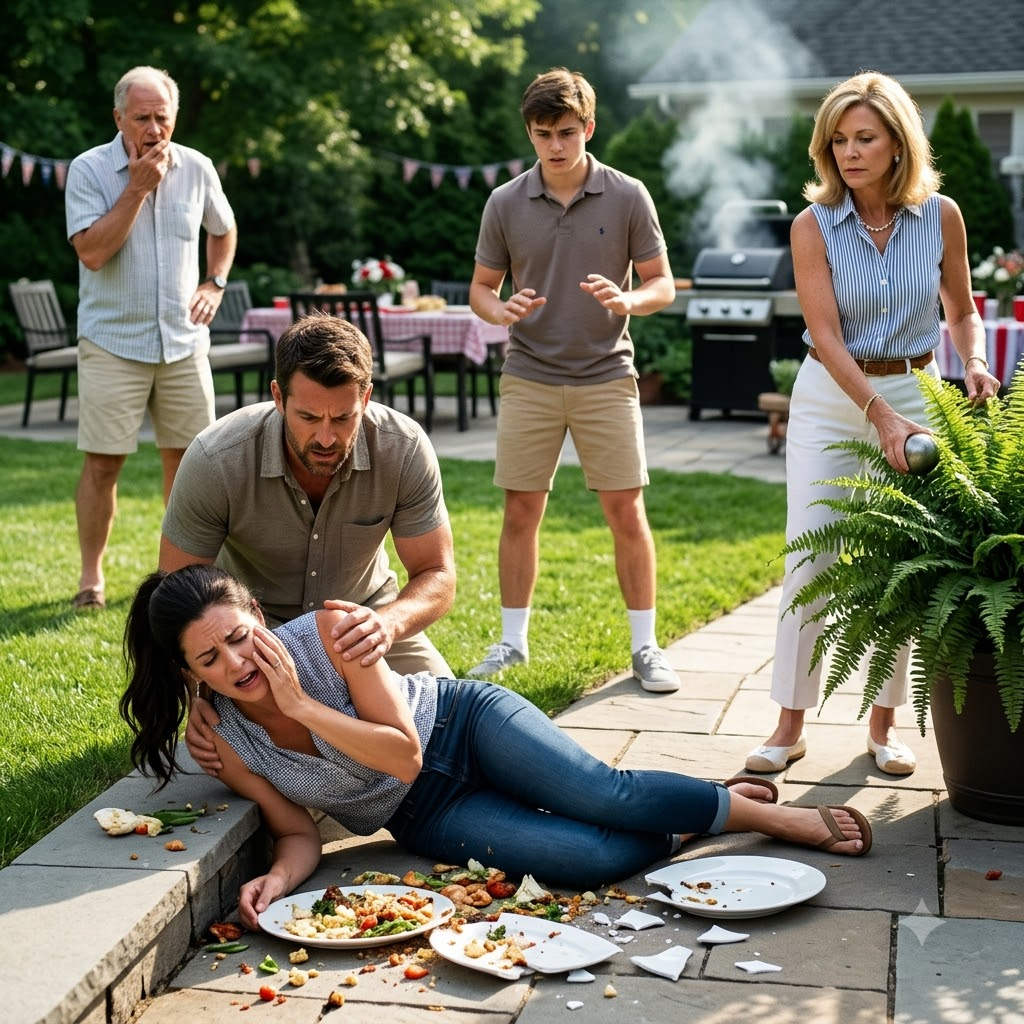
"Vesta hid the ball."
"I know."
"She put it behind the fern."
"I saw her."
I stared at him.
"You saw her?"
He nodded.
"I was coming around the side of the house when she picked it up. I thought she was trying to move it away from the walkway. Then I saw her push it behind the planter."
I felt sick.
"So she knew."
"Yes."
"She knew exactly what that thing was."
Hayes looked toward the window.
"She knew what her son had done, and her first instinct was to protect him."
For a moment, neither of us spoke.
Then he picked up his phone.
"There's something else I need to tell you."
I waited.
"My father called Kale's attorney before he called an ambulance."
I stared at him.
"How do you know?"
"Because I received a message from our family attorney. Orson wanted to know whether the incident could be described as an accidental injury during a recreational game."
I felt my throat tighten.
"They were already preparing a story?"
"Yes."
I closed my eyes.
The realization hurt more than I expected.
These people had watched me fall.
They had watched my husband kneel beside me.
They had heard the paramedics arrive.
And somewhere between the backyard and the hospital, they had begun discussing how to protect themselves.
"Hayes?"
"Yes?"
"Don't let them make me look like I caused this."
His expression hardened.
"They won't."
The following morning, a nurse entered carrying a tablet and a small package of paperwork.
She explained that the facial specialist would be examining me again and that further treatment would be necessary.
Hayes listened to every instruction.
He asked questions about the healing process, pain management, dental reconstruction, and the possibility of permanent complications.
I watched him carefully.
He had always been protective, but something about him had changed.
He no longer seemed interested in making his family understand his decisions.
He had stopped seeking their approval.
When the nurse left, my phone began vibrating on the bedside table.
It was my operations manager, Tessa.
I answered with difficulty.
"Marin? Oh, my God. Are you okay?"
"I'm at the hospital."
"I heard something happened at the barbecue. Hayes's cousin?"
I looked at my husband.
"Yes."
Tessa went quiet.
Then she said something that made my stomach turn.
"Marin, somebody from the Mercer family called the office this morning."
"Who?"
"A man claiming to represent Orson. He wanted to know whether your company had any financial arrangements with Hayes."
I frowned.
"What did you tell him?"
"Nothing. I told him I wouldn't discuss company information with an unauthorized caller."
"Good."
"But Marin, he asked something else."
"What?"
"He wanted to know whether your company could survive if your personal finances were tied up in a lawsuit."
I felt my fingers tighten around the phone.
"They're investigating me?"
"That's what it sounded like."
I glanced at Hayes.
He had heard enough to understand.
"Tell Tessa to preserve the call records," he said.
I repeated his instructions.
Tessa agreed.
Then she lowered her voice.
"Marin, there's something else. I found an email from a company called Mercer Capital Holdings. They requested copies of several old freight contracts."
My heartbeat quickened.
"Which contracts?"
"The ones involving the distribution network we built three years ago. The contracts that made your company profitable enough to expand nationally."
I stared at the ceiling.
Those contracts were among the most commercially sensitive documents my company possessed.
"Did they explain why they wanted them?"
"No. They said they were reviewing potential investment opportunities."
I almost laughed.
Potential investment opportunities.
The Mercers had spent years pretending my business was beneath them.
Now, apparently, they wanted access to the very contracts that had made it successful.
"Don't send them anything," I said.
"I won't."
After we ended the call, I looked at Hayes.
"They're not just protecting Kale."
He shook his head.
"No. They want control of the situation."
"And possibly my company."
His silence told me I wasn't imagining things.
Around ten thirty, the first member of the Mercer family arrived.
It wasn't Kale.
It wasn't Vesta.
It was Orson.
He walked into the hospital room wearing a navy blazer, pressed trousers, and the same expensive watch he had worn at the barbecue.
He looked around before approaching the bed.
"Marin."
I didn't answer.
His eyes moved toward Hayes.
"We need to talk."
Hayes remained seated.
"Then talk."
Orson glanced at Daniel, who had returned with another folder.
"I'd prefer to speak with my son privately."
"That's unfortunate," Hayes replied. "You should have thought about privacy before your family made this public."
Orson's jaw tightened.
"This situation has gotten out of hand."
I stared at him.
Gotten out of hand?
I was lying in a hospital bed because his grandson had thrown a steel ball into my face.
My company was being contacted by his financial associates.
And he thought the problem was that the situation had become inconvenient.
"Your son attacked me," I whispered.
Orson looked at me.
"Kale is young."
"He's nineteen."
"He's still learning."
I wanted to ask how old a person needed to be before they understood that throwing a heavy metal object at someone's face could cause serious injury.
Instead, I waited.
Orson continued.
"He made a mistake. He was embarrassed by what you said earlier, and things escalated."
Hayes stood.
"Are you seriously blaming Marin?"
"I'm explaining what happened."
"No. You're explaining why you think your grandson shouldn't face consequences."
Orson lowered his voice.
"We're family."
Hayes stared at him.
"That word doesn't mean what you think it means."
Orson placed a leather envelope on the small table beside my bed.
"This is an offer to settle the matter privately."
Hayes didn't touch it.
"What kind of offer?"
"Financial assistance for Marin's medical treatment. We can arrange everything through the family office."
I felt my stomach turn.
"How generous," I whispered.
Orson ignored the sarcasm.
"We would also appreciate a written statement confirming that the incident was accidental."
Hayes slowly turned toward him.
"Get out."
Orson blinked.
"Excuse me?"
"You heard me."
"Hayes, don't be emotional. You need to consider the consequences of what you're doing."
"My wife is the one who needs medical treatment. You're the one who needs to consider the consequences."
Orson looked toward Daniel.
"You're allowing this?"
Daniel remained composed.
"My client is entitled to independent legal representation."
Orson's face reddened.
"Your client is making a terrible mistake."
Hayes stepped closer.
"No. The mistake was letting your family believe money could buy its way out of everything."
Orson picked up the envelope.
Then he leaned toward his son.
"Your mother is going to be very disappointed when she hears what you've done."
Hayes didn't move.
"Tell her to join the line."
Orson left without another word.
The door closed behind him.
I exhaled slowly.
"Hayes, what was in that envelope?"
He looked at me.
"A settlement offer."
"How much?"
"Enough to make most people think twice."
"And what would I have had to do?"
"Sign a statement saying Kale's actions were accidental and agree not to pursue further claims."
I stared at him.
They wanted me to sign away the truth.
Not because they believed Kale was innocent.
Because they knew exactly what had happened.
That afternoon, Daniel returned with news.
He had spoken to an independent investigator and arranged for the incident to be documented.
The investigator had already contacted several people who attended the barbecue.
One guest had confirmed seeing Kale throw the metal ball.
Another had witnessed Vesta pick it up afterward.
But the most important information came from someone Hayes hadn't expected.
A teenager who had been sitting near the outdoor dining table had recorded part of the confrontation on his phone.
The recording apparently began shortly before the attack.
It captured Kale arguing with me.
It captured his mocking comments.
And according to Daniel, it also captured the sound of the metal ball striking my face.
"Do we have the video?" Hayes asked.
"Not yet. The witness is willing to cooperate, but his parents want to speak with an attorney first."
Hayes nodded.
"That's fine. Don't pressure them."
Daniel turned a page.
"There is another problem."
I looked at him.
"What?"
"Vesta has reportedly told several relatives that Marin accidentally fell while carrying the dishes."
My hands tightened against the blanket.
"She's lying."
"I know," Hayes said.
Daniel continued.
"She is also claiming that Kale picked up the bocce ball only after the accident."
I looked toward Hayes.
"That's not what happened."
"I know."
"Then why are we discussing what she says?"
"Because people who have money and influence often begin telling their version of events before anyone has gathered the evidence."
Hayes looked at Daniel.
"Find the original recording. Preserve the witnesses' statements. And make sure nobody gets near that weapon."
Daniel nodded.
Then his expression changed.
"Actually, about the weapon..."
He opened another document.
"The local authorities were informed about the incident. However, when officers visited the property, the bocce ball was no longer where Marin described it."
I felt my blood run cold.
"What?"
"Someone moved it."
Hayes stood immediately.
"Who?"
Daniel hesitated.
"According to the preliminary information, the potted fern was removed from the patio shortly after the ambulance left."
I stared at him.
Vesta had hidden the weapon.
And now the entire planter had disappeared.
Hayes reached for his phone.
Before he could make a call, Daniel's device rang.
He answered.
"Whitmore."
He listened.
His expression changed.
"What do you mean they found something?"
Hayes stepped toward him.
Daniel listened for another few seconds.
Then he slowly lowered the phone.
"Mr. Mercer, the investigator just sent me a photograph."
He turned his screen toward Hayes.
It showed the potted fern sitting inside the garage at the Mercer residence.
The metal ball was gone.
But beside the planter was a small plastic evidence bag.
And inside it was something that made Daniel stop speaking.
Hayes stared at the photograph.
Then his phone lit up with a message from an unknown number.
"If you want to know who really ordered the weapon hidden, ask your mother."






Comments 0