Mrs. Carter knocked again.
"Sloan? Honey, please open the door."
I stood frozen in my hallway.
My phone was pressed against my ear.
Caroline Hayes was still speaking.
"Sloan, are you there?"
"She's outside."
"Who?"
"Mrs. Carter."
There was a brief silence.
Then Caroline said, "Do not open that door yet."
I looked at the laptop on my kitchen table.
The document was still visible.
ATTACHMENT D — PARENTAL FITNESS CERTIFICATION
And beneath it, the signature.
MARGARET CARTER.
The woman who had watched Knox when I worked late.
The woman who brought us homemade soup when we were sick.
The woman who had once told me I was doing a wonderful job raising my son.
She had apparently signed a statement claiming I was an unfit mother.
My stomach twisted.
"Caroline, I don't understand."
"Neither do I. But I need you to listen carefully. An emergency petition was submitted electronically tonight. It includes a declaration attributed to Mrs. Carter."
"Is it real?"
"The filing exists. That doesn't mean the allegations are true or that a judge has accepted them."
I swallowed.
"What does it say?"
"It alleges that Knox has been left without appropriate supervision and that your parents should be granted temporary care."
My knees weakened.
"That's a lie."
"I understand."
"I've never left Knox alone."
"Sloan, we will challenge it."
Another knock.
This time, softer.
"Sloan," Mrs. Carter called. "I know you're scared. But I need to explain something."
I stared at the door.
Caroline said, "Keep the door locked. You can speak through it if you feel safe."
I took a breath.
Then stepped forward.
"Mrs. Carter?"
"Oh, thank goodness."
"Why is your name on a document saying I'm an unfit mother?"
Silence.
Then I heard her begin to cry.
"I didn't know what they were going to do with it."
Her voice broke.
I pressed my palm against the door.
"What did you sign?"
"A statement."
"What statement?"
She sniffed.
"Your mother came to see me two weeks before Christmas."
My heart pounded.
"Why?"
"She said your father was updating the family estate documents."
I closed my eyes.
That phrase again.
Estate documents.
Family planning.
Protecting the future.
Every betrayal had been wrapped in respectable language.
Mrs. Carter continued.
"She asked me to confirm that I sometimes watched Knox when you worked late."
"Which is true."
"Yes."
"Then what happened?"
"She gave me a paper to sign."
I stared at the door.
"Did you read it?"
A long silence.
"Not carefully enough."
My stomach turned.
"Mrs. Carter."
"I know, honey. I know."
I heard her crying harder.
"She told me it was just proof that you had a support system. That it would help with some insurance arrangement."
I closed my eyes.
"Did you sign a blank page?"
"No. There was writing on it. But the statement I saw tonight isn't the one I remember."
My pulse quickened.
"What do you mean?"
"Your mother emailed me a copy after I called her. It says things I never said."
I gripped the phone.
Caroline spoke immediately.
"Sloan, ask her to preserve every original message and document."
I repeated the instruction.
Mrs. Carter answered quickly.
"I have everything. The email. The attachment. Even the envelope she brought."
My heart began pounding.
"Why are you here now?"
"Because your mother called me tonight."
I went still.
"What did she say?"
"She said lawyers might contact me. She told me to remember that you were overwhelmed and Knox needed stability."
My stomach tightened.
"And?"
Mrs. Carter's voice dropped.
"She offered me ten thousand dollars."
I stopped breathing.
"For what?"
"To stand by the statement."
The hallway seemed to tilt.
Ten thousand dollars.
My parents were trying to buy testimony against me.
I looked toward the staircase.
Knox was asleep upstairs.
The boy Mrs. Carter had held when he was a baby.
The boy who called her Miss Margaret and brought her drawings.
"Did you take it?" I whispered.
"No."
Her answer came immediately.
"I told her to leave me alone. Then I read the document again, and I came straight here."
I swallowed.
"Mrs. Carter, why didn't you call me first?"
"I was afraid you wouldn't answer."
I stared at the door.
I wanted to believe her.
Desperately.
But I couldn't afford to trust anyone simply because I loved them.
Not anymore.
"Please send everything to Caroline," I said.
"Of course."
"Tonight."
"I will."
Then Mrs. Carter whispered:
"Sloan, I'm so sorry."
I closed my eyes.
"I know."
But I didn't open the door.
Twenty minutes later, Caroline called back.
"I've received Mrs. Carter's original email chain."
I sat at my kitchen table.
"What does it show?"
"The statement attached to Genevieve's original message is substantially different from the declaration filed tonight."
My pulse quickened.
"Different how?"
"The original says Mrs. Carter provided occasional childcare while you worked. It describes Knox as well cared for."
I closed my eyes.
"And the filed version?"
"It alleges neglect and emotional instability."
I gripped the table.
"Can we prove it was changed?"
"We have evidence of conflicting versions. We'll need to establish the document history and authenticate the records."
I nodded.
"Okay."
"Mrs. Carter is willing to provide a sworn statement explaining what happened."
I exhaled shakily.
"Thank God."
Caroline paused.
"There's another important point."
"What?"
"The emergency petition hasn't been granted. We're preparing an immediate response and requesting that the court consider the conflicting documents."
I pressed a hand over my mouth.
For the first time all night, I could breathe.
My parents had filed papers.
They had made allegations.
They had frightened me.
But they hadn't taken my son.
And now their evidence was beginning to collapse.
The following morning, I woke to a message from my father.
TOBIAS: You should have accepted our offer.
I stared at the screen.
Then another appeared.
TOBIAS: None of this needed to happen.
I forwarded both messages to Caroline.
Then I went downstairs to make breakfast.
Knox was sitting at the kitchen table with his dinosaur.
He looked up.
"Mom?"
"Morning, sweetheart."
"Did Mrs. Carter come last night?"
My heart tightened.
"Yes."
He looked down.
"Is she mad at us too?"
I crossed the kitchen and knelt beside him.
"No, baby."
"Then why did she sound sad?"
I hesitated.
"Sometimes grown-ups make mistakes. Mrs. Carter is trying to correct one."
He thought about that.
"Like when I spell a word wrong?"
I smiled sadly.
"Something like that."
He nodded.
"Okay."
Then he pushed his dinosaur toward me.
"Captain Rex says you need breakfast."
I laughed.
"Captain Rex is very wise."
Knox grinned.
And for a moment, I could pretend we were an ordinary family having an ordinary morning.
But my phone was vibrating on the counter.
The bank.
Again.
I returned Daniel Mercer's call through the official number.
After verification, he sounded unusually serious.
"Ms. Whitmore, the lender has completed another stage of its account review."
I sat down.
"Okay."
"We've issued formal notices to the borrowers regarding outstanding obligations and documentation requirements."
My heart quickened.
"What kind of notices?"
"I'm limited in what I can disclose while your role remains disputed."
"I understand."
"But I can confirm that the institution has identified material issues involving the loan's supporting records."
I looked at the company chart on my laptop.
"The false signatures?"
"Those remain under investigation."
"What else?"
"Financial representations and transactions associated with the borrowing entities."
I closed my eyes.
Whitmore Family Holdings.
Crescent Ridge.
The $425,000 transfer.
My father's entire financial structure.
Daniel continued.
"The institution has also taken steps to prevent further reliance on the disputed guarantee while the review continues."
Relief washed through me.
"Does that mean I'm no longer responsible?"
"No final determination has been made. Your attorney will receive the relevant communications."
I nodded.
"Right."
Then Daniel said something that made me sit straighter.
"Ms. Whitmore, I also want to inform you that the borrowers have been sent a final notice concerning certain outstanding requirements."
My stomach tightened.
"Final notice?"
"Yes."
I stared at the wall.
My father had spent years presenting himself as untouchable.
Now the bank was sending him a final notice.
"Can you tell me what happens next?"
"That depends on the borrowers' response and the applicable agreements."
I took a breath.
"Okay."
After the call, I immediately contacted Rebecca.
She already knew.
And she had more information.
"Sloan, I've reviewed the notice provided to us by the lender's legal department."
I sat at my desk.
"What does it say?"
"The bank has identified several potential defaults under the loan documents, including failures to provide required information and concerns about representations made during the financing."
My pulse quickened.
"Does that mean foreclosure?"
"Not automatically. The lender must follow the applicable contractual and legal procedures. But the notice is serious."
I closed my eyes.
"How serious?"
"The borrowers have a limited period to address the identified issues or respond as required."
I swallowed.
"Can Dad fix it?"
"That depends on the actual financial condition of the borrowers and whether the issues can be cured."
I looked at my spreadsheet.
Three thousand dollars a month.
Thirty-six months.
One hundred and eight thousand dollars.
I'd paid that money because my father told me the mortgage was manageable.
Because he said he needed temporary help.
Because he insisted the family home was secure.
But now I wondered whether he'd been using my payments to hide a much larger financial problem.
"Rebecca," I whispered, "was the mansion ever really worth four million dollars?"
"The estimated property value and the equity available to your parents are two different things."
I stared at the wall.
"What do you mean?"
"A house can have a high market value and still be heavily encumbered by debt."
I knew that.
Of course I knew that.
I worked in credit risk.
But I'd never applied the same skepticism to my father that I applied to a commercial borrower.
Because he was my father.
And I'd wanted to believe him.
"Rebecca, how much do they owe?"
"We're still obtaining verified information."
I closed my eyes.
"Okay."
Then she said:
"There's something else."
My stomach tightened.
"What?"
"The lender has identified a discrepancy involving the reported value of certain pledged assets."
I stared at the company chart.
"The investment vehicle?"
"Possibly. The review is ongoing."
I swallowed.
"Was my name used to support those assets?"
"That's one of the questions we're asking."
I looked at the documents.
The false guarantee.
The company formation.
The trust.
The video.
Everything.
My father had built a financial house of cards.
And he'd used my identity as one of the supports.
At eleven o'clock, Blair called.
I almost ignored it.
Then I answered.
"What?"
Her voice was shaking.
"Sloan, what did you do?"
I closed my eyes.
"Good morning to you too."
"This isn't funny."
"I didn't say it was."
"Dad just got a notice from the bank."
"I know."
"He's losing his mind."
I stared at the wall.
"Then he should speak with his attorney."
Blair made a frustrated sound.
"Do you understand what's happening?"
"Yes."
"No, you don't!"
Her voice rose.
"They're asking questions about everything. The house. The companies. My business."
I sat straighter.
"Your business?"
She went silent.
"Blair?"
She swallowed.
"The bank wants records about the money Dad gave me."
My pulse quickened.
"The $187,500?"
"Yes."
I closed my eyes.
"Then provide the records."
"It's not that simple."
"Why not?"
She began crying.
I stared at the phone.
For years, Blair had cried whenever she wanted something.
Money.
Attention.
Forgiveness.
But this sounded different.
She was frightened.
"Sloan," she whispered, "Dad told me that money was mine."
"An advance on your inheritance."
"Yes."
"Then why is the bank asking about it?"
She hesitated.
"Because it came from an account that wasn't supposed to be used for distributions."
My stomach tightened.
"What account?"
"I don't know."
"Blair."
"I swear."
I closed my eyes.
"Did you spend it?"
She began crying harder.
"Some of it."
"How much?"
She didn't answer.
"Blair, how much?"
"Almost all of it."
I stared at the wall.
Nearly two hundred thousand dollars.
Gone.
While she told me she had less than five thousand dollars.
While she begged me to guarantee her twenty-thousand-dollar business loan.
While she insulted my son.
I felt anger rise.
"Blair, you lied to me."
"I didn't know it was going to get this bad."
"You knew someone was pretending to be me."
She sobbed.
"Dad said you would never find out."
I stopped breathing.
There it was.
Not confusion.
Not misunderstanding.
A decision.
They had expected me to remain ignorant.
To keep paying.
To keep smiling.
To keep believing.
"Blair," I said quietly, "you need your own attorney."
She went silent.
"What?"
"Someone who represents you. Not Dad."
"But we're family."
I closed my eyes.
"That's exactly why you need one."
Then I ended the call.
At noon, my mother arrived at my office building.
I was in the middle of reviewing a commercial loan portfolio when the receptionist called.
"Sloan, there's a woman downstairs asking for you."
I closed my eyes.
"Who?"
"Genevieve Whitmore."
Of course.
I told the receptionist I wasn't available and asked building security to handle the situation.
Five minutes later, my phone rang.
Mom.
I answered.
"Sloan, I'm downstairs."
"I know."
"Come talk to me."
"No."
Her voice cracked.
"Please."
I stared at my computer.
"Mom, you need to leave."
"Your father says the bank could take the house."
I closed my eyes.
"Then he needs to address the bank's concerns."
"We don't have enough money."
I went still.
For the first time, she'd said it plainly.
Not temporary cash-flow issue.
Not short-term restructuring.
Not family investment.
We don't have enough money.
"Mom," I whispered, "where did it all go?"
She began crying.
"I don't know."
"Yes, you do."
"Sloan—"
"Your name is on the company records. You signed the Crescent Ridge documents. You authorized transfers."
She went silent.
I continued.
"You helped someone impersonate me."
Her breathing became uneven.
"Your father said it was necessary."
"Necessary for what?"
She sobbed.
"To keep people from finding out."
My stomach tightened.
"Finding out what?"
She didn't answer.
"Mom."
Then she whispered:
"That we were already broke."
I stopped breathing.
The mansion.
The cars.
The jewelry.
The parties.
The vacations.
The expensive Christmas dinners.
All of it.
A performance.
And I'd been paying to keep the curtain from falling.
"How long?" I asked.
She cried harder.
"Mom, how long?"
"Years."
I closed my eyes.
Years.
My father had been pretending to be wealthy for years.
And my mother had helped him.
I thought about every time they'd criticized my townhouse.
Every time they'd called my car cheap.
Every time they'd told me I wasn't ambitious enough.
They had looked down on the life I could actually afford.
While living in a mansion they couldn't.
"Mom," I whispered, "you need to tell the truth."
She sobbed.
"If I do, your father will never forgive me."
I stared at the wall.
"Then maybe you should stop asking for his forgiveness."
She didn't answer.
I ended the call.
And sat staring at my screen.
At three o'clock, Caroline called.
The emergency custody petition had been reviewed.
The court had not granted the requested emergency change in care on the submitted papers.
A hearing would be scheduled if the petition proceeded.
My parents' allegations would have to withstand scrutiny.
And Mrs. Carter's conflicting statements were now part of the response.
I closed my eyes.
"Thank you."
Caroline's voice softened.
"Sloan, this is an important development. But don't assume the matter is over."
"I won't."
"Keep documenting everything."
"I will."
After the call, I sat quietly for several minutes.
Then I looked at the photograph of Knox on my desk.
He was smiling.
Holding a toy rocket.
His whole face bright with excitement.
My father had threatened to take him.
My mother had prepared documents involving him.
My sister had signed a false statement.
And Mrs. Carter had nearly been used against me.
But now there was a record of what had happened.
Evidence.
Dates.
Messages.
Original documents.
For once, my family's version of the truth wasn't the only one anyone could hear.
At six o'clock, I picked Knox up from school.
He ran toward me.
"Mom!"
I crouched.
"Hey, astronaut."
He hugged me.
"Guess what!"
"What?"
"We learned about Jupiter!"
I smiled.
"Tell me everything."
He talked the entire drive home.
About storms.
Moons.
The Great Red Spot.
He was so excited that he barely stopped to breathe.
I listened.
Laughed.
Asked questions.
And felt something inside me begin to loosen.
My son was still my son.
Still curious.
Still funny.
Still full of wonder.
The people who had tried to use him hadn't changed that.
At home, we made grilled cheese sandwiches.
He spilled a little tomato soup.
Then looked at me.
For one brief second, I saw the old fear.
I smiled.
"Oops."
He smiled back.
"Oops."
We cleaned it together.
No yelling.
No threats.
No broken plates.
Just dinner.
At eight-thirty, Rebecca called.
Her voice was serious.
"Sloan, I received additional information from the lender."
I sat down.
"What happened?"
"The borrowers have responded to the final notice."
My pulse quickened.
"What did Dad say?"
"His representatives dispute several of the bank's findings."
I nodded.
"Of course."
"But they've also acknowledged certain financial difficulties."
I closed my eyes.
"How bad?"
Rebecca hesitated.
"The bank is reviewing whether the borrowers have sufficient resources to meet their obligations."
I stared at the wall.
"Okay."
"There's more."
My stomach tightened.
"What?"
"The lender has identified another property-related obligation that may affect the estate's equity."
I sat straighter.
"Another mortgage?"
"Possibly another secured claim. We're verifying the records."
I closed my eyes.
My father had told everyone the mansion was worth four million dollars.
But he had never told me how much debt was attached to it.
Now I was beginning to understand why.
Rebecca continued.
"Sloan, I want you to prepare for the possibility that the house cannot be saved."
I looked toward the living room.
Knox was reading his astronaut book.
I thought about the mansion.
The dining room.
The marble floor.
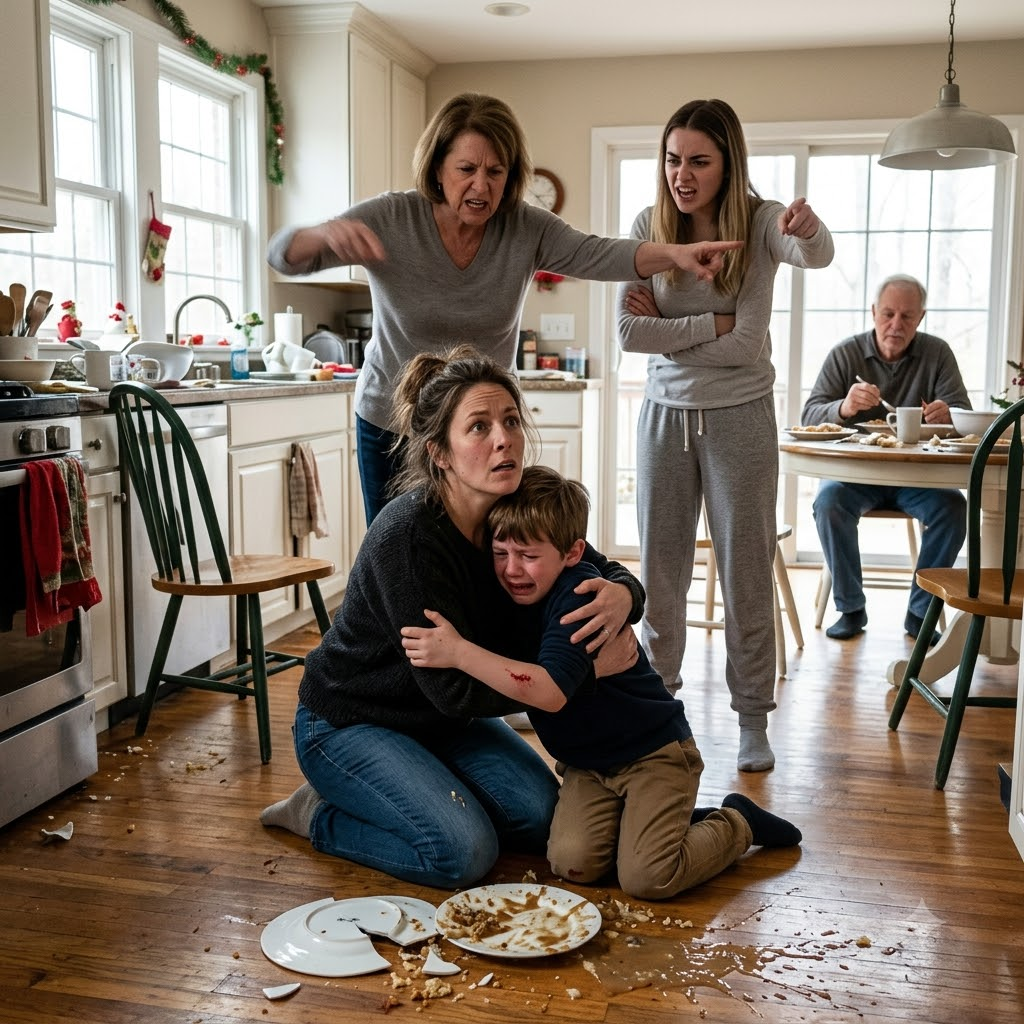
The blood on my son's arm.
Then I said:
"Rebecca, I'm not trying to save it."
She was quiet.
"I'm trying to make sure my name and my son's future aren't destroyed with it."
"I understand."
We ended the call.
And I sat in silence.
At ten-fifteen, I received an email from Evelyn Price.
SUBJECT: I FOUND THE MISSING ACCOUNT
My heart began pounding.
I opened it.
Sloan, the $425,000 transfer was not a routine investment transaction. I've located an internal reconciliation report from Halden Advisory. The receiving account belonged to a company connected to someone outside your immediate family.
I stared at the screen.
Another message followed.
That company received multiple payments over the past five years. The total exceeds $1.2 million.
My stomach dropped.
One point two million dollars.
My father had been paying someone for five years.
My mother knew.
Blair was frightened.
Martin Halden had helped structure the transactions.
And the bank was now uncovering the trail.
I opened the attachment.
A spreadsheet appeared.
Dates.
Amounts.
Reference numbers.
Recipient accounts.
Then a column labeled:
PAYMENT PURPOSE
Most entries contained vague descriptions.
Consulting.
Advisory services.
Strategic support.
But one entry was different.
CONFIDENTIAL SETTLEMENT OBLIGATION.
I leaned closer.
Settlement.
What settlement?
I scrolled down.
At the bottom was a note.
Payment schedule established pursuant to private agreement dated March 18, five years prior.
I stared at the date.
Five years.
Before the mortgage restructuring.
Before the forged guarantee.
Before Whitmore Family Holdings was formed.
Whatever my father had been hiding had started long before he used my identity.
I searched the attachment for the receiving company.
There it was.
NORTHBRIDGE RESOLUTION PARTNERS LLC.
I copied the name.
Opened the public business registry.
And searched.
The company existed.
Its registered agent was a corporate services firm.
But an older filing listed an individual authorized to manage the company.
I clicked the document.
The page loaded.
A signature appeared.
I leaned closer.
The name wasn't familiar.
Then I noticed an address.
A residential address in Atlanta.
I searched it.
A property record appeared.
The owner was a woman.
A woman whose name I had seen before.
Not in my family's financial documents.
Not in the bank records.
Somewhere else.
I stared at the screen.
Then remembered.
The Christmas photographs.
The woman standing beside my father at Blair's business opening.
The woman my mother had introduced as an old family friend.
I opened the photograph.
Zoomed in.
There she was.
Standing beside Tobias Whitmore.
Smiling.
Her hand resting lightly on his arm.
I had never questioned it.
Why would I?
My father had always been surrounded by business associates.
But now I looked at the property record again.
The name.
The address.
The company.
The payments.
One point two million dollars.
My stomach twisted.
Then my phone rang.
Unknown number.
I answered.
"Hello?"
A woman's voice spoke.
"Is this Sloan Whitmore?"
"Yes."
"My name is Vanessa Reed."
My heart stopped.
The name from the property record.
The woman in the photograph.
The recipient of my father's secret payments.
I gripped the phone.
"What do you want?"
She was silent for a moment.
Then said:
"I think it's time you learned why your father has been paying me."
I stared at the screen.
"Why?"
She took a shaky breath.
"Because five years ago, I found something that could destroy him."
My blood turned cold.
"What did you find?"
She hesitated.
Then whispered:
"Something about your family."
I gripped the phone tighter.
"What about my family?"
Another pause.
Then she said:
"Your father didn't just lie about the money, Sloan."
My heart slammed against my ribs.
"He lied about who belongs in the Whitmore family."
Before I could speak, a second voice sounded in the background.
A man's voice.
Angry.
Demanding.
"Vanessa! Who are you talking to?"
She gasped.
Then whispered:
"Sloan, don't tell your mother I called."
The line went dead.
I stared at the phone.
Then an email arrived.
From Vanessa Reed.
SUBJECT: THE DOCUMENT YOUR FATHER PAID ME TO HIDE
There was one attachment.
A scanned legal record.
I opened it.
The first page loaded.
Then the second.
At the top was a name.
A date.
And a heading that made my hands go numb.
CONFIDENTIAL PATERNITY AND FAMILY SETTLEMENT AGREEMENT.
I scrolled toward the signatures.
One belonged to Tobias Whitmore.
The other belonged to Vanessa Reed.
But the third name was hidden beneath a black redaction.
I clicked the next page.
The redaction disappeared.
And the third signature began to emerge.






Comments 0