The man on my porch was holding a photograph of me as a baby.
And he was crying.
I stood inside my locked townhouse, staring at the security camera.
His gray hair was damp from the rain. His hands trembled around the photograph. He looked exhausted, as though he'd been carrying something impossibly heavy for a very long time.
"Sloan," he said into the camera. "My name is Nathaniel Brooks."
My heart pounded.
The name.
I looked at the birth record still open on my laptop.
NATHANIEL JAMES BROOKS.
The same name.
The man standing outside claimed to be my biological father.
I pressed the intercom button.
"How did you find me?"
He lowered his eyes.
"Vanessa Reed."
I swallowed.
"Why now?"
"Because she told me you'd finally learned the truth."
My hand tightened around the phone.
"And what truth is that?"
He looked directly into the camera.
"That I spent thirty-four years believing my daughter had died."
I couldn't speak.
Then he whispered:
"Your mother told me you were stillborn."
I didn't open the door immediately.
I called Caroline Hayes.
Then David Rowan.
Both advised me to proceed cautiously, verify Nathaniel's identity, and avoid making decisions while I was overwhelmed.
I agreed.
I asked Nathaniel to leave his contact information and meet me the following afternoon at David's office.
He didn't argue.
He didn't demand to come inside.
He simply nodded.
"Whatever makes you comfortable."
Before leaving, he held the photograph toward the camera one last time.
The woman holding the newborn was Genevieve.
My mother.
She looked young.
Happy.
Almost unrecognizable.
And the baby in her arms was me.
When Nathaniel walked away, I sat on the kitchen floor and cried.
Not because I knew he was telling the truth.
I didn't.
Not yet.
But because I was beginning to understand how many years of my life had been built around stories other people controlled.
The following afternoon, Nathaniel sat across from me in David Rowan's conference room.
He had brought a folder.
Inside were photographs, letters, hospital records, and correspondence dating back more than three decades.
He spoke quietly.
"Your mother and I were together before she married Tobias."
I stared at him.
"We were young. I was finishing my engineering degree. She was working for a design firm."
He looked down.
"When she became pregnant, I asked her to marry me."
My throat tightened.
"What happened?"
"Her family didn't approve."
He swallowed.
"I wasn't wealthy. Tobias was."
I looked at the photograph.
Genevieve had always told me she married my father because he was ambitious and dependable.
She never mentioned another man.
Nathaniel continued.
"Your mother told me she needed time to think. Then she disappeared."
My stomach twisted.
"Disappeared?"
"Her family said she'd gone away."
He opened a folder.
"Months later, I received a letter saying the baby hadn't survived."
I stared at the page.
The letter was signed by Genevieve.
The handwriting looked familiar.
But David reminded us that the document still needed authentication.
Nathaniel nodded.
"I understand."
He looked at me.
"I don't expect you to believe everything today."
I swallowed.
"Then why did you come?"
His eyes filled with tears.
"Because if there's even a chance you're my daughter, I wanted you to know I never chose to leave you."
I looked away.
For most of my life, I'd tried to earn Tobias Whitmore's approval.
I'd studied harder.
Worked longer.
Paid bills I couldn't afford.
Apologized for things I hadn't done.
And now a stranger was sitting across from me, asking for nothing.
Not money.
Not loyalty.
Not forgiveness.
Just the opportunity to tell me what he knew.
David arranged for the records to be independently examined.
Nathaniel and I agreed to a properly administered DNA test.
I didn't hug him.
I didn't call him Dad.
But when he stood to leave, I said:
"Thank you for coming."
He smiled through his tears.
"Thank you for listening."
The next morning, I called Genevieve.
She answered immediately.
"Sloan?"
"Who is Nathaniel Brooks?"
Silence.
Then I heard her breathing change.
"Where did you hear that name?"
"He's alive, Mom."
She made a small sound.
"And he says you told him I died."
My mother began crying.
I waited.
For once, I didn't rush to comfort her.
Finally, she whispered:
"I was afraid."
"Of what?"
"Being poor. Raising a baby without security. Losing the life I wanted."
My stomach tightened.
"So you married Tobias."
"Yes."
"And you let Nathaniel believe I was dead?"
She sobbed.
"My parents helped me. I thought it would be easier if he stopped looking."
I closed my eyes.
Easier.
That word seemed to explain every terrible decision my family had made.
It had been easier to lie.
Easier to forge documents.
Easier to take my money.
Easier to threaten my son.
Easier to pretend.
"Did Tobias know?"
"Yes."
I swallowed.
"From the beginning?"
"Yes."
I stared at the wall.
Thirty-four years.
He'd known.
Every time he told me I owed him obedience because he'd raised me.
Every time he said I should be grateful to carry the Whitmore name.
He'd known the truth.
"Mom," I whispered, "why didn't you tell me?"
Her voice broke.
"Because I was afraid you'd stop loving me."
I felt tears burn behind my eyes.
"And you thought lying to me my entire life would make me love you more?"
She didn't answer.
I took a breath.
"You're going to have to live with what you've done."
"Sloan, please."
"I need space. And Knox needs safety."
She began crying harder.
I ended the call.
Three weeks later, the DNA results arrived.
I opened them with David present.
The report supported a biological father-daughter relationship between Nathaniel Brooks and me with overwhelming statistical confidence.
I read it twice.
Then I called Nathaniel.
He answered on the first ring.
"Sloan?"
I couldn't speak immediately.
He waited.
Finally, I whispered:
"It's true."
He exhaled shakily.
Then began crying.
So did I.
We didn't make grand promises.
We didn't pretend thirty-four missing years could be restored with one conversation.
We agreed to start slowly.
Coffee.
Phone calls.
Stories.
The ordinary work of getting to know each other.
And for the first time in my life, I was building a family relationship without being asked to pay for it.
Meanwhile, the Whitmore mansion was slipping away.
The lender-supervised sale process moved forward.
The property had been advertised for four million dollars, but the final sale price was lower.
After the secured obligations, transaction costs, and other claims were accounted for, there was no meaningful fortune left for my parents.
The house that had made Tobias Whitmore feel untouchable was gone.
The imported chandeliers were packed.
The artwork was removed.
The luxury cars were returned or sold.
The household staff received final payments through the winding-down arrangements.
And my parents moved into a small rented apartment.
I learned most of it through Blair.
She called one afternoon.
"Mom cried when they took the dining table."
I closed my eyes.
The table.
The same one Tobias had kicked.
The same one where Knox had been humiliated.
I didn't know what to say.
Blair continued.
"Dad keeps saying this wasn't supposed to happen."
I looked out my window.
"He had years to address the problems."
"I know."
Her voice sounded different.
Quieter.
She had retained her own attorney.
She had given a truthful statement about witnessing Natalie's impersonation.
And she had begun providing records concerning the money she'd received.
Her Luxury Paw Spa business was being restructured, with creditors being addressed through appropriate arrangements.
She no longer had a luxury car.
Or expensive vacations.
Or the illusion that someone else would always rescue her.
For the first time, Blair was working full days at her own business.
She sounded exhausted.
But she was working.
"Sloan," she whispered, "I'm sorry about Knox."
I closed my eyes.
"I know."
"No. I mean it."
I waited.
"I should have stopped Dad. I should have told the truth when that woman signed your name. And I should never have said those things about your son."
My throat tightened.
"You're right."
She began crying.
"I know."
I didn't promise that everything would return to normal.
Because it wouldn't.
But I told her that honest accountability was the only place a different relationship could begin.
The legal and financial investigations took longer.
There were no miraculous overnight victories.
No judge who solved everything in a single hearing.
No bank that erased every problem with one phone call.
But the evidence mattered.
Natalie Cross provided a sworn account of the impersonation.
Evelyn Price supplied the original identification concerns and preserved correspondence.
Blair confirmed that she had witnessed a woman who wasn't me.
Martin Halden, through counsel, produced records showing how the guarantee package had been assembled.
And Genevieve eventually admitted that she'd supplied my identification and participated in arranging the verification materials.
David submitted the evidence to the lender and coordinated with the appropriate investigators.
Independent examination found significant inconsistencies between the purported guarantee and the authentic records of my consent.
The Thanksgiving video was shown to have been assembled from earlier footage, with portions edited to create a misleading statement of authorization.
My father's attempted retraction in my name was rejected.
Finally, the lender formally confirmed that it would not enforce the disputed personal guarantee against me.
I read the letter at my kitchen table.
Then I read it again.
My name.
My financial future.
My ability to provide for Knox.
No longer tied to a guarantee I had never authorized.
I cried.
Not loudly.
Not dramatically.
I simply sat there with the letter in my hands and let myself feel the relief.
David continued helping me correct the false business records and challenge any remaining inaccurate information.
My credit reports were reviewed.
My employer's compliance investigation closed without a finding of misconduct against me.
The anonymous complaint had been traced through additional evidence to materials prepared within Halden Advisory. Martin acknowledged that pressure on my employment had been discussed at Tobias's request, and the relevant communications were preserved for the authorities.
My career survived.
More than that, I returned to work knowing I had protected it through the same qualities I'd always relied on.
Patience.
Documentation.
Integrity.
Rebecca Ellis's role was also independently examined.
The master authorization she had signed three years earlier was genuine.
But it was a limited organizational document, not permission to impersonate me or bind me to a personal guarantee.
The records did not establish that Rebecca had participated in the later forgery.
Her failure to disclose her earlier work for Crescent Ridge promptly, however, had been a serious lapse in judgment.
She acknowledged that.
Provided my complete file.
Cooperated with the independent review.
And returned the fees I'd paid after the conflict became apparent.
I accepted the explanation.
But I didn't hire her again.
Trust could survive a mistake.
It couldn't survive without honesty.
The matter involving Knox was resolved separately.
Mrs. Carter provided the original statement Genevieve had asked her to sign.
She also gave a sworn explanation of the altered declaration and the money she'd been offered to support it.
The emergency request to remove Knox from my care had already been denied.
When the court reviewed the evidence and the parties' positions, my parents withdrew their remaining petition.
The documents purporting to give Genevieve authority over Knox were challenged and found to provide no valid basis for changing his custody.
The child welfare assessment also concluded without a finding that I had neglected Knox.
The investigators had reviewed the Christmas injury, our home, his school information, and the relevant evidence.
I cooperated fully.
So did Caroline.
Knox remained with me.
Exactly where he belonged.
Mrs. Carter came to my house one afternoon with a plate of cookies.
She stood on the porch.
"I don't expect you to trust me again," she said.
I looked at her.
She was crying.
"I should have read that paper. I should have called you."
"Yes," I said.
She nodded.
"I know."
I accepted her apology.
But I made different childcare arrangements.
I could forgive a person without immediately placing my child's safety back in their hands.
Mrs. Carter understood.
And that mattered.
The Knox trust was finally untangled as well.
The original documents showed that Genevieve had attempted to establish an education-related trust while using inaccurate statements about my consent and Knox's living arrangements.
Some funds had been designated for the proposed arrangement, but the records did not support the claims my parents had made about my authorizing their control.
Transfers from associated accounts were examined as part of the broader financial investigation.
Any properly established funds belonging to Knox were identified and placed under independent administration, with no authority retained by Genevieve or Tobias.
The misleading guardianship papers were not allowed to dictate his future.
And I made certain that every document involving my son was reviewed by someone who represented his interests rather than my parents'.
As for Vanessa Reed, the truth about her child was painful but less mysterious than the secrecy had made it seem.
Her eleven-year-old daughter was Tobias's biological child.
Vanessa had agreed to a confidential support arrangement because Tobias promised financial security and eventual acknowledgment.
He had kept paying to preserve his reputation.
The agreement was genuine, but the company transfers used to fund it raised separate questions about the sources of the money.
Vanessa cooperated with the financial investigation through her attorney.
The child remained safely with her mother.
The adults worked toward a lawful, transparent arrangement for ongoing support, without using secrecy as a weapon.
I never blamed the little girl.
She hadn't asked to be born into a lie.
Neither had I.
Nathaniel and I discussed the situation once.
He listened quietly.
Then said:
"Children shouldn't have to carry the shame of adults."
I looked at him.
And knew he was right.
Tobias and Genevieve faced the consequences of their actions.
The financial investigation produced formal proceedings concerning false documents, misleading financial representations, and unauthorized transactions.
Their attorneys negotiated with creditors and responded to the allegations.
There were admissions, contested issues, restitution arrangements, and penalties imposed through the proper processes.
The legal consequences weren't identical for everyone involved.
Natalie's cooperation was considered.
Blair's involvement was addressed separately.
Martin Halden's professional conduct came under scrutiny.
And my parents could no longer pretend that everything had been an innocent misunderstanding.
The mansion was gone.
The wealth was gone.
The image was gone.
What remained was the truth.
And for the first time, Tobias Whitmore couldn't purchase a different version of it.
Six months after that terrible Christmas dinner, I received a letter from my father.
It arrived in an ordinary white envelope.
No expensive stationery.
No family crest.
No grand declaration.
Just my name.
Inside was a handwritten note.
Sloan,
I spent my life believing that providing a certain lifestyle made me a successful father. When I could no longer afford that lifestyle, I chose deception instead of admitting failure.
I used your money. I allowed your identity to be used. I threatened your livelihood and your relationship with Knox because I was afraid of losing everything.
I was wrong.
I am sorry for what I did to you.
And I am sorry for what I did to your son.
I don't expect forgiveness.
Tobias
I read it twice.
Then folded it.
I didn't cry.
I didn't call him.
I didn't rush to repair the relationship.
An apology was a beginning.
Not an eraser.
He would have to live differently for a long time before I considered allowing him near Knox again.
Genevieve sent a letter too.
Hers was longer.
Full of explanations.
Regret.
Memories.
But buried among the words was one sentence that mattered.
I knew the documents were wrong, and I let them be used anyway.
For the first time, she had stopped pretending she was merely confused.
I kept both letters.
Not because I wanted to preserve their guilt.
But because I wanted to remember that I hadn't imagined what happened.
The truth was finally written down.
A few weeks later, Nathaniel came to visit.
Knox had been curious about him.
I'd explained the relationship in simple terms, without forcing any labels.
Nathaniel brought a small model rocket kit.
Not an expensive watch.
Not a lavish gift designed to purchase affection.
Just a box of plastic pieces, instructions, and a promise to help build it.
Knox opened the box.
His eyes widened.
"Can we really make this?"
Nathaniel smiled.
"Absolutely."
"Will it fly?"
"If we follow the instructions."
Knox considered that.
Then asked:
"Are you good at building things?"
Nathaniel laughed.
"I've had some practice."
They spent the afternoon at the kitchen table.
Sorting pieces.
Reading instructions.
Making mistakes.
Starting again.
At one point, Knox accidentally knocked a container of screws onto the floor.
He froze.
I saw the fear flicker across his face.
Before I could say anything, Nathaniel crouched.
"Well," he said, "looks like the screws wanted to explore."
Knox blinked.
Then laughed.
Nathaniel smiled.
"Come on, partner. Let's round up the astronauts."
I stood in the doorway.
Watching.
My son dropped something.
An adult responded with kindness.
Such a small moment.
And yet it felt enormous.
That summer, I made a decision.
I was going to buy a house.
Not a mansion.
Not a property designed to impress strangers.
A home.
Something within my budget.
Something I could afford without sacrificing our future.
I had saved carefully.
My job was secure.
My financial records were being corrected.
And for the first time in years, I wasn't sending three thousand dollars a month to keep someone else's dream alive.
I found a small house with pale yellow siding.
A blue front door.
Three bedrooms.
A sunny kitchen.
And a backyard with enough room for a swing set.
When Knox saw it, he stopped on the front walkway.
"Mom."
I smiled.
"What?"
He stared at the house.
"It's my drawing."
My throat tightened.
Months earlier, he'd drawn a little yellow house with a blue door.
A place where nobody yelled.
A place where nobody ate outside as punishment.
A place where he felt safe.
I knelt beside him.
"It does look like your drawing."
He looked at me.
"Can we live here?"
I smiled through my tears.
"Yes, sweetheart."
His eyes widened.
"Really?"
"Really."
He threw his arms around my neck.
I held him tightly.
And for the first time in a very long time, I felt the future opening in front of us instead of closing.
On moving day, Nathaniel helped carry boxes.
Blair sent Knox a handwritten apology and a small book about space. I read the letter first and let Knox decide whether he wanted to keep it.
He did.
He wasn't ready to see her.
That was okay.
Caroline stopped by with flowers.
David sent a card congratulating us on the new house.
Patricia gave me an extra day off to get settled.
And Mrs. Carter left a plate of cookies at the door with a note wishing us happiness.
I thanked her.
The day was full of small kindnesses.
No expensive champagne.
No polished silver.
No chandeliers.
Just people who respected our boundaries.
By evening, the furniture was in place.
The kitchen smelled like fresh pizza.
Knox had arranged his dinosaurs along the windowsill.
And the backyard swing moved gently in the summer breeze.
I stood in the kitchen, looking around.
For years, I'd believed a beautiful home was something other people had to approve of.
My father had mocked my townhouse.
My mother had criticized my furniture.
Blair had laughed at my car.
They'd made me feel small because I lived within my means.
Now I understood how much freedom there was in owning a life that didn't depend on someone else's applause.
That night, Knox and I ate dinner at our new kitchen table.
It wasn't expensive.
It wasn't imported.
It had a small scratch near one corner.
But it was ours.
Knox took a bite of pizza.
Then accidentally tipped his glass.
Water spilled across the table.
He froze.
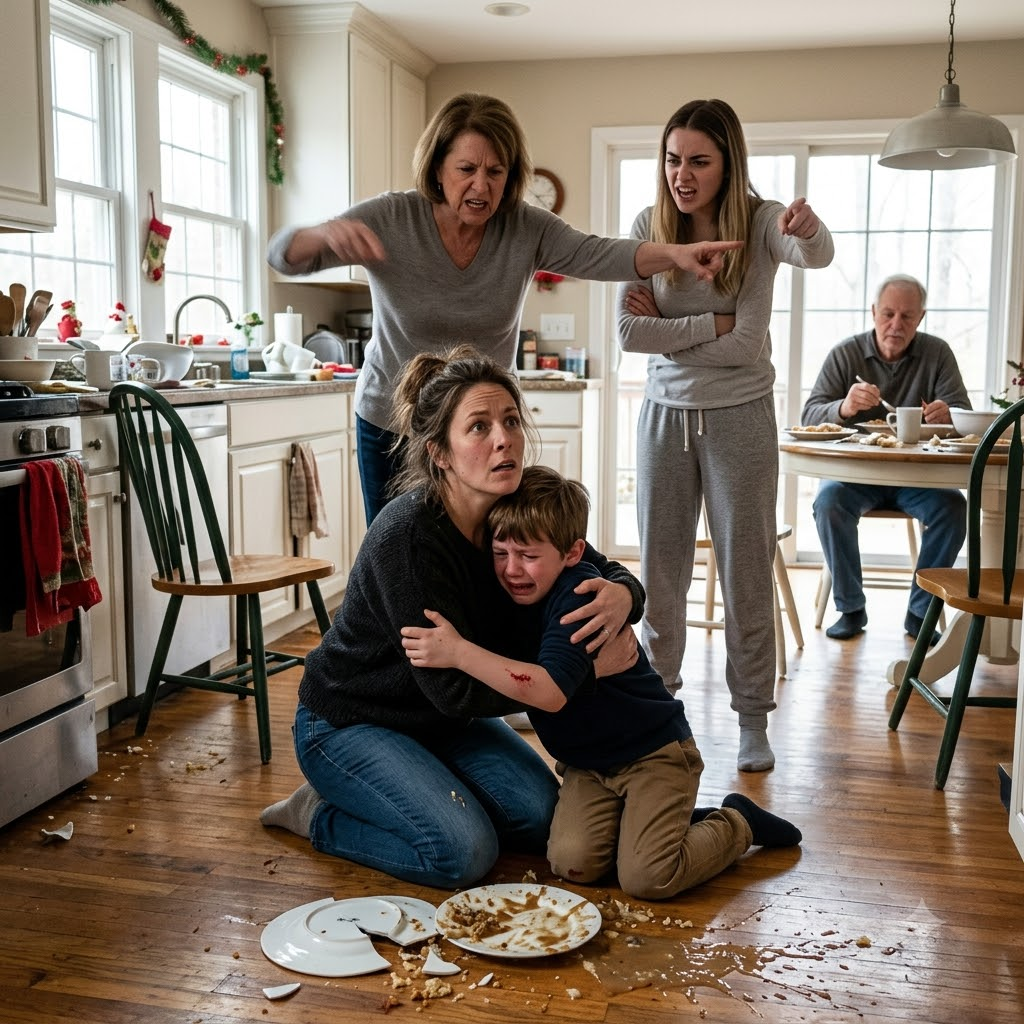
For one terrible second, I saw Christmas return to his eyes.
The broken porcelain.
The blood.
My father's voice.
I reached for a towel.
"Oops," I said gently.
Knox looked at me.
Then at the water.
"Oops," he repeated.
I smiled.
"Want to help me clean it?"
He nodded.
Together, we wiped the table.
No shouting.
No punishment.
No fear.
When we finished, Knox climbed back into his chair.
Then he looked at me.
"Mom?"
"Yeah, buddy?"
"Can I ask you something?"
"Anything."
He glanced toward the backyard.
"If I ever make a really big mistake, will you still love me?"
My heart tightened.
I set down my fork.
"Knox, there is no mistake you could make that would stop me from loving you."
He studied my face.
"Even a huge one?"
"Even a huge one."
He thought about that.
Then smiled.
"Okay."
I reached across the table and took his hand.
"Love isn't something you earn by being perfect."
He squeezed my fingers.
Then looked at his pizza.
"Good. Because I think I put way too much cheese on this."
I laughed.
He laughed too.
And the sound filled our little kitchen.
Later, after dinner, we went into the backyard.
The sky was turning pink.
The swing set stood beneath a maple tree.
Knox ran toward it.
"Mom! Push me!"
I followed.
He climbed onto the swing.
I stood behind him.
And pushed.
Gently at first.
Then a little higher.
He laughed.
The sound floated into the warm evening air.
"Higher!"
I smiled.
"Hold on, astronaut."
He leaned back.
His face turned toward the sky.
And for a moment, I thought about everything we'd survived.
The Christmas dinner.
The broken plate.
The forged documents.
The mortgage payments.
The threats.
The bank investigation.
The mansion.
The lies about my birth.
The father I'd lost before I knew him.
The father I'd spent my life trying to please.
The family I'd tried so hard to save.
I hadn't been able to save their mansion.
I hadn't been able to make Tobias and Genevieve become the parents I needed.
I hadn't been able to recover every lost year or every dollar.
But I had saved what mattered.
My son's safety.
My independence.
My future.
And the possibility of building honest relationships without surrendering myself.
Knox looked over his shoulder.
"Mom?"
"Yes?"
"Are you happy?"
I thought about the question.
Months earlier, at the park, he'd asked me the same thing.
Back then, I'd told him I was getting there.
Now I looked at our little yellow house.
The blue door.
The warm kitchen light.
The home we could afford.
The life we were building.
And I smiled.
"Yes, sweetheart."
He grinned.
"Me too."
I pushed him once more.
He laughed.
Then shouted:
"Mom, look how high I can go!"
I watched him swing toward the open sky.
Free.
Safe.
Loved.
And when he came back down, I was right there to catch him.






Comments 0