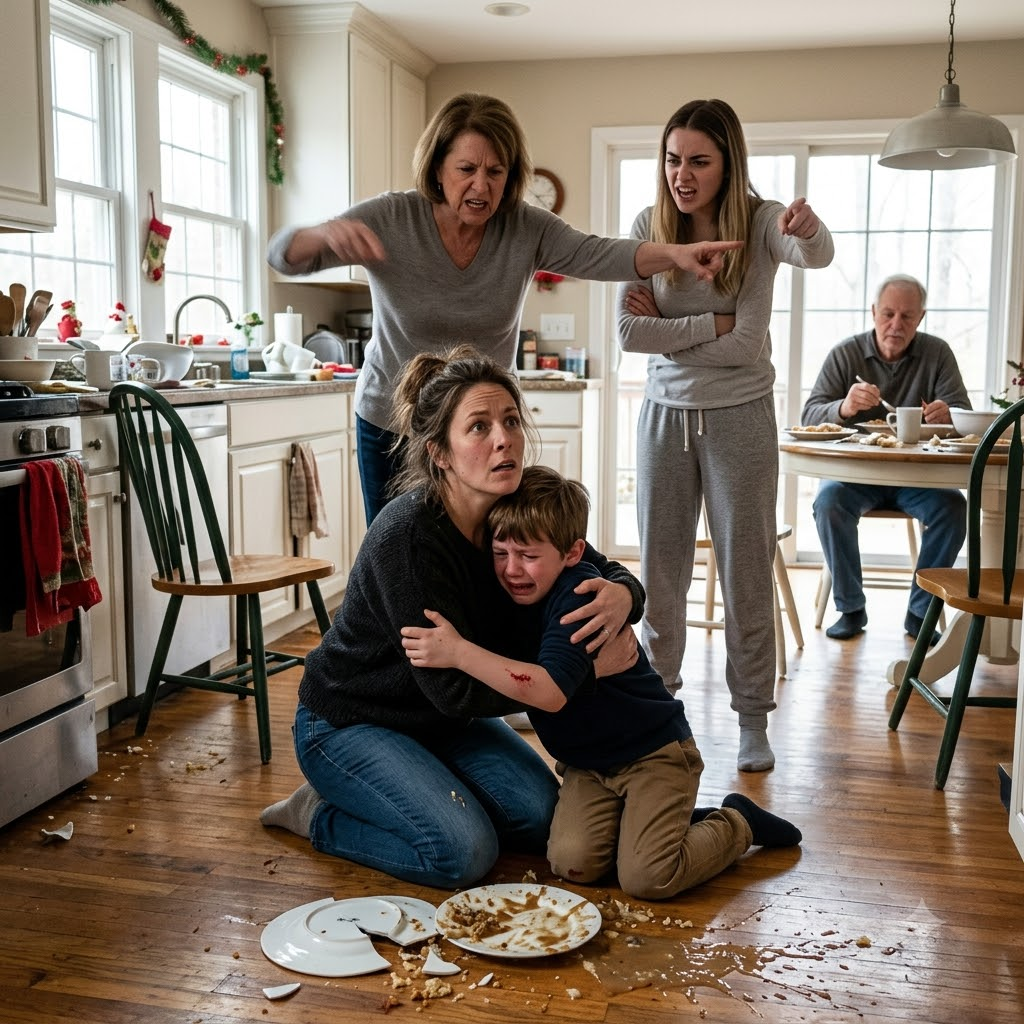
"Mommy, please! I didn't mean to spill it!"
My nine-year-old son scrambled backward as a porcelain dinner plate shattered inches from his feet.
My mother stood over him, gripping the edge of the dining table.
A tiny fragment of white porcelain lay beside his bleeding arm.
On its underside was a gold manufacturer's mark.
The same mark appeared on the dinner set I had purchased for my parents.
They had just used my own gift to hurt my child.
And something inside me went completely still.
"Look at what you've done!" my mother screamed.
Her name was Genevieve Whitmore, and at sixty-three, she had perfected the art of making cruelty sound like good manners.
"Do you have any idea how expensive those plates are?"
Knox stared at the broken pieces.
His lower lip trembled.
"I'm sorry, Grandma."
"Sorry doesn't fix anything!"
"Mom," I said quietly.
She ignored me.
"You come into my house, ruin my Christmas dinner, and expect everyone to pretend you're some precious little angel?"
Knox flinched.
I was already moving.
My chair scraped against the hardwood as I dropped to my knees beside him.
"Sweetheart, look at me."
His eyes found mine.
There was blood on his forearm.
Not much, but enough to turn my stomach.
"Does it hurt?"
He nodded.
"Okay. I've got you."
I pulled a clean napkin from the table and pressed it gently against the scratch.
Behind me, my mother made a disgusted sound.
"Oh, for heaven's sake, Sloan. Stop encouraging the dramatics."
I didn't answer.
My son was shaking.
That mattered more than anything she could say.
But then my father spoke.
And the last piece of the family I thought I had disappeared.
"Finish your plate outside or starve, you two."
I turned.
Tobias Whitmore sat at the head of the table, cutting another piece of prime rib.
He didn't look at Knox.
He didn't look at the blood.
He simply lifted his fork, placed the meat in his mouth, and continued chewing.
For a moment, I couldn't make sense of what I had heard.
"Excuse me?"
My father swallowed.
"You heard me."
"Dad, he's bleeding."
"Then perhaps he'll learn to be more careful."
Knox made a small sound against my shoulder.
I felt his fingers tighten around my sweater.
My father reached for his wineglass.
"Children need consequences, Sloan. Something you apparently never learned to provide."
Across the room, my younger sister laughed.
Blair.
Twenty-eight years old.
Owner of an upscale boutique pet spa.
Professional victim whenever the bills arrived.
Professional expert on everyone else's shortcomings.
She stood in the kitchen archway with her arms crossed.
"Seriously, Sloan. Just leave. Nobody wants to deal with your kid's behavior today."
I looked at her.
"My son spilled water."
"And ruined dinner."
"Mom threw his plate."
Blair rolled her eyes.
"Because he's constantly causing problems."
I stared at her.
"He's nine."
"And you're thirty-four. Maybe it's time you learned how to control him."
My mother nodded approvingly.
There it was.
The familiar alliance.
Genevieve attacked.
Blair agreed.
Tobias delivered the verdict.
And I was expected to apologize.
That had been our family structure for as long as I could remember.
Only this time, they had chosen the wrong person to punish.
My son.
My name is Sloan Whitmore.
I'm thirty-four years old, a single mother, and a commercial credit risk analyst in Atlanta.
I spend fifty hours a week evaluating businesses that want to borrow money.
I study their income.
Their debts.
Their assets.
Their liabilities.
Most importantly, I study the things they desperately hope nobody notices.
Over the years, I have learned that the most dangerous financial disasters rarely begin with a dramatic announcement.
They begin with small lies.
A payment quietly missed.
A debt hidden from a spouse.
An expense disguised as something necessary.
A lifestyle maintained long after the money supporting it has disappeared.
I knew all of that professionally.
What I had failed to recognize was that my own family had turned me into their private financial institution.
Three years earlier, my father had called me on a Tuesday afternoon.
His voice had sounded different.
Smaller.
"Sloan, I need to discuss something confidential."
I was sitting in my office, reviewing a commercial loan application.
"What's wrong?"
"Nothing serious."
That was his first lie.
He explained that a temporary cash-flow problem had affected his investments.
The mortgage on the family estate was coming due.
He needed help covering a payment.
Just once.
Three thousand dollars.
I remember staring at the number.
"Dad, that's a lot of money."
"I know. And I wouldn't ask if it weren't important."
Then he said something I had waited my entire childhood to hear.
"You're the only one I can depend on."
I transferred the money that afternoon.
The following month, he needed help again.
Then again.
Eventually, I established a recurring payment arrangement so the mortgage would never fall behind.
He promised to repay me when his investments recovered.
They never seemed to recover.
But the vacations continued.
The expensive dinners continued.
My mother's shopping trips continued.
And the Christmas decorations somehow grew more elaborate every year.
I told myself that helping family was the right thing to do.
I told myself that my parents had raised me.
That I owed them something.
I told myself that keeping their home secure was an act of love.
I never asked why love only seemed to travel in one direction.
"Mommy?"
Knox's voice brought me back.
He was still kneeling beside me.
"Can we go home?"
The question broke something in my chest.
Not because he wanted to leave.
Because he sounded afraid to ask.
I brushed his hair away from his forehead.
"Of course we can."
My mother threw up her hands.
"Oh, wonderful. Here comes the dramatic exit."
I ignored her.
"Can you stand, sweetheart?"
Knox nodded.
I helped him carefully to his feet.
His arm had stopped bleeding heavily, but the scratch still needed cleaning.
He kept his injured hand close to his chest.
My father finally glanced in our direction.
"You're seriously leaving over a broken plate?"
I looked at him.
"No."
"Then what is this performance?"
I took a breath.
And for the first time in my life, I didn't feel the need to explain myself.
"I'm taking my son home."
My father snorted.
"Fine. Go."
Blair stepped aside with exaggerated annoyance.
"Maybe next Christmas you can teach him some manners before bringing him here."
Knox lowered his head.
I felt his hand trembling inside mine.
I wanted to tell them everything.
About the money.
About the mortgage.
About the twenty thousand dollars I had personally guaranteed for Blair's business.
About the platinum credit cards linked to an account I funded.
I wanted to ask how people who depended on my paycheck could look at my child as though he were beneath them.
But something stopped me.
A realization so simple that it almost frightened me.
They didn't know.
They genuinely didn't know how much power I had handed them.
And they certainly didn't know I could take it back.
My mother folded her arms.
"Well? Aren't you going to apologize for ruining Christmas?"
I looked at Knox.
His cheeks were wet.
His eyes were swollen.
He had spent the morning excited about opening presents with his grandparents.
He had chosen his Christmas sweater himself.
He had asked me whether Grandma would like the handmade card he'd decorated with tiny gold stars.
That card was still sitting beside his untouched dessert plate.
I reached for it.
My mother frowned.
"What are you doing?"
"Getting his card."
"Oh, leave it. I don't want anything from him right now."
Knox heard her.
Of course he heard her.
Children always hear the words adults assume they'll forget.
I picked up the card anyway.
On the front, in crooked blue letters, he had written:
MERRY CHRISTMAS, GRANDMA.
Inside was a drawing of our family holding hands.
Even Blair.
Even Tobias.
Every person who had just stood there watching him cry.
I folded the card carefully and slipped it into my purse.
Then I lifted my son into my arms.
He was getting too big to carry comfortably.
I didn't care.
His arms wrapped around my neck.
His face disappeared against my shoulder.
And I walked toward the foyer.
Behind me, Blair called out, "Don't forget to clean up your kid's mess next time!"
My father said nothing.
I heard his fork touch the plate again.
That sound followed me all the way to the front door.
The cold Georgia air hit my face when I stepped outside.
Knox shivered.
I hurried toward my car and opened the back door.
"Let's get you buckled in."
He climbed into his booster seat without arguing.
That frightened me more than the crying.
Knox usually talked constantly.
About school.
About dinosaurs.
About whatever new fact he had discovered that morning.
But now he was silent.
I fastened his seat belt.
Then I took the small first-aid kit from the glove compartment and cleaned his scratch.
He winced.
"Sorry, sweetheart."
"It's okay."
I placed a small bandage over the wound.
Then I kissed his forehead.
"All done."
He looked at me.
"Mom?"
"Yeah?"
"Was Grandma really mad because I spilled the water?"
I swallowed.
"Yes."
"Did I ruin Christmas?"
"No."
His eyes filled again.
"But Aunt Blair said—"
"I know what she said."
I crouched beside the open car door.
"Listen to me carefully, Knox. You made a mistake. You spilled some water. Everybody makes mistakes."
He nodded.
"But nobody gets to hurt you because of a mistake. Not Grandma. Not Grandpa. Not anyone."
He stared at me for a long moment.
Then he whispered something I will never forget.
"Grandpa didn't even care that I was bleeding."
I felt my throat tighten.
"No, sweetheart. He didn't."
"Why?"
There are questions a mother cannot answer without destroying something innocent.
I could have made excuses.
I could have said Grandpa was tired.
That he hadn't noticed.
That Grandma didn't mean it.
I had spent years making those excuses for myself.
I wasn't going to teach my son to do the same.
"I don't know why he acted that way," I said. "But I know it was wrong."
Knox looked down at his bandage.
"Are we going back?"
I brushed a tear from his cheek.
"Not until I know you'll be treated with kindness and respect."
He leaned forward and hugged me.
I held him until his breathing steadied.
Then I closed the car door and walked around to the driver's seat.
For several minutes, I sat without starting the engine.
My parents' mansion glowed behind me.
The property was worth approximately four million dollars.
At least on paper.
Tall windows.
Expensive landscaping.
A circular driveway.
A grand entrance designed to make visitors feel small.
I knew exactly how much money went into keeping that illusion alive.
I had helped pay for it.
And I suddenly understood something that made my hands go cold.
My family wasn't wealthy.
My family was expensive.
There was a difference.
My phone buzzed before I pulled out of the driveway.
A message from Blair.
I expected an apology.
That was foolish.
BLAIR: Mom says you embarrassed everyone. You need to apologize before New Year's.
Another message appeared.
BLAIR: Also, don't forget the spa payment next Friday. The lender has been calling again.
I stared at the screen.
My son had been injured less than twenty minutes earlier.
She hadn't asked whether he was okay.
She hadn't asked about the bleeding.
She hadn't even mentioned his name.
But she remembered the money.
Of course she did.
I opened our old messages.
There were months of requests.
Emergency payroll.
Equipment financing.
Rent increases.
A marketing campaign that had supposedly been essential.
Every crisis came with a promise.
Every promise expired when the next crisis arrived.
I scrolled until I found the message from the previous summer.
BLAIR: You're the only person who believes in me, Sloan. I swear I'll make you proud.
I remembered how happy I'd felt reading it.
How desperately I'd wanted my little sister to succeed.
How I'd agreed to guarantee twenty thousand dollars because I thought I was helping her build a future.
Now she was standing in our parents' kitchen, calling my child a parasite.
I closed the conversation.
Then I opened my banking app.
Three thousand dollars.
Every month.
For thirty-six months.
One hundred and eight thousand dollars.
That was how much I had transferred toward the mortgage alone.
It didn't include Christmas gifts.
It didn't include emergency loans.
It didn't include the credit card charges.
It didn't include the business guarantee.
I stared at the number.
One hundred and eight thousand dollars.
That money could have been Knox's college fund.
A larger home for us.
A safety net.
A vacation where he didn't have to worry about upsetting anyone.
Instead, it had helped maintain a mansion where he wasn't even allowed to finish his dinner.
My hands stopped shaking.
I tapped the recurring mortgage payment.
A confirmation screen appeared.
CANCEL FUTURE AUTOMATIC TRANSFERS?
For a moment, I heard my father's voice.
You're the only one I can depend on.
Then I remembered Knox's voice.
Grandpa didn't even care that I was bleeding.
I pressed confirm.
The screen changed.
AUTOMATIC TRANSFER CANCELED.
I sat very still.
Nothing dramatic happened.
No alarms sounded.
No lights went out in the mansion.
My parents continued eating Christmas dinner, probably discussing how unreasonable I had been.
But the next mortgage payment would not come from me.
Not this time.
I opened the account connected to their platinum cards.
My mother had always described those cards as a family convenience.
The cards were in their names, but I had arranged and funded the underlying payment account.
At the time, I'd told myself it would help them manage unexpected expenses.
Instead, unexpected expenses had become their entire lifestyle.
Designer clothing.
Restaurant bills.
Travel reservations.
Luxury groceries.
I reviewed the latest charges.
Then I requested restrictions on the cards and removal of their access to my funds, subject to the issuer's processing rules.
I knew there could still be outstanding balances and obligations to resolve.
I wasn't going to ignore them.
I was simply done authorizing new spending for people who treated my child like an inconvenience.
My phone displayed a confirmation that the request had been submitted.
I placed it on the passenger seat.
Then I started the car.
By the time we reached our neighborhood, Knox had fallen asleep.
His head rested against the window.
His bandaged arm lay across his lap.
I parked outside our modest townhouse and looked at him through the rearview mirror.
For years, I'd convinced myself that being a good daughter meant enduring whatever my family demanded.
I had confused financial sacrifice with love.
I had confused silence with peace.
And I had mistaken their dependence on me for affection.
The truth was much uglier.
My parents loved what I provided.
My sister loved what I guaranteed.
And none of them had shown the slightest concern for the little boy who meant more to me than all their money combined.
I carried Knox inside.
I changed him into soft pajamas and settled him on the couch with his favorite blanket.
He woke briefly.
"Mom?"
"I'm here."
"Are you mad at me?"
The question nearly brought me to my knees.
I sat beside him.
"No, baby. Never."
He studied my face.
"Promise?"
"I promise."
He reached for my hand.
"I love you."
"I love you more."
A tiny smile appeared.
Then his eyes closed.
I stayed beside him until he was sleeping deeply.
Only then did I return to the kitchen.
I opened my laptop.
Logged into my personal financial records.
And created a new folder.
WHITMORE FAMILY — FINANCIAL SUPPORT
I downloaded the mortgage transfer history.
The credit card statements.
The personal loan agreements.
The business guarantee documents.
I had spent my professional life telling clients that undocumented financial exposure was dangerous.
Now I was finally following my own advice.
As I organized the files, I noticed something strange.
The mortgage payments had been leaving my account regularly.
But the most recent annual statement from the loan servicer showed a balance that didn't seem to match the repayment progress I expected.
I frowned.
Maybe the interest rate had changed.
Maybe there had been a modification.
Maybe my father had taken out additional financing.
I wasn't a borrower on the mortgage, and I couldn't access private loan details without authorization.
But I could examine the records I already possessed.
I opened the PDF my father had emailed me when he'd first asked for help.
The document was labeled:
MORTGAGE ASSISTANCE AGREEMENT
I remembered signing it electronically.
At the time, Dad had described it as a simple family acknowledgment.
Nothing legally complicated.
Just something for his accountant.
I scrolled through the pages.
My signature appeared near the bottom.
Then I noticed a small notation beside an attachment reference.
Schedule B — Additional Financial Undertakings
I didn't remember a Schedule B.
I searched the email.
There had been no attachment with that name.
I checked the document's page numbering.
Page one.
Page two.
Page three.
Then page five.
My stomach tightened.
Page four was missing.
I leaned closer to the screen.
Why would a family acknowledgment have a missing page?
And what exactly had I agreed to?
I checked the digital signature record.
There was a timestamp.
An authentication reference.
And an email address listed under the document preparation details.
I recognized the domain.
It belonged to the accounting firm my father had used for years.
I reached for my phone.
Before I could dial, a new email appeared.
The sender was unfamiliar.
The subject line made my pulse jump.
RE: WHITMORE ESTATE — YOUR SIGNATURE
I opened it.
There was no greeting.
No explanation.
Just one sentence.
Ms. Whitmore, before you cancel anything else, you need to see the document your father signed using your name.
Below it was an attachment.
WHITMORE_SCHEDULE_B_SIGNED.pdf
I stared at the filename.
Then I clicked.
The document began loading.
And the first page revealed a signature that looked exactly like mine—beneath a financial obligation I had never agreed to accept.






Comments 0