Thomas reached into his jacket.
I stumbled backward.
"Don't!"
My scream echoed through the study.
Arthur turned sharply.
"Thomas!"
But Thomas wasn't reaching for a gun.
He pulled out his phone.
Then he raised both hands.
"Miss Veta, please. I need you to see something."
I stared at him.
The study door had just locked behind us.
Grace Holloway stood beside Margaret, clutching the medical transfer form.
My grandfather's signature was at the bottom.
And Thomas was looking at me with an expression I had never seen before.
Shame.
"Why did you lock the door?" I demanded.
"I didn't."
Thomas glanced toward the entrance.
"The security system locks this room automatically when the emergency alarm is activated."
Margaret immediately pressed the release button beside the desk.
The lock clicked open.
"Then leave it open," she said firmly.
Thomas nodded.
"Of course."
I looked at my grandfather.
He hadn't moved.
His eyes remained fixed on the medical transfer form.
"Grandpa?"
His lips trembled.
"Veta, I can explain."
I felt my chest tighten.
"Then explain why your name is on the paper."
Arthur lowered himself into a chair.
For a moment, he looked like a man who had aged twenty years in twenty seconds.
"I authorized the transfer."
The room went silent.
I stared at him.
"You knew Mom was alive after they said she died?"
He shook his head.
"No. I knew she was alive when I signed that form. I didn't know a death certificate had already been issued."
My stomach twisted.
"How is that possible?"
Arthur looked at Grace.
"Because someone lied to me."
Grace nodded slowly.
Then she placed the document on the desk.
"Arthur, I believe you."
I stared at her.
"Why?"
She looked at me.
"Because I was there when Charles Pembroke gave him the papers."
Grace sat across from me.
Her hands trembled around a glass of water.
"Eleanor was critically ill," she began. "She had been admitted after collapsing at home. There were concerns about medication she had been taking, and the doctors were still trying to determine what had caused her condition."
My throat tightened.
"Was she poisoned?"
Grace hesitated.
"We couldn't establish that at the time. But there were irregularities in her medication history."
Arthur covered his face.
Grace continued.
"Charles told your grandfather that Eleanor needed specialized neurological care at Saint Catherine's."
I looked toward Arthur.
"Did you believe him?"
"Yes."
His voice broke.
"I had been told Eleanor was deteriorating. Charles brought me a transfer authorization and said there was no time to lose."
I swallowed.
"So you signed it."
Arthur nodded.
"I thought I was helping save her."
Grace looked at me.
"The form was genuine. The signature was genuine. But the information Charles gave Arthur was incomplete."
My hands tightened.
"What happened next?"
Grace's eyes filled.
"Eleanor was transferred. I accompanied her."
I stopped breathing.
"You went with her?"
"Yes."
"Then what happened to Mom?"
Grace looked down.
"She survived the transfer. She was conscious intermittently for two days."
I felt tears burning my eyes.
"Did she ask for me?"
Grace began crying.
"Every time she woke up."
I pressed my hand over my mouth.
Grace continued.
"She kept saying she needed to get back to her daughter."
Arthur made a broken sound.
I looked at him.
He was crying silently.
Grace took a shaky breath.
"On April nineteenth, Eleanor suffered a severe medical crisis. The doctors tried to save her."
My heart pounded.
"Did she die?"
Grace nodded.
"Yes, Veta. She died that evening."
I closed my eyes.
For one terrible moment, I had allowed myself to believe my mother might still be alive.
That she might be waiting somewhere.
That nine years could somehow be undone.
But Grace's voice was steady.
And the grief in her eyes was real.
"She didn't die on April fourteenth," I whispered.
"No."
"She died five days later."
Grace nodded.
"And I was with her."
Tears streamed down my face.
"Was she alone?"
Grace reached for my hand.
"No, sweetheart. I stayed beside her."
I began sobbing.
Because for nine years, I had imagined my mother dying alone.
And now I knew someone had held her hand.
Someone had heard her final words.
Someone had stayed.
Grace reached into her bag.
She removed a small recording device.
"I promised Eleanor I would give this to you if I ever found a safe way."
Margaret leaned forward.
"Has the recording been preserved?"
Grace nodded.
"I gave investigators a copy yesterday. This is another copy they returned to me."
I stared at the device.
"Can I hear it?"
Arthur looked at me.
"Veta, you don't have to."
I wiped my eyes.
"I want to."
Grace pressed play.
Static filled the room.
Then my mother's voice.
Weak.
Soft.
But unmistakable.
"Veta..."
I stopped breathing.
"My beautiful girl."
My hands began trembling.
"If you hear this someday, I want you to remember something."
A pause.
Her breathing sounded strained.
"You were the best thing that ever happened to me."
I covered my mouth.
"I know I haven't always been strong enough to protect you. I know there were days when I was frightened."
Her voice cracked.
"But loving you was never difficult."
I began crying harder.
"Not once."
Arthur bowed his head.
My mother continued.
"If anyone tells you that you were a burden, don't believe them."
I closed my eyes.
"If anyone tells you that you owe them your happiness, don't believe that either."
A faint breath.
"You belong to yourself, sweetheart."
I pressed both hands against my face.
"And wherever you go, whatever you become, I will always be proud that I was your mother."
The recording ended.
Nobody spoke.
I sat there crying until I couldn't cry anymore.
Then Grace reached across the table.
"She loved you very much."
I nodded.
"I know."
And for the first time, I truly did.
The investigation that followed uncovered more than any of us expected.
Charles Pembroke had arranged for Eleanor's official death records to be falsified.
The earlier date allowed him to conceal her transfer and create confusion about the documents she had refused to sign.
The second will was a forgery.
The trust amendment was also fraudulent.
And several financial authorizations had been created using signatures copied from authentic documents.
The original medical records from Saint Catherine's confirmed that Eleanor died on April nineteenth.
An independent review found evidence that her care had been compromised by unauthorized medication changes before her first hospitalization.
Investigators traced those changes to prescriptions obtained through misleading information supplied by Gideon.
The evidence did not establish that Gideon had deliberately killed my mother.
But it did establish that he had concealed critical medical information, interfered with her care, and participated in falsifying records afterward.
Charles had helped him.
Rosalind had witnessed documents she knew Eleanor hadn't signed.
And Victor Hale had threatened people who tried to expose the truth.
Grace had hidden for years because Charles warned her that speaking publicly would destroy her career and put her family in danger.
Lydia Grant had been threatened for preserving the original files.
Denise had been pressured to keep me working and away from Arthur.
Even the bus ticket Gideon bought for my eighteenth birthday had been part of his plan.
He wanted me out of the house before I learned the trust had become legally accessible to me.
He had chosen Oak Haven because he knew I would be frightened and alone there.
But he had forgotten one thing.
Arthur Whitmore lived in Oak Haven.
And someone else knew exactly where I was going.
The anonymous messages that helped me find my grandfather came from Thomas.
He admitted it one afternoon while we sat beside the garden.
"I found out about the bus ticket through an old contact," he explained.
I stared at him.
"You were the one texting me?"
He nodded.
"I couldn't contact you openly. Gideon had blocked every attempt."
I swallowed.
"Why didn't you tell me?"
"Because I was afraid you'd think I was another stranger trying to control you."
I looked at him.
He lowered his eyes.
"I should have trusted you with the truth sooner."
I thought about the night the Bentley appeared.
The black car.
The open door.
The man who told me my grandfather was alive.
"You saved me," I whispered.
Thomas shook his head.
"Your mother made sure we knew where to look. I only drove the car."
I smiled through my tears.
"That was enough."
He smiled back.
Then I asked about the brass key he had carried into my bedroom.
Thomas explained that Eleanor had entrusted him with the second key years earlier.
She wanted the hidden desk compartment opened only when I was old enough to receive the documents.
He had been afraid that reading about Nathaniel alone would leave me devastated.
"I was wrong to tell you to stop," he admitted.
I nodded.
"Yes."
He accepted it.
And I appreciated that more than he knew.
The question of Nathaniel Brooks took longer.
We completed the DNA test through an accredited laboratory.
I waited twelve days for the results.
Twelve days of wondering whether the man who looked at me with my mother's eyes was really my father.
Arthur sat beside me when the envelope arrived.
Nathaniel waited across the room.
Nobody spoke as I opened it.
I read the first page.
Then the second.
My hands began trembling.
The results established a biological father-daughter relationship between Nathaniel Brooks and me.
I stared at the words.
Then looked up.
Nathaniel was crying.
He didn't approach.
He didn't reach for me.
He simply waited.
I stood.
For a moment, I thought about all the birthdays he had missed.
All the school events.
All the nights I cried in the basement.
All the years Gideon had kept us apart.
Nathaniel couldn't give those years back.
Nobody could.
But he was standing there now.
And he was willing to stay.
I walked toward him.
"Hi, Dad."
His face crumpled.
Then he opened his arms.
I stepped into them.
He held me carefully.
As though I were something precious.
Not something he owned.
Something he had finally found.
Gideon's financial empire collapsed over the following months.
Caroline Price and the investigators traced the suspicious transfers through the companies he controlled.
The frozen $4.8 million transfer never went through.
Additional assets were secured.
Civil proceedings recovered property and funds that had been diverted from my trust.
The court confirmed that I was the lawful beneficiary of the protected assets.
The house where I grew up was held for my benefit.
Not Gideon's.
Not Rosalind's.
Mine.
When the final accounting was completed, the trust's assets and recoveries exceeded the original eighteen-million-dollar estimate.
But I wasn't interested in celebrating the number.
I was interested in what it meant.
No more asking permission to buy groceries.
No more working until midnight because someone threatened to throw me out.
No more sleeping in a basement while people upstairs spent money that belonged to me.
And no more believing that survival was the most I deserved.
Charles Pembroke eventually pleaded guilty to multiple offenses involving forged documents, financial fraud, and obstruction.
Victor Hale faced charges connected to the kidnapping, threats, and unlawful entry.
Rosalind entered a plea agreement that required her cooperation in the financial investigation and restitution proceedings.
Gideon was convicted of fraud-related offenses after a lengthy trial.
He also faced separate consequences for his role in concealing evidence connected to my mother's medical care.
The court ordered restitution.
He lost control of the companies.
He lost access to the trust.
And he lost the house he had once used to threaten me.
Saraphina wasn't charged with the financial offenses after investigators determined she hadn't controlled the forged transactions, although her company had received money that became subject to recovery.
Her online business collapsed.
Sponsors left.
Her followers turned against her.
But the worst consequence wasn't public embarrassment.
It was having to face what she had done without an audience to applaud her.
One afternoon, Saraphina asked to see me.
I agreed to meet her at Margaret's office.
She arrived without makeup.
Without a camera.
Without the expensive clothes she once used to remind me how little I had.
She sat across from me.
For a long time, she said nothing.
Then she whispered, "I was horrible to you."
I looked at her.
"Yes."
She swallowed.
"I knew you were working all those hours. I knew Dad was taking your money."
I felt my chest tighten.
"Then why did you laugh?"
Her eyes filled.
"Because I wanted to be the daughter everyone liked."
I stared at her.
She continued.
"And because I was afraid if I defended you, they'd turn on me."
I looked down.
For years, I had wanted Saraphina to understand how much she hurt me.
Now she did.
But understanding didn't erase the past.
"I'm sorry," she whispered.
I nodded.
"I hear you."
She looked up.
"Can we ever be sisters?"
I took a breath.
"I don't know."
Her face fell.
I continued.
"But I hope you become someone who doesn't need another person to suffer in order to feel important."
She began crying.
I didn't hug her.
I didn't promise forgiveness.
I simply wished her well.
And that was enough.
The last time I saw Gideon, he was sitting behind a glass partition.
He had requested a meeting through his attorney.
Margaret accompanied me.
I wasn't there to reconcile.
I wanted to ask one final question.
Gideon looked smaller than I remembered.
His hair had gone gray around the temples.
His eyes were tired.
For a moment, he simply stared at me.
Then he whispered, "You look like your mother."
I swallowed.
"I know."
His eyes filled.
"Veta, I'm sorry."
I studied him.
"Are you sorry for what you did?"
He lowered his head.
"Yes."
"Or because you got caught?"
He didn't answer immediately.
Then he whispered, "Both."
It wasn't the answer I wanted.
But it was the first honest answer he had given me in years.
I looked at him.
"Why did you make me feel unwanted?"
His face crumpled.
"I was angry at your mother. Angry at Arthur. Angry at Nathaniel."
I stared.
"And you punished me."
He nodded.
Tears slipped down his cheeks.
"Yes."
My throat tightened.
I had imagined this moment so many times.
I thought I would scream.
I thought I would tell him how much he had hurt me.
But sitting across from him, I realized he already knew.
I didn't need to prove my pain anymore.
I took a breath.
"I was a child."
Gideon covered his face.
"I know."
"I deserved a father who protected me."
His shoulders shook.
"I know."
I looked at him one final time.
"And you had eighteen years to become that person."
He lowered his hands.
I stood.
"Goodbye, Gideon."
He began crying harder.
But I walked away.
Not because I hated him.
Because I finally understood that loving myself meant refusing to return to the place where he had taught me not to.
Six months after my eighteenth birthday, I made a decision.
I didn't want to live in the house where Gideon had raised me.
The basement held too many memories.
The kitchen still reminded me of Rosalind's insults.
The driveway still reminded me of the morning I was thrown out.
So I sold the property through the trust's approved process.
And I used part of the proceeds to create something my mother would have loved.
A foundation.
The Eleanor Whitmore Foundation.
Its first project was a transitional housing program for young adults who had been abandoned, displaced, or forced out of unsafe homes.
Nathaniel helped design the building.
Arthur provided additional funding.
Margaret helped establish its governance.
Denise volunteered to connect residents with job opportunities.
Mrs. Bellamy organized the kitchen.
Thomas helped arrange transportation.
And Grace Holloway joined the advisory board for its health-support partnerships.
We named the first residence Blue Rose House.
Because my mother had always loved blue roses.
Because Arthur had planted them for her.
And because a single note about those flowers had led me home.
The opening ceremony took place on a warm Saturday morning.
I stood outside the building, staring at the front doors.
There were twelve apartments inside.
A shared kitchen.
A study room.
A small library.
And a garden filled with blue roses.
No basement bedrooms.
No locked food cabinets.
No rules designed to humiliate people who needed help.
Every resident had a private space.
Every resident had access to support.
And every resident was treated like someone whose future mattered.
Arthur stood beside me.
He looked healthier than he had in months.
Nathaniel stood on my other side.
Margaret and Thomas waited near the entrance.
Mrs. Bellamy was crying before the ceremony even began.
I smiled.
"You're going to make me cry too."
She laughed through her tears.
"Then we'll cry together."
I looked toward the crowd.
Former coworkers.
Neighbors.
People who had followed my story.
Young adults who were about to move into the building.
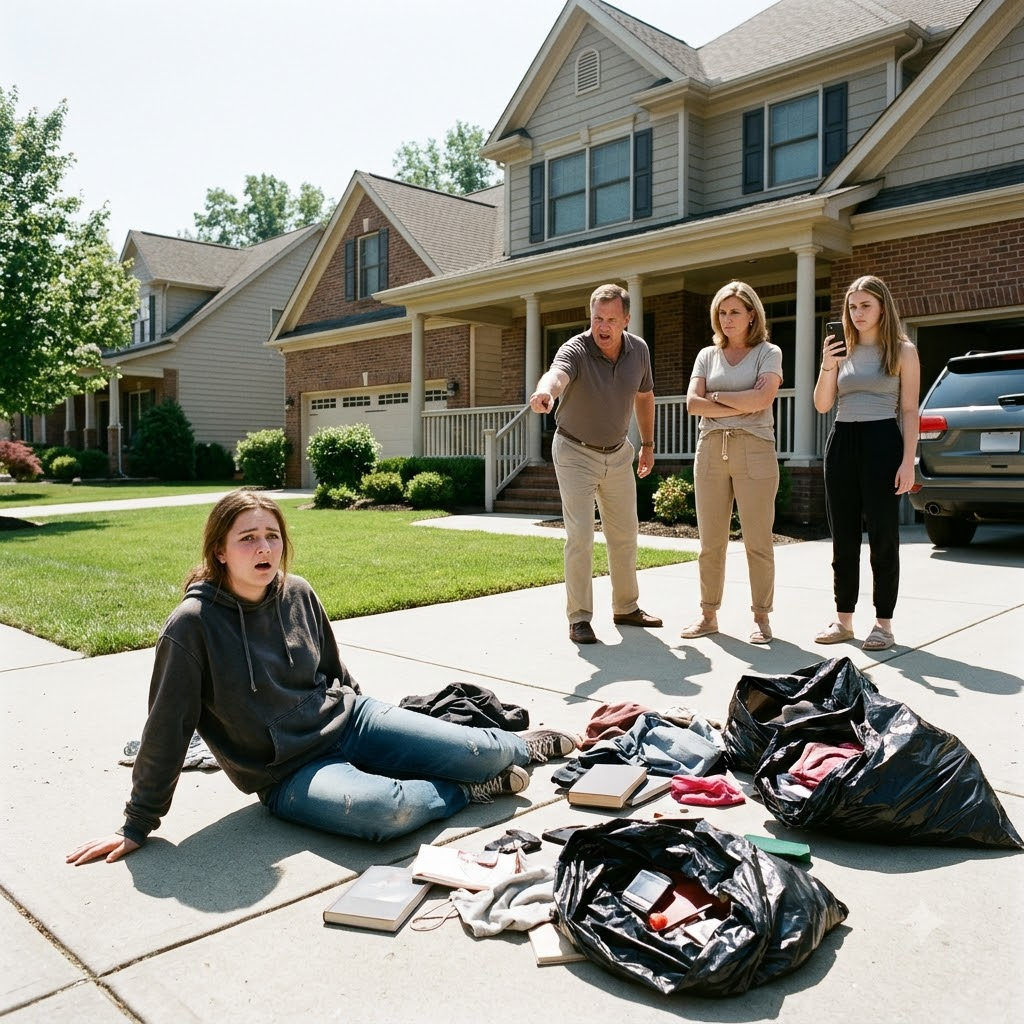
For a moment, I thought about the girl standing beside two black trash bags on her eighteenth birthday.
She had believed her life was over.
She had believed she was unwanted.
She had believed nobody would come for her.
I wished I could go back and tell her what happened next.
Not about the money.
Not about the court.
Not about the house.
I wanted to tell her about Arthur's hugs.
Thomas's kindness.
Mrs. Bellamy's cooking.
Margaret's steady voice.
Nathaniel's careful patience.
And the sound of my mother's recording telling me that I belonged to myself.
I stepped toward the microphone.
"My mother used to say that a home isn't defined by its walls."
I looked at the building.
"It's defined by whether the people inside feel safe."
My voice trembled.
"For a long time, I didn't know what that felt like."
Arthur reached for my hand.
I squeezed it.
"But I do now."
I smiled through my tears.
"And I want other people to have that chance too."
The crowd applauded.
Then I cut the ribbon.
The doors opened.
And the first residents stepped inside.
That evening, we returned to Whitmore Estate.
Arthur had arranged a small family dinner.
Nothing extravagant.
Just the people who had helped me find my way home.
Mrs. Bellamy made roast chicken.
Thomas insisted on bringing out the good silverware.
Nathaniel brought a homemade dessert that leaned slightly to one side.
I laughed when he placed it on the table.
"What happened?"
He looked offended.
"It's architecture."
Arthur chuckled.
"Then I suggest you stick to buildings."
Everyone laughed.
For a moment, I looked around the table.
The people sitting there weren't perfect.
Arthur had made mistakes.
Nathaniel had made mistakes.
Thomas had kept secrets.
Even Margaret admitted she wished she had questioned certain documents sooner.
But they had done something Gideon never learned to do.
They had taken responsibility.
They had listened.
And when they were wrong, they had tried to make things right.
After dinner, Arthur handed me a small wrapped package.
I stared at it.
"What's this?"
He smiled.
"A late birthday present."
I laughed softly.
"Grandpa, you've already given me everything."
He shook his head.
"No, sweetheart. This belonged to your mother."
My heart tightened.
I carefully removed the paper.
Inside was a small wooden music box.
Dark walnut.
Brass hinges.
A blue rose carved into the lid.
I stared at it.
"I remember this."
Arthur smiled.
"She used to play it for you when you were little."
I opened the lid.
A gentle melody filled the room.
Inside was a photograph.
My mother holding me as a baby.
She was smiling.
I was laughing.
And beneath the photograph was a tiny handwritten note.
To Veta, my greatest gift.
My eyes filled.
I touched the words.
Then I looked at Arthur.
"Thank you."
He leaned forward and kissed my forehead.
"Happy birthday, sweetheart."
I laughed through my tears.
"It's a little late."
He smiled.
"Then we'll celebrate again next year."
I looked around the table.
At Nathaniel.
At Margaret.
At Thomas.
At Mrs. Bellamy.
At the people who had become my family.
Then I looked down at the photograph.
For eighteen years, I had believed my birthday was the day my father decided I wasn't worth keeping.
But that wasn't what my birthday meant anymore.
It was the day my mother had brought me into the world.
The day my grandfather had never stopped hoping to see me again.
The day Thomas had arrived in a black Bentley and opened a door I never knew existed.
And the day I finally began discovering that my life belonged to me.
A year later, on my nineteenth birthday, I woke to sunlight streaming through the windows of Whitmore Estate.
Blue roses bloomed outside.
The music box sat beside my bed.
My mother's photograph rested on the nightstand.
Downstairs, I could hear Mrs. Bellamy laughing.
Nathaniel was arguing with Arthur about pancake batter.
Thomas was pretending not to listen.
I smiled.
Then I opened the walnut box I had carried out of Gideon's house.
The photographs were still there.
The letters.
The tiny brass key.
The note about the blue roses.
I carefully placed everything inside a new velvet-lined case.
Not because I wanted to forget.
Because I wanted to remember without being afraid.
Then I went downstairs.
Arthur stood when he saw me.
"There's our birthday girl."
Nathaniel smiled.
"Happy birthday, Veta."
Mrs. Bellamy hugged me.
Thomas handed me a cup of coffee.
And for the first time in my life, nobody asked me what I was going to pay for breakfast.
Nobody told me I was a burden.
Nobody threatened to throw me out.
I sat at the table.
Surrounded by people who wanted me there.
And I thought about the two black trash bags that had once held everything I owned.
They were long gone.
But the girl who carried them had survived.
She had found her grandfather.
She had discovered the truth about her mother.
She had met her biological father.
She had reclaimed her inheritance.
And she had built a home for people who needed one.
My mother had left me money.
She had left me letters.
She had left me a will.
But the greatest gift she gave me was something Gideon could never steal.
The knowledge that I had always been loved.
I looked around the table.
Then I smiled.
"Can someone pass the pancakes?"
Arthur laughed.
Nathaniel handed me the plate.
And just like that, my birthday began.
Not with two trash bags.
Not with a slammed door.
Not with someone telling me to leave.
But with a family asking me to stay.






Comments 0