If Gideon ever sends you away, find the man who remembers the blue roses.
I read the sentence six times before I realized I was holding my breath.
Blue roses.
What did that even mean?
The paper trembled between my fingers as the bus rattled down the interstate. My mother's handwriting was unmistakable. The little curl at the end of her letters. The way she crossed her t's too low. The tiny heart she sometimes drew instead of a period.
I had spent nine years trying to remember the sound of her voice.
Now I was staring at a message she had hidden for me.
A message that seemed to predict the very thing my father had done that morning.
I turned the paper over.
There was another sentence.
Never let Gideon know you found this.
My stomach dropped.
I looked toward the front of the bus, suddenly aware of every stranger around me.
A man in a baseball cap slept two rows ahead. An elderly woman held a paperback against her chest. Across the aisle, a young mother was helping her little boy open a package of crackers.
Nobody was watching me.
Still, I folded the paper and slipped it inside my sock.
Then I closed my mother's wooden box.
My phone vibrated.
Another message from the unknown number.
Have you found the note?
I stared at the screen.
Whoever was texting me knew about the photograph.
They knew about Oak Haven.
And now they apparently knew about the note hidden inside my mother's box.
I typed carefully.
Who are you?
The reply came seconds later.
Someone who promised your mother you would not be alone today.
My throat tightened.
How do you know my mother?
This time, the response took longer.
I worked for her family.
I looked down at the photograph again.
The elderly man beside my mother was tall, with silver hair and kind eyes. He wore a dark suit, and behind him stood a stone mansion surrounded by trees.
My father had always told me my mother's family was poor.
He said she had grown up moving between rented apartments, never finishing college because she couldn't afford it.
He said her parents had died before I was born.
But the woman in the photograph didn't look like someone who had grown up with nothing.
She looked comfortable.
Happy.
Loved.
I typed another question.
Is the man in the picture my grandfather?
Three dots appeared.
Then disappeared.
Finally, the answer came.
Yes.
My heart pounded.
What's his name?
Arthur Whitmore.
I whispered the name aloud.
"Arthur Whitmore."
It sounded unfamiliar.
But something about it stirred a memory.
A man laughing.
A garden.
My mother's voice telling me not to pick the flowers because Grandpa had planted them especially for her.
I closed my eyes.
For a moment, I could almost smell roses.
Then the memory vanished.
I opened my phone's browser and searched the name.
The results loaded slowly.
Arthur Whitmore.
Whitmore Development Group.
Whitmore Holdings.
A newspaper article about a wealthy real estate investor who had disappeared from public life following a family tragedy.
I tapped the article.
The photograph showed the same man.
Older, perhaps.
But unmistakably him.
My grandfather.
According to the article, Arthur Whitmore had once controlled commercial properties, apartment complexes, and investment holdings across three states.
The estimated value of his businesses was enormous.
I stared at the number.
Then read it again.
Millions.
Not thousands.
Millions.
I almost laughed.
My father had spent years telling me that my mother's family had left nothing.
Meanwhile, the man in the photograph appeared to have been one of the wealthiest businessmen in the region.
I searched for his obituary.
Nothing.
I tried several variations of his name.
Still nothing.
That didn't prove he was alive.
But it made my father's story harder to believe.
My phone buzzed again.
Do not contact Gideon. Do not tell Rosalind. Do not respond if Saraphina calls.
I frowned.
Why?
Because they cannot know who is waiting for you.
A cold sensation spread through my chest.
I glanced at the bus window.
The reflection showed a frightened girl with tired eyes and copper-red hair falling loose from a messy ponytail.
I looked nothing like the girl in the expensive photograph.
My mother had worn a beautiful white dress.
Her hair had been carefully styled.
She stood beside a mansion.
I sat on a bus wearing a faded green sweatshirt, carrying everything I owned in trash bags.
How could those two lives possibly belong to the same family?
I typed one final message.
How do I know this isn't a trap?
The answer arrived almost immediately.
You don't. Keep your phone charged, keep your money, and decide for yourself when you arrive. Thomas will not force you to go anywhere.
I stared at those words for a long time.
It was the first thing anyone had said to me that day that sounded like I had a choice.
I put my phone away.
Outside, the highway stretched into the distance.
I still had nine hours to go.
And for the first time since my father had thrown me out, I wasn't only afraid.
I was angry.
Not the loud kind of anger Gideon understood.
Something quieter.
Something that made me remember every lie he had ever told.
At 2:17 p.m., my stepsister's video appeared online.
I discovered it because my phone began vibrating so frequently that I thought something was wrong with it.
Notifications flooded the screen.
People from my old school.
Former coworkers.
Strangers.
One message simply said:
Girl, are you okay?
Another said:
Please tell me that isn't your dad.
Then I saw the link.
Saraphina had posted the video.
The caption read:
When your entitled stepsister finally gets told to grow up.
My stomach turned.
I pressed play.
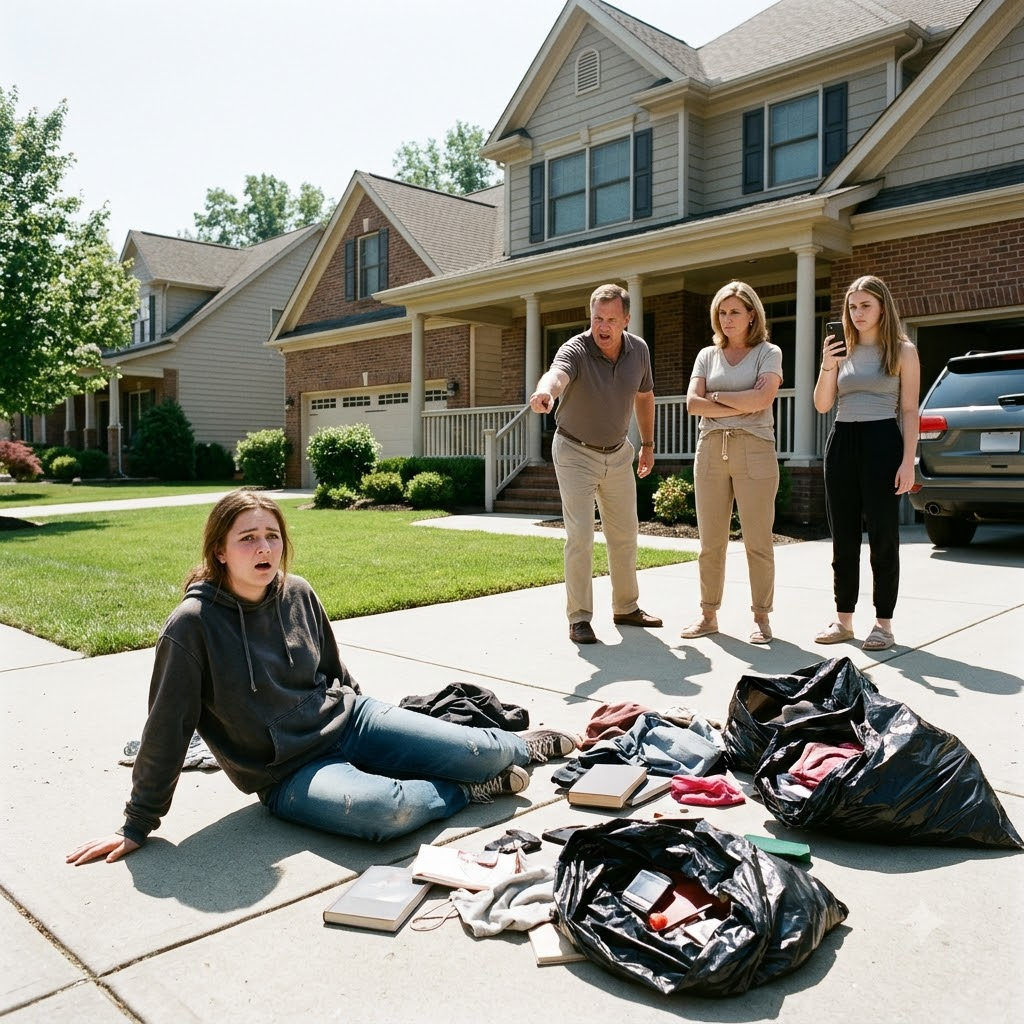
There I was.
Falling onto the driveway.
My clothes scattering across the concrete.
My father's finger pointing toward the street.
His voice shouting that I was dead to the family.
Saraphina had added dramatic music.
She had also cut out the part where Gideon pushed me.
The video began just as I lost my balance, making it look like I had thrown myself onto the ground.
Then came the worst part.
My voice.
Small.
Broken.
"It's my birthday."
Saraphina had zoomed in on my face.
A caption appeared over my head.
Drama queen level: 100.
I stopped the video.
My hands were shaking.
I had spent years trying to make myself invisible in that house.
Now thousands of strangers were watching the worst moment of my life.
I opened the comments.
Some people laughed.
Others called me lazy.
A few said I deserved to be kicked out if I hadn't contributed to the household.
I wanted to scream.
I wanted to tell them about the sixty-hour workweeks.
The grocery bills.
The basement.
The electricity payments.
I wanted to show them the bank transfers.
But then I saw another comment.
Why is the dad pushing her? Look at the first frame.
Another person replied:
Exactly. And why is she carrying trash bags?
A third wrote:
This looks like abuse, not discipline.
I stared at the screen.
For the first time, someone outside my family had seen what happened and recognized it for what it was.
Then my phone rang.
My father's name appeared.
I froze.
The call continued.
I let it go to voicemail.
Seconds later, he called again.
Then a text appeared.
Where are you?
I didn't answer.
Another message followed.
You need to take down whatever you've been telling people.
I stared at it in disbelief.
I hadn't told anyone anything.
Saraphina had posted the video herself.
A third message arrived.
Don't make this worse for yourself.
My heart began pounding.
Even hundreds of miles away, he was still trying to control me.
I blocked his number.
Then Rosalind called.
I blocked hers too.
Saraphina sent a message through social media.
You better not ruin my account because you're being dramatic.
I took screenshots.
Of the video.
The caption.
The comments.
The messages.
I didn't know why.
Maybe because I had spent my entire childhood being told that things hadn't happened the way I remembered.
This time, I wanted proof.
At 3:06 p.m., my supervisor called.
Her name was Denise.
She was a tough woman in her forties who ran the dispatch office like an air traffic control tower.
She had never been particularly sentimental.
But when I answered, her voice was unusually gentle.
"Veta, honey, where are you?"
I swallowed.
"On a bus."
"Are you safe?"
"I think so."
There was a pause.
"I saw the video."
My eyes burned.
"I'm sorry."
"For what?"
"I won't be able to work tonight."
Denise went silent.
Then she said, "Sweetheart, I am not calling about your shift."
That broke something in me.
I covered my mouth.
She waited while I tried to control my breathing.
Finally, I whispered, "He kicked me out."
"I know."
"I didn't do anything."
"I believe you."
Three words.
I believe you.
I hadn't realized how desperately I needed to hear them.
Denise asked where I was going.
I told her Oak Haven.
She was quiet for a moment.
"Do you have someone there?"
"Maybe."
"Maybe?"
I explained the messages, the photograph, and the chauffeur who was supposed to meet me.
She didn't interrupt.
When I finished, she said, "Listen carefully. Don't get into any vehicle unless you feel safe. Send me the license plate. Share your location with me. And if anything feels wrong, walk away."
"I will."
"And Veta?"
"Yes?"
"Your job is still here if you need it."
I closed my eyes.
"Thank you."
"Don't thank me. You're one of the best dispatchers I've ever had."
After we hung up, I cried again.
But this time, the tears felt different.
Someone cared whether I was safe.
Someone believed me.
Someone thought I was worth helping.
I looked at the photograph of my mother.
"Did you know?" I whispered.
"Did you know this would happen?"
Of course, the photograph didn't answer.
But the folded note inside my sock seemed to burn against my skin.
By late afternoon, the bus had crossed into unfamiliar territory.
The towns grew smaller.
The highways narrowed.
Fields replaced shopping centers.
I bought a sandwich at a rest stop and ate half of it.
I saved the other half because I didn't know when I would have money for another meal.
At 6:42 p.m., another message arrived from the unknown number.
Thomas will be at the station when your bus arrives. He will be wearing a black chauffeur's uniform. He will know your mother's favorite flower.
I typed back.
Blue roses?
The reply came immediately.
Ask him yourself.
I stared at the message.
Something about the answer made me feel a little better.
Whoever was contacting me wasn't demanding blind trust.
They were giving me a way to test the story.
Still, I couldn't shake the fear that I was being led into something dangerous.
I had never traveled alone before.
I had never stayed in a hotel.
I had never even taken a vacation without my family.
And now I was heading toward a stranger who claimed to know my dead mother.
At 8:15 p.m., the bus stopped at a small terminal.
A man boarded.
He wore a dark jacket and carried no luggage.
He walked slowly down the aisle, glancing at the passengers.
When his eyes passed over me, he hesitated.
Just for a second.
Then he took a seat near the back.
I told myself I was imagining things.
But fifteen minutes later, I noticed him watching me in the reflection of the window.
I shifted in my seat.
He looked away.
My phone buzzed.
Another unknown number.
You shouldn't have gone looking for him.
My blood ran cold.
I stared at the message.
Then another arrived.
Your father gave you one chance to leave quietly.
I looked toward the back of the bus.
The man in the dark jacket was staring at his phone.
My mouth went dry.
I typed:
Who is this?
No response.
I took a screenshot and sent it to Denise.
Then I forwarded it to the number that had been contacting me about Thomas.
The response came almost immediately.
Do not engage. Stay near the driver when you arrive.
I read the message twice.
Then I asked:
Am I being followed?
Three dots appeared.
Disappeared.
Finally:
We are taking precautions. Please stay calm.
That was not an answer.
I looked toward the back again.
The man had closed his eyes.
Maybe he was just another passenger.
Maybe the message had come from Saraphina playing a cruel joke.
Maybe I was letting fear turn ordinary strangers into threats.
But I didn't feel safe.
I moved my backpack onto my lap and kept my phone in my hand.
The bus continued through the darkness.
Every passing mile felt longer than the last.
At 11:38 p.m., we finally reached Oak Haven.
The terminal was little more than a small brick building beside an empty parking lot.
A flickering sign hung above the entrance.
Only a few streetlights illuminated the pavement.
The bus doors opened with a hiss.
I waited until most of the passengers had left.
The man in the dark jacket stood.
He glanced toward me.
Then he walked off without a word.
I watched him through the window.
He crossed the parking lot and disappeared behind the terminal.
I exhaled slowly.
Maybe I had been wrong.
Maybe he had never been watching me.
The driver appeared beside my seat.
"Last stop, miss."
I nodded.
"Sorry."
I lifted my backpack and stepped outside.
The cold hit me immediately.
I collected my two trash bags from the luggage compartment.
One had been tied with a piece of string because the plastic had torn.
The other was covered in dirt from the driveway.
I placed them beside a bench.
The bus pulled away.
Its taillights disappeared around the corner.
And suddenly, I was alone.
Again.
I looked around.
No chauffeur.
No black car.
No Thomas.
Just an empty station, a vending machine, and a street that seemed to lead nowhere.
I checked my phone.
11:46 p.m.
My battery was at twelve percent.
I called Denise.
It went to voicemail.
I left a message telling her I had arrived.
Then I sent my location.
I looked toward the road.
Nothing.
A horrible thought entered my mind.
What if this was all a trick?
What if Gideon had sent me here knowing nobody would come?
What if the messages were part of some elaborate punishment?
I remembered Rosalind's smile.
Saraphina's phone.
My father's cold eyes.
I wrapped my arms around myself.
"Please," I whispered.
I wasn't sure who I was speaking to.
My mother.
God.
The grandfather who might not exist.
"Please let someone come."
A pair of headlights appeared at the far end of the street.
I stood.
The vehicle approached slowly.
Then turned into the station parking lot.
It was a black Bentley.
Not an ordinary luxury sedan.
A beautiful, polished Bentley with dark tinted windows and a silver emblem that caught the streetlight.
It moved silently toward the curb.
My heart began pounding.
The car stopped several feet away.
The driver's door opened.
An older man stepped out.
He wore a pristine black chauffeur's uniform, white shirt, and dark tie.
His silver hair was neatly combed.
He looked to be in his sixties.
He didn't rush toward me.
He stopped at a respectful distance.
"Miss Veta?"
I tightened my grip on my backpack.
"Who's asking?"
The man gave a small nod.
"My name is Thomas."
I stared at him.
He glanced at the trash bags.
Something painful crossed his face.
Then he looked back at me.
"I was asked to bring you somewhere safe."
I didn't move.
"Who sent you?"
He hesitated.
"Someone who has waited a very long time to meet you."
My throat tightened.
"What's my mother's favorite flower?"
Thomas looked at me.
For the first time, his professional expression softened.
"She loved blue roses," he said quietly. "Though she always complained that nature should have made them without human help."
My breath caught.
He continued.
"Your grandfather planted an entire garden of pale blue flowers for her when she turned twenty-one. She told him they weren't really blue roses. He told her that love sometimes required a little imagination."
I stared at him.
The story felt too specific to be invented.
But I still didn't move.
Thomas seemed to understand.
"You don't have to get into the car, Miss Veta."
He reached into his coat.
I stepped back.
He stopped immediately.
"May I show you something?"
I nodded.
Slowly, he withdrew a small envelope.
My name was written across the front.
Not printed.
Handwritten.
In elegant blue ink.
He held it out.
I took it.
Inside was a photograph.
My mother.
Younger than I remembered.
Standing in a garden filled with pale blue flowers.
Beside her stood the same elderly man from the first photograph.
And between them was a little girl.
Me.
I recognized the pink dress.
The white shoes.
The small scar above my eyebrow.
I had gotten that scar when I was four, falling against the corner of a kitchen counter.
My father always said nobody from my mother's family had ever met me.
But there I was.
Standing between my mother and grandfather.
Smiling.
Loved.
I pressed the photograph against my chest.
Thomas looked away discreetly.
I wiped my eyes.
"Why did my father lie?"
Thomas was silent for a moment.
Then he said, "That is something your grandfather should explain himself."
I looked at him.
"He's really alive?"
"Yes, Miss Veta."
The world seemed to tilt.
"Where is he?"
"Waiting for you."
I swallowed.
"Does he know what happened today?"
Thomas's expression changed.
"Yes."
I looked down at my torn trash bags.
"Does he know about these?"
His jaw tightened.
"Yes."
For a moment, neither of us spoke.
Then Thomas said something I would remember for the rest of my life.
"Miss Veta, your grandfather asked me to tell you that you are not arriving as a guest."
I frowned.
"What does that mean?"
Thomas opened the rear passenger door.
"It means you are coming home."
I sent Denise the Bentley's license plate and Thomas's name.
Then I shared my live location.
Thomas waited without complaint.
When I finally climbed inside, I nearly cried again.
The leather seats were softer than my mattress had ever been.
A folded blanket rested beside me.
There was bottled water in the center console.
And a small paper bag containing a sandwich, fruit, and a chocolate cupcake.
A single unlit birthday candle had been placed beside it.
I stared.
Thomas glanced at me through the rearview mirror.
"Your grandfather wasn't certain what you liked to eat."
I picked up the cupcake.
"He remembered my birthday?"
Thomas's eyes softened.
"Miss Veta, he has remembered every one."
I looked away.
The car began moving.
Oak Haven passed outside the windows.
Small shops.
Quiet streets.
Old houses with wide porches.
Then the road climbed into wooded hills.
I ate the sandwich slowly.
It was the first proper meal I'd had all day.
Thomas didn't ask questions.
He didn't make conversation unless I spoke first.
For that, I was grateful.
After several minutes, I asked, "How long have you worked for my grandfather?"
"Thirty-two years."
"Did you know my mother?"
"Very well."
I looked up.
"What was she like?"
Thomas smiled faintly.
"Stubborn."
I laughed before I could stop myself.
He continued.
"Kind. Brilliant. Terrible at following instructions."
"Really?"
"She once reorganized an entire charity event because she discovered the caterer was underpaying the staff."
I smiled.
That sounded like someone I wanted to know.
"Was she happy?"
Thomas's expression grew serious.
"She was happiest when she was with you."
I looked down at the cupcake.
"What happened between her and my grandfather?"
He was quiet for a moment.
"Your mother made a choice your grandfather didn't agree with."
"My father?"
"Yes."
"Did he hate Gideon?"
Thomas tightened his hands around the steering wheel.
"He had concerns."
I almost laughed.
"That's a polite way to say it."
Thomas met my eyes in the mirror.
"Your grandfather has always been a polite man."
Something in his tone told me there was much more to the story.
I looked out the window.
The road had become narrower.
Tall trees lined both sides.
Then, suddenly, the woods opened.
A massive stone gate stood ahead.
Two carved pillars supported an iron arch.
Across the top were the words:
WHITMORE ESTATE.
My heart began pounding.
Thomas pressed a button.
The gates opened.
The Bentley rolled forward.
A long driveway curved through landscaped grounds.
I saw fountains.
Gardens.
Stone pathways.
And then the mansion appeared.
It was enormous.
Three stories of pale stone and dark windows.
Wide steps led to a grand entrance.
Warm light glowed from several rooms.
I had seen houses like that in magazines.
On television.
In Saraphina's videos.
I had never imagined entering one.
The Bentley stopped beneath the front portico.
Thomas stepped out and opened my door.
I remained seated.
For a moment, I couldn't move.
"Miss Veta?"
I looked up.
"What if he doesn't like me?"
Thomas's expression changed.
He seemed genuinely surprised.
"Why would you think that?"
I stared at my hands.
"Because my father didn't."
The silence that followed was painful.
Then Thomas knelt slightly so we were at eye level.
"Your grandfather has spent years waiting for this moment."
I swallowed.
"That doesn't mean he'll like me."
Thomas shook his head.
"No, Miss Veta. It means he already loves you."
I wanted to believe him.
More than anything.
But I had spent eighteen years learning that love could disappear without warning.
I stepped out of the car.
Thomas carried my trash bags.
I followed him up the steps.
The front doors opened before we reached them.
A woman in her fifties stood inside.
She wore a simple dark dress.
Her eyes immediately filled with tears when she saw me.
"Oh," she whispered.
She pressed a hand against her mouth.
"She looks just like Eleanor."
I froze.
"Eleanor?"
The woman nodded.
"Your mother."
Nobody had spoken my mother's name with that much tenderness in years.
Thomas introduced her as Mrs. Bellamy, the estate's longtime housekeeper.
She stepped forward.
Then stopped.
"May I hug you?"
I stared at her.
Nobody had asked my permission to hug me before.
I nodded.
She wrapped her arms around me.
Warm.
Gentle.
Careful.
I stood stiffly for a moment.
Then I hugged her back.
And suddenly, I was crying against the shoulder of a complete stranger.
Mrs. Bellamy held me without saying a word.
When I finally pulled away, she wiped her eyes.
"Forgive me," she said. "I've waited a long time to meet you again."
"Again?"
She smiled sadly.
"You used to chase me through the kitchen when you were little."
I stared at her.
"I don't remember."
"That's all right, sweetheart."
She touched my shoulder.
"We remember you."
The words settled somewhere deep inside me.
We remember you.
Not we tolerate you.
Not you should be grateful.
We remember you.
Thomas cleared his throat gently.
"Mr. Whitmore is waiting."
My heart began racing.
Mrs. Bellamy stepped aside.
Beyond her stretched a magnificent entrance hall.
Marble floors.
A sweeping staircase.
Paintings.
Fresh flowers.
A chandelier that sparkled above us.
But none of those things mattered.
Because at the far end of the hall, I could see a pair of closed wooden doors.
Thomas approached them.
Then stopped.
"Before we go in," he said, "there is something you should understand."
I looked at him.
"Your grandfather is not the man the newspapers describe."
I frowned.
"What do you mean?"
"He has been ill."
My stomach dropped.
"How ill?"
Thomas hesitated.
"His health has improved considerably, but the last several years have been difficult."
"Is he dying?"
"No."
The answer came quickly.
"Then what happened?"
Thomas looked toward the doors.
"That is part of what he needs to tell you."
I stared at the polished wood.
Behind those doors was a man I had been told was dead.
A man who had known my mother.
A man who might finally explain why my father had spent years lying to me.
I took a breath.
"Okay."
Thomas raised his hand.
Knocked twice.
A voice answered from inside.
"Come in."
My heart stopped.
The voice was old.
Deep.
Steady.
Thomas opened the doors.
And I stepped into a room filled with books, paintings, and the soft glow of a fireplace.
An elderly man stood beside a large wooden desk.
Silver hair.
Dark suit.
A cane in one hand.
The same face from the photograph.
Arthur Whitmore.
My grandfather.
He stared at me.
For a moment, he didn't move.
Then his cane slipped slightly against the floor.
His eyes filled with tears.
"Veta?"
I couldn't speak.
He took one careful step forward.
Then another.
"My little girl."
His voice broke.
I stood frozen.
He stopped several feet away.
As if afraid I might disappear.
"I know you don't remember me," he whispered.
I shook my head.
"I'm sorry."
He smiled through his tears.
"Don't apologize."
He looked at my face.
My hair.
My eyes.
Then he whispered, "Eleanor."
I felt my throat close.
He pressed a hand against his chest.
"You look so much like your mother."
I wanted to run toward him.
I wanted to demand answers.
I wanted to ask why he hadn't come for me.
Instead, I asked the only question that mattered.
"Why did my father tell me you were dead?"
Arthur's expression changed.
The warmth disappeared.
Something darker replaced it.
He looked toward Thomas.
Then back at me.
"Because your father needed you to believe there was nobody left who could protect you."
I stared at him.
"What?"
Arthur moved toward his desk.
He opened a drawer.
Inside was a thick leather folder.
He placed it on the desk between us.
"Veta, your mother left you something."
My pulse quickened.
"What?"
Arthur looked directly into my eyes.
"Something Gideon has spent years trying to keep from you."
I looked at the folder.
My name was written across the front.
VETA ELEANOR WHITMORE.
Below it was a date.
My eighteenth birthday.
Arthur opened the folder.
The first page contained a photograph of my mother.
The second held a legal document.
And the third—
The third contained a number so large I thought I had misunderstood it.
I stared at the page.
Then at Arthur.
"Grandpa... what is this?"
His face tightened.
He reached for another document.
But before he could answer, Thomas's phone rang.
He glanced at the screen.
His expression went pale.
Arthur noticed immediately.
"What is it?"
Thomas didn't answer.
He walked toward the door.
Then stopped.
"Sir."
Arthur's voice sharpened.
"Thomas?"
The chauffeur turned toward me.
For the first time since I had met him, he looked genuinely frightened.
"Mr. Whitmore, we have a problem."
Arthur gripped his cane.
"What kind of problem?"
Thomas swallowed.
"Someone followed Miss Veta from the bus station."
My blood turned cold.
Arthur stepped toward him.
"Who?"
Thomas looked down at his phone.
Then slowly raised his eyes.
"The security cameras just identified the man."
Arthur's face went white.
He whispered a name.
And at that exact moment, the locked door behind us began to open.






Comments 0