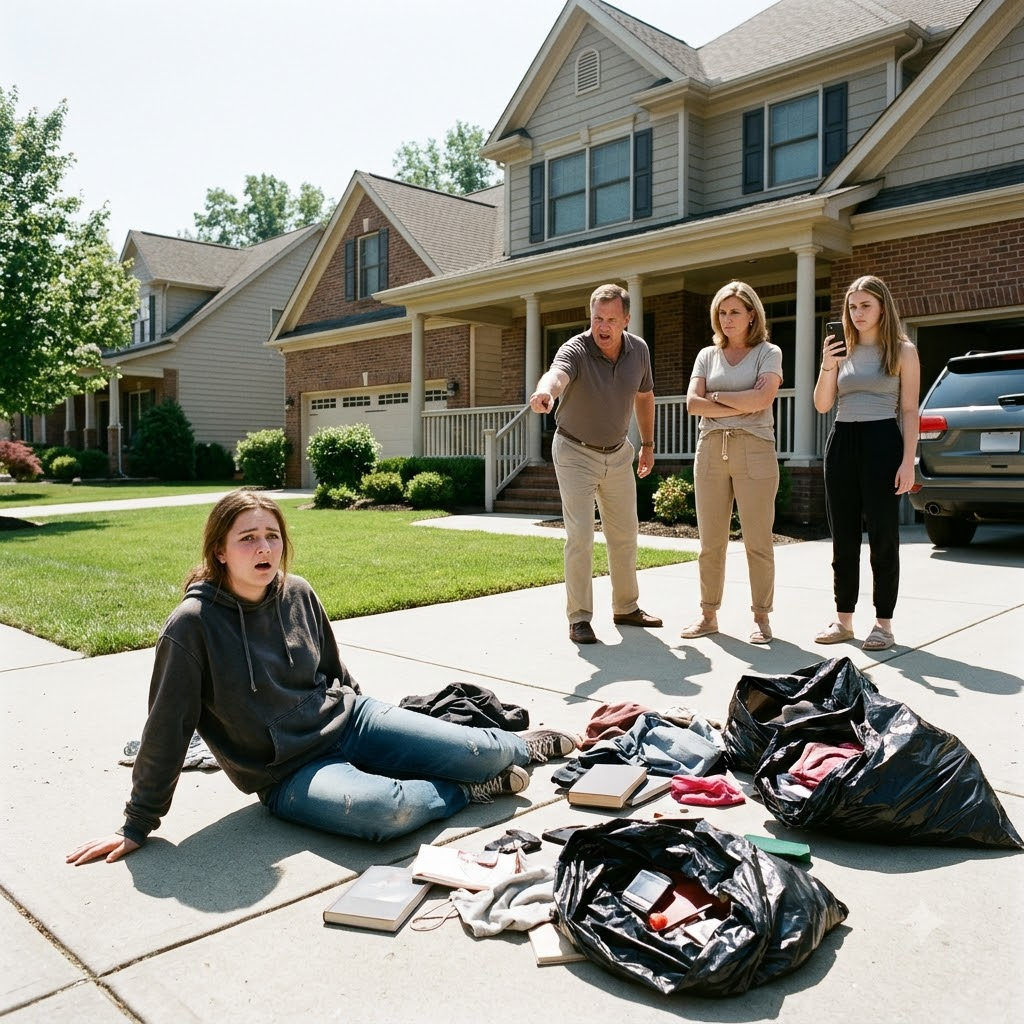
"GET OUT OF MY HOUSE!"
My father kicked my basement door open while holding a one-way bus ticket.
A small handwritten number was visible beneath the destination: 18.
He had no idea that number was about to destroy everything he owned.
My name is Veta, and on the morning I turned eighteen, I learned that some families don't wait for you to die before they bury you.
They just put your belongings in garbage bags and tell you to disappear.
It was exactly 5:00 a.m. when the door slammed against the basement wall.
I had been asleep for less than three hours.
My work uniform was still on. My shoes were beside the mattress. My phone was charging from an extension cord I had bought myself because my father refused to have another outlet installed downstairs.
I worked as a tow truck dispatcher.
Sixty hours a week.
Sometimes more.
I answered calls from stranded drivers, frightened teenagers, exhausted truckers, and people who had broken down on highways in the middle of the night.
I had talked strangers through panic attacks.
I had helped a seventy-year-old woman find shelter when her car died during a snowstorm.
I had stayed on the phone with a man whose wife was going into labor while he waited for roadside assistance.
But nothing in that job had prepared me for the sound of my own father shouting at me like I was an animal.
"Get up, Veta. Now."
I sat upright.
My father, Gideon, stood in the doorway wearing an expensive navy polo shirt and charcoal trousers.
Behind him was my stepmother, Rosalind.
Her dark auburn hair was perfectly styled, even at five in the morning.
That should have been my first warning.
Rosalind never got out of bed before eight unless something important was happening.
She was carrying two enormous black trash bags.
"What's going on?" I asked.
She threw the bags onto my mattress.
"You're eighteen."
I blinked.
"I know."
"Then congratulations," she said. "You're officially an adult."
For one ridiculous second, I thought this was some kind of cruel birthday joke.
Maybe they were going to tell me I could finally move into the guest bedroom.
Maybe my father had remembered my birthday.
Maybe—
"Pack your things," Gideon interrupted.
I looked between them.
"What?"
"You heard me."
Rosalind walked to my narrow closet and began pulling clothes off the hangers.
"Wait."
She ignored me.
A sweatshirt landed in the first bag.
Then two pairs of jeans.
Then my winter coat.
"Rosalind, stop."
She turned toward me.
"Don't use that tone."
"You're throwing my clothes into garbage bags."
"Because you have garbage to pack."
I stared at her.
My father folded his arms.
"You're not staying here another night."
The words didn't register immediately.
I had lived in that house since I was nine.
Not in the bedrooms upstairs, of course.
Those belonged to people who mattered.
I had lived in the basement.
A damp, unfinished room with a concrete floor, exposed pipes, and a small window near the ceiling.
In the winter, the cold came through the walls.
In the summer, the room smelled like mildew.
I had asked for a heater once.
Gideon told me electricity wasn't free.
So I bought my own.
I paid for my groceries, my phone, my transportation, and part of the electric bill.
I had started working at sixteen and saved every dollar I could.
I wasn't a burden.
I was barely even a presence.
"Where am I supposed to go?" I whispered.
"That's your responsibility now," Gideon said.
I looked at the date on my phone.
My birthday.
Not even six hours into it.
"You're kicking me out today?"
Rosalind gave a short laugh.
"Would tomorrow make it easier?"
"Why?"
She stopped packing long enough to look at me.
"We're renovating the basement."
I waited.
She continued.
"Saraphina needs a proper video studio. Her brand is growing, and she can't keep filming in her bedroom."
Saraphina.
My twenty-year-old stepsister.
The girl who had received a luxury SUV for her sixteenth birthday.
The girl whose closet was larger than my entire basement room.
The girl who called herself a lifestyle entrepreneur because she posted videos of expensive things she hadn't paid for.
They were throwing me out so she could have another room.
I looked at my father.
"You're serious?"
His expression hardened.
"Don't start."
"I've been paying you three hundred dollars a month."
"And you should be grateful that's all we charged."
I felt something cold settle in my chest.
Grateful.
That was his favorite word.
I was supposed to be grateful for the basement.
Grateful for leftovers.
Grateful when Rosalind remembered to buy the laundry detergent I was allowed to use.
Grateful that I had a roof over my head.
Never mind that I had spent most of my childhood cleaning the house, watching Saraphina's friends, and working every job I could find.
Never mind that my mother had once owned half of that house.
At least, that was what I remembered.
I had been too young when she died to understand the paperwork.
Gideon always said the debts had swallowed everything.
"Your mother left nothing," he told me whenever I asked.
Eventually, I stopped asking.
But I never stopped wondering.
Rosalind pulled a small wooden box from beneath my bed.
"What's this?"
I lunged toward her.
"Don't touch that."
She raised her eyebrows.
"Excuse me?"
"Please. That's mine."
The box had belonged to my mother.
It was dark walnut, scratched along one corner, with a tiny brass clasp.
Inside were three photographs, a broken silver bracelet, and a birthday card my mother had written before she died.
It was the only thing I owned that felt like home.
Rosalind shook it.
"Sounds like junk."
I grabbed it from her hands.
"Don't."
For the first time that morning, Gideon moved toward me.
"Watch yourself."
I stepped back.
My heart hammered.
He stared at the box.
Something flickered across his face.
Not anger.
Recognition.
Then it disappeared.
"Put it in the bag," he ordered.
I held it against my chest.
"No."
His jaw tightened.
"Veta."
"It's all I have of Mom."
Silence.
Rosalind rolled her eyes.
"Oh, here we go."
I looked at my father.
For one second, I thought mentioning my mother might reach whatever part of him had once loved her.
Instead, he said, "Your mother isn't here to save you."
The words hit harder than I expected.
I didn't cry.
Not then.
I simply placed the wooden box inside my backpack.
Rosalind continued packing.
Ten minutes later, everything I owned was divided between two black trash bags and a backpack.
That was eighteen years of my life.
Two bags.
One backpack.
And eighty dollars in my wallet.
I had another eight hundred in a savings account my father didn't know about.
I had been saving to leave.
Just not like this.
Not without a plan.
Not on my birthday.
Gideon grabbed the bags.
"Move."
I followed him upstairs.
The kitchen lights were on.
Fresh coffee was brewing.
There was a plate of pastries on the counter.
For a strange moment, I remembered my tenth birthday.
My mother had been gone less than a year.
I had asked whether we could make pancakes.
Rosalind said birthdays weren't an excuse to waste food.
That afternoon, Saraphina had complained that she was bored.
Gideon took her shopping.
I stayed home and washed the dishes.
Now, eight years later, nothing had changed.
Except I was old enough for them to throw away.
We reached the front door.
Saraphina stood near the staircase.
She was wearing a bright blue top and cream-colored trousers.
Her platinum-blonde hair was pulled into a high ponytail.
She had her phone in her hand.
Of course she did.
"Wait," she said brightly. "Are we doing it now?"
My stomach dropped.
"Doing what?"
She smiled.
"Nothing."
Then she raised her phone.
The little red recording indicator appeared.
I looked at my father.
"Tell her to stop."
He opened the front door.
"Get outside."
"Saraphina's filming me."
"Then stop making a scene."
I stared at him.
I hadn't shouted.
I hadn't threatened anyone.
I hadn't even refused to leave.
But somehow, I was making a scene.
Rosalind stepped behind me.
"Honestly, Veta, you're embarrassing yourself."
Something inside me began to crack.
Not loudly.
Not dramatically.
Just a small, terrible realization.
They had planned this.
All of them.
Saraphina hadn't stumbled downstairs because she heard an argument.
She had dressed for the occasion.
Rosalind had been awake before dawn.
Gideon already had the ticket.
They had discussed my removal like a home improvement project.
And they were enjoying it.
I stepped onto the front porch.
The neighborhood was quiet.
The sky had begun to brighten.
Sprinklers clicked across the lawns.
A bird landed on the mailbox.
Everything looked normal.
That was the worst part.
The world hadn't stopped.
My life was falling apart, and someone down the street was probably making breakfast.
Gideon carried my bags toward the driveway.
I followed.
"Can I at least call someone?" I asked.
"You can do whatever you want once you're gone."
"I need to know where I'm going."
He turned.
"Oak Haven."
I frowned.
"What?"
"There's a bus leaving this morning."
"Why Oak Haven?"
"Because that's where the ticket goes."
I stared at the crumpled paper in his hand.
Oak Haven.
I'd never heard of it.
"Do I know someone there?"
"No."
"Then why—"
"Enough!"
He shoved one bag toward me.
I reached for it.
The plastic slipped.
My other bag fell.
I bent to catch it.
Gideon grabbed my upper arm.
"Stop wasting my time."
"You're hurting me."
"Then move."
He pushed me away.
My foot caught against the edge of the bag.
I lost my balance.
The concrete came up fast.
My palm struck first.
Then my hip.
Pain shot through my wrist.
One trash bag split open.
Clothes scattered across the driveway.
A notebook slid toward the grass.
My paperback landed face down near the curb.
For a moment, I couldn't breathe.
Then I heard Saraphina laugh.
Not loudly.
Just a small, delighted sound.
"Oh my God," she said. "This is unbelievable."
I looked up.
She was filming.
My father stood over me.
Rosalind watched from behind him, her arms folded.
Nobody moved to help.
"Get up," Gideon snapped.
I tried.
My palm burned.
A thin line of blood ran across the skin.
"Please," I whispered.
His face twisted.
"Don't start begging."
"I'm not."
"You're eighteen now. You're not my responsibility."
I looked at him.
"You're my father."
His expression went flat.
Then he pointed toward the street.
"You are dead to this family! Get off my property!"
The words rang across the driveway.
Somewhere nearby, a dog barked.
Saraphina moved closer with her phone.
I could see myself reflected in the dark screen.
A girl sitting on concrete.
Hair falling loose.
Clothes scattered around her.
A father pointing at her like she was something disgusting.
I wanted to disappear.
Instead, I reached for my notebook.
It was an ordinary spiral-bound notebook, the kind sold in packs of three at discount stores.
I used it to write down my work schedule, expenses, and savings goals.
On the inside cover, I had written a promise to myself when I turned sixteen.
One day, I will have a home where nobody can tell me I don't belong.
I picked it up.
Held it against my chest.
Then I looked at my father.
"It's my birthday," I said.
He didn't answer.
I waited.
I don't know why.
Maybe I wanted him to remember the little girl who used to run to the front door when he came home.
Maybe I wanted him to remember teaching me to ride a bicycle.
Maybe I wanted proof that somewhere beneath the expensive clothes and cruel words, my father still existed.
Rosalind glanced at her watch.
"Gideon, we're going to be late."
He looked away from me.
"Get your things."
I wiped my palm against my sweatshirt.
Then I stood.
Slowly.
Carefully.
I gathered the scattered clothes.
Folded what I could.
Placed the notebook inside my backpack.
Saraphina continued recording.
At one point, she stepped close enough for me to hear her whisper.
"This is going to get so many views."
I turned toward her.
"Please don't post that."
She smiled.
"Why? It's real life."
I wanted to tell her that real life wasn't content.
That humiliation wasn't entertainment.
That one day she might understand what it felt like to have everything taken away while someone watched through a camera.
But I said nothing.
Because I finally understood something.
There was no sentence I could speak that would make these people care.
Gideon loaded my bags into his SUV.
"Get in."
I looked toward the house.
The windows reflected the morning sunlight.
I could see the upstairs bedroom that had once belonged to my mother.
Rosalind had turned it into a dressing room years ago.
I remembered the smell of my mother's perfume.
Her hand brushing my hair away from my forehead.
Her voice telling me that I was loved.
I wondered what she would think if she could see me now.
"Veta!"
I turned.
My father was waiting beside the passenger door.
I climbed inside.
He slammed it.
Through the window, I saw Rosalind put an arm around Saraphina.
They were already laughing about something on the phone.
Then Gideon started the engine.
We drove away.
For the first several minutes, neither of us spoke.
I watched familiar streets slide past.
The grocery store where I bought discounted food.
The library where I used to stay after school because the basement was too cold.
The gas station where I once worked weekend shifts.
Every place carried a piece of my life.
And suddenly, none of them felt like mine anymore.
I looked at the ticket.
Oak Haven.
One way.
Departure: 7:15 a.m.
I studied the printed details.
Then I noticed something strange.
Beneath the destination, someone had written the number eighteen in blue ink.
Not my age.
Not the date.
Just the number.
18.
"What's this?" I asked.
Gideon glanced over.
"What?"
"The number."
He looked at the ticket.
His fingers tightened around the steering wheel.
"Nothing."
"Did you write it?"
"No."
"Then who did?"
"Stop asking questions."
I stared at him.
He was angry.
But something else had entered his expression.
Something I hadn't seen before.
Nervousness.
It vanished almost immediately.
I looked back at the ticket.
"Why Oak Haven?"
"I told you."
"No, you didn't."
His jaw tightened.
"Because it's far enough away."
I swallowed.
"Far enough from what?"
He didn't answer.
The rest of the drive passed in silence.
At the Greyhound station, he pulled into a loading zone.
He didn't park.
He didn't turn off the engine.
He simply reached into his pocket and handed me the ticket.
"Your bags are in the back."
I looked at him.
"Can I have a few days to find somewhere to stay?"
"No."
"I don't know anybody in Oak Haven."
"That's not my problem."
"I only have eighty dollars."
"Then learn to manage it."
My throat tightened.
"Can I at least keep my job until I find another one?"
He shook his head.
"You're leaving town."
"I could stay with a coworker."
"No."
The answer came too quickly.
I stared at him.
"Why do you care where I go if you don't want me anymore?"
For the first time that morning, he looked directly into my eyes.
There was something hard there.
Something frightened.
Then he said, "Because some things are better left buried."
I didn't understand.
Before I could ask what he meant, he reached across me and opened the passenger door.
"Out."
I stepped onto the pavement.
He unloaded the two trash bags.
One landed beside my shoe.
The other rolled against a bench.
I stood there with my backpack over one shoulder.
"Goodbye, Dad."
He didn't respond.
He climbed back into the SUV.
The engine growled.
Then he drove away.
No hug.
No apology.
Not even a final look.
I watched the vehicle disappear into traffic.
Only then did I cry.
Not loudly.
I sat on the bench, put my hands over my face, and let the tears come.
I cried for my mother.
For the childhood I'd spent trying to earn affection.
For every birthday that had passed without a cake.
For the father who had just abandoned me.
And for the girl I had been that morning, who still believed being good enough might make someone love her.
Eventually, I stopped.
I cleaned the scrape on my palm with a tissue and water from my bottle.
Then I checked my bank balance.
Eight hundred dollars.
It wasn't much.
But it was mine.
I could survive a few nights in a cheap motel.
I could find work.
I knew how to answer phones, manage dispatch schedules, calm angry customers, and keep track of complicated routes.
I knew how to survive on very little.
I had been doing it for years.
At 7:10, I carried my bags toward the bus.
The driver checked my ticket.
He frowned slightly.
"Oak Haven?"
"Yes."
He looked at me.
"You got family there?"
"No."
He hesitated.
Then he handed the ticket back.
"Long ride."
"I know."
I climbed aboard.
Found a seat near the middle.
Placed my backpack on my lap.
As the bus pulled away, I watched the city disappear behind us.
For the first time in my life, I was completely alone.
Or so I thought.
Three hours into the journey, my phone vibrated.
A message from an unknown number.
I almost ignored it.
Then I saw the first sentence.
Veta, if you're on the bus to Oak Haven, please don't get off anywhere else.
My stomach tightened.
I read the rest.
Your mother wanted you to know the truth when you turned eighteen.
I stared at the screen.
Another message arrived.
The people who raised you have lied about more than you can imagine.
My hands began to shake.
I typed a response.
Who is this?
Three dots appeared.
Disappeared.
Appeared again.
Then a photograph arrived.
It showed a young woman standing beside an elderly man in front of a large stone mansion.
The woman was my mother.
I recognized her immediately.
Her smile.
Her eyes.
The silver bracelet on her wrist.
The same bracelet I had kept in the wooden box.
But the elderly man beside her was someone I had never seen before.
He wore a dark suit.
His hand rested gently on her shoulder.
On the back of the photograph, written in faded blue ink, were four words.
For Veta. Love, Grandpa.
I stopped breathing.
My grandfather?
My father had told me both of my mother's parents were dead.
He had said there was nobody left.
I stared at the photograph until the screen dimmed.
Then another message appeared.
When you reach Oak Haven, a man named Thomas will be waiting for you.
I looked around the bus.
Passengers slept.
A woman across the aisle read a magazine.
Nobody seemed to notice that my entire world had just shifted.
I typed one final question.
Is my grandfather alive?
The reply came almost immediately.
He has been waiting eighteen years to tell you what happened.
I read it twice.
Then a third time.
Outside, the highway stretched toward a town I had never heard of.
Inside my backpack, my mother's wooden box suddenly felt heavier than it had that morning.
I opened it.
Lifted the birthday card.
And noticed something I had never seen before.
A tiny folded piece of paper was tucked beneath the velvet lining.
My fingers trembled as I pulled it free.
There was a name written across the top.
A name my father had forbidden me to mention.
And underneath it, in my mother's handwriting, were the words:
If Gideon ever sends you away, find...






Comments 0