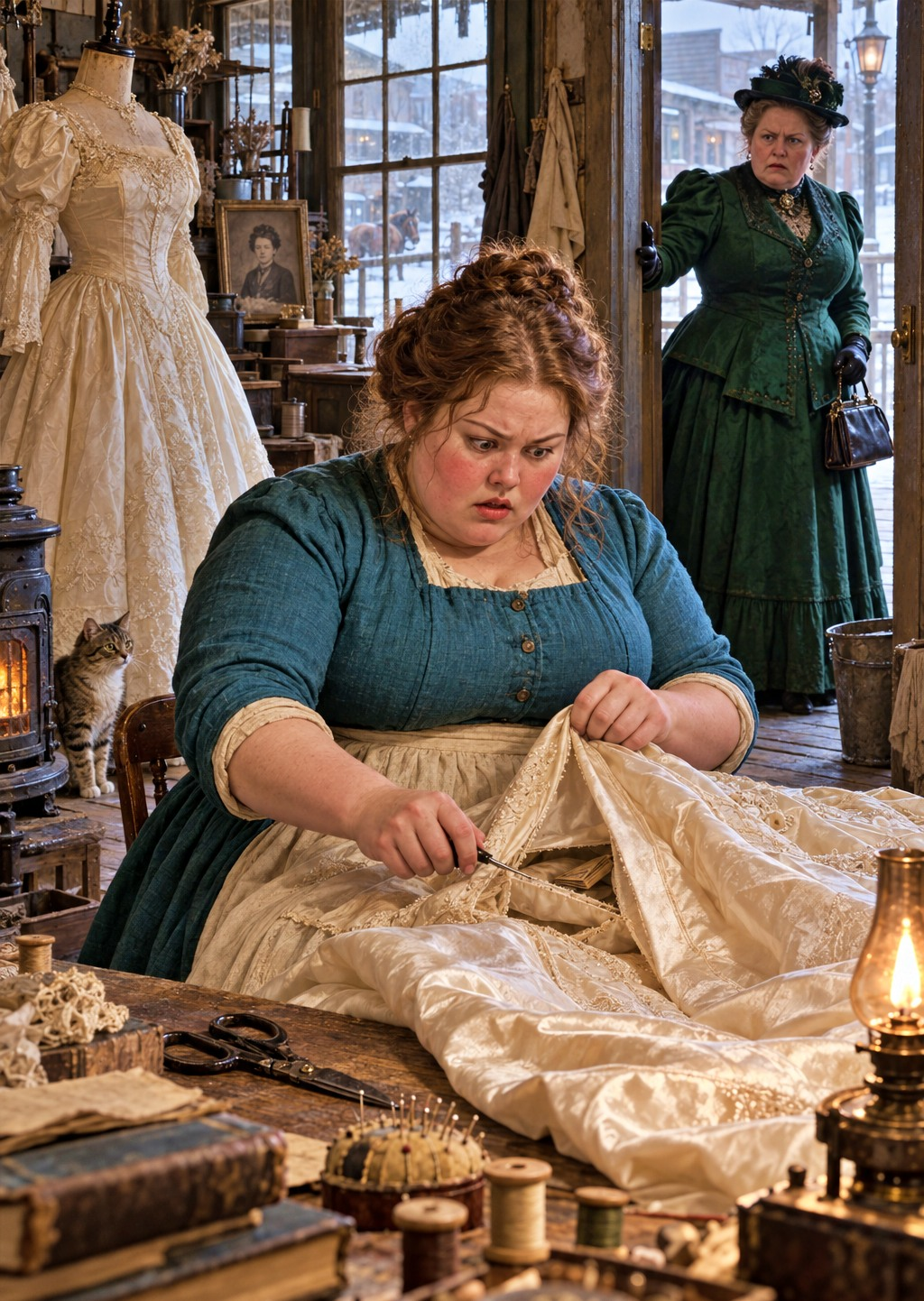
Adah Quill pulled the ivory skirt toward the window and whispered, "Who did this?"
Mrs. Prudence Loach appeared in the doorway, her gloved finger pointing at the abandoned wedding gown.
Inside its skirt, ten tiny stitches to the inch sealed a perfectly finished pocket.
The thread was deliberately lighter than the surrounding silk.
Someone had wanted that seam to be found.
Four days before the wealthy woman arrived, Adah had possessed little more than a borrowed key and a determination that hunger had not yet managed to destroy.
She was twenty-four years old.
Her mother was dead.
Her relatives had taken everything they could sell, including the little cottage where she had learned to walk, read, and guide a needle through cloth without pricking her fingers.
Her aunt had called the sale necessary.
Her uncle had called it sensible.
Neither had offered Adah a place to sleep.
"You are a grown woman," her aunt had informed her while counting the money from the cottage. "You cannot expect other people to support you forever."
Adah had looked at the familiar kitchen, at the empty space where her mother's sewing basket had once stood, and understood that grief was a luxury she could no longer afford.
She had left without arguing.
Three days later, a solicitor named Mr. Edwin Bell summoned her to his office.
He was an elderly gentleman with spectacles that continually slipped down his nose and a habit of arranging papers whenever a conversation became uncomfortable.
"Did your mother ever mention a woman named Honoria Slade?"
Adah shook her head.
"Not that I remember."
"She was a dressmaker. Rather accomplished in her younger years, I understand. She and your mother were apprentices together."
He opened a drawer and removed an envelope.
"Miss Slade died four months ago. Her instructions were unusually specific."
He handed Adah a document.
She read it twice.
The deceased dressmaker had left her remaining possessions and the lease of a shop on Cinder Row to the daughter of Margaret Quill.
To Adah.
"But I never met her."
"Apparently, that did not concern Miss Slade."
"Why would she leave me anything?"
Mr. Bell hesitated.
"Some people remember kindness long after the person responsible has forgotten it."
He placed a tarnished brass key on the desk.
"I should warn you that the property is in rather poor condition."
Poor condition turned out to be an extraordinarily generous description.
The shop stood between a shuttered cobbler's establishment and a narrow passage where rainwater collected in permanent puddles.
Its front window was almost opaque with dirt.
The painted lettering above the entrance had faded until only fragments remained.
SL—DE.
DRESSM—KER.
Adah inserted the key.
The lock resisted before finally turning.
Inside, the smell of damp wood and old cloth greeted her.
A warped counter occupied the front room. Shelves leaned against the walls. A broken chair lay beneath a window, and a brown water stain spread across the ceiling.
She stepped around a bucket containing several inches of stale rainwater.
"Well," she murmured, "at least it has walls."
Then she entered the workroom.
And stopped.
A wedding gown stood beneath a dust-covered sheet that had slipped from one shoulder of a dressmaker's mannequin.
Adah approached it slowly.
She removed the sheet.
Ivory silk unfolded before her eyes.
Even beneath years of neglect, the gown was breathtaking.
Its bodice was decorated with delicate embroidery. Tiny flowers followed the neckline. Lace fell gracefully from the sleeves, and the skirt gathered into a magnificent train.
Adah had spent three years working beneath a fashionable dressmaker who charged wealthy customers enormous sums for garments Adah herself had constructed.
She knew expensive workmanship.
This was something different.
Whoever had made this dress had not merely been completing an order.
She had been making something for someone she loved.
Adah lifted the skirt.
The seams were nearly perfect.
Ten stitches to the inch.
Even.
Patient.
Beautiful.
Her mother had taught her that fine sewing revealed the character of the person holding the needle.
Careless people left careless stitches.
Angry people pulled their thread too tightly.
Patient people created work that could survive generations.
Honoria Slade, Adah decided, must have possessed extraordinary patience.
Then she discovered the pocket.
It was positioned along the left side of the skirt, discreet enough to remain invisible when the gown was worn.
Adah searched for its opening.
There wasn't one.
Someone had sewn it completely shut.
She examined the stitches.
The thread was half a shade lighter than the silk used elsewhere.
A mistake?
Impossible.
A woman capable of constructing such a gown would never have made so obvious an error.
Adah reached for her sewing scissors, then stopped.
The dress had belonged to someone.
Opening that pocket felt disturbingly like opening a stranger's private correspondence.
She lowered the skirt.
"Not yet," she whispered.
There were more immediate problems.
She had enough money for two days of bread and perhaps a little coal. If she intended to survive, she needed customers.
For the next three days, Adah worked until her shoulders ached.
She scrubbed the windows.
She cleared the shelves.
She dragged ruined pattern books into a pile and used the damaged boards to start a fire in the iron stove.
She borrowed a ladder from the cobbler's widow and temporarily covered the damaged portion of the roof.
By the fourth morning, the shop no longer smelled abandoned.
Adah placed a handwritten card in the window.
MENDING, ALTERATIONS, COLLARS AND CUFFS.
HONEST PRICES.
She stood outside for a moment, admiring her work.
It wasn't much.
But it belonged to her.
For the first time since her mother's death, she allowed herself to imagine a future.
That was when the carriage arrived.
Its polished wheels stopped directly outside her window.
A driver descended and opened the door.
The woman who emerged wore bottle-green silk, expensive gloves, and a bonnet decorated with dark feathers.
She surveyed the shop with undisguised contempt.
Adah returned inside.
The woman followed without knocking.
"So it is true."
Adah straightened.
"Good morning, ma'am. May I help you?"
The visitor looked around.
"Honoria's miserable little rat's nest has acquired another tenant."
Adah remained silent.
"I am Mrs. Prudence Loach. My husband holds the mortgage on half this row."
She paused, apparently expecting that information to produce an immediate display of respect.
Adah offered a polite nod.
"Adah Quill."
"Yes. Margaret's daughter."
Something about the familiarity of the woman's response unsettled her.
"You knew my mother?"
Mrs. Loach removed one glove.
"Everyone knew everyone in those days. That does not make them important."
She walked toward the counter.
"I hope you understand that we maintain certain standards in Marley. This street is not to become a gathering place for beggars."
"I intend to earn my living honestly."
"Honesty does not pay the rent, child."
"Neither does an empty shop."
Mrs. Loach turned sharply.
For several seconds, neither woman spoke.
Then the visitor noticed the wedding gown.
Her expression changed.
It happened so quickly that another person might have missed it.
Her shoulders stiffened.
Her lips parted.
The color drained slightly from her cheeks.
Then her face became hard again.
"Why is that still here?"
Adah followed her gaze.
"The wedding gown?"
"Obviously."
"It was here when I arrived."
Mrs. Loach approached the mannequin but stopped short of touching the silk.
"Honoria never finished it. The bride abandoned the arrangement years ago."
"It appears finished to me."
"Then you know considerably less about dressmaking than you imagine."
Adah looked at the immaculate bodice.
She knew better than to argue.
Mrs. Loach turned toward her.
"Burn it."
Adah thought she had misunderstood.
"Ma'am?"
"Burn that dress, or I'll send someone to destroy it myself."
The words hung between them.
Outside, a horse stamped against the cobblestones.
Adah folded a loose section of silk over the mannequin's arm.
"I understand."
Mrs. Loach appeared satisfied.
"Good. You have no use for a dead woman's failures."
"But silk of this quality is expensive. I could use the material."
The older woman's expression tightened.
"You will do no such thing."
"Why?"
"Because it is mine to speak of. My family were Honoria's only relatives in Marley."
Adah considered the claim.
Mr. Bell had mentioned no relatives.
Certainly none who had shown an interest in the abandoned shop.
Mrs. Loach stepped closer.
"Girls in your circumstances should be careful about the battles they choose."
Adah met her eyes.
"I only intend to sew."
"See that you remember it."
The woman turned and departed.
Her carriage disappeared around the corner, leaving Adah standing beside the gown.
For several minutes, she did not move.
Mrs. Loach had called the dress unfinished.
She had called it worthless.
Yet she had traveled personally to a neglected shop to demand its destruction.
Why?
Adah examined the sealed pocket again.
She remembered the woman's sudden alarm.
Her mother had once told her that people often revealed their greatest fears by the things they insisted did not matter.
Apparently, this dress mattered a great deal.
That evening, Adah ate a thin slice of bread beside the stove.
She locked the front door.
Then she returned to the workroom and lifted the gown from its mannequin.
She spread the skirt across the cutting table.
Under the candlelight, the pale thread became even more noticeable.
She traced the sealed pocket with one finger.
Then she examined the surrounding seams.
Everything was perfect until she reached the hem.
There, the stitching changed.
It was heavier.
Doubled.
Almost clumsy.
She bent closer.
The same woman who had sewn ten flawless stitches to the inch had apparently struggled to finish a simple hem.
Adah frowned.
That made no sense.
She reached for her scissors.
A sudden sound came from the front room.
Three deliberate knocks.
Adah glanced at the clock.
It was nearly midnight.
The knocking came again.
She covered the gown and carried her candle toward the entrance.
"Who is there?"
No answer.
She approached the door.
A folded piece of paper slid beneath it.
Adah picked it up.
Written across the front, in unfamiliar handwriting, were five words.
Do not open the pocket.
Before she could unfold the paper, someone began turning the handle of the locked door.


Comments 0