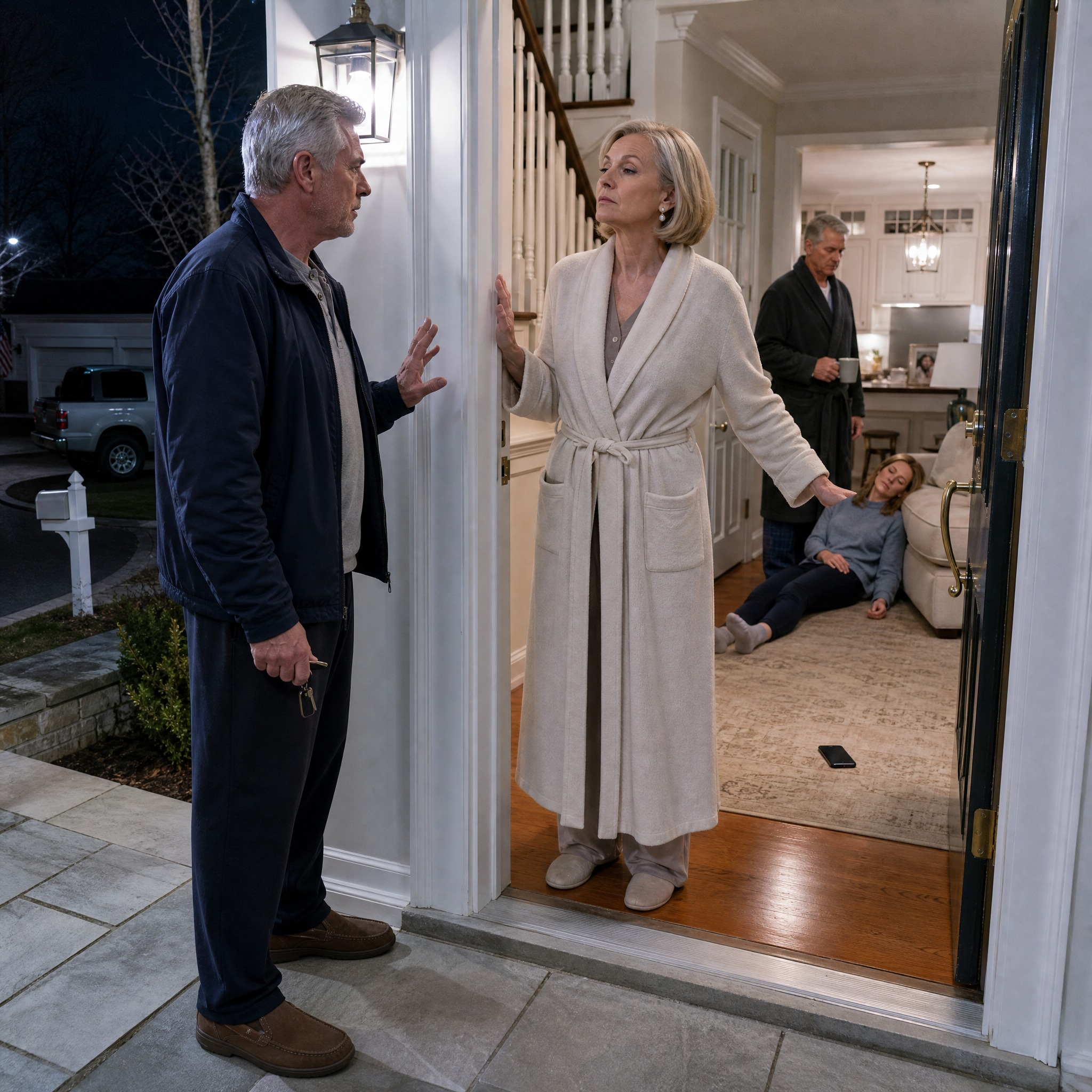
"Eddie? I know you're in there."
Jamie Lancaster's voice came through the hospital-room door with the same easy confidence I'd heard at every Christmas dinner for the past six years.
But this time, my daughter was trembling.
Debbie's fingers tightened around my hand so hard that I could feel her nails pressing into my skin.
"Don't let him in," she whispered.
I looked at the nurse standing beside the door.
"Please tell him she's not receiving visitors."
The nurse glanced at Debbie.
"Mrs. Lancaster, is that what you want?"
Debbie nodded.
"Yes."
The nurse didn't hesitate.
"Then that's what we'll do."
She stepped outside, closing the door behind her.
I heard Jamie speaking in the hallway.
His voice was low at first.
Then louder.
"I'm her husband. I have a right to know what's happening."
The nurse answered calmly.
"Your wife has requested privacy."
There was a pause.
Then Jamie laughed.
It was a small sound.
Almost friendly.
But I'd heard that laugh before.
He used it whenever someone challenged him in front of other people.
It was the laugh of a man who believed every disagreement could be handled by making the other person feel foolish.
"Come on," he said. "There must be some misunderstanding."
I watched Debbie's face.
She had gone pale.
Her eyes were fixed on the door.
"He's going to be angry," she whispered.
I leaned closer.
"Let him be angry."
She shook her head.
"Dad, you don't understand."
"Then help me understand."
She looked at me for a long moment.
I could see her trying to decide how much she could safely say.
That hurt more than I expected.
My daughter had spent thirty-three years telling me everything from embarrassing school stories to problems at work.
Now she was lying in a hospital bed, afraid to explain why her own husband frightened her.
"Jamie isn't like you think," she finally said.
I swallowed.
"I know that now."
"No," she whispered. "You don't."
Outside, I heard footsteps.
Then silence.
The nurse returned a minute later.
"He's agreed to wait downstairs."
Debbie closed her eyes.
The nurse checked her blood pressure and adjusted the blanket.
"Your doctor will be back shortly," she said. "And someone from our patient-support team can speak with you privately whenever you're ready."
Debbie nodded without opening her eyes.
After the nurse left, I sat beside the bed.
Neither of us spoke for several minutes.
I watched the morning light beginning to creep through the narrow window.
Somewhere down the hall, a cart rattled across the floor.
A phone rang at the nurses' station.
The hospital continued operating as though the world hadn't changed.
For everyone else, I supposed, it hadn't.
But for me, the man I'd trusted with my daughter's happiness had become a stranger overnight.
And the worst part was realizing that Debbie had probably been living with that stranger for much longer than I knew.
Jamie didn't leave the hospital.
I learned that an hour later when a nurse told me he was still waiting downstairs.
He'd brought flowers.
White roses.
Debbie's favorite.
That detail made me angrier than it should have.
Not because of the flowers themselves.
Because Jamie knew exactly which ones to buy.
He remembered birthdays.
He remembered anniversaries.
He remembered the names of Debbie's childhood friends.
He knew how she liked her coffee and which side of the bed she preferred.
He knew all the small things that made a person feel loved.
And somehow, none of that had prevented her from ending up unconscious on his living-room floor.
Around nine, the doctor returned.
His name was Dr. Harris.
He was a quiet man with thinning brown hair and the patient manner of someone who'd spent years delivering difficult information.
He asked Debbie how she felt.
"Dizzy," she answered.
"Any nausea?"
"A little."
"Headache?"
She nodded.
He checked her eyes, asked several orientation questions, and explained that her symptoms were consistent with a mild concussion.
Her blood pressure had improved, but they wanted to continue observing her.
Then he asked what had happened.
Debbie looked at me.
I waited.
She looked down at her hands.
"I had a panic attack," she said.
I felt my stomach drop.
Dr. Harris remained neutral.
"Can you tell me what led up to it?"
"I'd been anxious all evening."
"Had you taken any medication?"
She hesitated.
"Something for anxiety."
"Was it prescribed to you?"
"Yes."
"Did you drink alcohol?"
"A little wine."
The doctor nodded.
"Do you remember falling?"
Debbie's eyes flickered toward the door.
"I was on the stairs."
"Did you lose your balance?"
"I think so."
"Was anyone with you?"
Another pause.
"Jamie."
I leaned forward.
"Debbie—"
She squeezed my hand beneath the blanket.
Hard.
A warning.
I stopped.
Dr. Harris continued.
"Did Jamie see you fall?"
"He tried to catch me."
Her voice was barely audible.
I stared at her.
The bruises on her arms were visible beneath the hospital gown.
I remembered the marks I'd seen on the floor.
The shape of fingers.
The uneven coloring.
The way she'd been lying beside the sofa instead of near the staircase.
But Debbie kept her eyes lowered.
Dr. Harris glanced at me, then back at her.
"Mrs. Lancaster, I'd like to speak with you alone for a few minutes."
I stood immediately.
"Of course."
Debbie caught my wrist.
"Dad?"
"I'm right outside."
She looked frightened again.
I bent down.
"I promise."
The doctor waited until I stepped into the hallway.
Then he closed the door.
I stood beside a vending machine and stared at a poster about handwashing.
For nearly twenty minutes, I didn't move.
I thought about the first time Debbie had brought Jamie home.
It had been a Sunday afternoon.
Margaret had been gone five years.
I'd spent the morning making pot roast because Debbie had told me Jamie liked traditional meals.
He arrived carrying a bottle of expensive wine and a box of pastries from a bakery in Middleburg.
He shook my hand firmly.
Called me sir.
Complimented the house.
Asked thoughtful questions about my work.
When Debbie stepped into the kitchen, Jamie followed her with his eyes.
At the time, I'd thought it was affection.
Now I wondered whether it had been something else.
I remembered the way he'd answered questions for her.
The way he'd corrected small details in her stories.
The way he'd occasionally placed a hand on her shoulder when she spoke.
I'd thought he was being attentive.
I wondered how many warnings I'd mistaken for manners.
The door opened.
Dr. Harris stepped out.
He didn't look surprised to find me standing there.
"Mr. Lechman?"
"How is she?"
"She's resting."
I lowered my voice.
"Doctor, I don't believe she fell down the stairs."
He studied me.
"Why do you say that?"
"Because she called me asking for help. Because her in-laws wouldn't let me see her. Because she was unconscious on the living-room floor and nobody had called an ambulance."
He listened without interrupting.
"And because," I continued, "she looks terrified every time someone mentions her husband."
Dr. Harris nodded slowly.
"I understand your concerns."
"Can you make her tell you what happened?"
"No."
The answer came gently but firmly.
"She's an adult patient. If she's capable of making her own decisions, we have to respect them."
"What about the bruises?"
"We've documented the injuries we observed. We also discussed additional examination and support options."
"Did she agree?"
"Not at this time."
I looked toward the closed door.
"She's protecting him."
"That may be one possibility. But I can't make assumptions about her reasons."
He paused.
"Mr. Lechman, people in frightening situations sometimes need time before they feel safe enough to speak openly."
I rubbed my forehead.
"So what am I supposed to do?"
"Stay available. Listen. Avoid pressuring her. Make sure she knows she has choices."
He handed me a small card.
It contained contact information for a domestic-crisis support organization.
"She has this information, too."
I stared at the card.
For the first time, the word domestic felt like something dangerous.
Not a description of home.
A warning about what could happen inside one.
Jamie approached me outside the hospital cafeteria shortly before noon.
I was carrying a paper cup of coffee that tasted like burnt cardboard.
He appeared from beside the elevators wearing a navy sweater and pressed gray trousers.
His hair was neatly combed.
He looked as though he'd come from a business meeting.
Not a house where his wife had been found unconscious.
"Eddie."
I stopped.
"Jamie."
He looked exhausted.
Or perhaps he wanted me to think he did.
There were dark circles beneath his eyes.
His jaw was unshaven.
He held a bouquet of white roses wrapped in clear plastic.
"How is she?"
"Stable."
He exhaled.
"Thank God."
I watched him.
"Where were you last night?"
His expression changed.
Only slightly.
"I was dealing with something."
"What?"
"A family matter."
I almost smiled.
There was that phrase again.
"Your wife was unconscious."
"I know."
"Your parents were there."
"I know that, too."
"And you weren't."
Jamie shifted the flowers to his other hand.
"Eddie, there's a lot you don't understand."
"Then explain it."
He glanced toward the elevators.
"Not here."
"Why not?"
"Because this is personal."
I stepped closer.
"Your wife called me at one forty-three in the morning. She asked me to come get her. When I arrived, your mother blocked the door and your father was standing in the kitchen drinking coffee while Debbie lay on the floor."
Jamie looked away.
"Mom panicked."
"She didn't look panicked."
"People react differently under stress."
"Did you know Debbie was unconscious?"
He hesitated.
"I knew she wasn't feeling well."
"That's not what I asked."
"Eddie—"
"Did you know?"
His face hardened.
"Yes."
I stared at him.
"Then why didn't you call for help?"
"Because Debbie has had episodes before."
"What episodes?"
"Anxiety. Panic attacks. She's been under a lot of pressure."
"From what?"
Jamie sighed.
"Financial issues. Family expectations. Things she's been struggling to manage."
There was something familiar about the way he spoke.
Not just the words.
The rhythm.
He sounded like Evelyn.
Calm.
Reasonable.
Patiently explaining why someone else's suffering was inconvenient.
I looked at the roses.
"She doesn't want to see you."
His jaw tightened.
"She's confused."
"She made herself clear."
"She's my wife."
"And she's my daughter."
For a moment, neither of us moved.
Then Jamie lowered his voice.
"Eddie, I respect you. I really do. But you need to be careful about getting involved in things you don't understand."
I thought of Evelyn standing in the doorway.
The same warning.
Almost the same words.
"What exactly am I supposed to be careful about?"
He looked at me.
Then smiled.
Not warmly.
Not kindly.
Just enough to make the threat sound like advice.
"Families can get damaged when people start making accusations."
I held his gaze.
"Then maybe people should stop giving them reasons."
His smile disappeared.
I walked past him.
My hands were shaking by the time I reached the elevator.
Not from fear.
From the effort of keeping them at my sides.
Debbie stayed in the hospital for two days.
During that time, Jamie called her repeatedly.
Sometimes every hour.
Sometimes several times in ten minutes.
When she didn't answer, he sent messages.
Baby, please talk to me.
I'm worried about you.
Mom says Eddie is making things worse.
We need to handle this privately.
I love you.
Then, late on the first evening:
You know what happens when outsiders get involved.
Debbie read that one twice.
I saw her face change.
She didn't show me the screen.
She simply turned the phone over and placed it on the bedside table.
"Do you want me to ask the nurse to block his calls?" I asked.
"No."
"Why not?"
"Because I need to know what he's saying."
I didn't understand.
Not yet.
But I remembered what she'd told me.
Don't confront Jamie.
Don't call a lawyer yet.
We need their records first.
I was beginning to realize Debbie wasn't merely afraid.
She was planning something.
And whatever she'd discovered had frightened her enough to keep it hidden even while she was lying in a hospital bed.
On the second night, she asked me to close the door.
Then she held out her phone.
"Can you help me with something?"
"Anything."
"I need you to promise you won't open the files unless I tell you to."
I nodded.
"All right."
She showed me a folder labeled Household Receipts.
Inside were dozens of documents.
Bank statements.
Screenshots.
Emails.
Photographs of signed papers.
I recognized Margaret's name on several pages.
My throat tightened.
"Why do you have all this?"
Debbie looked down.
"Because I started noticing things."
"What things?"
"Money disappearing."
I pulled my chair closer.
She explained that distributions from her mother's trust had become smaller over the past two years.
At first, Jamie blamed market conditions.
Then he blamed administrative fees.
Later, he said the trust had been restructured to protect the assets from unnecessary taxes.
"Did you ask to see the statements?"
"Yes."
"And?"
"He told me Phil was handling everything."
I stared at her.
"Your father-in-law?"
She nodded.
"Phil's office prepared some documents. Jamie said it was routine."
I remembered Phil offering to help with the trust.
I remembered thinking it was generous.
"Why didn't you tell me?"
Debbie's eyes filled with tears.
"Because every time I asked questions, Jamie made me feel stupid."
I didn't speak.
"He'd explain things with all these financial terms. Then he'd get frustrated when I didn't understand. He'd say I was accusing his family of stealing."
She wiped her cheek.
"Eventually, I stopped asking."
I looked at the documents on her phone.
"But you started again."
"Three months ago."
"What changed?"
She hesitated.
"I tried to withdraw money for repairs on Mom's old rental property."
I knew the property.
A small brick duplex outside Leesburg.
Margaret had bought it before we were married.
She'd insisted we keep it even when money was tight.
"That property belongs to the trust," I said.
"That's what I thought."
"What do you mean?"
"The bank told me I wasn't authorized to access the account anymore."
I felt my stomach tighten.
"Why?"
"Because Jamie had management authority."
I stared at her.
"Since when?"
"That's what I wanted to know."
She opened a photograph.
It showed part of a legal document.
At the top were the words:
Amendment to Trust Administration Agreement.
Below that, I could see Jamie's name.
And beside it:
Co-Trustee.
I leaned closer.
"Jamie is a trustee?"
"Apparently."
"Who approved that?"
Debbie looked at me.
"That's the problem."
She enlarged the photograph.
At the bottom of the page was a signature.
Her signature.
Or something that looked like it.
"I never knowingly signed this," she whispered.
I stared at the screen.
The handwriting resembled hers.
But something about it looked wrong.
The letters were too even.
The final stroke was different.
I remembered Margaret signing Christmas cards.
I remembered Debbie practicing her signature as a teenager.
I knew the shape of that name.
And I knew what I was looking at wasn't quite right.
"Could it have been one of those papers you signed at Phil's office?"
"Maybe they put it among the tax documents. I remember signing an acknowledgment page. But nobody explained that Jamie would be able to borrow against Mom's trust."
I looked up sharply.
"Borrow against it?"
Debbie nodded.
"That's what I think happened."
"How much?"
"I don't know yet."
"Debbie."
Her voice cracked.
"Dad, I think it's a lot."
I sat back.
For a moment, I couldn't speak.
Margaret and I had spent our lives building those assets.
We hadn't inherited money.
We hadn't won the lottery.
We'd worked.
Saved.
Bought properties when we could afford them.
Fixed leaking roofs ourselves.
Painted apartments on weekends.
Margaret had kept every receipt in labeled folders.
She believed financial security meant freedom.
Especially for Debbie.
And now I was looking at a document that might have handed control of everything Margaret had built to a man who frightened our daughter.
I wanted to call an attorney immediately.
I wanted to drive to Phil's office and demand answers.
I wanted to confront Jamie in front of every employee he had.
But Debbie caught my hand.
"Please don't."
I looked at her.
"Sweetheart, if they did this—"
"I know."
"We can't just sit here."
"We're not."
She pointed to the phone.
"I've been collecting evidence."
I stared at her.
"For how long?"
"Months."
"And Jamie doesn't know?"
She shook her head.
"Not everything."
That answer frightened me.
Because it meant he knew something.
And because I was beginning to understand why Debbie had called me in the middle of the night.
On Thursday afternoon, the hospital discharged her.
She refused to return to the Lancaster house.
I didn't ask her twice.
We drove to my home in Leesburg.
The house looked exactly as it always had.
White siding.
A narrow front porch.
Margaret's flower beds along the walkway.
I'd never been able to bring myself to change much.
Debbie walked slowly beside me.
Her head still hurt.
Her arms were bruised.
But she was standing.
And she was coming home.
I carried her small hospital bag upstairs.
Her old bedroom was at the end of the hallway.
The blue curtains she'd chosen in high school still hung above the window.
There were books on the shelf.
A photograph of her and Margaret at the beach.
A faded stuffed rabbit sitting on the dresser.
Debbie stopped in the doorway.
For a moment, she didn't move.
Then she began crying.
Not loudly.
Not dramatically.
She simply covered her face with both hands.
I put the bag down.
"Hey."
She shook her head.
"I'm sorry."
"For what?"
"For bringing all this here."
I stepped toward her.
"Debbie, this is your home."
She tried to speak.
Couldn't.
I put my arms around her carefully.
She leaned against me.
And for the first time since I'd found her on that living-room floor, she let herself cry without trying to stop.
I held her until she was ready to let go.
That evening, I made chicken soup.
Margaret's recipe.
Debbie ate half a bowl.
Then she went upstairs and slept for eleven hours.
I stayed awake.
I checked the locks twice.
I left the porch light on.
And I kept my phone beside me.
Jamie called at 8:17.
Then 8:43.
Then 9:06.
I didn't answer.
At 9:32, Evelyn called.
I let it ring.
At 10:11, Phil sent a text.
Eddie, we should discuss this situation before it becomes unnecessarily complicated.
I stared at those words.
Unnecessarily complicated.
My daughter had been hospitalized.
Her husband had apparently gained control over her mother's trust.
And Phil Lancaster was worried about complications.
I put the phone down.
Then I took Margaret's old photograph from the mantel.
She was smiling in the picture.
Standing beside Debbie at her college graduation.
I sat in my chair and looked at it for a long time.
"I'm trying, Maggie," I whispered.
The house was quiet.
But for the first time in years, I didn't feel alone.
My daughter was upstairs.
She was safe for the moment.
And I was going to make sure she stayed that way.
The next morning, Debbie came downstairs wearing one of Margaret's old sweaters.
It was too large for her.
She looked exhausted.
But her eyes were clearer.
I made coffee.
She sat at the kitchen table.
For a while, we talked about ordinary things.
The neighbor's new dog.
A leaking faucet.
Whether the grocery store still sold the cinnamon rolls she liked.
I understood what she was doing.
She needed a few minutes in a world where nothing terrible had happened.
I let her have them.
Then she put down her mug.
"Dad?"
"Yeah?"
"Can we talk about Tuesday night?"
I sat across from her.
"Of course."
She looked at her hands.
"I didn't fall the way I told the doctor."
I felt my chest tighten.
I said nothing.
"Jamie and I were arguing."
"About the trust?"
She nodded.
"I told him I wanted copies of every document Phil's office had prepared."
"What did he say?"
"He told me I was being paranoid."
She swallowed.
"Then I told him I'd already found some of the records."
I leaned forward.
"What happened?"
"He got angry."
"Did he hit you?"
She closed her eyes.
For several seconds, I thought she wasn't going to answer.
Then she whispered, "He grabbed me."
I looked at the bruises.
"He held my arms so tightly I couldn't pull away."
My hands curled beneath the table.
"He kept asking who I'd talked to. Whether I'd told you. Whether I'd contacted the bank."
"Did you?"
"Not yet."
She wiped her eyes.
"I tried to get my phone. He took it. We struggled over it."
I remembered the cracked screen.
"He pushed me away."
I forced myself to breathe.
"Then what?"
"I hit the edge of the sofa. I remember feeling dizzy."
She looked down.
"After that, everything gets confused."
"Where were his parents?"
"They came over when he called them."
I stared at her.
"Jamie called his parents?"
She nodded.
"He told them I was having another episode."
"Another?"
Her face changed.
She looked embarrassed.
"That's what he calls it whenever I get upset."
I felt sick.
She continued.
"Evelyn kept telling me to calm down. Phil said we needed to handle everything quietly."
"Did anyone call a doctor?"
"No."
"Why?"
She shook her head.
"I don't know."
I wanted to ask a hundred questions.
Instead, I asked the one that mattered most.
"Did you take anxiety medication and drink wine?"
Debbie nodded.
"I took my prescribed medication earlier. I had a glass of wine at dinner. I shouldn't have mixed them."
"Did you fall down the stairs?"
"No."
The word was almost inaudible.
I sat back.
The hospital story had been false.
Not completely.
But enough.
"Why did you tell the doctor that?"
She stared at the table.
"Because Jamie told me if anyone thought he'd hurt me, he'd make sure I lost access to everything."
I felt the room grow very quiet.
"He said I was unstable. That his family had records proving it."
"What records?"
"I don't know."
Her eyes filled again.
"He said he could make me look like I couldn't manage my own affairs."
I looked at my daughter.
Thirty-three years old.
Educated.
Capable.
Kind.
And frightened that her husband could convince the world she wasn't competent to control her own money.
I reached across the table.
"Listen to me."
She looked up.
"Whatever happens with that trust, you are not going back there unless you choose to. And nobody is going to make that decision for you."
Her lower lip trembled.
"Okay."
I squeezed her hand.
"We'll get help. We'll do this carefully."
She nodded.
Then she said something that made me understand how much she'd already endured.
"I just want to be able to sleep without listening for his footsteps."
I couldn't answer.
Not immediately.
Because there are things a father can hear that change him forever.
That was one of them.
The following week passed slowly.
Debbie rested.
I drove her to follow-up appointments.
She spoke privately with a domestic-crisis counselor.
I didn't ask what they discussed.
That belonged to her.
Jamie continued calling.
Sometimes his messages were apologetic.
Sometimes angry.
Sometimes so affectionate they almost sounded sincere.
I miss you.
Come home and we'll work this out.
You're letting your father turn you against me.
I can't believe you'd do this to our marriage.
Then one afternoon:
Dad says the trust issue can be resolved if you stop making accusations.
Debbie showed me that message.
"Save it," I said.
"I already did."
She gave me a tired smile.
It was the first real smile I'd seen since the hospital.
On the second Monday after she'd come home, we sat at the kitchen table with her phone, a notebook, and a folder of papers.
The bruises on her arms had begun fading.
Yellow and purple shadows remained.
I hated looking at them.
But Debbie had insisted on photographing them.
She'd learned from the counselor that documenting injuries and keeping records could matter later.
She'd also written down everything she remembered about the night.
Times.
Conversations.
Who had been present.
What Jamie had said.
What Evelyn had said.
What Phil had done.
I watched her organize the information.
She was methodical.
Careful.
More like Margaret than I'd realized.
At eleven that morning, Debbie opened a bank statement.
"Dad, I need to show you something."
I leaned closer.
The account belonged to the trust.
At least, that was what the heading indicated.
There were several transfers I didn't recognize.
Some were small.
Others were substantial.
One payment had gone to a company called Lancaster Property Management Services.
Another had gone to an account identified only by a reference number.
"Do you recognize any of these?" Debbie asked.
I shook my head.
"Should I?"
"Phil told me they were administrative expenses."
"How much?"
She turned the phone toward me.
I read the amount.
Then read it again.
"That can't be right."
"I know."
"Debbie, that's more than your mother spent renovating the entire duplex."
She nodded.
"And there are others."
I felt my pulse quicken.
"How many?"
"At least nine that I've found."
I stared at her.
"Nine?"
She opened another document.
Then another.
The dates stretched back nearly two years.
I recognized the month when Phil had prepared the trust amendment.
The transfers began shortly afterward.
I looked at the name on the statement.
Lancaster Property Management Services.
"Is that Jamie's company?"
Debbie shook her head.
"I don't know. I've never heard him mention it."
I picked up my notebook.
"Then we find out."
She nodded.
"But carefully."
"Carefully," I agreed.
She opened a photograph of the trust amendment.
The page was slightly blurred.
But the names were clear.
Debbie Lancaster.
Jamie Lancaster.
Phil Lancaster's office.
And beneath the signature block, a line that made me lean closer.
Witnessed and acknowledged.
I pointed at it.
"Who's the witness?"
Debbie enlarged the image.
The name was difficult to read.
She adjusted the brightness.
I reached for my glasses.
Then the letters came into focus.
I recognized the handwriting.
Not Debbie's.
Not Jamie's.
Mine.
My full name appeared beneath the witness declaration.
Edward Lechman.
I stared at the screen.
"I never witnessed this."
Debbie went still.
"What?"
"I never signed this document."
She looked at the photograph.
Then at me.
"Dad, are you sure?"
I felt my mouth go dry.
"Absolutely."
She slowly scrolled downward.
There was a date beneath the signature.
A date I remembered.
Because on that exact day, I'd been in Richmond attending a memorial service for Margaret's older brother.
I hadn't been anywhere near Phil Lancaster's office.
Debbie stared at the screen.
Then whispered, "Dad, look at the next page."
She swiped.
A second document appeared.
At the top were the words:
Certification of Trustee Authority.
Below them was a list of authorized individuals.
Jamie Lancaster.
Debbie Lancaster.
And a third name.
I leaned closer.
The name wasn't Phil's.
It wasn't Evelyn's.
It was someone I hadn't seen in eleven years.
Someone whose signature should have been impossible.
My wife.
Margaret Lechman.
And beneath her name was a date.
Two years after her death.






Comments 0