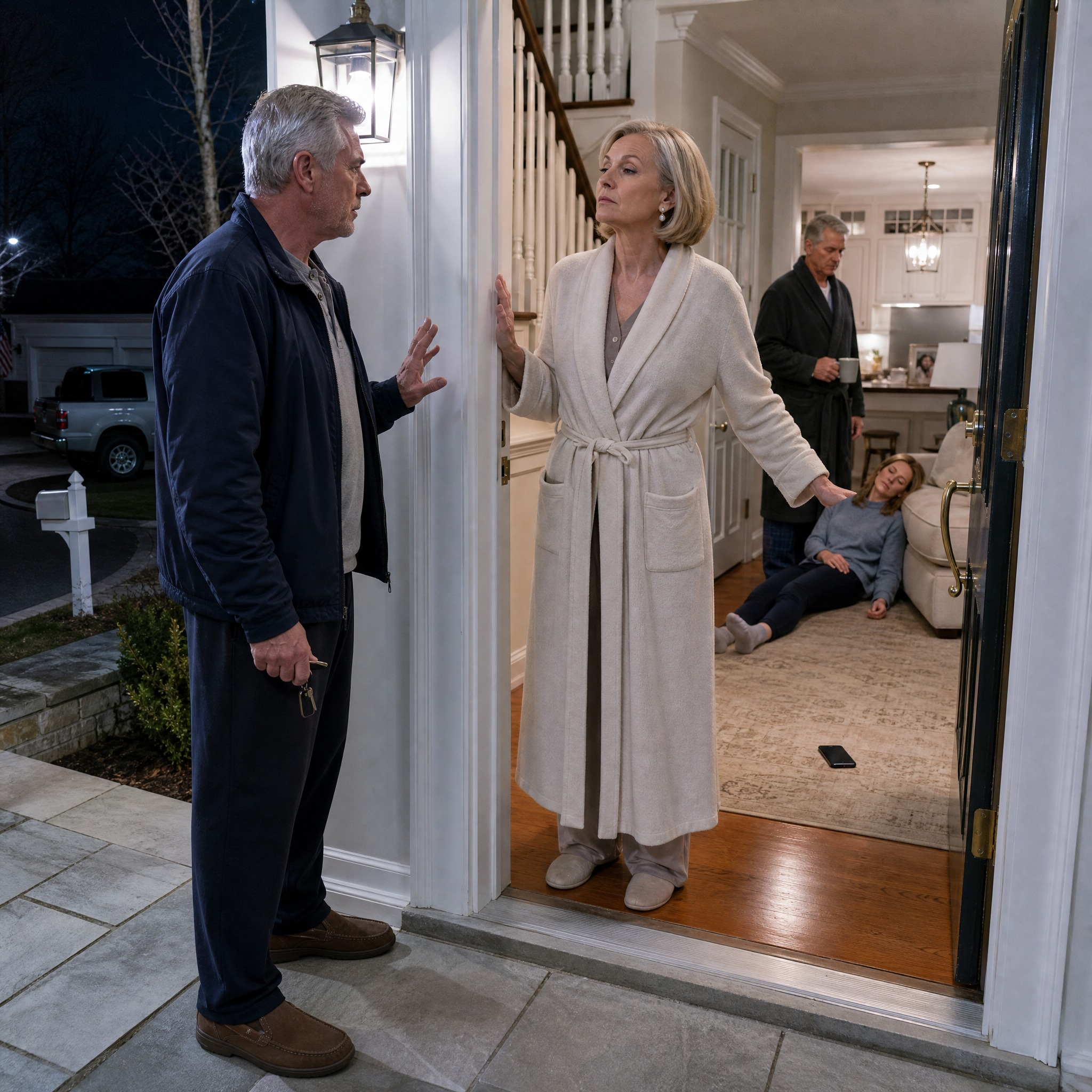
"Don't let them keep me here, Dad," my daughter whispered.
Then the phone went dead.
Fifteen minutes later, I stood outside the Lancaster house with my car keys in one hand and a phone showing her last call in the other.
There were four words in the text she had sent before calling.
Please don't call Jamie.
That was when I knew this wasn't a family disagreement.
My name is Eddie Lechman. I was sixty-five years old that November, and by then I'd learned that most disasters didn't announce themselves with screaming sirens or shattered glass.
Sometimes they began with a phone ringing in a quiet bedroom.
Sometimes they began with your only child whispering your name like she was afraid someone might hear.
And sometimes they began with a woman standing in a doorway, telling a father he wasn't allowed to see his daughter.
I had been asleep for maybe three hours when Debbie called.
The clock on my nightstand read 1:43 a.m.
I remember that number because I stared at it afterward, trying to understand how an ordinary Tuesday night had turned into something that would change our family forever.
"Dad?"
Her voice was barely audible.
"Debbie? Honey, what's wrong?"
I heard breathing.
Not hers, I thought.
Someone else's.
Then a faint scraping noise, like a chair moving across a wooden floor.
"Dad, please come get me."
I sat upright.
"Where are you?"
"At the house."
"Is Jamie there?"
She didn't answer.
"Debbie?"
"Please hurry."
Then the connection disappeared.
I called back immediately.
Straight to voicemail.
I tried again.
Nothing.
On the third attempt, I got out of bed.
My wife, Margaret, had been dead for eleven years, but I still kept the slippers she'd given me for Father's Day beside the bed.
They were old, brown, and worn nearly smooth at the heels.
I slipped them on without thinking.
I didn't change out of my sweatpants.
I grabbed a jacket from the hallway closet, took my keys from the kitchen counter, and walked out into the night.
There were things I could tolerate at sixty-five.
Pain in both knees.
The occasional forgotten name.
The silence that settled over a house after the person you loved most was gone.
But I couldn't tolerate hearing fear in my daughter's voice.
Not after everything we'd already survived.
Debbie had been twenty-two when Margaret died.
She'd been standing beside me in the hospital hallway when the doctor explained that the complications had become too severe.
I remember Debbie holding my hand.
I remember her telling me we would be okay.
She was trying to comfort me when she was the one who had just lost her mother.
That was Debbie.
Even as a little girl, she'd worried more about everyone else than herself.
When she was seven, she found an injured bird behind our garage and insisted we build it a shelter.
When she was twelve, she saved her allowance for three months to buy a birthday present for a classmate whose parents couldn't afford a party.
When she was seventeen, she stayed awake all night helping a friend prepare for a chemistry exam.
And when she married Jamie Lancaster, she believed she had found a man who appreciated that part of her.
I believed it, too.
That was my first mistake.
The drive from Leesburg to Ashburn usually took fifteen minutes.
That night, I made it in thirteen.
The roads were nearly empty.
Every red light felt personal.
I kept checking my phone, hoping Debbie would call again.
She didn't.
I tried Jamie twice.
Both calls went unanswered.
That frightened me almost as much as Debbie's whisper.
Jamie Lancaster was not the kind of man who ignored his phone.
He worked in commercial real estate and treated every incoming call as a potential opportunity.
I'd seen him interrupt Christmas dinner to answer a business associate.
I'd watched him step outside during Debbie's birthday because someone needed to discuss a property valuation.
But at two in the morning, when his wife's father was calling repeatedly, he apparently couldn't be reached.
I turned onto their street.
The Lancaster house sat near the end of a quiet cul-de-sac.
It was a beautiful place.
White columns.
Tall windows.
A broad driveway.
The kind of house people photographed for real-estate brochures.
Margaret would have called it unnecessarily large.
Debbie had once called it her dream home.
That night, it looked like a place holding its breath.
The porch light was on.
So were several lights downstairs.
I pulled into the driveway behind Phil Lancaster's SUV.
That surprised me.
Phil and Evelyn lived about twenty minutes away.
They had their own house, their own lives, and more than enough money to occupy themselves.
There was no reason for them to be visiting their son and daughter-in-law at two in the morning.
Unless something had happened.
I got out of the car.
My knees protested as I climbed the front steps.
Two replacements had given me back the ability to walk without constant pain, but they hadn't made me young again.
I rang the bell.
Before the second chime finished, the door opened.
Evelyn Lancaster stood there.
She wore a green silk robe, her hair pulled back neatly.
She didn't look surprised.
That was the first thing I noticed.
Not confused.
Not sleepy.
Not concerned that her daughter-in-law's father had appeared in the middle of the night.
She looked prepared.
"Eddie," she said.
"Where's Debbie?"
Evelyn glanced at my slippers.
A tiny movement.
Barely noticeable.
But I saw it.
"She's resting."
"She called me."
"Yes, well, she's had a difficult evening."
I stepped closer.
"I need to see her."
Evelyn didn't move.
"That isn't necessary."
I stared at her.
For a moment, I wondered whether I'd misunderstood.
"Excuse me?"
"Debbie is fine. She's emotional, and she needs to sleep."
"Then let me see her."
Evelyn folded her arms.
"She's not leaving."
There it was.
Not she can't come to the door.
Not the doctor says she needs rest.
Not even Jamie would prefer you come back tomorrow.
She's not leaving.
As though Debbie were a piece of furniture Evelyn had decided belonged in that house.
I felt something cold settle in my chest.
"Move, Evelyn."
Her expression hardened.
"Eddie, you're making this unnecessarily difficult."
"My daughter called me asking for help."
"She was confused."
"Move."
"We are handling a private family matter."
I almost laughed.
Private family matter.
I'd heard that phrase before.
Usually at Lancaster dinners, whenever someone asked a question that made Evelyn uncomfortable.
Where had Debbie gone for Thanksgiving?
Private family matter.
Why had Jamie taken over managing certain household accounts?
Private family matter.
Why did Debbie suddenly need permission to use money her mother had left her?
Private family matter.
I hadn't understood the pattern then.
Standing on that porch, I began to.
"Your family includes my daughter," I said. "And I'm going to see her."
Evelyn put one hand against the doorframe.
"You need to understand that there are consequences to interfering in a marriage."
I looked at her hand.
Then at her face.
"Are you threatening me?"
"I'm warning you not to make a situation worse."
I heard movement inside.
A man's voice.
"Who's at the door?"
Phil Lancaster appeared beyond the foyer, carrying a white coffee mug.
He wore a cardigan and pajama pants.
His expression was almost offensively casual.
"Eddie," he said. "Didn't expect you."
"Where's Debbie?"
Phil looked toward Evelyn.
It was quick.
But it was there.
A silent exchange.
The kind married couples develop after decades together.
Only this one didn't look affectionate.
It looked coordinated.
"She's had a rough night," Phil said.
"Then why didn't somebody call me?"
"There's no reason to get excited."
I looked past him.
The living room was visible through the wide archway beside the staircase.
A lamp glowed beside a cream-colored sofa.
There was a blanket draped over one armrest.
A phone lay on the rug.
And beside the sofa—
I stopped breathing.
Debbie.
My daughter was lying on the floor.
One arm was stretched toward the coffee table.
Her dark hair covered part of her face.
She wasn't moving.
For one impossible second, I couldn't make sense of what I was seeing.
My mind tried to rearrange the picture.
Maybe she was sleeping.
Maybe she'd fainted.
Maybe there was some explanation that would make everything normal again.
Then I saw the marks on her arm.
Dark bruises.
Several of them.
My body moved before I had time to think.
I stepped past Evelyn.
She caught my sleeve.
"Eddie, wait."
I pulled free.
"Debbie!"
Phil moved slightly into my path.
"Now, let's not—"
"Get out of my way."
Something in my voice made him stop.
I crossed the foyer as quickly as my knees allowed.
Every step felt too slow.
When I reached Debbie, I lowered myself onto the rug.
My knees screamed.
I barely noticed.
"Baby?"
I touched her cheek.
Her skin was cool.
"Debbie, it's Dad."
Nothing.
I pressed two fingers against her neck.
I couldn't find anything at first.
My hands were shaking too badly.
I moved my fingers.
Waited.
And then—
There.
A pulse.
Weak enough to terrify me.
Strong enough to keep my world from ending.
I closed my eyes for half a second.
"Thank God."
Behind me, Evelyn was talking.
"She had some wine earlier, and she became upset. We tried to calm her down."
I turned.
"What happened to her?"
"She fell."
"From where?"
"The stairs."
I looked toward the staircase.
Then back at Debbie.
"How long has she been lying here?"
Evelyn hesitated.
"Not long."
"How long?"
Phil set his mug on a nearby table.
"Eddie, she's breathing. We were monitoring her."
I stared at him.
"Monitoring her?"
He said nothing.
"My daughter is unconscious on your floor, and you're drinking coffee?"
Phil's face tightened.
"There's no need to be insulting."
I looked down at Debbie.
Her sweatshirt sleeve had ridden up.
There were bruises along her forearm.
One looked like the outline of fingers.
I had worked with my hands for most of my life.
I knew what accidental bruises looked like.
I also knew what it looked like when someone grabbed another person too hard.
"Where's Jamie?"
Silence.
I turned toward Evelyn.
"Where is your son?"
"He's not here right now."
"Where did he go?"
"That isn't relevant."
I couldn't believe what I was hearing.
"His wife is unconscious. How is that not relevant?"
Evelyn stepped closer.
"You're upset. I understand. But Debbie has been struggling emotionally, and we have been doing everything possible to help her."
I looked at my daughter.
Then at Evelyn.
"Did you call an ambulance?"
"No."
"Did you call a doctor?"
"That wasn't necessary."
"Did you even check whether she had a concussion?"
Phil shifted his weight.
"We were going to reassess in the morning."
I felt something inside me go very still.
For years, I'd thought anger meant shouting.
I'd thought it meant pounding a fist on a table or saying things you'd regret later.
But real anger, I discovered that night, could be quiet.
It could make the world narrow until only one thing mattered.
Getting my daughter out.
I took out my phone and called 911.
I gave the dispatcher the address, described Debbie's condition, and asked for medical assistance.
Evelyn began protesting immediately.
"That is completely unnecessary."
I ignored her.
The dispatcher asked whether Debbie was breathing.
"Yes."
Was she conscious?
"No."
Had she suffered a head injury?
"I don't know."
I looked at the bruises.
"But something happened to her."
The dispatcher told me help was on the way and instructed me not to move Debbie unless she was in immediate danger.
I stayed beside her, monitoring her breathing.
For the first time since I'd entered the house, Evelyn seemed uncertain.
"Eddie," she said quietly, "you have no idea what you're starting."
I looked up.
"No," I said. "I don't."
She studied my face.
"But I know what I'm stopping."
The paramedics arrived minutes later.
Two of them entered with equipment while a police officer followed.
Evelyn immediately began explaining.
Too much wine.
Anxiety.
A fall.
Debbie had been under stress.
She'd been confused.
She was prone to panic attacks.
Every sentence sounded like something she'd rehearsed.
One paramedic examined Debbie while the other asked me questions.
I told him exactly what I knew.
My daughter had called asking me to come get her.
The call had disconnected.
When I arrived, her in-laws refused to let me see her.
Then I'd found her unconscious.
I didn't add theories.
I didn't accuse anyone.
I simply told the truth.
The police officer wrote everything down.
Phil stood near the kitchen, arms folded.
Evelyn remained beside the staircase.
Neither of them asked whether Debbie would be okay.
That detail stayed with me.
When the paramedics lifted Debbie onto the stretcher, I noticed her phone still lying on the rug.
The screen was cracked.
I pointed it out to the officer.
"That's hers."
He photographed where it lay, then allowed me to collect it for her.
As I picked it up, the screen briefly illuminated.
There was a notification.
A message from Jamie.
Only part of it appeared.
You need to remember what we agreed—
The screen went dark.
I stared at the phone.
Then slipped it into my jacket pocket.
Outside, the ambulance lights flashed across the driveway.
I followed the stretcher down the steps.
My knees hurt.
My hands were cold.
I was frightened in a way I hadn't been since Margaret's final night in the hospital.
But Debbie was alive.
That was enough to keep me moving.
At the ambulance, one of the paramedics told me they would take her to the emergency department.
I asked whether I could ride along.
He said there was room.
I climbed inside.
Debbie lay strapped securely to the stretcher.
An oxygen monitor glowed beside her.
I sat close enough to see her face.
"You're not alone, baby," I whispered.
The paramedic checked her blood pressure.
I watched the numbers appear.
I didn't understand all of them.
I understood his expression.
He was concerned.
The ambulance began moving.
I reached for Debbie's hand.
It was the same hand I'd held when she was four and afraid of crossing a busy street.
The same hand that had clutched mine at Margaret's funeral.
The same hand I'd placed in Jamie Lancaster's on her wedding day.
That memory nearly broke me.
I remembered Jamie standing at the altar.
Perfect suit.
Perfect smile.
Perfect promises.
He'd looked me in the eye afterward and said, "I'll always take care of her, Eddie."
I'd believed him.
I'd even thanked him.
Now my daughter lay unconscious beside me, and I had no idea what her husband had done.
Or what his parents were trying to hide.
At the hospital, the staff moved quickly.
A nurse took Debbie's information.
A doctor examined her.
They ordered tests.
I sat in a plastic chair outside the treatment room with my hands clasped between my knees.
I wanted to call Margaret.
The thought came so suddenly that I almost reached for my phone.
Eleven years.
And there were still moments when my mind forgot she was gone.
I pictured what she would have said.
Stay with our girl, Eddie.
So I stayed.
The doctor eventually came out.
He told me Debbie was stable.
She had a mild concussion, dehydration, and low blood pressure.
They were continuing to monitor her.
I asked about the bruises.
He paused.
"Some injuries may be consistent with a fall," he said carefully. "Others require more context."
"Do you think someone hurt her?"
"I can't determine that from the examination alone."
I nodded.
He explained that when Debbie was alert enough, the staff would speak with her privately and discuss options for documenting her injuries.
I thanked him.
Then I sat down again.
It was almost dawn when they let me into her room.
Debbie was sleeping.
Her face looked younger than thirty-three.
For a moment, I could see the little girl who used to fall asleep on the couch while waiting for me to finish work.
I pulled a chair beside her bed.
Her phone was in my pocket.
I took it out.
The screen was badly cracked, but it still worked.
I didn't know her passcode.
I didn't try to guess.
Instead, I placed it on the bedside table.
Then I noticed something.
A small piece of folded paper had been tucked inside the back of her phone case.
The case had separated slightly from the impact.
I hadn't seen it before.
I carefully pulled the paper free.
It was a receipt from a printing service in Ashburn.
There was a date from three weeks earlier.
A transaction number.
And a handwritten note in Debbie's unmistakable handwriting.
Original trust documents. Do not let Jamie know.
I stared at those words.
Trust documents?
Margaret had established a family trust before she died.
It held the real-estate assets we'd spent decades building.
Debbie was its primary beneficiary.
I'd never been particularly interested in the paperwork.
Margaret had been the organized one.
After her death, attorneys handled the administration, and I trusted that everything was being managed properly.
Two years earlier, Phil Lancaster had offered to help simplify some of the financial arrangements.
He had an office full of accountants and legal contacts.
Jamie worked in real estate.
It had seemed practical.
I remembered signing a few acknowledgments.
Debbie had signed documents, too.
At the time, I hadn't thought twice about it.
Now I looked at the receipt in my hand.
Original trust documents.
Why would Debbie secretly print copies?
Why would she hide the receipt?
And why was she afraid of Jamie finding out?
I folded the paper carefully.
Then placed it in my wallet.
A nurse came in to check Debbie's vitals.
I moved aside.
As she adjusted the monitor, Debbie stirred.
Her eyes opened briefly.
"Dad?"
I leaned forward.
"I'm here, sweetheart."
She looked frightened.
Not confused.
Frightened.
"Did you go to the house?"
"Yes."
Her breathing changed.
"Did you talk to Jamie?"
"No. He wasn't there."
She swallowed.
"Don't."
"Don't what?"
"Don't confront him."
I touched her hand.
"Debbie, honey, you need to tell me what's happening."
Her eyes filled with tears.
She looked toward the doorway.
Then back at me.
"Did they take my phone?"
"No. I have it."
Her grip tightened.
"Don't give it to anyone."
"I won't."
She tried to sit up, but the movement made her wince.
"Easy," I said. "You're safe."
She shook her head.
It was a small movement.
But it carried more fear than anything I'd heard that night.
"No, Dad."
I leaned closer.
"What do you mean?"
Her voice dropped to a whisper.
"Jamie doesn't know what I found."
I felt my chest tighten.
"What did you find?"
She looked toward the closed hospital door.
Then she reached for my hand.
"Promise me you won't call Phil's office."
"I promise."
"And don't call a lawyer yet."
"Debbie—"
"Please."
I nodded.
"Okay."
She closed her eyes for a moment.
When she opened them again, there was something different in her expression.
Not just fear.
Determination.
"There's a folder on my phone," she whispered. "Bank statements. Messages. Copies of documents."
I glanced at the cracked screen.
"What documents?"
Her lips trembled.
"Mom's trust."
I stared at her.
"What about it?"
She looked directly into my eyes.
Then she said the words that would keep me awake for the next several nights.
"Dad, I think Jamie's been stealing from us."
Before I could answer, someone knocked on the hospital-room door.
A nurse stepped inside.
"Mr. Lechman?"
"Yes?"
"There's a gentleman at the front desk asking for your daughter."
My stomach tightened.
"Who?"
The nurse hesitated.
"He says he's her husband."
Debbie's hand clamped around mine.
Her eyes widened.
And from the hallway, a familiar male voice said—
"Eddie? I know you're in there."






Comments 0