The name at the bottom of the photograph was mine.
Edward Lechman.
For a moment, I couldn't breathe.
I enlarged the image until the letters blurred against the cracked screen of Debbie's phone.
There was my signature.
Not something resembling it.
Not a misspelled name or a hurried imitation.
It was the signature I'd been using for more than forty years.
And according to the date beside it, I had signed a document authorizing changes to Margaret's trust on a day when I was attending her brother's memorial service in Richmond.
"Dad?" Debbie whispered.
I didn't answer.
She leaned closer.
"Is that really your signature?"
I looked at the screen again.
Then at the old trust documents spread across our kitchen table.
"I didn't sign that."
"Are you absolutely sure?"
I turned toward her.
"Debbie, I buried your Uncle Harold that day. I drove to Richmond before sunrise. I didn't get home until almost midnight."
She stared at the photograph.
"Then somebody forged it."
I wanted to disagree.
I wanted to tell her there had to be a reasonable explanation.
Maybe the date was wrong.
Maybe someone had attached the wrong page.
Maybe an office assistant had made a mistake.
But those explanations were becoming harder to believe.
Margaret's signature appeared on a document dated after her death.
My signature appeared on a document I had never seen.
And Jamie Lancaster had somehow gained authority over the assets my wife had spent her life protecting.
I looked at the message from Karen Whitmore.
Before you trust anyone, you need to know who signed the amendment.
I read it twice.
Then I reached for my phone.
Debbie caught my wrist.
"Don't call her."
"Why not?"
"Because we don't know who's using that number."
I looked at my daughter.
She was right.
The old Eddie Lechman would have called immediately.
He would have demanded answers, raised his voice, and probably driven straight to Phil Lancaster's office before lunchtime.
But the old Eddie Lechman had also trusted Jamie.
He'd trusted Phil.
He'd believed Evelyn when she smiled across the dinner table and called Debbie the daughter she'd always wanted.
That man had made enough mistakes.
I put my phone down.
"All right," I said. "We do this carefully."
Debbie nodded.
Then she pointed to the photograph.
"Look at the corner."
I enlarged the image again.
At the lower right edge of the document was a small handwritten notation.
Three letters.
One number.
EL-4.
I frowned.
"What does that mean?"
"I don't know."
I stared at it.
The notation looked familiar.
Not because I'd seen it on legal documents.
Because Margaret used to label things that way.
She'd put initials and numbers on folders when she wanted to keep related papers together.
But this document had supposedly been prepared by Phil's office.
Why would it carry a notation resembling Margaret's filing system?
I looked toward the staircase.
Her old office was upstairs.
The fireproof box was still open on the desk.
And suddenly, I had the uncomfortable feeling that we'd only begun to understand what my wife had left behind.
Karen sent another message at 12:17.
I understand why you may not trust me. I wouldn't trust anyone connected to Phil's office either.
I showed Debbie.
She read it without speaking.
Another message followed.
I have worked for Phil Lancaster for nineteen years. I know what was submitted to the bank, and I know what was kept out of the official file.
I felt my stomach tighten.
Debbie took the phone.
"Can I answer?"
"Go ahead."
She typed slowly.
How do we know you're really Karen Whitmore?
The response came almost immediately.
Your mother used to bring lemon cookies to Phil's office every December. She always wrapped them in blue tissue paper. Eddie called them her peace offerings.
I stared at the screen.
Margaret had done exactly that.
But the detail wasn't enough to prove Karen's identity.
Phil knew about those cookies.
So did Evelyn.
Several people who worked at the office probably remembered them.
Debbie understood that, too.
She typed another question.
Why are you contacting us now?
This time, Karen didn't answer immediately.
Five minutes passed.
Then ten.
I got up and poured coffee neither of us wanted.
When the phone finally vibrated, Debbie nearly dropped it.
Because I saw what happened to Debbie, and I can no longer pretend the paperwork is harmless.
I read the message.
My jaw tightened.
"What does she mean, she saw what happened?"
Debbie shook her head.
"I don't know."
I wanted to ask whether Karen had been at the Lancaster house that night.
But Debbie was already typing.
What exactly did you see?
The reply came after another long pause.
Not in writing. Please.
Then an address appeared.
A small public library in Sterling.
Tomorrow.
Ten in the morning.
Come without Jamie or Phil. Bring a copy of Margaret's original trust provisions. Do not bring the originals.
I looked at Debbie.
"We should talk to someone before meeting her."
"An attorney?"
I nodded.
She hesitated.
"Dad, I told you not to call a lawyer yet."
"I remember."
"Then why—"
"Because we have documents with signatures neither of us recognizes, money missing from your trust, and a woman claiming she knows what happened."
I took a breath.
"We don't need to accuse anybody. But we do need someone who understands what we're looking at."
Debbie looked down.
For a moment, I thought she would argue.
Instead, she whispered, "I'm scared."
I reached across the table.
"I know."
"What if Jamie finds out?"
"Then we handle that when it happens."
She shook her head.
"You don't understand how he gets."
I held her hand.
"Then tell me."
She looked toward the kitchen window.
"He's not always angry. That's the part nobody understands."
I waited.
"Sometimes he's wonderful. He makes breakfast. He remembers things I mention once. He tells me I'm the only person who really knows him."
Her voice trembled.
"Then something happens. I ask about money. I disagree with his mother. I want to visit you without him."
She swallowed.
"And suddenly I'm selfish. Ungrateful. Unstable."
I felt my chest tighten.
"He says he only gets upset because he loves me so much."
I didn't interrupt.
"He says marriage means trusting each other completely. But somehow, that always means I have to trust him. He never has to trust me."
She wiped her cheek.
"And when I finally get angry, he acts like my reaction proves everything he said about me."
I looked at the fading bruises on her arms.
"Has he grabbed you before?"
She hesitated.
"Yes."
The word was so quiet I almost missed it.
"How many times?"
"I don't know."
"Debbie."
She looked at me.
"Enough that I started paying attention to where I stood when we argued."
I closed my eyes.
There are sentences a father never expects to hear.
That was one of them.
When I opened my eyes, Debbie was watching me carefully.
As though she expected me to explode.
I didn't.
I squeezed her hand.
"You don't have to explain any more right now."
Her shoulders relaxed.
"Thank you."
I looked at the documents.
Then at my daughter.
"We'll get help. And we'll make sure you're the one deciding what happens next."
That afternoon, I called an attorney named Susan Keller.
I hadn't spoken to Susan in almost eight years.
She'd handled a property dispute for me after a tenant damaged one of our rental houses.
She was practical, direct, and unimpressed by expensive suits.
Margaret had liked her.
That was enough for me.
Susan answered on the fourth ring.
"Eddie Lechman?"
"Hello, Susan."
"Well, that's a name I haven't heard in a while. Everything all right?"
I looked at Debbie.
"No."
Susan's tone changed.
"What happened?"
I explained that Debbie had questions about her mother's trust and that we had found documents containing signatures we didn't recognize.
I didn't tell her every detail.
Not over the phone.
But I told her enough.
Susan listened.
Then she said, "Don't confront anyone involved in preparing those documents."
I looked at Debbie.
She raised her eyebrows.
"I've been hearing that a lot lately," I said.
"Then listen."
Susan asked whether we had the original trust instrument.
"We have copies of the original provisions."
"Good. Preserve them exactly as they are."
"What about the newer documents?"
"Keep every copy. Don't mark them. Don't alter the electronic files."
I wrote everything down.
"Can you represent us?"
"My practice doesn't handle complex trust litigation anymore," she said. "But I can help you find someone who does."
She paused.
"And Eddie?"
"Yes?"
"If you believe signatures were forged, you need independent legal advice before you speak to the people who may have benefited."
I stared at the notebook.
"Understood."
"One more thing. Is Debbie safe?"
I looked toward my daughter.
"She's staying with me."
"Does her husband have access to the house?"
"He has visited before."
"Then consider changing the locks and reviewing your security. If she's afraid of him, take that seriously."
I nodded.
"I will."
After the call, Debbie looked at me.
"What did she say?"
"That your mother was right about lawyers."
Debbie almost smiled.
"What does that mean?"
"That they're expensive because they know how to keep fools like me from making things worse."
She laughed.
A small laugh.
But real.
I hadn't realized how much I'd missed hearing it.
The next morning, we drove to Sterling.
Debbie insisted on coming.
I wasn't sure it was a good idea.
Her concussion symptoms had improved, but she still tired easily.
She'd also been sleeping poorly.
Every time a car slowed outside our house, she looked toward the window.
Every time her phone vibrated, her shoulders tightened.
But she was determined.
"These are my records," she said. "And it's my life."
I couldn't argue with that.
We parked near the library shortly before ten.
I had chosen a space close to the entrance.
My knees were stiff from the drive.
Debbie carried a thin folder containing copies of the original trust provisions.
We had left the originals locked away at home.
Before getting out, she looked at me.
"Dad?"
"Yeah?"
"If Karen says something terrible about Jamie, I need you to let me hear it."
I turned toward her.
"What do you mean?"
"Don't interrupt. Don't get angry. Don't try to protect me from knowing."
I studied her face.
She looked frightened.
But there was determination beneath it.
"All right," I said.
She nodded.
We entered the library.
Karen Whitmore was waiting at a table near the back.
I recognized her immediately.
She was in her late fifties, with short brown hair and reading glasses hanging from a chain around her neck.
She wore a plain gray cardigan.
There was a canvas bag beside her chair.
When she saw us, she stood.
"Eddie."
"Karen."
She looked at Debbie.
"I'm sorry about what happened."
Debbie didn't answer.
Karen's eyes filled with tears.
"I should have spoken sooner."
I pulled out a chair.
"Then speak now."
Karen sat down.
For several seconds, she looked at the folder in Debbie's hands.
Then she reached into her bag and removed a thick envelope.
"I need you to understand something first," she said.
"I worked for Phil Lancaster for nineteen years. I handled scheduling, correspondence, document preparation, and filing."
She looked at me.
"I trusted him."
I said nothing.
"I believed he was a good man."
Her hands trembled.
"Then I started noticing things that didn't make sense."
Debbie leaned forward.
"What things?"
Karen opened the envelope.
She removed several photocopied pages.
"At first, it was small discrepancies. Dates that changed between drafts. Signature pages appearing after documents had already been finalized."
She placed one page on the table.
"Then Phil began asking me to prepare replacement pages without keeping the earlier versions in the active file."
I stared at the document.
"Replacement pages?"
"Yes."
"Why?"
"He said clients frequently made mistakes and that we were correcting administrative errors."
Debbie looked at her.
"Did you believe him?"
"For a while."
Karen swallowed.
"Then I saw your mother's name."
The air seemed to leave the room.
I leaned forward.
"What about Margaret?"
Karen looked at me.
"Her signature appeared on a certification dated after her death."
"I know."
She nodded.
"I thought it was a clerical mistake."
"What did Phil say?"
"He told me the document had been executed earlier and the date referred to a later administrative action."
I stared at her.
"Was that true?"
"I don't know."
She took another page from the envelope.
"But I found something else."
She slid it toward us.
It was a copy of an internal office memorandum.
At the top was Phil's name.
Below it was a reference to the Lancaster trust amendment.
Karen pointed to a line near the bottom.
Signature page to be supplied separately.
Debbie frowned.
"What does that mean?"
"It means the document was prepared before the signature page was attached."
"Is that unusual?" I asked.
"Not necessarily. Drafts can be assembled that way."
Karen paused.
"But this one was marked complete before the signature page appeared in our records."
I looked at the date.
It was three days before the supposed signing.
"Who attached the signature page?"
Karen hesitated.
"That's what I couldn't determine."
I stared at her.
"You worked there. Surely somebody knew."
She shook her head.
"Phil handled it personally."
Debbie leaned closer.
"And Jamie?"
Karen looked at her.
"Jamie visited the office several times during that period."
My daughter's face tightened.
"Did he know what was happening?"
"I can't tell you what he knew."
Karen folded her hands.
"But I can tell you what I saw."
She removed another document.
It was an email.
From Jamie.
To Phil.
The subject line read:
Authorization Problem.
The message contained only two sentences.
Debbie is asking too many questions. We need this finished before she requests another statement.
I felt my hands go cold.
Debbie stared at the page.
"That's his email address."
Karen nodded.
"I know."
My daughter didn't cry.
She didn't speak.
She simply sat very still.
I wanted to reach for her.
Instead, I remembered what she'd asked me in the car.
Let me hear it.
So I waited.
Karen continued.
"After that email, Phil instructed me to stop sending certain statements directly to Debbie."
Debbie looked up.
"What?"
"He said Jamie would handle all communications."
"Did you question that?"
"Yes."
"What did he say?"
Karen's voice dropped.
"He said you were having emotional difficulties and that Jamie was trying to protect you."
Debbie closed her eyes.
I felt anger rising in my chest.
Not loud anger.
The kind that made my hands feel heavy.
Karen looked ashamed.
"I believed him."
Debbie opened her eyes.
"For how long?"
Karen hesitated.
"Too long."
We sat there for almost an hour.
Karen showed us copies of correspondence, internal notes, and document logs.
She explained which records she had personally handled and which ones she'd only seen later.
She was careful not to claim more than she knew.
That made her account more frightening.
Because she wasn't telling us a dramatic story.
She was describing ordinary office procedures.
Dates.
Files.
Signatures.
Instructions.
And somewhere inside those ordinary procedures, someone appeared to have changed the financial future Margaret had intended for our daughter.
I asked Karen about the handwritten notation on the photograph.
EL-4.
She looked at it.
Then frowned.
"That's not Margaret's filing system."
I stared at her.
"How do you know?"
"Because Phil's office used those codes for internal document batches."
"What does EL mean?"
"Edward Lechman."
My stomach tightened.
"And the four?"
"Fourth version."
I looked at Debbie.
She looked back at me.
"Fourth version of what?" I asked.
Karen hesitated.
"The signature page."
I stared at her.
"You're telling me there were four versions of a document bearing my name?"
"At least four."
I felt my pulse pounding.
"Where are the others?"
Karen looked down at her bag.
"I have copies of two."
She removed another envelope.
Inside were two pages.
Both contained my name.
Both carried signatures.
But they weren't identical.
One had a longer final stroke.
The other had a slightly different capital E.
I stared at them.
Someone had been practicing.
That was the only explanation I could think of.
I looked at Karen.
"Who prepared these?"
"I don't know."
"Who printed them?"
"The office printer records show they came from Phil's workstation."
I felt my jaw tighten.
"Does that prove he signed them?"
"No."
Karen's answer was immediate.
"It proves only that the documents were printed from his workstation. I don't want you making accusations you can't support."
I looked at her.
"Then why bring them?"
"Because someone needs to investigate."
She glanced at Debbie.
"And because your daughter deserves to know what was done in her name."
Debbie looked at the pages.
Then she asked a question I hadn't considered.
"Did Jamie ever ask you to copy my signature?"
Karen went still.
I watched her face.
She didn't answer immediately.
"Karen?" Debbie whispered.
Karen looked toward the library windows.
Then back at us.
"Once."
Debbie's expression changed.
"When?"
"About two years ago."
"What did he say?"
"He told me you were traveling and needed some routine paperwork completed."
My daughter stared at her.
"Where did he get my signature?"
Karen swallowed.
"He brought in a signed acknowledgment page."
I remembered Debbie telling me she'd signed routine tax documents.
I felt sick.
Karen continued.
"He asked whether we could use it as a reference for preparing the final paperwork."
Debbie whispered, "And did you?"
"No. I told him signatures had to be obtained properly."
I leaned forward.
"What happened then?"
"Phil came into the room."
Karen looked at me.
"He told Jamie he'd handle it."
Silence settled over the table.
I could hear someone turning pages nearby.
A printer hummed behind the circulation desk.
The world continued as though nothing extraordinary had happened.
But I was looking at two versions of my signature and listening to a woman describe how my daughter's signature might have been copied.
I thought of Margaret.
Of her yellow legal pads.
Of the way she'd planned everything carefully because she wanted Debbie protected.
And I wondered how many years of work could be undone by a few sheets of paper.
Before we left, Karen handed me the envelope from the photograph.
For Eddie Only.
I recognized Margaret's handwriting.
My throat tightened.
"Where did you get this?"
Karen looked uncomfortable.
"It was in an old file Phil asked me to archive."
"Why would Margaret have left something at his office?"
"I don't know."
I stared at her.
"Did you open it?"
"No."
"How long have you had it?"
"Three weeks."
I looked at the envelope.
The paper was yellowed.
The edges were worn.
It had clearly been handled many times.
Karen leaned closer.
"Eddie, I need to tell you something."
I looked up.
"Phil knows I copied some of the records."
My stomach tightened.
"How?"
"He asked me about missing pages yesterday."
"What did you say?"
"That I was reviewing old files."
"Did he believe you?"
She gave a sad smile.
"I don't think so."
Debbie looked frightened.
"Are you in danger?"
Karen hesitated.
"I don't know."
I reached for my phone.
"We should document this meeting."
Karen nodded.
"I've already written down what I remember. And I've spoken to someone about preserving the records."
"Who?"
"An attorney."
I felt relieved.
"Good."
She looked at Debbie.
"Please be careful."
My daughter nodded.
Karen stood.
Then she paused.
"One more thing."
I looked at her.
"Jamie wasn't the only person who asked about your mother's trust."
"Who else?"
Karen's expression changed.
"Evelyn."
I stared at her.
"Why?"
"She wanted to know whether Debbie could challenge the amendment."
My daughter went pale.
"When?"
Karen swallowed.
"Three days before you were taken to the hospital."
I felt the room tilt slightly.
Three days.
Evelyn had been asking whether Debbie could challenge the paperwork.
Then Debbie had confronted Jamie.
Then she'd ended up unconscious.
I looked at Karen.
"What did you tell her?"
"That I wasn't qualified to answer."
"And what did she say?"
Karen looked down.
"She said Phil had better make sure the problem was handled."
I didn't speak.
I couldn't.
Because suddenly Evelyn standing in that doorway at two in the morning looked very different.
She hadn't simply been protecting her son.
She'd been protecting something else.
Something that might have begun long before Debbie called me.
We drove home in silence.
Debbie held the envelope in her lap.
I kept both hands on the steering wheel.
At a red light, she looked at me.
"Dad?"
"Yeah?"
"Do you think Mom knew something like this could happen?"
I thought about Margaret's letter.
About her warning that no future husband should control Debbie's inheritance.
"I think your mother understood people better than I did."
Debbie looked down.
"She always said money changes people."
I shook my head.
"No."
She looked at me.
"Money doesn't always change people."
I paused.
"Sometimes it shows you who they already were."
We reached the house shortly after noon.
I checked the driveway before parking.
No unfamiliar cars.
No one waiting on the porch.
Inside, I locked the door.
Debbie carried the documents into the kitchen.
I made tea.
Then we sat at the table.
The envelope lay between us.
For Eddie Only.
I stared at those words.
Margaret had written them.
My wife.
The woman who had trusted me with her life.
The woman who had planned for our daughter's future even while she was dying.
I carefully opened the envelope.
Inside was a folded letter and a small brass key.
I recognized the key immediately.
It belonged to the old storage cabinet Margaret kept in her office.
I'd forgotten about it because the cabinet had been locked for years.
I unfolded the letter.
Eddie,
If this reaches you, there is something important you need to know about the trust.
My heart began pounding.
I read on.
I have always believed that protecting Debbie means making sure no one can take away her ability to make her own decisions.
There are documents that explain why I structured the trust the way I did.
Some of those documents are not in the attorney's file.
I looked up.
Debbie was watching me.
"What does it say?"
I swallowed.
"Your mother kept additional records."
"Where?"
I looked at the brass key.
"In the cabinet."
We went upstairs.
Margaret's office smelled faintly of old paper and furniture polish.
The cabinet stood against the far wall.
Dark wood.
Two drawers.
A narrow locked compartment beneath them.
I knelt carefully.
My knees protested.
Debbie crouched beside me.
I inserted the key.
It turned.
The compartment opened.
Inside was a metal document box.
I lifted it onto the desk.
There were several folders inside.
Property records.
Correspondence.
Copies of legal documents.
And one thick folder labeled:
Trust Administration—Private.
Debbie reached for it.
I stopped her gently.
"Let me."
I opened the folder.
The first pages were copies of correspondence between Margaret and Robert Ellis.
The attorney named in the original trust provisions.
I recognized his signature.
There were notes about successor trustees, conflicts of interest, and restrictions on borrowing against trust property.
Then I found a letter dated shortly before Margaret's death.
It was addressed to Robert Ellis.
The subject line read:
Concerns Regarding Future Trustee Appointments.
I began reading.
Margaret had written that she wanted any future changes reviewed independently.
She specifically warned against allowing a beneficiary's spouse or the spouse's relatives to gain control over trust assets without proper safeguards.
I stared at the page.
Debbie leaned closer.
"She really thought of everything."
I nodded.
But something bothered me.
At the bottom of the letter was a handwritten note.
Robert—please retain the original signed instructions. Do not release them without verification.
I read it twice.
Then I turned the page.
There was a copy of a receipt.
It showed that the letter had been delivered.
Signed for.
Accepted.
But not by Robert Ellis.
The recipient's name was partially obscured by a dark photocopy mark.
I held the page closer to the lamp.
The first name was visible.
Phil.
I felt my stomach tighten.
"Debbie."
She looked up.
"What?"
"Phil received this."
She stared at the receipt.
"Before Mom died?"
"Yes."
We looked at each other.
The implication was terrible.
Phil had known about Margaret's restrictions.
He had known she wanted independent oversight.
And years later, his office had prepared documents that appeared to give his son control over the very assets Margaret had tried to protect.
Debbie sat down.
Her face had gone pale.
"He knew."
I didn't answer.
"He knew what Mom wanted."
I looked at the receipt.
Then at the letter.
"Yes."
She covered her mouth.
For a moment, I thought she might cry.
Instead, she looked angry.
Not frightened.
Not ashamed.
Angry.
It was the first time I'd seen that expression on her face since the hospital.
"Dad, I want every record."
I nodded.
"Every one."
"I want to know who signed those papers."
"We'll find out."
"And I want to know where the money went."
I looked at her.
"So do I."
She stood.
Then her phone rang.
Jamie.
She stared at the screen.
I waited.
She let it ring.
A message appeared.
I know you met with Karen.
Debbie's face drained of color.
Another message arrived.
You need to stop before this gets worse.
I looked at the phone.
Then toward the office window.
A dark SUV was parked across the street.
I hadn't noticed it when we came home.
Its engine was running.
The windows were tinted.
I moved closer to the curtain.
The SUV remained motionless.
Then my own phone vibrated.
An unknown number.
A photograph appeared.
It showed Debbie and me entering the library that morning.
Taken from across the parking lot.
Beneath it was a message.
You should have listened when Evelyn told you not to interfere.
I stared at the screen.
Debbie stepped beside me.
"Dad?"
I didn't answer.
The SUV's headlights switched on.
Then another message arrived.
This one contained a photograph of Margaret's old office.
Our office.
The room we were standing in.
The photograph had been taken from inside the house.
And beneath it were six words.
Check what is missing from the box.
I turned toward the open cabinet.
The metal document box sat on Margaret's desk.
Its folders were spread across the surface.
I looked at the empty space beneath them.
There was a rectangular impression in the dust.
Something had been stored there for years.
Something larger than a folder.
Something someone had recently removed.
Debbie leaned closer.
"What was there?"
I stared at the mark.
Then I remembered Margaret's old leather ledger.
The one she'd used to record every property transaction by hand.
I hadn't seen it since her funeral.
My stomach tightened.
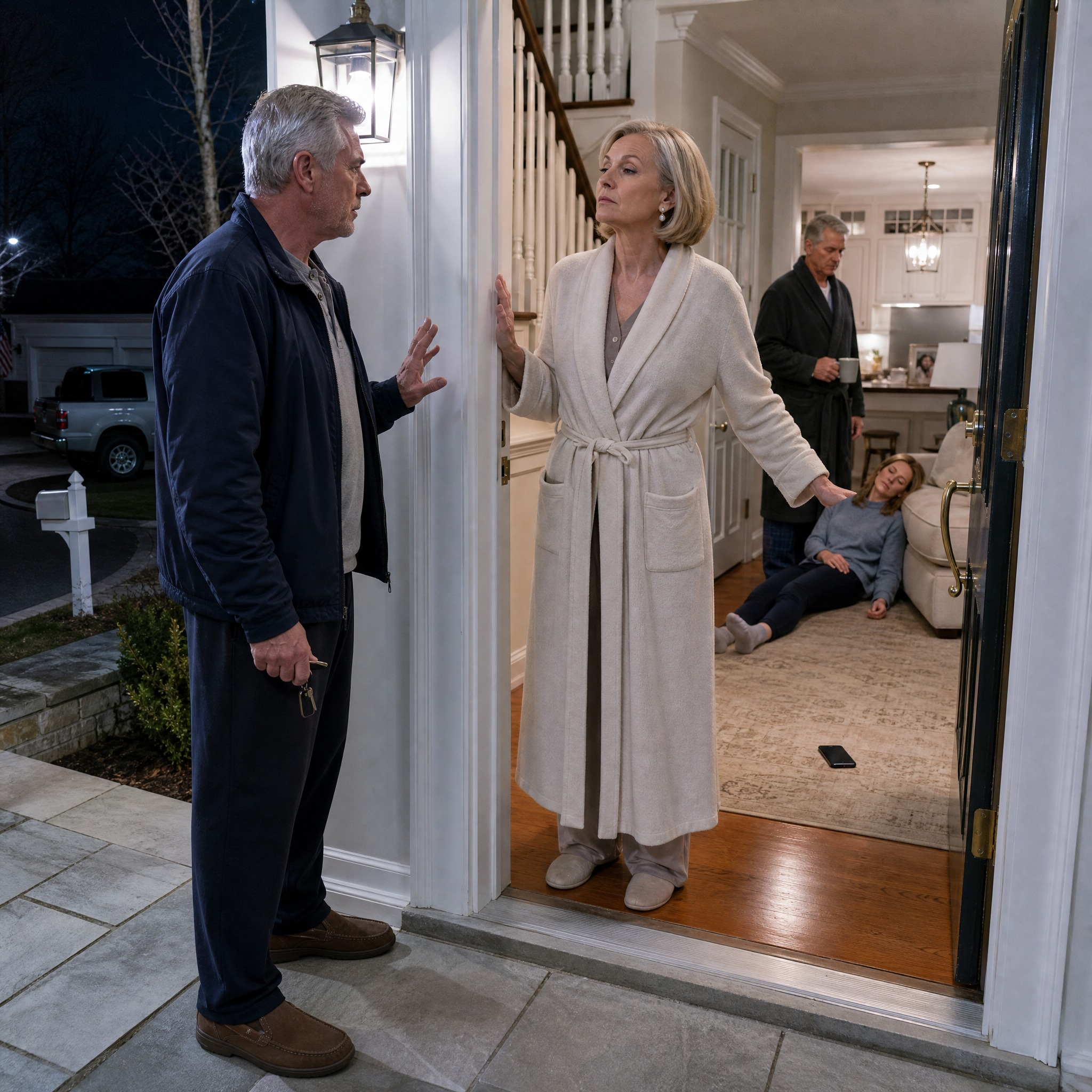
"Debbie," I whispered, "your mother's ledger is gone."
Before she could answer, the downstairs doorbell rang.
Once.
Then twice.
I looked toward the hallway.
A man's voice called from the front porch.
"Mr. Lechman? My name is Robert Ellis."
I froze.
The voice continued.
"I need to speak with you about Margaret's trust."
Then he said something that made my blood run cold.
"Whatever you do, don't open the door until I tell you who is standing behind me."






Comments 0