At 8:47 on Monday morning, I sat in Clare's office watching the bank's confirmation screen.
The scheduled transfer was supposed to happen in thirteen minutes.
Ninety-two thousand dollars.
My father's final attempt to move the remaining money into an account under my name, using an application my mother had submitted without my authorization.
I had barely slept.
Neither had Clare.
On the table between us were copies of the original beneficiary appointment, my grandmother's letter, the false settlement agreement, the account-opening application, and the bank statements connecting the missing money to Richard Cole's property company.
Mark sat beside the window.
He looked exhausted.
My mother was sitting across from him, quietly wiping her eyes.
Nobody spoke until Clare's phone rang.
She answered.
"Good morning. Yes, this is Clare Bennett."
She listened carefully.
Then she opened the bank's latest email.
"Has the transfer been placed on hold?"
A pause.
"Good. Please confirm that no funds will be released without the beneficiary's independently verified authorization."
She listened again.
Then she ended the call.
I looked at her.
"What happened?"
"The bank has suspended the scheduled transaction."
I exhaled.
For the first time in weeks, I felt my shoulders relax.
"Is the money safe?"
"Temporarily. The bank has agreed to preserve the disputed balance while the ownership and authorization records are reviewed."
I closed my eyes.
My father had tried to move the last identifiable portion of my grandmother's money.
But this time, the transaction had stopped before it could be completed.
Clare turned toward my mother.
"Mrs. Hayes, we need to discuss your signature on the account application."
My mother nodded.
"I understand."
"Did you submit this document?"
"Yes."
"Did Rebecca authorize you?"
My mother looked at me.
Then she shook her head.
"No."
The room became silent.
Clare continued.
"Did Robert tell you to submit it?"
"Yes."
"Did you understand that the application would make Rebecca appear to have accepted the family settlement?"
My mother began crying.
"Yes. I understood that."
I looked at her.
"Why did you do it?"
She lowered her eyes.
"Your father told me it was the only way to return the money without exposing the original transactions."
"That doesn't make sense."
"I know."
"Then why?"
She took a shaky breath.
"Because he said if the investigation continued, everyone would lose everything. He said the family would never recover."
I stared at her.
"And you believed him again?"
She nodded.
"Yes."
For a moment, I wanted to say everything I had been holding inside.
I wanted to remind her of the anniversary party, the driveway, the years of silence, and the way she had watched my father treat my property as his own.
Instead, I asked one question.
"Are you finally ready to tell the truth?"
She looked directly at me.
"Yes."
And this time, I believed she understood what that answer would cost her.
At 10:30, Margaret Ellis joined the meeting by video.
She had the original appointment documents in front of her.
Clare explained that the bank had suspended the transfer and requested a complete review of the original property fund.
Margaret nodded.
"That's appropriate. Eleanor's instructions were very clear. No disputed distribution could be completed without independent verification."
I leaned toward the screen.
"Margaret, I need to know what Grandma intended to happen to the money."
She opened a document.
"Your grandmother established the property fund to provide financial stability for you and to protect a portion of the family assets for future generations."
I listened carefully.
"She appointed you as the independent beneficiary representative six years before her death. The appointment was never revoked."
I looked at Clare.
Margaret continued.
"She also instructed that any property purchased with your designated distribution would remain your personal property unless you voluntarily entered into a separate written arrangement."
I felt something inside me finally settle.
The cabin.
My cabin.
Not a family resort.
Not an inheritance everyone could divide.
Not a place my father could offer to strangers.
It was mine.
"Was the $8,500 deposit intended for my cabin?" I asked.
Margaret nodded.
"Yes. It was the first portion of your designated property distribution."
I stared at her.
"How much was the total?"
"Fifty thousand dollars."
Clare made a note.
"And the remaining amount?"
"It was supposed to remain protected until Rebecca acquired qualifying property. The subsequent transfers were not authorized under the original instructions."
I looked down at my hands.
I had worked extra consulting jobs to purchase the cabin.
I had sacrificed weekends, holidays, and time with friends.
I had done everything I could to create something stable after my divorce.
And all along, my grandmother had intended to help me build exactly that.
I hadn't known.
But she had.
"Margaret," I asked, "why didn't you contact me when the first unauthorized transfer occurred?"
Her expression became sad.
"I tried."
I looked up.
"What?"
"I sent several letters to your parents asking them to arrange a meeting. I was told you had already received the information and had agreed to the changes."
I shook my head.
"I never received anything."
"I know that now."
She paused.
"Your grandmother anticipated that possibility. That's why she instructed Thomas to preserve the original appointment and keep a separate copy of her final letter."
I looked toward Thomas.
He nodded.
"I should have done more."
He spoke quietly.
"I believed the documents presented to me were genuine. I should have verified them independently."
Clare interrupted.
"Your statement acknowledging that failure will be included in the review."
Thomas nodded.
"I understand."
I looked at Margaret again.
"Can we recover the money?"
"Some of it can be traced directly. Other portions require further accounting. But the evidence is sufficient to challenge the unauthorized transfers and seek recovery from the responsible parties."
For the first time, I believed the investigation might actually reach an end.
The following weeks were difficult.
My father refused to cooperate initially.
He claimed that the family had always operated under an informal understanding.
He said the cabin was shared property.
He described the money as a family investment.
He accused me of trying to destroy his reputation.
But the documents kept telling a different story.
The original trust declaration was valid.
My appointment was valid.
The alleged resignation was not.
The signatures attributed to me were referred for independent examination.
The examination found that the disputed signatures did not match my verified handwriting samples.
The account records also established that the original property fund had been transferred without the required authorization.
My father's company had received money.
Richard's company had received money.
Mark's account had been used as an intermediary.
And my mother had signed documents she later admitted she had not properly understood or verified.
Once the full accounting was completed, the successor firm began formal recovery proceedings.
Richard agreed to cooperate and provide the property records.
He also agreed to return the portion of the investment that could be recovered from his company.
Thomas provided a sworn statement explaining what he had witnessed and acknowledging that he had notarized the disputed declaration without personally observing me sign it.
Daniel supplied the original account-opening paperwork and confirmed that he had never authorized the use of my signature.
Mark provided the remaining bank statements and transfer instructions.
He also admitted that he had received six thousand dollars to pay a property-related invoice, although he maintained that he had not understood the original source of the funds.
His cooperation helped establish the route taken by the money.
My father eventually had little room left to deny the transactions.
The bank records were too clear.
The signatures were too different.
And the original instructions were too specific.
The family settlement he had attempted to enforce was formally challenged.
The successor firm rejected his request to replace me.
My appointment as independent beneficiary representative remained in place.
The disputed account stayed under review until the accounting process was completed.
And the money that could be traced was returned to the protected fund.
It wasn't an instant victory.
There were meetings, formal notices, legal expenses, and difficult conversations.
But the truth no longer depended on who spoke the loudest.
It depended on the documents.
And for once, the documents were on my side.
Three months later, I received the final accounting report.
I opened it at my kitchen table.
The report confirmed that the original $186,000 account had been used for several unauthorized transactions.
Some payments had been recovered from the recipients.
Some were recovered through the sale and restructuring of the property held by Richard's company.
The remaining recoverable funds were returned to the original property arrangement.
The report also identified the $8,500 that had been distributed to me.
That payment was recognized as part of my grandmother's intended fifty-thousand-dollar contribution toward my property purchase.
The remaining beneficiary distribution was accounted for separately.
The cabin remained titled in my name.
No family member had a legal ownership interest in it.
The disputed family settlement was not recognized as a valid transfer of my rights.
The unauthorized administrator changes were reversed.
And my father's request to replace me was formally denied.
I read the final paragraph twice.
It stated that my grandmother's original instructions would govern the remaining administration of the fund.
I put the report down.
Then I called Clare.
"Is it really finished?"
She laughed softly.
"The major accounting dispute is resolved. There are still some administrative matters, but your beneficiary appointment is confirmed, and the cabin's ownership is unaffected."
I closed my eyes.
"Thank you."
"You did the hard part."
I looked toward the photograph of my grandmother on the shelf.
"No. She did."
Clare was quiet for a moment.
Then she said, "I think she would be proud of you."
I swallowed.
"I hope so."
My father contacted me two weeks later.
He asked to meet.
I almost declined.
But eventually, I agreed to have one conversation.
We met at a restaurant near his office.
He arrived alone.
He looked older.
His usual confidence had disappeared, replaced by an expression I had rarely seen on him.
Uncertainty.
He sat opposite me.
"Rebecca."
"Hello, Dad."
He studied my face.
Then looked down at the menu.
For several minutes, neither of us spoke.
Finally, he said, "I suppose you got what you wanted."
I put my hands on the table.
"What I wanted was for the truth to come out."
He sighed.
"Your grandmother made this more complicated than it needed to be."
I looked at him.
"No. The unauthorized transfers did that."
He looked away.
"I was trying to protect the family."
"From what?"
"The business was struggling. I had obligations."
"Then you should have handled them with your own money."
He shook his head.
"You don't understand what it was like."
"You're right. I don't understand why you thought you could use Grandma's money without permission."
He looked at me.
For the first time, he didn't have an immediate answer.
Then he said, "I made mistakes."
I nodded.
"Yes."
"I never intended to hurt you."
I thought about the driveway.
The anniversary celebration.
My mother serving champagne while I sat alone on the porch.
The years of unauthorized rentals.
The false signatures.
The attempted transfer.
"Maybe you didn't intend to hurt me. But you were willing to keep doing it as long as nobody challenged you."
He lowered his eyes.
"I know."
I took a breath.
"I'm not going to pretend everything is fine."
He nodded.
"I understand."
"You won't have access to the cabin unless I invite you. You won't make reservations for relatives. You won't give anyone keys or tell people they can stay there."
He looked up.
"Even family?"
"Especially family. Everyone will be treated the same."
He didn't argue.
I continued.
"And if we ever have a relationship again, it will be based on honesty. Not money. Not guilt. Not your position as my father."
He nodded slowly.
"I understand."
We finished our conversation without shouting.
I didn't forgive him that afternoon.
But I no longer needed his approval to move forward.
That was enough.
My mother came to see me the following weekend.
She arrived carrying a small box.
"I found something in your grandmother's belongings," she said.
I invited her inside.
She placed the box on the table.
Inside were several photographs, old letters, and a small notebook.
I recognized the notebook immediately.
It was Grandma's recipe book.
I opened it.
On the first page, she had written:
For Rebecca, who always made the kitchen feel like home.
I smiled despite myself.
My mother sat opposite me.
"I wanted you to have it."
"Thank you."
She looked at the photographs.
"Your grandmother loved you very much."
"I know."
"She used to tell me that you were the strongest person in the family."
I looked down.
"I don't always feel strong."
My mother nodded.
"Neither did she."
I turned another page.
There was a handwritten recipe for apple pie.
Beside it was a small note.
Make this when the family has had a difficult week. It gives everyone a reason to sit down together.
I felt tears gather in my eyes.
My mother reached across the table.
This time, I didn't move my hand away.
"I'm sorry," she whispered.
I looked at her.
"I know you are."
"I don't expect you to forget."
"I won't."
She nodded.
"But I would like to try to rebuild things. Slowly."
I considered that.
Trust wasn't something I could restore simply because she had apologized.
But she had finally admitted what she had done.
She had provided a statement.
She had cooperated with the investigation.
And she had stopped protecting my father at my expense.
"Slowly," I agreed.
She smiled through her tears.
It wasn't the end of everything that had happened.
But it was the beginning of something better.
Mark's situation took longer to resolve.
He apologized in person.
He admitted that he should have told me about the account much earlier.
He also acknowledged that accepting money for the property-related invoice had been a decision he should have questioned.
I listened.
Then I told him that I appreciated his cooperation but that trust would take time.
He understood.
Several months later, he sent me a message asking whether he could visit the cabin.
I agreed to meet him there for lunch.
He arrived without his wife, carrying a small bag of groceries.
He stood in the driveway for a moment.
"Looks different without everyone else's stuff."
I smiled faintly.
"That's the idea."
He laughed.
We spent the afternoon cleaning the storage room and sorting through the remaining belongings.
He found an old family photograph beneath a stack of blankets.
It showed my grandmother sitting on the dock, smiling at the camera.
Mark handed it to me.
"She really loved this place."
I looked at the photograph.
"She did."
We placed it in a simple wooden frame.
I hung it inside the cabin.
Not in the dining room.
Not in the living room where everyone had once gathered to celebrate themselves.
I put it in the small hallway near the entrance.
It was the first thing I would see whenever I came home.
By the beginning of summer, the cabin had changed.
The scratchy flannel sheets were gone.
The closets contained only my belongings.
The refrigerator was stocked with food I had chosen.
The grill remained outside, but I had replaced the old equipment and arranged the patio the way I liked it.
The hot tub my mother had installed was removed after an inspection revealed several problems with its connection and maintenance.
I didn't replace it.
Instead, I planted flowers beside the porch.
I also changed the smart lock.
Only I controlled the access.
There were no extra cards.
No unauthorized guests.
No surprise rentals.
No family members arriving without asking.
The property agent who had helped with the original evaluation contacted me with an update.
The cabin's value had increased.
But I had no intention of selling it.
I had spent too many years working to own something stable to give it up simply because other people had treated it as theirs.
I wanted to enjoy it.
And I finally could.
One Friday evening, I drove to the cabin alone.
The sun was setting behind the trees.
I carried a bottle of red wine and a small bag of groceries.
For a moment, I stood in the gravel driveway.
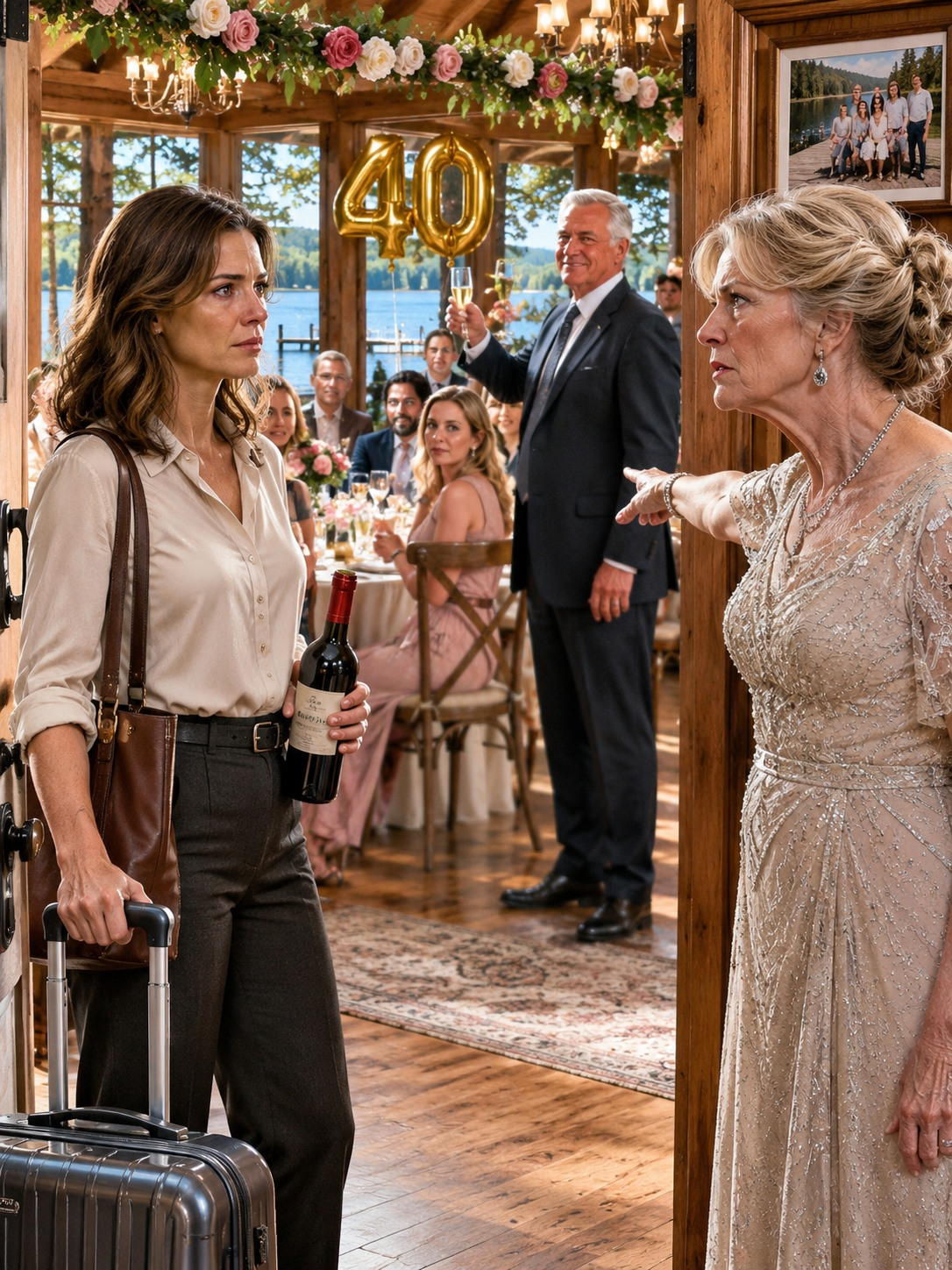
The same driveway where my mother had once told me that nobody wanted me there.
I remembered the suitcase.
The wine bottle.
The way I had simply nodded and walked inside.
Back then, I had believed silence was the easiest way to avoid another argument.
Now I understood that silence could also be the space where I gathered the strength to make a decision.
I unlocked the door.
Inside, everything was quiet.
The kitchen smelled faintly of wood and fresh flowers.
The dining table was mine.
The photographs were mine.
The rooms were arranged exactly as I wanted them.
I opened the windows.
Then I placed the wine on the counter.
For the first time in years, I didn't feel like a guest in my own family.
I felt at home.
A week later, I invited Hannah, Mark, and my mother for a small dinner.
There were no balloons.
No elaborate decorations.
No speeches about family ownership.
Just a simple meal on the porch.
My mother brought the apple pie from Grandma's recipe.
Hannah brought flowers.
Mark brought a bottle of sparkling cider.
We sat together as the evening light faded.
At one point, my mother raised her glass.
"I want to thank you for allowing us to be here."
I looked at her.
"You're welcome."
She paused.
"And I want you to know that I understand something now."
"What?"
"Being family doesn't mean you're entitled to everything someone owns."
I smiled slightly.
"No. It means you respect what belongs to each other."
She nodded.
"You're right."
We ate dinner.
We talked about ordinary things.
Hannah told us about her new job.
Mark discussed plans to move closer to his workplace.
My mother asked whether I needed help planting the flowers near the dock.
Nobody asked about the trust.
Nobody mentioned the money.
Nobody claimed the cabin belonged to everyone.
For the first time, we were simply people sharing a meal.
And that was enough.
Later that night, after everyone had left, I walked down to the dock.
The water was still.
The cabin lights reflected across its surface.
I took my grandmother's photograph from my pocket.
It was the one Mark had found beneath the blankets.
I looked at her smiling face.
"Thank you, Grandma," I whispered.
I thought about the letter.
The appointment.
The original declaration.
The words she had written about ownership, responsibility, and never confusing access with rights.
She had known that protecting something sometimes meant disappointing people.
She had known that love without boundaries could become another form of control.
And she had trusted me to understand that eventually.
I returned to the porch and placed her photograph beside the door.
Underneath it, I added a small wooden plaque.
It contained only five words:
OUR FAMILY. MY HOME. MY RULES.
Then I turned off the porch light.
The cabin was quiet.
The locks were secure.
The accounts were protected.
The property belonged to me.
And for the first time since that anniversary celebration, I could finally enjoy the place I had worked so hard to own.
I hadn't destroyed my family by refusing to surrender what was mine.
I had simply stopped allowing them to mistake my generosity for permission.
My grandmother had wanted me to have something stable.
She had wanted me to feel safe.
She had wanted me to know that I never needed to earn my place by giving away what belonged to me.
I finally understood.
The cabin had never been the thing that made me feel welcome.
The freedom to decide who entered it was.
And that freedom was mine to keep.






Comments 0