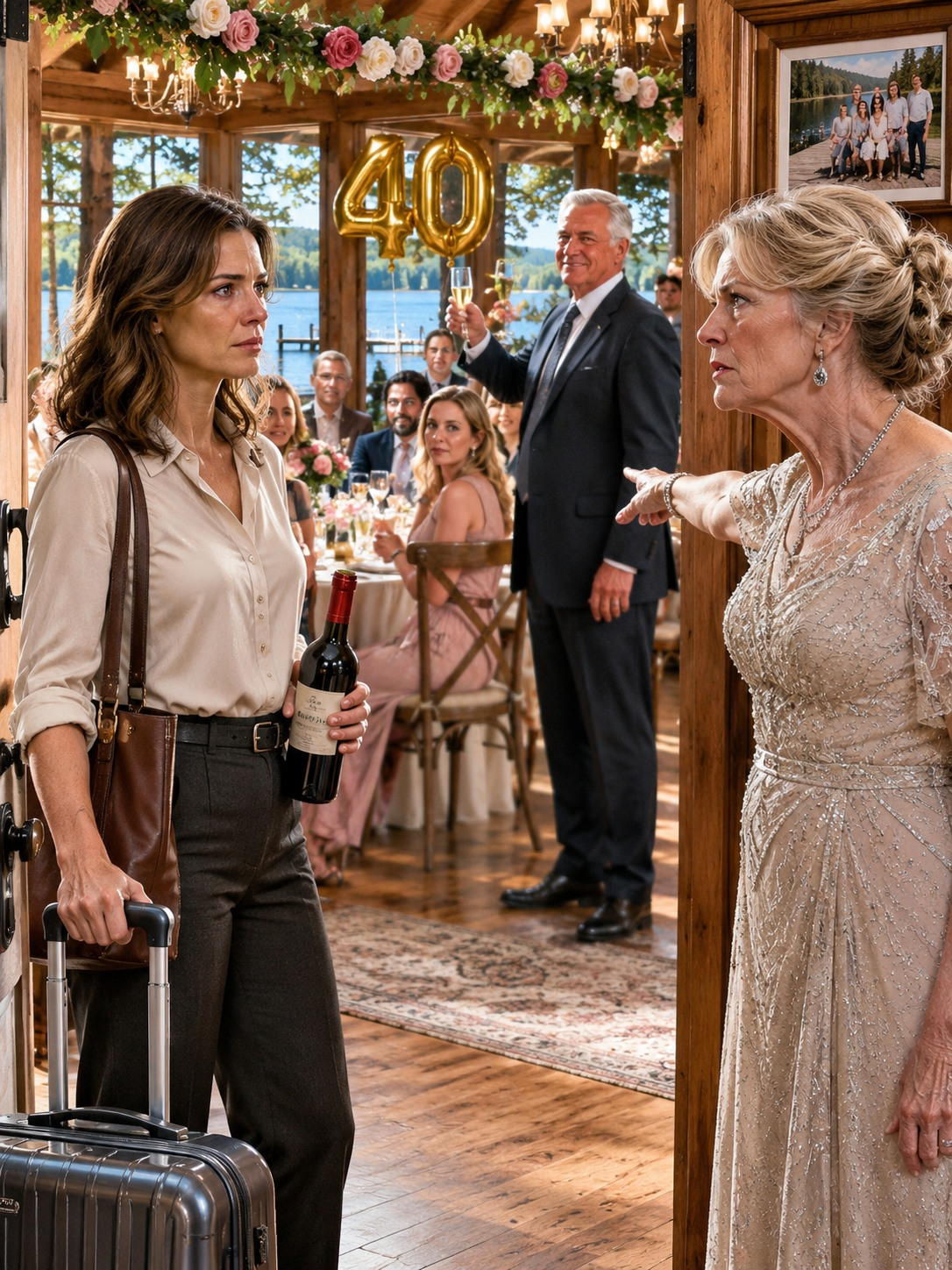
"Nobody actually wants you here," my mother whispered, blocking the doorway.
My father stood behind her with a champagne glass and a folder containing the anniversary arrangements.
A small handwritten note was attached to the folder.
Our Little Paradise.
But the deed to that paradise had only one name on it.
Mine.
And standing there with a suitcase in one hand and a bottle of red wine in the other, I realized my family had somehow managed to make me feel like a trespasser in a house I owned.
"Excuse me?" I asked.
My mother, Diane, didn't even have the decency to look embarrassed.
She was fifty-nine, with a perfectly styled auburn bob and the kind of expensive jewelry that always seemed to appear shortly after she'd complained about not having enough money.
Her navy velvet dress caught the afternoon light as she folded her arms.
"Oh, don't start, Rebecca."
"I haven't started anything."
"Then don't. This is your father's celebration. We've worked very hard to make everything perfect."
I glanced past her shoulder.
Inside, rose garlands hung from the exposed wooden beams. White and pink flowers decorated the dining tables. Two enormous gold balloons formed the number forty.
Forty years of marriage.
Forty years of my parents presenting themselves as the perfect couple.
Forty years of my mother smiling for photographs and making sure everyone knew how much she'd sacrificed for her family.
And apparently, thirty-eight years of teaching her daughter that love was something she had to earn.
"I brought wine," I said.
My mother looked at the bottle.
"That's nice."
She didn't reach for it.
She didn't thank me.
Instead, she leaned closer.
"You can come, but don't get comfortable. Nobody actually wants you here."
The words landed with such casual precision that, for a second, I wondered whether I'd heard her correctly.
Not because my mother had never said anything cruel before.
She had.
Plenty of times.
But there was something different about hearing those words while standing at the entrance of the home I'd spent years working to buy.
I looked at her.
She waited.
I knew what she expected.
An argument.
Tears.
A desperate attempt to convince her that I deserved to be included.
Maybe even an apology for whatever imaginary offense she'd decided I'd committed.
Instead, I nodded.
"Okay."
Her eyebrows lifted.
"Okay?"
"Okay, Mom."
I stepped around her.
My suitcase rolled across the wooden floor.
And just like that, I entered my own cabin as though I were a guest who had arrived without an invitation.
My name is Rebecca Hayes.
I was thirty-eight years old, divorced, and a senior business consultant for a company that specialized in helping struggling businesses rebuild their finances.
I was good at my job.
Very good.
I could look at a company's financial statements and usually identify where the money was disappearing before the owners even realized they had a problem.
I could negotiate contracts, restructure budgets, and identify hidden liabilities.
I could tell a stranger exactly how to protect their assets.
What I couldn't do, apparently, was establish a single reasonable boundary with my own family.
That was the embarrassing truth.
I had spent most of my adult life trying to become the kind of daughter my parents would finally appreciate.
I paid for dinners.
I remembered birthdays.
I helped relatives move.
I covered unexpected expenses.
I listened to complaints.
And whenever I tried to say no, someone reminded me that family was supposed to help family.
My mother was especially talented at that.
When I was twenty-four, she convinced me to pay my younger cousin's college application fees because his parents were struggling.
When I was twenty-nine, she asked me to cover a portion of my father's medical bills, even though his insurance had already paid most of them.
When I was thirty-three, she borrowed money for a kitchen renovation and somehow forgot that borrowing meant eventually paying it back.
And when my marriage ended, she told me that perhaps I'd been too focused on my career to keep a husband happy.
That last comment had hurt more than I wanted to admit.
My ex-husband, Daniel, hadn't left because I worked too much.
He'd left because he'd fallen in love with someone else.
I discovered the affair through a hotel receipt tucked into the pocket of a jacket I was taking to the dry cleaner.
For six months afterward, I lived in a small apartment downtown and tried to remember what it felt like to trust my own judgment.
Then I found the cabin.
It sat beside a quiet lake, surrounded by pine trees and old maples.
The building had wide windows, a deep porch, a private dock, and a large stone fireplace.
It wasn't perfect.
The plumbing needed work.
The roof had a leak.
The kitchen appliances were outdated.
But the first time I stood on the dock, looking across the water, I felt something I hadn't experienced in years.
Peace.
Not excitement.
Not happiness.
Just peace.
And after the divorce, peace was worth almost anything.
I bought the property six months later.
Not because I was wealthy.
Because I was determined.
I took additional consulting contracts.
I worked weekends.
I canceled vacations.
I drove the same car long after I could have justified replacing it.
I saved every bonus.
When the closing costs came in higher than expected, I sold a piece of jewelry I'd received for my thirtieth birthday.
I didn't tell anyone.
Not even my mother.
Especially not my mother.
On the day I received the keys, I sat alone on the porch and cried.
They were happy tears.
The first I'd cried in a very long time.
That cabin represented something simple.
Something that belonged to me.
Something nobody could take away just because they stopped loving me.
Or so I thought.
"Rebecca!"
My cousin Hannah waved from the dining area.
She was holding a champagne flute and wearing a pale lavender dress.
"You're here!"
I smiled politely.
"Hi, Hannah."
She approached, gave me a quick one-armed hug, and immediately looked at my suitcase.
"Are you staying all weekend?"
"I thought I might."
"Oh."
There it was.
That tiny hesitation.
The same one I'd noticed in my mother's voice.
"Is that a problem?" I asked.
"No, of course not."
Hannah glanced toward the kitchen.
"It's just that the bedrooms are pretty much assigned."
I looked at her.
"Assigned?"
"Well, Aunt Diane made arrangements."
"For whose cabin?"
Hannah blinked.
"What?"
"Nothing."
I wasn't going to argue with her.
Not yet.
"Where's my room?"
She shifted uncomfortably.
"Your mom said you could take the couch."
I looked toward the hallway.
The cabin had four bedrooms.
One of them had been mine.
Not officially, perhaps, because I owned the entire property.
But it was the bedroom I'd furnished after buying the place.
The one with the lake view.
The one where I'd placed my favorite books on the windowsill.
The one where I'd slept during the first peaceful summer after my divorce.
"Who's in the back bedroom?" I asked.
Hannah studied her champagne.
"Your parents."
"And the lake-view room?"
"Mark and Melissa."
"The guest room?"
"Jack and his girlfriend."
"And the fourth?"
"The kids."
I waited.
Hannah finally looked at me.
"I'm sorry, Rebecca. I thought your mom had already talked to you."
Of course she hadn't.
My mother rarely discussed decisions with me.
She simply made them and expected me to accept the results.
I looked around the room.
My cousin Mark was crouched beside the entertainment system, adjusting speakers I'd purchased.
His wife, Melissa, was in the kitchen reheating catered food.
My aunt Linda was arranging flowers in a crystal vase that had once belonged to my grandmother.
A group of relatives stood near the windows, admiring the lake.
They all looked comfortable.
At home.
As though they'd been invited by the owners.
Which, in their minds, they probably had.
I placed the wine bottle on the counter.
"Where should I put this?"
Hannah brightened.
"Oh, just leave it there. Your mom has a whole wine table set up."
I glanced toward the dining area.
There were twelve bottles arranged in silver ice buckets.
Not one of them had been purchased by me.
I wondered who had paid for them.
Then I remembered something.
Two weeks earlier, my father had asked whether I could transfer money into the family trust account to cover an unexpected maintenance expense.
He'd said the cabin needed repairs before the anniversary.
I'd sent the money.
No questions asked.
I looked at the champagne.
The flowers.
The catered food.
A cold suspicion began forming in my stomach.
But I pushed it away.
Surely they hadn't used the maintenance money for a party.
Surely even my parents wouldn't do that.
I would later learn that there were many things I still didn't understand about my family.
The celebration began at six.
By then, I'd changed out of my emerald blazer and back into it again.
That sounds ridiculous, I know.
But after Hannah told me I was sleeping on the couch, I'd gone to the downstairs bathroom and stared at myself in the mirror.
My auburn curls were slightly flattened from the drive.
My face looked tired.
I considered changing into the casual sweater I'd packed.
Then I realized I didn't want to make myself smaller.
Not that evening.
So I washed my face, fixed my hair, and returned to the celebration wearing exactly what I'd arrived in.
Nobody noticed.
My father, Robert Hayes, was standing near the fireplace when I came back.
He was sixty-three, broad-shouldered, silver-haired, and still handsome in the way men often become when they've spent their entire lives being told they're impressive.
He wore a burgundy dinner jacket and held court among the guests.
When he saw me, he smiled.
"There's my girl."
For one foolish second, warmth rose in my chest.
Then he held out his empty glass.
"Be a sweetheart and get your old man another champagne, would you?"
I looked at the glass.
Then at him.
"Sure, Dad."
I took it.
Because apparently, even after everything, some habits were difficult to break.
When I returned, he was telling my uncle about the new grill he'd installed.
"Top of the line," he said proudly. "Had it delivered last month."
My uncle whistled.
"Must've cost a fortune."
Dad waved a hand.
"Well, you know me. I believe in investing in your home."
I stopped walking.
Your home.
Not Rebecca's cabin.
Not the place my daughter bought.
Your home.
I handed him the champagne.
"Thanks, sweetheart."
He didn't notice my expression.
Or maybe he did and simply didn't care.
At seven fifteen, Mark lowered the music.
My father tapped a spoon against his champagne glass.
"Everybody! If I could have your attention!"
The conversations faded.
People turned toward him.
My mother moved to his side and slipped her arm through his.
They looked like a couple posing for a magazine advertisement.
Elegant.
Successful.
Loved.
I stood near the kitchen doorway.
My father cleared his throat.
"Forty years ago, I married the most wonderful woman in the world."
Applause.
My mother smiled.
"We've built a beautiful life together," he continued. "We've raised a family, made incredible memories, and found a place where everyone can come together."
He gestured toward the windows.
"This place has been the heart of our family for years. We've really made it our own."
People nodded.
Someone said, "You certainly have."
My father raised his glass.
"To family. To love. And to the home we've created together."
Everyone cheered.
I nearly choked on my wine.
The home we'd created together?
I remembered signing the purchase agreement.
Alone.
I remembered sitting across from the bank officer, explaining my income.
Alone.
I remembered paying the contractor after the roof repair.
Alone.
I remembered spending an entire Saturday painting the guest bedroom because hiring someone would have cost more than I wanted to spend.
Alone.
And now my father was standing in my living room, accepting compliments for a property he hadn't purchased.
My mother leaned into him and kissed his cheek.
People applauded again.
Nobody looked at me.
Nobody said my name.
I stood there with my glass in my hand, feeling something inside me quietly shift.
It wasn't anger.
Not exactly.
Anger would have been easier.
Anger might have given me the energy to interrupt the toast and tell everyone the truth.
Instead, I felt tired.
Deeply, completely tired.
Tired of explaining.
Tired of pretending.
Tired of being useful but never important.
Tired of paying for a seat at a table where nobody wanted me to sit.
I set down my glass.
And walked outside.
The porch was quiet.
A cool breeze moved across the lake.
The dock stretched into the darkening water, its wooden boards reflecting the last traces of evening light.
I sat in one of the Adirondack chairs I'd bought shortly after closing.
From inside came laughter.
Music.
The sound of people celebrating.
My family.
In my house.
Without me.
I pulled my phone from my pocket.
There were three new messages in the family group chat.
Melissa had posted a photograph of the anniversary cake.
Hannah had shared a video of my father's toast.
And my mother had written:
Such a beautiful evening with the people who matter most.
I stared at the message.
Then I locked my phone.
I didn't respond.
I didn't react.
For the first time in years, I didn't feel obligated to prove I was happy for them.
A few minutes later, the porch door opened.
My cousin Mark stepped outside.
"Hey, Becca."
"Hey."
He leaned against the railing.
"Nice party, huh?"
"Looks like everyone is having fun."
"Yeah. Your folks really went all out."
I almost laughed.
Instead, I asked, "Did they?"
He didn't notice the question.
"Listen, while I've got you here, I wanted to ask something."
Of course he did.
"What is it?"
"Melissa and I were thinking about coming up for a couple weeks next summer."
I looked at him.
"Two weeks?"
"Yeah. Her friend from work might join us for part of it."
"How many people?"
"Six, maybe eight. Depends."
I folded my hands in my lap.
"Mark, you'd need to ask me before making plans."
He frowned.
"Ask you?"
"Yes."
"Well, I figured since it's the family cabin—"
"It's my cabin."
The words came out quietly.
Mark blinked.
Then laughed.
"Come on, Becca. You know what I mean."
"I do."
He looked toward the lake.
"Your dad said everyone's welcome to use it."
"My dad doesn't own it."
A brief silence followed.
Then Mark shrugged.
"Okay. I didn't realize we were getting technical."
Technical.
That was the word he chose.
As though legal ownership were some minor administrative inconvenience.
As though the years of work, the mortgage payments, the taxes, and the maintenance bills were details that shouldn't interfere with his vacation plans.
"I'll let you know about next summer," I said.
He studied me.
"Everything okay?"
"Fine."
"You're being kind of weird."
I looked at him.
"Am I?"
He shifted his weight.
"Forget I asked."
Then he went back inside.
I remained on the porch.
And for the first time, I allowed myself to ask a question I'd been avoiding for years.
If I stopped giving my family things, would they still want me around?
I already knew the answer.
My mother had given it to me at the door.
By ten thirty, the party was winding down.
I helped Melissa carry plates into the kitchen.
Not because anyone asked.
Because I couldn't stand watching food dry onto dishes I'd paid for.
My mother appeared beside the refrigerator.
"Rebecca, could you take the trash out before you go to bed?"
I looked at her.
"Sure."
"And please don't leave your suitcase in the hallway. Someone could trip."
"I'll move it."
"Good."
She started to leave.
"Mom?"
She turned.
"What?"
I hesitated.
I had a hundred things I wanted to say.
About the bedroom.
About the toast.
About the way she'd spoken to me.
About the fact that she'd made me feel unwelcome in the only place I'd ever truly considered mine.
Instead, I asked one simple question.
"Did you use the money Dad requested for repairs to pay for tonight?"
Her expression changed.
Only slightly.
But I saw it.
"Excuse me?"
"The maintenance money. Dad said the cabin needed repairs."
She folded her arms.
"Your father and I don't appreciate being interrogated."
"I'm asking a question."
"And I'm telling you that this is neither the time nor the place."
"Mom, it's my money."
Her eyes narrowed.
"There it is."
"What?"
"That attitude."
I stared at her.
"You always have to remind everyone what you've paid for."
"Because I paid for it."
She let out a sharp breath.
"Do you have any idea how exhausting it is to be around someone who keeps score?"
I felt the familiar pressure behind my eyes.
The old urge to apologize.
To smooth things over.
To make her comfortable.
But something stopped me.
Maybe it was the champagne.
Maybe it was the toast.
Maybe it was hearing my mother tell me that nobody wanted me there.
Whatever it was, I didn't apologize.
I simply said, "Good night, Mom."
Then I walked away.
At midnight, I was lying on the living room couch beneath a thin blanket.
Someone had replaced my soft cotton bedding with scratchy flannel sheets.
I could hear my parents moving around in the bedroom down the hall.
My bedroom.
The one I'd decorated.
The one with the lake view.
I stared at the ceiling.
Sleep wouldn't come.
At one fifteen, the house finally became quiet.
At two, I heard the refrigerator motor switch on.
At two thirty, a car passed along the road beyond the trees.
And at three in the morning, I sat up.
Across the room, a framed photograph hung on the wooden wall.
I hadn't noticed it when I arrived.
It showed my parents sitting on my dock with their grandchildren.
Everyone was smiling.
The lake glittered behind them.
The photograph was professionally printed and mounted in an expensive wooden frame.
Beneath it, someone had added a small engraved plaque.
Our Little Paradise.
I got off the couch.
Walked across the room.
And studied the photograph.
I wasn't in it.
Not because I hadn't been there that day.
I remembered the afternoon clearly.
I'd been inside preparing lunch while everyone else went down to the dock.
My mother had asked me to make sandwiches.
My father had wanted coffee.
One of the children had spilled juice on the kitchen floor.
By the time I finished cleaning up, the photographs were already taken.
Nobody suggested taking another.
I stood there for a long moment.
Then I reached up and touched the edge of the frame.
Our Little Paradise.
They hadn't even included me in the picture.
I returned to the couch and opened my laptop.
The screen illuminated the dark room.
I signed into my private document storage.
There were folders for taxes, insurance, mortgage statements, maintenance receipts, and legal records.
I opened the folder marked:
LAKE PROPERTY — ORIGINAL PURCHASE DOCUMENTS
Inside were the closing papers.
The deed.
The insurance agreements.
And a document I hadn't reviewed in years.
The trust agreement.
When I bought the cabin, my attorney friend Clare had insisted on structuring the ownership carefully.
At the time, I'd thought she was being overly cautious.
I remembered sitting across from her in a small office downtown.
She'd reviewed the paperwork, then looked at me over her glasses.
"Rebecca, I know you love your family."
"I do."
"And I know you want them to enjoy the cabin."
"Of course."
"But generosity and ownership are two very different things."
I'd laughed.
"Clare, my parents aren't going to steal my cabin."
She hadn't laughed.
Instead, she'd slid the documents toward me.
"Set it up as if you might have to take it back someday."
I remembered those words.
Every single one.
Now, sitting alone on my couch at three in the morning, I began reading.
The trust had been established with me as the primary beneficiary.
The property had been placed under a structure designed to protect my interests.
Certain administrative privileges had been extended to family members.
Limited privileges.
Conditional privileges.
Privileges that, according to the language Clare had insisted upon, could be revoked under specific circumstances.
I scrolled farther.
My pulse quickened.
There was a section concerning financial access.
Another concerning authorized property use.
And another concerning the rights of the primary beneficiary.
I read them twice.
Then a third time.
I wasn't an attorney.
I knew better than to assume I understood every legal implication.
But I understood enough to realize that my parents might have made a very serious mistake.
For years, they'd treated the trust as a shared family fund.
They'd spoken about the cabin as though everyone owned it.
They'd given relatives access.
They'd made arrangements without consulting me.
And they'd apparently forgotten something important.
They weren't the people who had purchased the property.
I was.
I opened my email and searched for Clare's name.
The last message from her was nearly two years old.
I clicked it.
The subject line read:
RE: Trust Administration and Property Access
I began typing a new message.
Clare, I need you to review the cabin trust. I think my family has been using it in ways I never authorized.
I paused.
Then added:
And I need to understand exactly what I can legally take back.
I attached the documents.
My finger hovered over the send button.
Before I could click it, my phone vibrated.
A notification appeared from the family group chat.
It was from my father.
Great news, everyone. Diane and I have decided to make the cabin available for more family gatherings next year.
A second message followed.
Mark already has a few weekends lined up.
I stared at the screen.
Then a third message appeared.
This one was from Mark.
Thanks, Uncle Robert! I'll confirm the rental deposits tomorrow.
Rental deposits.
I read those two words again.
Slowly.
My family wasn't just using my cabin.
Someone was collecting money for it.
I opened the group chat.
For a moment, I considered responding.
Instead, I took a screenshot.
Then another.
I saved both to a private folder.
And finally, I sent Clare the email.
I thought that would be the end of the night's discoveries.
I was wrong.
Because just as I closed my laptop, another message appeared.
This one wasn't from the family group chat.
It was an automated notification from the financial institution associated with the trust.
A NEW EXTERNAL ACCOUNT HAS BEEN LINKED TO YOUR TRUST PROFILE.
I sat perfectly still.
I hadn't linked any account.
I opened the notification.
The screen displayed the last four digits of an unfamiliar bank account.
Beneath them was a name.
A name I recognized immediately.
And when I clicked to view the authorization record, I saw that someone had already scheduled a transfer for Monday morning.
Phần hiện tại gồm danh sách đầy đủ 15 chương và Chapter 1. Câu chuyện chưa kết thúc.






Comments 0