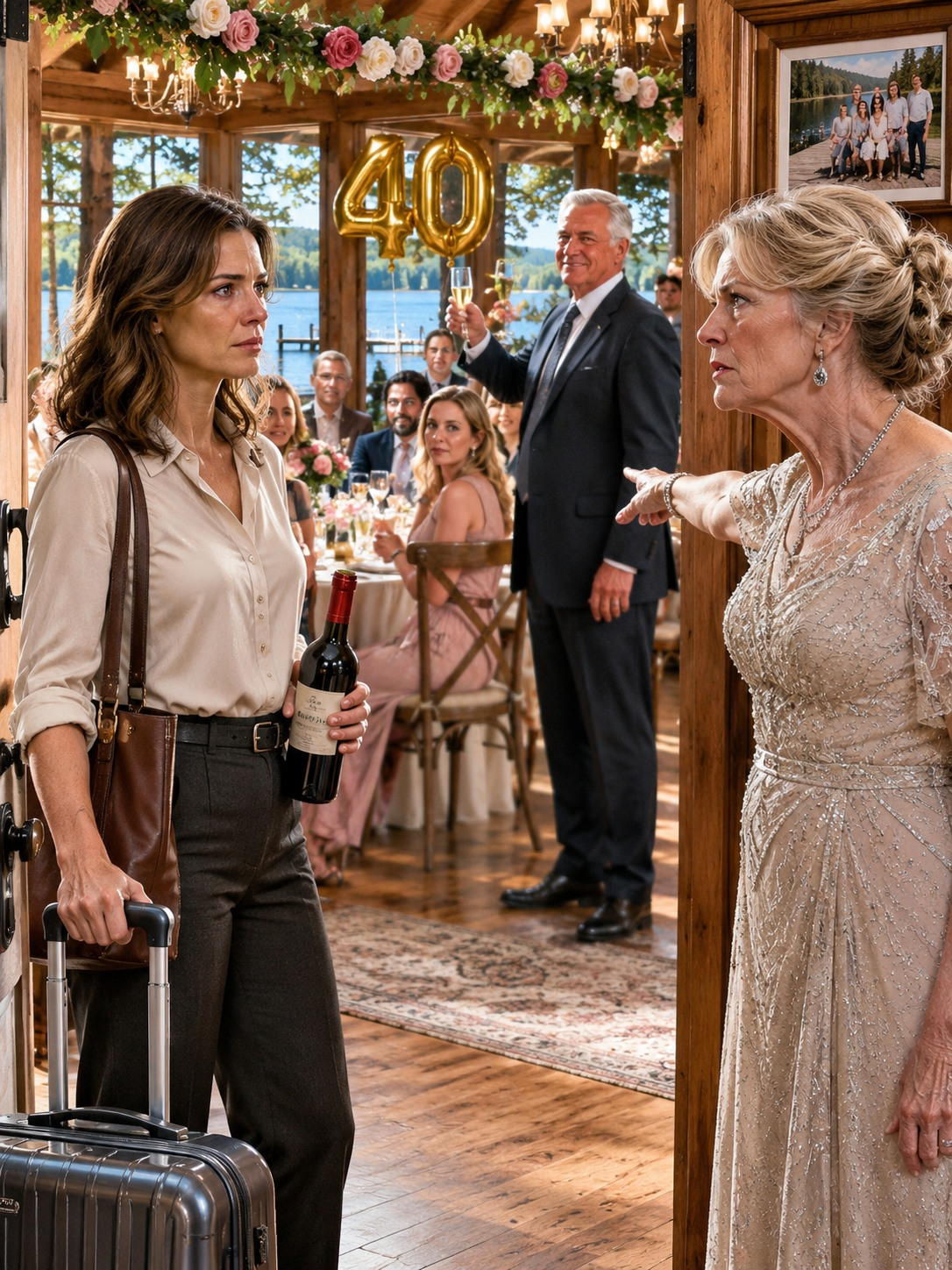
Hannah shoved the yellow envelope beneath her sweater as my father stepped into the room.
"Why are you holding that?"
My father stood in the doorway, staring at the desk.
Hannah froze.
Behind him, my mother appeared with a champagne glass in her hand.
And on the wooden desk, beneath the photograph of my grandmother, lay a document bearing a signature that could change everything.
I was still holding my phone when Hannah's message arrived.
Dad just walked into the room, and he's asking why I'm holding Grandma's envelope.
I immediately called her.
She declined the call.
A second later, another message appeared.
Don't call. He's standing right here.
I stared at the screen.
My first instinct was to drive straight to the cabin.
It was nearly midnight, and the journey would take more than two hours. But I didn't care about the distance. Hannah was alone with my father, and he had just discovered that someone had found a document he apparently didn't want anyone seeing.
I typed carefully.
Tell him you're looking for Grandma's old photographs. Don't mention my name.
The typing indicator appeared.
Then disappeared.
I waited.
Nothing.
I sent another message.
Hannah, please answer me.
Finally, my phone vibrated.
I told him it was an old letter. He wants to see it.
My stomach tightened.
Did you give it to him?
Three dots appeared.
No.
Then:
He says Grandma left it for the family.
I closed my eyes.
My grandmother, Eleanor Hayes, had been the only person in my family who never made me feel like I needed to earn affection.
She had died six years earlier.
She wasn't wealthy in the traditional sense, but she had been careful with money. She paid her bills on time, kept every important document organized, and never trusted anyone who insisted that family matters shouldn't be put in writing.
She had also been the first person to tell me that kindness didn't mean allowing people to walk over me.
When I was seventeen, I'd once complained that my mother expected me to babysit my younger cousins every weekend.
Grandma had looked at me over her reading glasses.
"Being a good person doesn't mean being available to everyone, Rebecca."
I remembered laughing.
At the time, I thought she was talking about babysitting.
Now I wondered whether she'd been trying to teach me something much bigger.
I typed another message.
Don't let Dad take the envelope. Put it somewhere safe.
Hannah replied almost immediately.
He knows I found it.
Then:
He's asking why Grandma wrote your name on it.
I felt my heart drop.
My grandmother had specifically addressed the envelope to me.
Not to my parents.
Not to the entire family.
To me.
And she had written that it should only be opened if the family trust was changed.
That wasn't a casual instruction.
It was a warning.
Hannah had always been the quiet one in our family.
She was thirty-five, married to Mark, and had two young children.
Unlike my mother, she didn't enjoy arguments.
Unlike my father, she didn't believe every disagreement needed to end with someone being declared the winner.
She was usually the person who tried to keep everyone happy.
That was probably why I trusted her.
When we were younger, she'd often come to my room after our family dinners and ask whether I was okay.
She knew how my mother could be.
She knew how my father could turn a simple question into an accusation.
And she had seen how differently they treated me whenever I refused to help.
But she rarely challenged them.
She had her own family to protect.
I understood that.
Still, I was worried about what was happening inside the cabin.
I called her again.
This time, she answered.
Her voice was barely audible.
"Rebecca?"
"Are you alone?"
"No."
I heard a door close.
Then she whispered, "I'm in the hallway."
"Where's Dad?"
"In the study."
"Does he have the envelope?"
"No."
I exhaled.
"Good."
"He's angry."
"I know."
"He keeps saying Grandma's personal papers should stay with the family."
I looked at the yellow envelope in the photograph Hannah had sent.
"Did you open it?"
"No. I only found it in the desk."
"Did you read the writing?"
"Just the front."
I lowered my voice.
"Hannah, listen carefully. That envelope has my name on it. If Grandma wanted me to have it, I don't want Dad deciding what happens to it."
"I know."
"Can you keep it somewhere safe?"
There was a long pause.
Then she whispered, "I think he already knows where I put it."
My grip tightened around the phone.
"Where?"
"In my handbag."
"Move it."
"I can't. Mom is in the bedroom, and Dad keeps walking past the hallway."
I thought quickly.
"Can you leave through the back door?"
"Rebecca, it's almost midnight."
"I know."
"Mark is asleep. The kids are asleep. I can't just leave."
I understood.
I also knew my father.
If he believed something valuable was hidden in that envelope, he wouldn't simply forget about it.
"Okay," I said. "Don't do anything that makes you uncomfortable. Just keep your phone with you."
Hannah exhaled.
"Do you think it's important?"
"I don't know."
"Why would Grandma write that it could only be opened if the trust changed?"
I looked at the photograph again.
"Because she may have known something we don't."
There was silence.
Then Hannah said something that made my blood run cold.
"Rebecca, I think Dad has seen this envelope before."
"What makes you think that?"
"Because when he saw it, he didn't look confused."
I waited.
"He looked scared."
I barely slept that night.
Every time I closed my eyes, I saw my father's face in the doorway.
I imagined him taking the envelope.
I imagined him opening it.
I imagined him discovering that my grandmother had left something behind that contradicted everything he'd been telling the family.
At six in the morning, I gave up trying to sleep.
I made coffee.
Opened my laptop.
And reviewed the documents I'd collected.
The original trust.
The partial amendment.
The bank records.
The photograph of my father and Daniel.
The handwritten note.
And now my grandmother's envelope.
I created a separate folder for each item.
Then I emailed everything to Clare.
At 7:18, she replied.
I received the additional material. Please do not attempt to retrieve the envelope yourself if doing so would create a confrontation. We need to establish its contents and preserve it properly.
I understood.
But I couldn't ignore Hannah.
I sent her a message.
Are you okay?
She replied five minutes later.
Yes. Dad is acting normal now.
Then:
He told Mom the envelope was probably an old insurance document.
I stared at the message.
That was interesting.
If it was only an insurance document, why had he been so interested in taking it?
I typed:
Did he ask you to give it to him?
Yes.
What did you say?
I told him I'd look for it later.
I exhaled.
Then another message arrived.
Rebecca, there's something else.
I waited.
Dad said Grandma never wanted you to own the cabin.
I stared at the screen.
My fingers went cold.
What?
Hannah responded:
He said Grandma had a different plan for the family property. He said you changed everything when you bought it.
I read the message twice.
My grandmother had died before I bought the cabin.
How could she have had an opinion about a property that hadn't even been mine yet?
Unless my father was referring to something else.
Something that existed before the purchase.
Something he and Daniel had discussed.
I called Clare.
She answered immediately.
"Rebecca?"
"My father told Hannah that Grandma never wanted me to own the cabin."
There was a pause.
"Did he explain why?"
"No. He said Grandma had a different plan for the family property."
Clare didn't respond right away.
Then she asked, "When did your grandmother die?"
"Six years ago."
"And when did you purchase the cabin?"
"Three years ago."
"Did she leave any property or financial interests to your father?"
"Yes. She left him some money and a portion of her estate."
"Did you receive anything?"
I thought about it.
"A small personal inheritance. Mostly jewelry and some savings."
"Did you use any of that money to purchase the cabin?"
"No. I kept it separate."
"Good."
I heard her typing.
"Rebecca, I want to see the original envelope and its contents. There may be nothing legally significant in it, but the timing and the language are unusual."
"Can we meet today?"
"Yes. Ten o'clock."
"At your office?"
"At my office."
I looked at the clock.
It was 7:34.
"Okay."
"Bring the original photograph of your father and Daniel as well."
"I will."
"One more thing."
"What?"
"Have you spoken to your father since last night?"
"No."
"Keep it that way until we have more information."
I agreed.
But I was beginning to realize that my father might not give me the same courtesy.
At 8:02, my mother called.
I answered because I wanted to hear what she would say.
"Rebecca."
Her voice was unusually controlled.
"Morning, Mom."
"Your father tells me you've been discussing private family documents with Hannah."
I looked out the window.
"Good morning to you too."
"Don't be sarcastic."
"I'm not."
She sighed.
"Listen, I don't know what you've been telling your cousin, but she's very upset."
"Why?"
"Because you've dragged her into something that has nothing to do with her."
I almost laughed.
"Hannah contacted me."
"Exactly. Because you've made everyone uncomfortable."
I leaned against the counter.
"Mom, I haven't asked Hannah to do anything."
"Then why is she searching through your grandmother's belongings?"
"Perhaps because Grandma left something addressed to me."
My mother went silent.
Then she said, "Your grandmother left plenty of things."
"She didn't leave plenty of envelopes with instructions about the family trust."
A sharp breath came through the phone.
"Rebecca, you need to stop."
"Stop what?"
"Turning everything into a legal matter."
I closed my eyes.
There it was again.
The familiar accusation.
The suggestion that asking for documentation was somehow a betrayal.
"Mom, I'm not turning anything into anything. I'm trying to understand why Dad has been making changes to the trust without explaining them."
"Your father has done nothing wrong."
"Then why won't he show me the documents?"
"He doesn't have to justify every decision to you."
I looked at the screen.
"Actually, if the documents concern my property and my trust, he does."
My mother let out a bitter laugh.
"You hear yourself?"
"Yes."
"You're talking like a stranger."
I said nothing.
She continued.
"Your grandmother would be ashamed of how you're treating this family."
That sentence hurt.
Not because I believed it.
Because my mother knew exactly which words would hurt.
I took a breath.
"Did Grandma ever tell you about an envelope she left for me?"
Silence.
Then my mother said, "What envelope?"
"The yellow one in her desk."
Another pause.
When she spoke again, her voice had changed.
"Where did you hear about that?"
I gripped the counter.
"Hannah found it."
My mother didn't answer.
Then she said, very quietly, "You should leave it alone."
My heart began beating faster.
"Why?"
"Because it belongs to the family."
"Grandma wrote my name on it."
"That doesn't mean you understand what it contains."
I stared at the wall.
"Have you read it?"
She hesitated.
"No."
"Then how do you know what it means?"
"Rebecca, I am asking you to trust me."
I almost said something.
Then I remembered the anniversary party.
The sleeping arrangements.
The champagne.
The missing bedroom.
The money.
The photographs.
The unauthorized rentals.
The attempted transfer.
And the way my mother had looked at me when she told me nobody wanted me there.
I finally answered.
"I can't do that anymore, Mom."
She went quiet.
Then the call ended.
At ten o'clock, I was sitting across from Clare again.
She had already reviewed the new material.
The photograph of my father and Daniel was on her desk.
Beside it was a printed copy of my grandmother's envelope.
Clare studied the handwriting.
"Did your grandmother write this herself?"
"Yes."
"Are you certain?"
"Very."
"Did she have a lawyer who handled her estate?"
"Yes. His name was Thomas Whitaker."
Clare looked up.
"Thomas Whitaker?"
I nodded.
"He passed away about six years ago."
Clare leaned back.
"Do you have his estate records?"
"No."
"Do you remember which firm handled his files?"
I thought for a moment.
"I believe his practice was taken over by another firm."
Clare wrote down the name.
"That may be worth investigating."
She turned the envelope photograph toward me.
"Look at the signature."
I leaned forward.
The attorney's name appeared in the lower corner.
Thomas Whitaker.
Below it was the date.
Three months before I purchased the cabin.
"Why would he sign something related to a property I hadn't bought yet?" I asked.
"He may have been certifying something unrelated to the property. We can't assume."
She pointed to the handwritten instruction.
To be opened only if the family trust is changed.
"That wording suggests your grandmother anticipated a future dispute involving a trust."
"Could she have known my father would do this?"
"Possibly. But we need evidence."
Clare opened her laptop.
"I also reviewed the partial amendment you signed."
She brought up a highlighted section.
"Your father appears to have relied on this document to expand his administrative authority. However, the missing schedule is essential."
"Can you get it?"
"I've requested the complete execution copy from the institution."
"How long?"
"Hopefully, a few business days."
I looked at the document.
"And the transfer?"
"We're reviewing the available options for protecting the account. I've asked the institution to flag the pending transaction and verify the authority behind it."
"Can we stop it?"
"That depends on the account structure and the bank's procedures. We won't assume it's blocked until they confirm it."
I nodded.
She closed the document.
"Now, about your grandmother."
Clare opened another file.
"I found a reference to Thomas Whitaker in an old estate administration index."
I leaned forward.
"What did it say?"
"His firm retained certain client correspondence after his death. The files were transferred to another practice."
"Can we request them?"
"We can make inquiries."
She paused.
"But there's something else."
"What?"
"Your grandmother's estate included a private letter that wasn't distributed with the general inheritance documents."
I felt my pulse quicken.
"A letter?"
"Yes."
"To whom?"
Clare checked her notes.
"That isn't clear from the index."
"Could it be the envelope Hannah found?"
"It might be. We need to inspect the original."
I looked at the photograph.
The handwritten instruction.
The attorney's signature.
The date.
Everything seemed connected.
But I still didn't understand how Daniel had become involved.
Clare appeared to read my thoughts.
"Have you asked Daniel for more information?"
"No."
"Good."
She gathered the papers.
"Let's wait until we have the original envelope."
At noon, Hannah sent me a message.
Can we meet somewhere?
I immediately replied.
Are you safe?
Yes. I'm going into town with the kids.
Can you bring the envelope?
There was a pause.
I think so.
Then:
But Dad has been asking about it all morning.
I stared at the message.
Does he know you still have it?
I told him I couldn't find it.
I exhaled.
Where did you put it?
Inside the lining of my overnight bag.
I smiled despite everything.
Hannah had always been smarter than people gave her credit for.
Don't bring it if you think he'll notice.
She replied:
I can meet you at the coffee shop near the highway.
I agreed.
Then I called Clare.
She instructed me not to open the envelope or remove anything from it until she could document its condition.
I understood.
At 1:30, I arrived at the café.
Hannah was already there.
She sat at a table near the back with her two children.
Her husband, Mark, wasn't with her.
She looked exhausted.
Her hair was pulled into a loose ponytail, and she kept glancing toward the entrance.
When she saw me, she stood.
"Rebecca."
I hugged her.
"Are you okay?"
She nodded.
Then she looked at the children.
"I told them we were meeting you for lunch."
"That's fine."
We ordered food.
For the first few minutes, we talked about ordinary things.
School.
Work.
The children.
The weather.
Then, when they became distracted by a coloring book, Hannah reached into her bag.
She removed a folded sweater.
Then a small toiletry case.
Finally, she placed a yellow envelope on the table.
I stared at it.
My grandmother's handwriting was unmistakable.
"Did you open it?" I whispered.
"No."
"Did anyone else?"
"I don't think so."
She pushed it toward me.
"Take it."
I didn't touch it.
"Are you sure?"
Hannah nodded.
"Grandma wrote your name."
I looked at the envelope.
The paper was old but still intact.
The edges had softened slightly with age.
There was a small crease across the upper corner.
I recognized the handwriting from birthday cards she'd sent me when I was younger.
I felt my throat tighten.
"Thank you."
Hannah reached across the table.
"Rebecca, I need to tell you something."
I looked at her.
"What?"
"When Dad saw the envelope, he didn't just ask what it was."
I waited.
"He asked whether Grandma had written the date on it."
I frowned.
"Why would he care about the date?"
"Because he already knew what it was."
My stomach tightened.
"Did he say that?"
"Not directly."
She glanced at the children.
Then lowered her voice.
"He said, 'That should have been destroyed years ago.'"
I felt cold.
"Those exact words?"
"Yes."
I looked down at the envelope.
Destroyed.
My father had wanted it destroyed.
Why?
Hannah continued.
"Then he told Mom that Grandma had been confused near the end of her life and that we shouldn't take anything she wrote too seriously."
I shook my head.
"Grandma wasn't confused."
"I know."
"She was completely sharp."
"I know, Rebecca."
Hannah's eyes filled slightly.
"That's why I brought it."
I reached across the table and squeezed her hand.
"Thank you."
She looked down.
"Just promise me something."
"What?"
"Don't let Dad know I gave it to you."
"I won't."
She nodded.
Then she stood and gathered the children's things.
Before leaving, she turned back.
"Rebecca?"
"Yes?"
"There's something else I haven't told you."
I waited.
"Last night, after you messaged me, Dad went into Grandma's old room."
I frowned.
"Why?"
"He was looking for another document."
"What document?"
Hannah shook her head.
"I don't know."
She looked toward the entrance.
"But I heard him say something to Mom."
"What?"
She swallowed.
"He said, 'If Rebecca gets the original, Daniel won't be able to protect us.'"
I felt the blood drain from my face.
Daniel.
Again.
Hannah left a few minutes later.
I remained at the table with the envelope beside my coffee.
I didn't open it.
I didn't even turn it over.
I simply sat there, trying to understand why my father believed my ex-husband could protect him from something my grandmother had written.
At three, I brought the envelope to Clare's office.
She cleared a space on her desk.
Then she examined the front, back, and edges without opening it.
She took photographs.
Recorded the visible markings.
And placed it inside a protective document sleeve.
"Your grandmother was careful," she said.
I looked at her.
"How can you tell?"
"The envelope is sealed with an older paper adhesive. There's no obvious sign that it's been opened and resealed."
She turned it gently.
"The attorney's signature appears to be on the outside, not on a separate attachment."
"Does that mean he witnessed it?"
"Possibly. But I want to compare the handwriting and signature with the estate records."
She studied the date again.
Then she looked at me.
"Rebecca, I need to ask something."
"Okay."
"Did your grandmother ever discuss your father's financial behavior?"
I thought about it.
"Yes."
"Can you be more specific?"
I remembered sitting with Grandma at her kitchen table.
She'd been sorting bills.
My father had called earlier that afternoon, asking whether she could help him with an investment.
Afterward, she'd looked at me and said something strange.
"Your father believes that being related to someone means he can borrow their judgment."
I'd laughed.
"What does that mean?"
She'd smiled sadly.
"It means he sometimes confuses permission with affection."
At the time, I hadn't understood.
Now I repeated the words to Clare.
She wrote them down.
"Did she say anything else?"
"She told me to keep my financial documents somewhere safe."
Clare looked up.
"When?"
"Just before she died."
"Did she explain why?"
"No."
Clare was quiet.
Then she said, "I think we should contact the successor firm handling Thomas Whitaker's estate files."
She made a call.
After explaining the circumstances, she asked whether they could verify the existence of the original estate correspondence.
The person on the other end requested several details.
Clare provided them.
Then she listened.
Her expression changed.
"You're certain?" she asked.
Another pause.
"Could you confirm the file reference?"
She wrote something down.
Then ended the call.
I looked at her.
"What?"
She studied the note.
"The successor firm has a record of a sealed instruction from your grandmother."
My heart began beating faster.
"What kind of instruction?"
"They won't release details over the phone. But they confirmed that it was retained separately from the general estate file."
"Does it mention me?"
Clare looked at the note.
"Your name appears in the reference."
I swallowed.
"What does that mean?"
"It means we have a reason to request the complete file."
She turned toward her computer.
"And we should do it immediately."
At 5:18, I returned to my apartment.
The envelope remained in Clare's custody.
For the first time in several days, I felt as though someone was finally taking the situation seriously.
I put my bag down.
Removed my boots.
And sat on the couch.
My phone buzzed.
A message from my mother.
Your father wants to speak with you.
I didn't answer.
Another message arrived.
You need to stop involving attorneys in private family matters.
I locked the screen.
Then my phone rang.
Daniel.
I stared at his name.
I hadn't expected him to call.
I considered letting it go to voicemail.
But I wanted answers.
So I answered.
"Hello?"
"Rebecca."
His voice sounded older.
Or perhaps I simply hadn't heard it in so long that it felt unfamiliar.
"What do you want, Daniel?"
"I got your message."
"I didn't send you one."
"You forwarded the email asking about the documents."
I frowned.
I hadn't forwarded anything to him.
Then I remembered Clare had received the message.
Perhaps he'd seen a copy through another source.
"Who gave you my email?"
"Your father."
My stomach tightened.
"Why does he have my correspondence?"
"He forwarded something to me."
"What?"
"The document you found."
I sat upright.
"Which document?"
"The amendment."
I felt my pulse quicken.
"Why does my father have it?"
"Rebecca, I think we need to talk in person."
"No."
"Please."
"You've had three years to explain yourself."
"I know."
"Then explain it now."
He exhaled.
"I didn't know what your father was planning."
"That's not an answer."
"I know."
A long silence followed.
Then he said, "I was at Thanksgiving because your father asked me to come."
"I remember."
"He told me he needed help with some paperwork."
"What paperwork?"
"Your grandmother's estate."
I felt my throat tighten.
"Why would you help him with that?"
"He said there was a family dispute."
"Between whom?"
"Your father and your grandmother."
I closed my eyes.
"Daniel, what did you sign?"
He didn't answer.
"Daniel?"
Finally, he spoke.
"I signed as a witness."
My heart began pounding.
"To what?"
"I thought it was an acknowledgment of the documents."
"What documents?"
"I don't remember every page."
I stood.
"How can you not remember?"
"Rebecca, it was two years ago."
"You were my husband. You knew my finances. You knew I was buying the cabin. And you signed something connected to my family trust?"
He was quiet.
Then he said, "I didn't know the trust would be used this way."
I felt sick.
"What does that mean?"
"I think your father has been telling everyone a different version of what happened."
"Daniel, I need you to tell me exactly what you witnessed."
He exhaled.
"I can't explain it properly over the phone."
"Then email me."
"There's something else."
I closed my eyes.
"What?"
He lowered his voice.
"Your father told me that if you ever discovered the original document, you would have the right to challenge everything."
I gripped the back of the couch.
"What original document?"
"I don't know where it is now."
"Daniel!"
"I'm telling you the truth."
I heard him take a breath.
Then he said something I wasn't prepared for.
"Rebecca, your grandmother didn't just leave you a letter."
I stopped moving.
"What do you mean?"
"She left instructions."
"What instructions?"
"I only saw the first page."
"And?"
He hesitated.
Then:
"Your father told me the rest had been destroyed."
I looked toward the window.
The city lights were beginning to come on.
I thought about the yellow envelope.
The handwritten warning.
The missing Schedule B.
The photograph of Daniel and my father.
And the fact that my grandmother's attorney had preserved something separately from the rest of her estate.
"Daniel," I whispered, "what did the first page say?"
He was silent.
Then he answered.
"It said that if your father ever tried to claim the family property as his own, the original beneficiary would have to be notified."
I felt my knees weaken.
"Who was the original beneficiary?"
Daniel took a breath.
"Rebecca, that's the part your father never wanted you to see."
Before he could continue, another call appeared on my phone.
Clare.
I switched over.
"Clare?"
Her voice was urgent.
"Rebecca, I just received a response from the successor firm."
I gripped the phone.
"What did they find?"
She paused.
Then said:
"They've located the original document your grandmother instructed them to preserve."
I closed my eyes.
"Okay."
"There's a problem."
"What problem?"
Clare lowered her voice.
"The document is not just a letter."
I stood completely still.
"What is it?"
"It's a signed legal declaration, and it contains a second name."
I felt my heartbeat in my throat.
"Whose name?"
Clare was silent for a moment.
Then she answered.
"Your father's."
And before I could ask another question, she added:
"Rebecca, he signed it six months before your grandmother died."






Comments 0