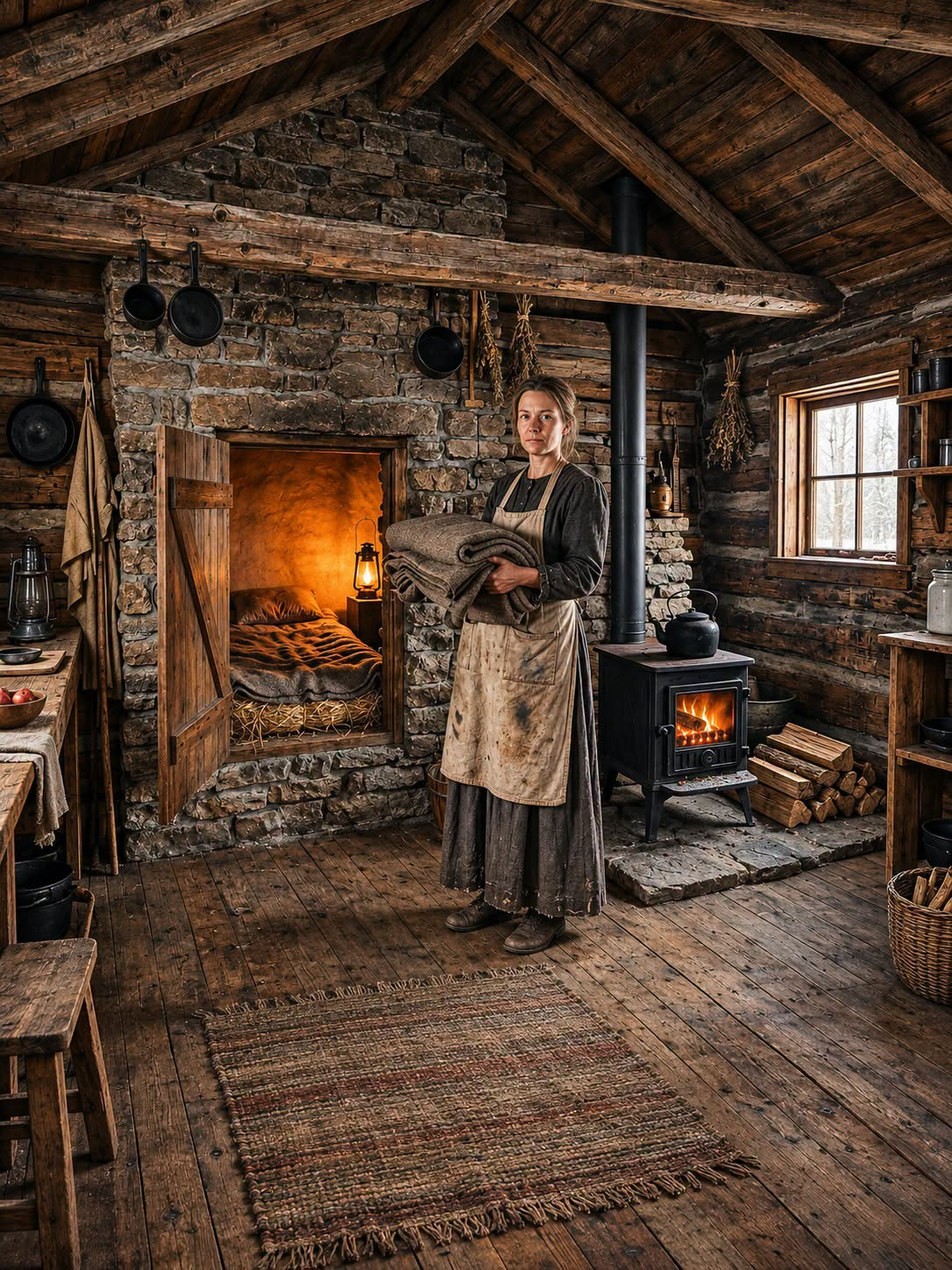
Two men stood in Clara Whitmore's doorway, staring at the enormous stone wall.
"Where in God's name does she expect to sleep?"
The older man pointed toward the stones.
The younger one laughed and knocked his knuckles against the limestone.
Then Clara opened the little wooden door.
And suddenly, neither man was laughing.
But that morning had not yet happened.
Three months earlier, when Clara Whitmore first showed the settlement what she intended to build, the reaction had been almost identical.
She had been standing in the middle of her unfinished cabin, holding a hammer in one hand and a folded piece of paper in the other.
Outside, several men were unloading timber from a wagon. A woman named Martha Bell had come to deliver a sack of flour. Two other settlers had followed her, curious about the widow who had arrived from Iowa with little more than a wagon, a few tools, and a determination that seemed considerably larger than her circumstances.
Clara was forty-six years old.
Her husband had died of fever the previous winter. They had spent years working farmland in Iowa, saving what little money they could and hoping that one day they might own a piece of land that belonged entirely to them.
That day never came.
After his death, Clara had discovered that staying in Iowa meant spending the rest of her life surrounded by memories and obligations she could no longer afford.
So she sold what remained of their belongings, purchased a small stretch of northern prairie land, and traveled north alone.
The settlement was not particularly welcoming.
People were accustomed to newcomers arriving with families, livestock, and plans that sounded sensible.
Clara arrived with none of those things.
She had a strong back, a practical mind, and no interest in explaining herself to people who had already decided what a widow could accomplish.
Her cabin measured sixteen by eighteen feet.
It was modest, but sturdy.
The pine logs were carefully fitted, the roof was low enough to resist the worst prairie winds, and the doorway faced south.
There was a small window, a wooden table, one chair, and enough room for cooking and storing supplies.
Anyone looking at the building from outside would have considered it ordinary.
Anyone entering it, however, noticed the wall.
It occupied an enormous portion of the interior.
Fieldstone rose from the packed earth floor almost to the roof beams. The structure was thick, uneven in places, and much larger than the little iron firebox incorporated into its center.
It looked less like part of a home and more like something built to protect a fortress.
Martha Bell had noticed it immediately.
She stood near the doorway, studying the stones.
"Clara, where are you putting your bed?"
Clara continued measuring a wooden frame.
"Inside the wall."
Martha blinked.
"Inside what?"
"The wall."
For several seconds, nobody answered.
Then a man outside laughed.
His name was Thomas Harlan. He was fifty-five, broad through the shoulders, and had lived in the settlement long enough to believe that experience gave him the right to question almost anything another person attempted.
He stepped through the doorway and looked at the construction.
"You're putting a bed in that?"
Clara nodded.
Thomas glanced toward the other man standing behind him.
Eli Mercer, forty-eight, was taller and thinner. He had a habit of smiling whenever Thomas made a joke, particularly when there was an audience.
"That isn't a bedroom," Eli said. "That's a stone coffin."
The men laughed.
Clara did not.
She placed her measuring stick against the wall and marked another line.
Thomas shook his head.
"Listen, widow. Winters here aren't like winters in Iowa. The wind comes across that prairie without a single tree to slow it down. You need a proper stove, a proper bed, and enough room to move around."
"I have a stove," Clara replied.
"A little iron box?"
"It's enough."
"And where are you going to put the firewood?"
"Beside the stove."
Thomas looked at the remaining floor space.
He laughed again.
"You've built yourself a house with no bedroom and no room for anything else."
Clara set down the measuring stick.
She looked at him.
"I built myself a house."
There was nothing particularly sharp in her voice.
That somehow made the response more uncomfortable.
Thomas turned away, muttering something about stubborn women.
Martha remained for another moment.
She seemed less amused than the men, but she was clearly worried.
"People are only trying to help you," she said.
"I know."
"That wall is going to make the room terribly small."
"Perhaps."
"And if the fire goes out in the middle of the night?"
Clara glanced toward the small firebox.
"Then the room will be cold."
Martha sighed.
She had expected an explanation.
Instead, Clara returned to her work.
The visitors eventually left.
Their laughter traveled across the clearing and disappeared into the afternoon wind.
Clara listened until she could no longer hear them.
Then she picked up her hammer.
She had not traveled hundreds of miles to let strangers decide how she would survive.
The idea for the wall had not appeared overnight.
During her years in Iowa, Clara had watched her husband struggle through winters when firewood became difficult to obtain.
They had lived in a small wooden house that heated quickly when the stove was burning.
It also lost warmth quickly.
Every night, someone had to rise from bed and feed the fire.
Sometimes the wood was damp.
Sometimes the wind pushed smoke back down the chimney.
Sometimes the fire died before dawn, leaving the floor so cold that stepping out of bed felt like placing bare feet on ice.
Clara remembered those mornings.
She remembered the exhaustion of waking repeatedly to tend the stove.
And she remembered something else.
Stone did not behave like wood.
A stone warmed slowly.
But once it became warm, it did not release that warmth immediately.
She had noticed it near an old fireplace years earlier, when the flames had been extinguished but the surrounding masonry remained warm long afterward.
At the time, it had seemed like an ordinary observation.
Now, living alone on the prairie, it had become the foundation of her entire plan.
She wanted a structure that would absorb heat while the fire burned and release it gradually after the flames disappeared.
She did not need to keep the whole cabin blazing through the night.
She needed a sleeping space protected by the warmth stored inside the stone.
That was the difference.
And it was why she had chosen the largest pieces of limestone she could find.
The nearest creek lay half a mile west.
Clara made the journey repeatedly.
She used a small wagon when the ground allowed it and carried individual pieces when the larger stones could not be moved easily.
Some were flat.
Some were rounded.
Others had sharp edges that made her hands bleed.
She learned which pieces fitted together and which required smaller stones to fill the gaps.
She mixed clay and sand by hand.
When the mortar needed additional binding, she worked animal hair into it.
The work was slow.
There were days when she could manage only a few courses of stone before her shoulders became too tired to lift another piece.
There were evenings when she sat beside the unfinished wall, rubbing her fingers and studying the measurements.
But she continued.
The firebox was placed near the center of the stone structure.
Its opening faced south, toward the table and chair.
The arrangement was unusual because the main purpose of the fire was not to warm the air as quickly as possible.
Clara wanted the heat to enter the masonry.
She built the structure around that purpose.
On the eastern side, she left a hollow space.
It measured approximately sixty inches in length.
Just enough room for a person to lie down.
The stone formed the back, ceiling, and sleeping platform.
A pine frame covered the opening.
Clara fitted the panel with iron hinges and worked carefully until its surface sat almost flush with the surrounding stone.
From the room, it looked like a small cupboard.
Nothing about it suggested that a person could sleep inside.
That was precisely what she wanted.
When the construction was finished, she climbed inside and tested the dimensions.
She could lie comfortably on the platform.
There was room for a wool blanket, a pillow, and a little space above her head.
The stone felt cool against her hand.
She imagined what it would feel like after several hours of fire.
She adjusted the frame once more.
Then she closed the panel.
From outside, it disappeared into the wall.
The first time Clara lit the firebox, she stayed awake for hours observing the structure.
She used split hardwood, arranged tightly enough to produce a strong, concentrated fire.
The flames burned hot.
The stone gradually absorbed their heat.
Clara checked the masonry at intervals, placing her palm against different sections.
Some areas warmed faster than others.
She made notes.
The next evening, she adjusted the amount of wood.
The evening after that, she changed the arrangement of the pieces.
She was not guessing.
She was testing.
And while the settlement continued to laugh about the widow's ridiculous stone wall, Clara was learning how to make it work.
One afternoon, Martha returned with a basket of apples.
She found Clara kneeling beside the sleeping alcove, fitting a final wooden support into place.
"You're still working on that thing?"
Clara looked up.
"Almost finished."
Martha stepped closer.
She noticed the little pine panel.
"Is that really where you're going to sleep?"
"Yes."
"But what if something happens?"
"What sort of thing?"
Martha hesitated.
"Fire. Smoke. The roof falling. I don't know."
Clara stood and brushed dust from her dress.
"The wall is made of stone. The firebox is separate from the sleeping space. I have taken care with the construction."
Martha studied her face.
"You really believe this will work."
Clara looked toward the firebox.
"I believe it is worth trying."
Martha set down the basket.
For a moment, she seemed to want to say something else.
Instead, she picked up her shawl.
"Well, I hope you're right."
Clara nodded.
"Thank you."
When Martha left, Clara returned to the wall.
She opened the little panel.
The alcove was dark and quiet.
She placed a folded wool blanket on the platform and smoothed it with both hands.
Then she sat at the edge.
For the first time since leaving Iowa, she felt that the cabin was becoming something more than shelter.
It was becoming a home designed around the way she wanted to live.
Outside, the prairie wind moved through the dry grass.
Inside, Clara closed the wooden panel.
She stood in front of the stone structure and studied its surface.
There was still much to learn.
The winter would be the real test.
And winter was approaching faster than anyone expected.
Three days later, Thomas Harlan stopped beside her cabin while returning from the settlement.
He looked at the chimney.
Then at the massive wall visible through the open doorway.
He shook his head.
"Still building that coffin, I see."
Clara did not answer.
Thomas walked away laughing.
But before he reached the path, he noticed something on the ground beside her cabin.
A fresh pile of split hardwood.
Stacked carefully.
Every piece nearly identical in size.
And beside it sat a small notebook Clara had left open on the wooden workbench.
Thomas stopped.
He leaned closer.
There were measurements on the page.
Temperatures.
Times.
And one sentence written beneath them:
Three hours of fire. Warm stone through the night.
Thomas stared at the words.
Then he heard Clara approaching from behind him.
She reached for the notebook.
Thomas looked at her.
"What's that supposed to mean?"
Clara closed the notebook.
"Something you'll understand when it gets cold."
Thomas opened his mouth to answer.
But his eyes had already moved back toward the little pine door.
And for the first time, he wondered what Clara had hidden behind it.
Tiến độ: Đã hoàn thành Chapter 1. Câu chuyện được triển khai theo đúng 15 chương đã liệt kê, giữ nguyên các sự kiện cốt lõi, nhân vật Clara, hai người hàng xóm, căn nhà gỗ và bí mật bức tường đá. Mỗi chương tiếp theo sẽ được viết nối tiếp, có cliffhanger riêng; Chapter 15 sẽ kết thúc trọn vẹn và có hậu.
Vì giới hạn độ dài mỗi lần trả lời, câu chuyện sẽ được gửi thành nhiều phần, không cắt ngang giữa một chapter.






Comments 0