"Arthur's letter was not meant for you."
The voice came from behind the moving stone wall.
Clara turned.
Samuel Reed raised the lantern.
A narrow opening had appeared beside the iron chest. Dust drifted through the air as the heavy stone panel moved several inches and stopped.
Someone stood behind it.
An elderly man stepped into the light.
He wore a dark wool coat, a brown hat, and leather boots covered in snow.
His hair was white.
His face was deeply lined.
But his eyes were sharp.
Thomas immediately recognized him.
"Mr. Whitcomb?"
Henry Harlan stood motionless.
Margaret gripped the edge of the desk.
Clara looked from one person to another.
"Who is he?"
Henry finally spoke.
"Edward Whitcomb. Arthur's younger brother."
Edward removed his hat.
"That's right."
Clara looked at the letter in her hands.
"Why wasn't I supposed to receive this?"
Edward glanced toward the paper.
"Because Arthur was not writing to the person who owned the cabin. He was writing to the person who understood the wall."
Clara frowned.
"I don't understand."
Edward approached the desk.
He placed his hat beside the old iron chest.
"My brother believed that someday someone would restore the eastern heating system. He knew the structure would eventually be forgotten. He also knew that the land would change hands."
He looked toward Clara.
"He wanted the person who rebuilt it to discover the truth."
Thomas stepped forward.
"What truth?"
Edward looked at Henry.
"Perhaps your father should explain."
Henry lowered his head.
For the first time, he did not try to avoid the question.
Edward opened the iron chest.
Inside were several bundles of documents, carefully wrapped in oilcloth.
He removed the first bundle and placed it on the desk.
The papers were old but remarkably well preserved.
There were property deeds, architectural drawings, personal letters, and a small leather journal.
Clara recognized Arthur's handwriting.
Edward opened the journal.
"My brother spent the final years of his life trying to protect this property from being divided and sold."
He turned several pages.
"After his wife died, Arthur became concerned about the future of the settlement. Winters were becoming harsher, and families were struggling to heat their homes."
Clara listened.
Edward continued.
"He believed the stone heating system could help them. He wanted to build several similar structures throughout the region."
Samuel Reed examined the drawings.
"These are construction plans."
"Yes," Edward replied. "Arthur intended to make them available to anyone who needed them."
Clara looked at the documents.
There were detailed measurements.
Instructions for selecting limestone.
Notes about mortar mixtures.
Diagrams showing the arrangement of the ventilation channels.
Everything was there.
The same principles she had discovered through weeks of difficult work.
But there was more.
At the bottom of the chest lay a sealed envelope.
Edward picked it up.
"This is the document that caused all the trouble."
He handed it to Henry.
Henry stared at the envelope.
His hands trembled.
Thomas looked at his father.
"What is it?"
Henry slowly opened it.
Inside was a deed.
It identified the entire eastern property as a protected family trust.
The land included Clara's cabin, the original heating chamber, the creek, and the abandoned stone foundation.
Thomas frowned.
"Who owns it?"
Edward answered.
"Not one person."
He placed another document on the desk.
"Arthur intended the property to be held for the benefit of the settlement. The cabin was supposed to remain available to someone willing to maintain the heating system and preserve the original structure."
Clara looked at him.
"Then what about the land I purchased?"
Edward nodded.
"Your purchase was legitimate. The deed transferred ownership of the cabin and the surrounding homestead. But the original underground structure was never properly recorded."
Clara glanced at the map.
"So the hidden chamber was part of the trust?"
"Yes."
"And the heating plans?"
"Arthur wanted them shared."
Clara looked toward the iron chest.
For weeks, she had believed she was building an unusual home.
Now she understood that she had unknowingly restored something much larger.
Edward turned toward Margaret.
"I owe you an apology."
Margaret remained silent.
Edward continued.
"I should have come forward years ago."
Margaret looked at him.
"You knew she was alive?"
Edward nodded.
"I suspected."
"Suspected?"
"I found evidence that Arthur had continued maintaining the chamber after you disappeared. But Henry refused to tell me where the lower entrance was."
Margaret's expression hardened.
"And you accepted that?"
Edward lowered his eyes.
"No. I did not."
He removed another document.
It was a letter dated twenty-two years earlier.
Arthur had written it shortly before his death.
The letter explained that the heating system had been damaged during a severe winter.
Margaret had become trapped inside the upper chamber.
Samuel Harlan had attempted to rescue her.
The lower passage collapsed.
Henry had managed to save Margaret, but Samuel remained trapped.
Arthur ordered Henry to keep the chamber supplied until a proper rescue could be organized.
But Arthur died before the work could be completed.
Edward looked toward Thomas.
"Henry was supposed to tell the county authorities. He never did."
Thomas turned toward his father.
"Why?"
Henry looked exhausted.
"Because I was afraid they would blame me for the collapse."
Margaret spoke quietly.
"You were afraid of losing your reputation."
Henry nodded.
"Yes."
"And so you let Samuel remain down there."
Henry closed his eyes.
"I know."
Thomas walked toward the window.
His hands were clenched.
He had spent twenty-three years believing his brother had abandoned him.
He had buried a lie.
He had mourned a person who had never died.
When he finally spoke, his voice was low.
"You took my brother away from me."
Henry did not defend himself.
"I did."
Thomas turned.
"Do you understand what that did to our family?"
Henry looked at him.
"I do now."
Thomas shook his head.
"You're only saying that because we found the documents."
Edward intervened.
"Thomas, your anger is justified. But there is something else you should know."
He opened the leather journal.
"Henry did not act alone in concealing the truth. Several people in the settlement knew about the lower chamber."
Thomas stared at him.
"Who?"
Edward placed a list on the desk.
Names.
Dates.
Signatures.
Among them were several former landowners and officials.
The secret had not belonged to one man.
It had been protected by an entire chain of silence.
Edward looked at Clara.
"That is why Arthur left these documents here. He wanted the truth to survive even if the people responsible tried to bury it."
The following morning, the weather cleared.
Samuel Reed traveled to the settlement to bring back the physician and several men who could help with the remaining repairs.
He returned before noon.
The physician examined Samuel Harlan.
His condition was serious, but he was stable.
He had suffered from malnutrition, weakness, and prolonged confinement.
His legs needed rehabilitation.
But he could recover.
Margaret remained beside him.
She refused to leave his side.
Thomas helped prepare a proper bed.
Clara gave them the sleeping alcove.
Samuel Harlan looked around the small space.
"Is this where you've been sleeping?"
Clara nodded.
He placed his palm against the stone.
"It's warm."
"That's the idea."
He smiled faintly.
"Arthur would have liked this."
Clara looked toward him.
"You knew him?"
Samuel nodded.
"He used to sit beside the fireplace and explain the design. He said the stones were better at remembering warmth than people were."
Clara laughed softly.
"That's a strange thing to say."
"He was a strange man."
Samuel looked toward the wooden panel.
"But he was right."
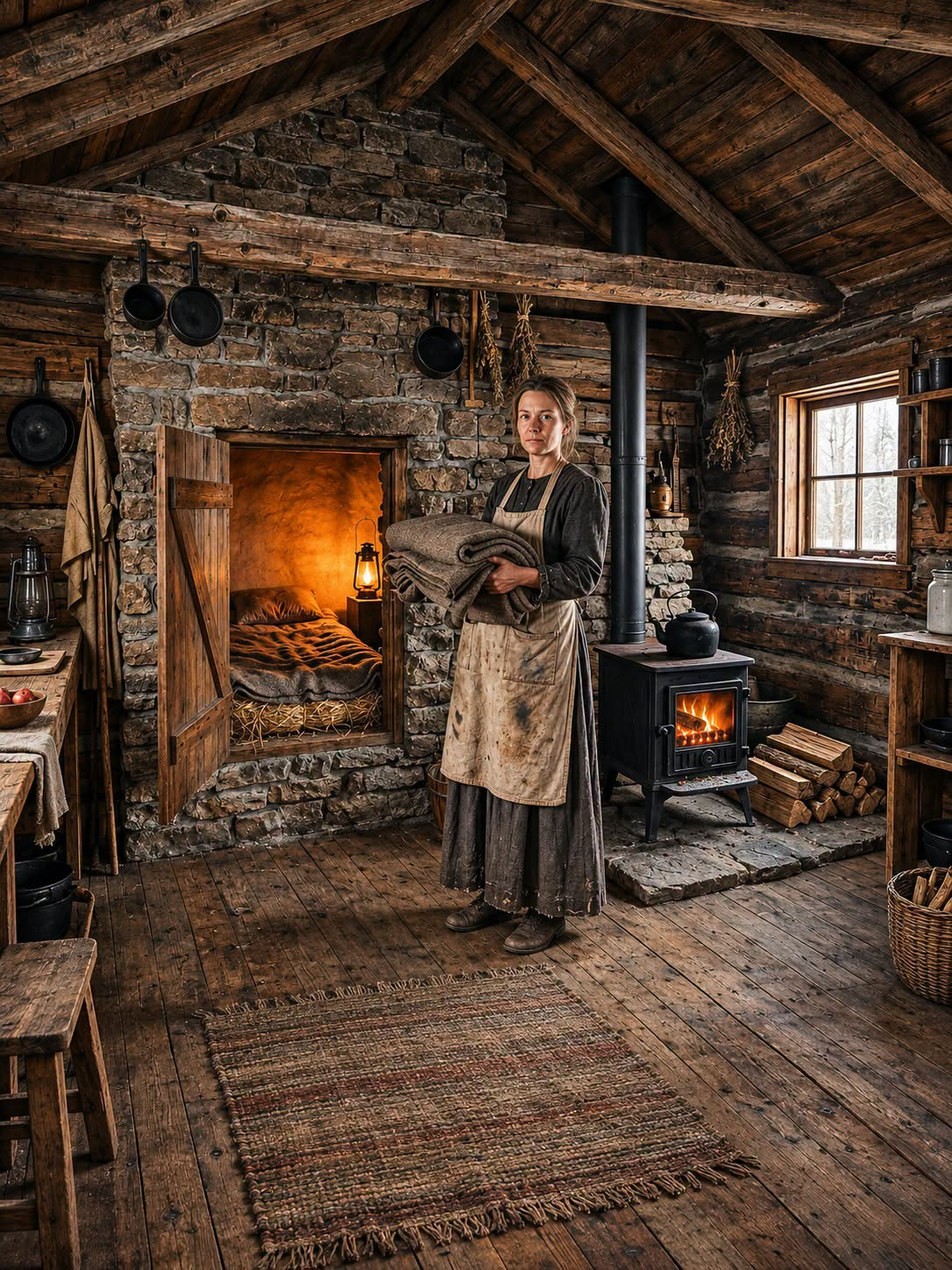
Clara folded another blanket.
For the first time since discovering the hidden chamber, the cabin felt peaceful.
There was still work to do.
The lower passage needed repairs.
The ventilation system required careful inspection.
The old timber supports had to be replaced.
But the people who had been trapped in the past were finally above ground.
That mattered more than anything else.
Over the next several days, the cabin became the center of activity.
Samuel Reed supervised the repairs.
Edward Whitcomb provided the original construction plans.
Clara measured the stones and recorded the temperature changes.
Henry assisted with the masonry.
He did not ask anyone to forgive him.
He simply worked.
He replaced damaged timber.
He repaired the eastern ventilation channel.
He helped reinforce the lower staircase.
And when Samuel Harlan needed assistance walking, Henry carried him outside to feel the sunlight.
The first time they stood together near the creek, neither man spoke.
Then Samuel looked at his father.
"You should have told me the truth."
Henry nodded.
"I should have."
"All those years."
Henry looked down.
"I know."
Samuel leaned against his walking stick.
"I don't know if I can forgive you."
Henry accepted the words.
"I understand."
Samuel looked across the snow-covered land.
"But I'm glad you came upstairs."
Henry's eyes filled with tears.
He reached toward his son.
Samuel did not pull away.
It was not forgiveness.
Not yet.
But it was the beginning of something.
Two weeks later, the county officials arrived.
Edward presented Arthur's documents.
The old property records were examined.
The hidden heating structure was officially recognized as part of the Whitcomb trust.
The documents also confirmed that Clara's cabin and her surrounding homestead remained legally hers.
She would not lose the home she had built.
More importantly, the original heating plans could now be preserved and shared.
The officials agreed to investigate the concealment of the lower chamber and the false reports surrounding Samuel's disappearance.
Henry gave a complete statement.
He admitted what he had done.
He admitted that he had concealed the collapse, lied about Samuel's departure, and maintained the secret for years.
There would be consequences.
He did not ask to escape them.
Thomas attended the meeting.
Margaret attended too.
Samuel Harlan sat beside his brother.
Clara brought the original notebook containing her temperature measurements.
The officials examined it carefully.
One engineer was particularly interested in her observations.
"You reconstructed much of the original system without the plans?"
Clara nodded.
"Not intentionally."
He smiled.
"That's remarkable."
Clara looked toward the drawings.
"I just needed a warm place to sleep."
The engineer laughed.
"Sometimes that's where the best inventions begin."
By early December, the cabin had changed.
Not its appearance.
The pine logs remained the same.
The wooden table stood in the same place.
The blackened firebox still occupied the center of the stone wall.
But the hidden structure had been restored.
The lower ventilation channel was clear.
The eastern chamber retained warmth.
The third chamber had been repaired and protected.
The iron chest and Arthur's records were moved to a secure room in the settlement for preservation.
The original sleeping alcove remained intact.
Clara kept the little pine panel.
She had no intention of replacing it.
It had become part of the cabin's history.
One afternoon, Samuel Reed brought a thermometer.
He checked the eastern wall.
Then he examined the sleeping platform.
"Still warm."
Clara nodded.
"How long since the fire went out?"
"Sixteen hours."
Samuel smiled.
"That's better than the old system ever managed."
Clara looked toward the fireplace.
"I think Arthur would have approved."
Samuel placed the thermometer on the table.
"He would have been proud."
Clara did not answer immediately.
She touched the stone.
The warmth was steady.
Quiet.
Reliable.
Exactly as she had intended.
The following week, Martha Bell visited.
She brought fresh bread and a jar of preserves.
When she entered, she looked toward the sleeping alcove.
"So this is the famous bedroom."
Clara smiled.
"Would you like to see it?"
Martha approached.
Clara opened the pine panel.
The stone platform was covered with a clean wool blanket.
The small space looked comfortable.
Martha leaned forward.
Then she placed her palm against the wall.
Her eyes widened.
"Good heavens."
Clara laughed.
"I told you."
Martha shook her head.
"I thought you were building a cupboard."
"Everyone did."
"Well, I suppose we were wrong."
Clara closed the panel.
Martha looked around the cabin.
"People have been talking."
Clara sighed.
"About what now?"
"They want to see the heating system."
Clara frowned.
"Why?"
"Because the county is considering building something similar near the schoolhouse."
Clara looked toward the documents on the table.
"That would be useful."
Martha nodded.
"And they want you to help."
Clara was quiet.
She had never intended to become an inventor.
She had simply wanted a home that stayed warm through winter.
But perhaps the system could help other families.
Perhaps the work Arthur had started could finally continue.
Clara looked toward the stone wall.
"Tell them I'll help."
By January, the first community heating project had begun.
Clara worked with Samuel Reed and several local builders.
They used Arthur's original drawings.
They adapted the measurements to the new building.
Clara explained how she had selected the limestone and mixed the mortar.
She showed them how to position the firebox.
She explained why the ventilation channels needed to remain clear.
The builders listened.
Some had laughed at her cabin months earlier.
Now they were asking her questions.
Thomas became involved too.
He helped transport stone and timber.
He also began spending more time with Samuel Harlan.
His brother's recovery was slow.
But every week, he became stronger.
Margaret moved into a small house near the settlement.
Edward helped arrange for her care.
She occasionally visited Clara.
Sometimes they talked about Arthur.
Sometimes they sat quietly beside the fireplace.
Neither needed to fill every silence.
One afternoon, Margaret brought Clara a small wooden box.
Inside was a photograph.
It showed Arthur standing beside the original stone structure.
A young Margaret stood beside him.
Henry was visible in the background.
Samuel Harlan was holding a hammer.
Thomas was a small boy standing near the creek.
Clara studied the picture.
It was difficult to imagine that so much history had existed beneath the ordinary-looking cabin.
Margaret touched the photograph.
"Arthur always said the wall would outlive all of us."
Clara looked toward the stones.
"Perhaps he was right."
Margaret smiled.
"Now it has someone to look after it."
Spring arrived slowly.
The snow melted.
The prairie turned green.
The creek began running freely again.
The settlement changed with the season.
The schoolhouse heating project was completed.
Several families asked for plans to build smaller versions of Clara's system.
The county agreed to preserve the original structure.
Arthur's documents were copied and distributed to local builders.
The hidden chambers were no longer secrets.
They became part of the region's history.
Henry accepted the consequences of his actions.
He was no longer responsible for maintaining the original structure alone.
He spent his remaining time helping Samuel Reed teach the younger builders.
He and Thomas did not become close overnight.
Some wounds needed more than a few conversations.
But they began meeting every Sunday.
Sometimes they worked together.
Sometimes they simply sat outside and talked.
Samuel Harlan continued recovering.
By spring, he could walk with a cane.
He moved into a small house near Thomas.
Margaret visited him regularly.
The two of them often spoke about the years they had lost.
They could never recover that time.
But they could decide what to do with the years ahead.
One evening, Clara stood outside her cabin.
The sun was setting over the prairie.
The chimney released a thin ribbon of smoke.
Inside, the stone wall was beginning to absorb the warmth of the evening fire.
She had finished the day's work.
Her notebook rested on the table.
The latest measurements were written neatly across the final page.
The heating system was working exactly as designed.
Three hours of fire.
Warmth through the night.
No midnight tending.
No desperate search for another piece of wood.
No cold floor beneath her feet.
Clara entered the cabin.
She placed the final dinner plate on the table.
Then she walked toward the eastern wall.
She opened the little pine panel.
The sleeping alcove was warm.
She touched the stone.
It felt almost alive.
Behind it lay the old chambers.
The preserved documents.
The passage that had once held so many secrets.
And the history of people who had struggled, made mistakes, and finally found their way back to one another.
Clara closed the panel.
She looked around her home.
It was still modest.
Still sixteen by eighteen feet.
Still built from pine logs and stone.
But it was no longer the strange cabin that had made the neighbors laugh.
It was a place where families could learn.
Where forgotten knowledge had been recovered.
Where a man who had been believed dead had returned to his brother.
Where a woman who had disappeared had finally been heard.
And where one widow, who had arrived alone on a cold stretch of prairie, had built something that would help an entire community.
Later that evening, Thomas and Samuel visited.
They brought a wooden chair Clara had ordered from the settlement.
Samuel Harlan walked inside without assistance.
He approached the eastern wall.
Then he placed his hand against the stone.
"Still warm," he said.
Clara smiled.
"Always."
Thomas looked toward the fireplace.
"You know, people still call this the cabin without a bedroom."
Clara laughed.
"Let them."
Samuel glanced at the little pine panel.
"Perhaps that's not such a bad name."
Clara looked at the two brothers.
For years, they had been separated by a lie.
Now they stood together inside the home that had helped bring them back.
Outside, the evening wind moved across the prairie.
Inside, the fire slowly faded.
The stones held their warmth.
And Clara finally understood what Arthur had wanted people to discover.
A good home was not measured by how much space it contained.
It was measured by how well it protected the people inside.
She closed the sleeping alcove.
Then she sat down with her guests.
For the first time since arriving on the prairie, she no longer felt like a stranger.
She had built a home.
She had found a purpose.
And she had helped restore a family that winter had nearly erased.
The little pine door remained set into the stone wall.
But nobody laughed at it anymore.






Comments 0