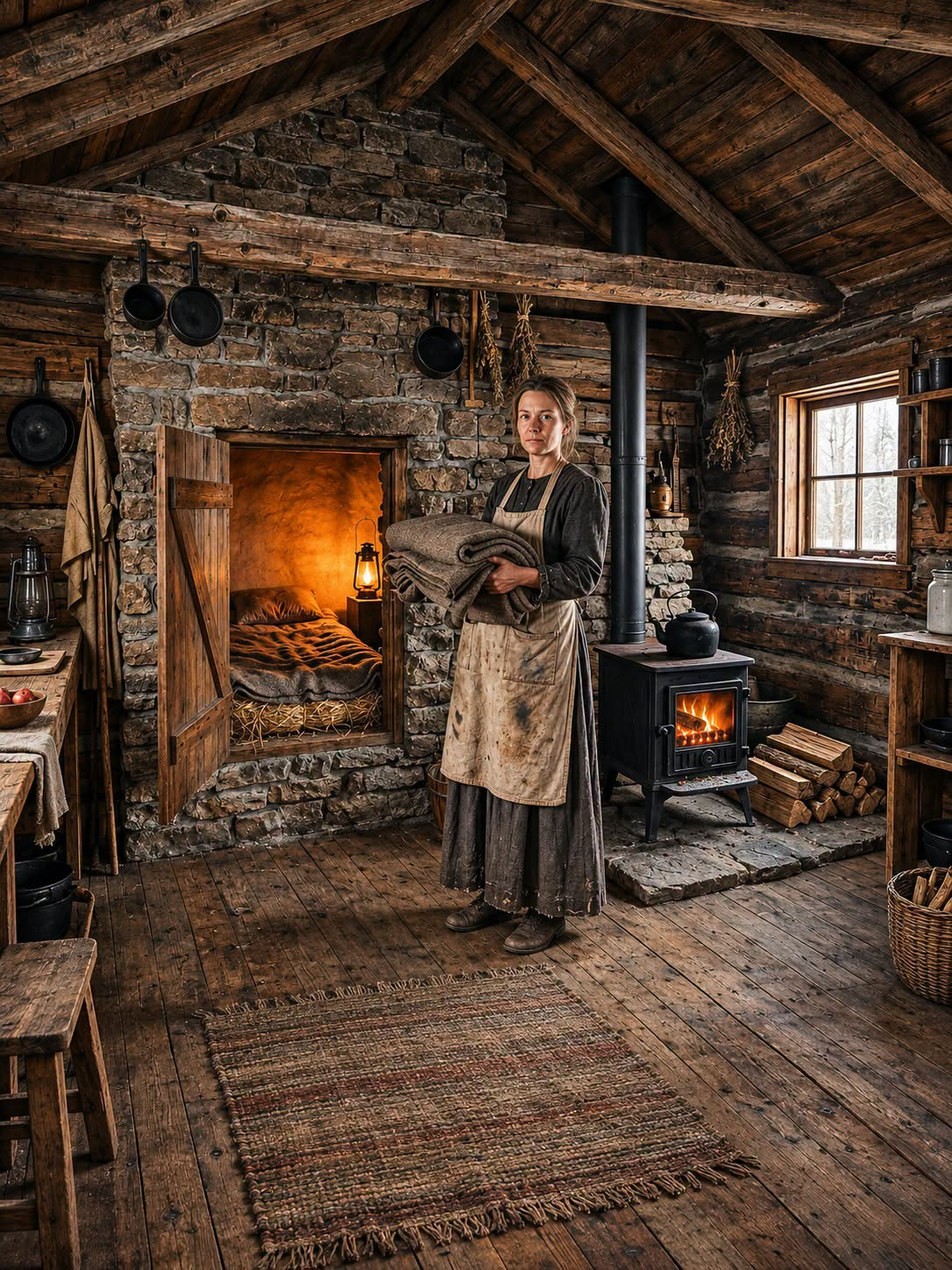
"You're making a mistake, Clara."
Thomas Harlan stood beside her woodpile, holding a piece of split oak as though it were evidence in a trial.
Clara did not look up.
She was kneeling beside the stone wall, carefully examining a narrow gap between two limestone pieces. A small wooden wedge rested between her fingers. She tapped it once with the handle of her hammer, paused, and checked the alignment.
Thomas waited.
He was not accustomed to being ignored.
"Did you hear me?"
"I heard you."
"Then perhaps you should listen."
Clara pressed the wedge into place.
Thomas dropped the oak onto the pile.
"That wall is too big. Your stove is too small. And you've left yourself hardly any room to live."
Clara finally stood.
She wiped her hands against her apron and looked at him.
"Is there something you need, Thomas?"
He frowned.
"Someone ought to tell you when you're doing something foolish."
"Someone already has."
Thomas stared at her.
For a moment, he seemed unable to decide whether she had insulted him.
Then he laughed.
"Well, I suppose a person has to learn the hard way."
He picked up his gloves and walked toward the settlement.
Clara watched him disappear beyond the trees.
Then she returned to her work.
She had learned something during the first weeks of her arrival.
Building a cabin was difficult.
Building one while everyone around her believed she was incapable of doing it was considerably harder.
The settlement had its own rules.
Not written rules.
Nobody had gathered the residents around a table and declared how a woman should build a home or how a widow should spend her money.
But everyone seemed to know.
A woman living alone was expected to make herself useful, accept assistance, and avoid unnecessary risks.
She was expected to ask questions before attempting anything unfamiliar.
She was expected to be grateful when men offered advice.
And, above all, she was expected to understand that surviving on the prairie required doing things the way they had always been done.
Clara understood those expectations.
She simply did not intend to follow all of them.
The following morning, Clara carried a basket of laundry to the small washing area near the settlement's communal well.
Three women were already there.
Martha Bell stood beside a wooden tub, rubbing a shirt against a washboard.
Beside her was Agnes Porter, a thin woman in her late fifties who had lived in the settlement for almost twenty years.
The third woman, Rebecca Harlan, was Thomas's wife.
Rebecca was younger than Agnes, but she had adopted her husband's habit of treating every disagreement as an opportunity to establish who knew more.
When Clara approached, their conversation slowed.
Martha offered a polite smile.
"Morning, Clara."
"Good morning."
Clara placed her basket on a low bench.
She began separating the laundry.
Agnes glanced toward the direction of Clara's cabin.
"Thomas says you're still building that stone contraption."
Clara folded a linen shirt.
"It's nearly finished."
"Does it have a proper chimney?"
"Yes."
"And a proper bed?"
Clara looked at her.
"Yes."
Agnes seemed confused.
Rebecca gave a small laugh.
"She means the bed inside the wall."
Agnes stopped washing.
"Inside the wall?"
Rebecca nodded.
"That's what she's telling everyone."
Martha sighed.
"I've seen it. There really is a little door."
Agnes looked at Clara.
"Why would you do something like that?"
Clara dipped a cloth into the water.
"Because stone holds warmth."
"Wood does too," Rebecca replied.
"Not in the same way."
Rebecca shook her head.
"My husband says you'll spend more wood heating all that stone than you would heating a proper room."
Clara wrung out the cloth.
"Perhaps."
The answer irritated Rebecca.
She had expected an argument.
Instead, Clara continued washing.
Agnes leaned closer.
"Have you thought about what happens if you get sick? You'll have nobody to help you."
Clara's hands slowed.
For a moment, the sound of water moving through the wooden tub seemed louder than the conversation.
"I have thought about it."
"And?"
"I intend to stay healthy."
Agnes looked disappointed.
"That isn't an answer."
"No," Clara said. "It isn't."
Martha watched her carefully.
She could tell Clara was becoming uncomfortable, although her face revealed almost nothing.
After a few minutes, the women returned to their laundry.
But Rebecca was not finished.
"My husband says you ought to sell that land and move closer to the settlement before winter."
Clara looked up.
"Why?"
"Because you can't manage everything alone."
"I've managed so far."
"That isn't the same as surviving a winter."
Clara folded the wet cloth over the edge of the tub.
"Then I suppose winter will tell us."
Nobody answered.
Clara finished her washing and lifted the basket.
As she turned to leave, Martha called after her.
"Clara?"
She stopped.
"Thomas doesn't mean any harm."
Clara looked back.
"I know."
"He just worries that you'll get hurt."
Clara nodded.
Then she walked home.
She understood that people often disguised their desire to control something as concern for its safety.
Sometimes they genuinely wanted to help.
Sometimes they simply disliked watching someone do something differently.
She had no way of knowing which kind of concern she was receiving.
So she concentrated on the work.
The cabin was still unfinished in several places.
The wooden door needed another adjustment.
A section of the roof required additional sealing.
The small window let in more air than Clara liked.
And the stone wall needed careful attention before she could trust it through the winter.
She spent most of the afternoon working on the sleeping alcove.
The platform was sixty inches long, but one corner needed smoothing.
She had discovered that even a small uneven surface became uncomfortable after several hours of lying down.
She used a hand tool to remove a rough edge.
Then she swept away the stone dust.
Inside the alcove, she placed a thin layer of dry material beneath the wool bedding.
She wanted the sleeping surface to be comfortable without filling the hollow with unnecessary objects.
When she finished, she crawled inside.
The space was narrow.
But it was not cramped.
She could stretch her legs, turn onto her side, and pull the blanket around her shoulders.
She rested her palm against the stone.
Cold.
That was expected.
The fire had not been burning.
Clara closed her eyes and imagined the evening ahead.
She would light the firebox.
She would allow the flames to burn hot.
She would spend the next few hours preparing food, repairing clothing, and finishing her notes.
Then she would let the fire die.
The stone would continue releasing warmth.
At least, that was the plan.
She needed to test it repeatedly.
One successful evening would prove very little.
A full winter would prove everything.
That evening, Clara lit her firebox just before sunset.
She used three carefully selected pieces of hardwood.
The flames caught quickly.
She sat at the wooden table with her notebook open.
There were columns of measurements on the page.
The first recorded the time she started the fire.
The second described the amount of wood.
The third contained observations about the stone.
She had begun keeping the notes because she did not trust memory.
A person could easily convince herself that something had worked better than it actually had.
Numbers were less forgiving.
Clara checked the stone near the firebox.
It was beginning to warm.
She moved toward the eastern side.
That section remained cooler.
She wrote it down.
Then she checked the upper stones.
Warmer than the previous evening.
Another note.
Outside, the light gradually disappeared.
A wagon passed along the road.
Clara heard voices.
Someone laughed.
She did not look through the window.
The fire continued burning.
After a while, there was a knock at the door.
Clara opened it.
Martha stood outside with a covered bowl.
"I made too much stew."
Clara stepped aside.
"Come in."
Martha entered and looked toward the fire.
"That's a very small fire."
"Yes."
"Are you certain it will be enough?"
Clara took the bowl.
"I've been testing it."
Martha removed her gloves.
She approached the stone wall and studied its surface.
"It doesn't look warm."
"Not yet."
"How long does it take?"
Clara glanced at her notebook.
"That depends on the stones and the fire."
Martha looked at the writing.
She leaned closer.
"Are all those measurements?"
"Most of them."
"You really are treating this like an experiment."
Clara gave a small nod.
Martha smiled faintly.
"My husband would have called you stubborn."
"Your husband calls everyone stubborn."
That made Martha laugh.
It was the first genuinely comfortable moment they had shared since Clara arrived.
Martha placed her hands near the firebox.
"I still think you should have built a proper bedroom."
Clara stirred the stew.
"I know."
"But I suppose it isn't my decision."
"No."
Martha looked toward the little pine panel.
"Can I see inside?"
Clara hesitated.
Then she walked over and opened it.
The alcove was dark.
Martha bent slightly to examine the platform.
She touched the stone.
It was warmer than the rest of the room.
Her eyebrows lifted.
"Already?"
Clara nodded.
"The fire has been burning for nearly two hours."
Martha looked at the sleeping space again.
For the first time, she seemed to understand that the wall had a purpose beyond occupying the cabin.
But she was not convinced.
"Will it stay warm?"
"That's what I'm trying to find out."
Martha straightened.
She looked at Clara for a long moment.
Then she placed the covered bowl on the table.
"Well, I hope it does."
Before leaving, she paused at the doorway.
"Clara, if you need anything, you can come to me."
"Thank you."
"And don't wait until you're in trouble."
Clara met her eyes.
"I won't."
Martha departed.
Clara closed the door.
She returned to her notes.
The fire had burned for nearly three hours by the time she finally allowed it to die.
She did not add another log.
Instead, she waited.
She checked the stone at several points.
The temperature was not uniform, but the structure had absorbed a considerable amount of warmth.
Clara placed her hand against the interior of the sleeping alcove.
The stone was noticeably warmer than it had been earlier.
She climbed inside.
The blanket rested beneath her.
She lay down and closed the pine panel.
For several minutes, she listened.
The cabin was quiet.
The wind moved across the roof.
The firebox gave a faint metallic sound as it cooled.
Clara rested one hand against the stone beside her shoulder.
It was warm.
Not hot.
Warm.
She allowed herself to breathe more slowly.
For the first time, she could imagine sleeping through the night without waking to feed the fire.
But she did not consider the experiment finished.
She had only tested one evening.
The next day brought an unexpected problem.
Clara was carrying a bucket of water from the well when she noticed a wagon standing outside her cabin.
Thomas Harlan was beside it.
Eli Mercer sat on the wagon seat.
A third man stood near the rear wheel.
His name was Samuel Reed.
Samuel was a carpenter who had helped build several homes in the settlement.
He was not as outspoken as Thomas, but people respected his opinion because he understood construction.
Thomas raised a hand.
"Clara."
She set the bucket down.
"What is it?"
Samuel approached the cabin.
"We heard you were making changes to the chimney."
Clara glanced toward the roof.
"I am checking the joints."
"Thomas says the smoke isn't drawing properly."
"It draws properly."
"How do you know?"
"I've tested it."
Thomas stepped closer.
"You can't just build something unusual and expect everyone to believe it's safe."
Clara looked at him.
"I haven't asked anyone to believe anything."
Samuel examined the firebox.
He looked at the stonework.
Then he looked toward the small wooden panel.
"Is this the sleeping space?"
"Yes."
He leaned toward it.
"How is the air moving in there?"
Clara explained what she had considered when designing the alcove.
Samuel listened.
His expression remained serious.
He asked several questions about the dimensions, the placement of the firebox, and the materials.
Clara answered as clearly as she could.
When she finished, Samuel looked toward Thomas.
"I'd like to examine the chimney."
Thomas seemed pleased.
"That's what I've been saying."
Clara stepped aside.
"Go ahead."
Samuel inspected the visible sections.
He checked the joints and examined the opening.
He did not immediately criticize anything.
That made Clara more comfortable than Thomas's constant commentary.
Eventually, Samuel straightened.
"The stonework is solid."
Thomas folded his arms.
"That doesn't mean the whole thing is sensible."
"No," Samuel replied. "It doesn't."
He turned to Clara.
"Have you checked how the structure behaves after the fire goes out?"
"Every evening."
"And?"
"It continues releasing warmth."
Samuel nodded.
He looked at the wall again.
"Interesting."
Thomas frowned.
"Interesting? It's a bedroom inside a pile of rocks."
Samuel ignored him.
He walked toward the eastern side of the structure and touched the stone.
Then he looked at Clara.
"How long did it take you to build this?"
"Several weeks."
"Alone?"
"Mostly."
Samuel glanced toward the wagon.
"That's a great deal of stone."
"Half a mile from the creek."
He gave a low whistle.
"That's a long way to haul it."
Clara shrugged.
"It was what I needed."
Thomas was becoming impatient.
"Samuel, you're making it sound like she's built something remarkable."
Samuel did not answer immediately.
He was looking at the small panel.
Then he noticed something Clara had not intended anyone to see.
A faint dark mark ran along one edge of the wooden frame.
He crouched.
He touched it with his thumb.
"Clara, what's this?"
She stepped closer.
Her expression changed.
She looked at the mark.
Then she looked at the upper edge of the panel.
For a moment, she said nothing.
Samuel examined the hinge.
Thomas leaned forward.
"What is it?"
Clara reached toward the little wooden door.
She opened it halfway.
Then she stopped.
Something was not right.
The panel had shifted slightly.
One hinge was no longer sitting as firmly as it had the previous evening.
Clara studied the frame.
Samuel stood.
"That needs attention."
"I know."
Thomas shook his head.
"See? This is exactly what I've been talking about."
Clara did not respond.
She was examining the hinge.
Samuel offered to help repair it.
Clara thanked him, but asked him to wait while she fetched her tools.
She walked toward the workbench.
Thomas followed.
"You should let us rebuild the whole thing before winter."
"No."
"Clara, don't be foolish."
She picked up the iron tools.
"I said no."
Thomas's face reddened.
Samuel looked between them.
"Thomas, leave it."
But Thomas was not finished.
He stepped toward the wooden panel and placed his hand on its edge.
"One day, you'll understand that a person can't live out here by ignoring everyone."
Clara turned.
Her eyes settled on his hand.
"Please don't touch that."
Thomas looked at her.
Then he slowly removed his hand.
Clara approached the panel.
She examined the hinge again.
The frame had not failed.
But something had shifted.
She could repair it.
That was not the problem.
The problem was the mark beneath the hinge.
It was darker than the surrounding wood.
And it had not been there the previous evening.
Samuel noticed her expression.
"Is something wrong?"
Clara crouched and brought her face closer.
Then she saw another mark.
A narrow line.
Running from the hinge toward the lower edge of the panel.
She touched it carefully.
The wood felt damp.
Her eyes moved toward the stone above it.
There was no obvious leak.
No visible crack.
Nothing that explained the moisture.
Thomas gave an impatient sigh.
"Well? What is it now?"
Clara did not answer.
She stood and walked to the workbench.
She took out her notebook.
She turned to the page where she had recorded the previous evening's observations.
Then she looked toward the wall again.
Something had changed.
And when she reached the final line of her notes, she discovered a measurement that should not have been possible.
It had been written in her own handwriting.
But she had no memory of recording it.
The eastern wall had lost warmth almost twice as quickly as the previous night.
Clara slowly closed the notebook.
Behind her, Samuel stepped toward the chimney.
Then he called her name.
"Clara. You need to come and look at this."
She turned.
Samuel was standing beside the firebox, holding something small in his hand.
His expression had changed completely.
"Where did you get this?" he asked.
Clara stared at the object.
It was a fragment of dark, brittle material.
And it had come from inside her chimney.
Then Samuel looked toward the wooden sleeping panel.
"Clara, I don't think this problem started with the hinge."
He pointed toward the stone wall.
Something inside it was beginning to fail.






Comments 0