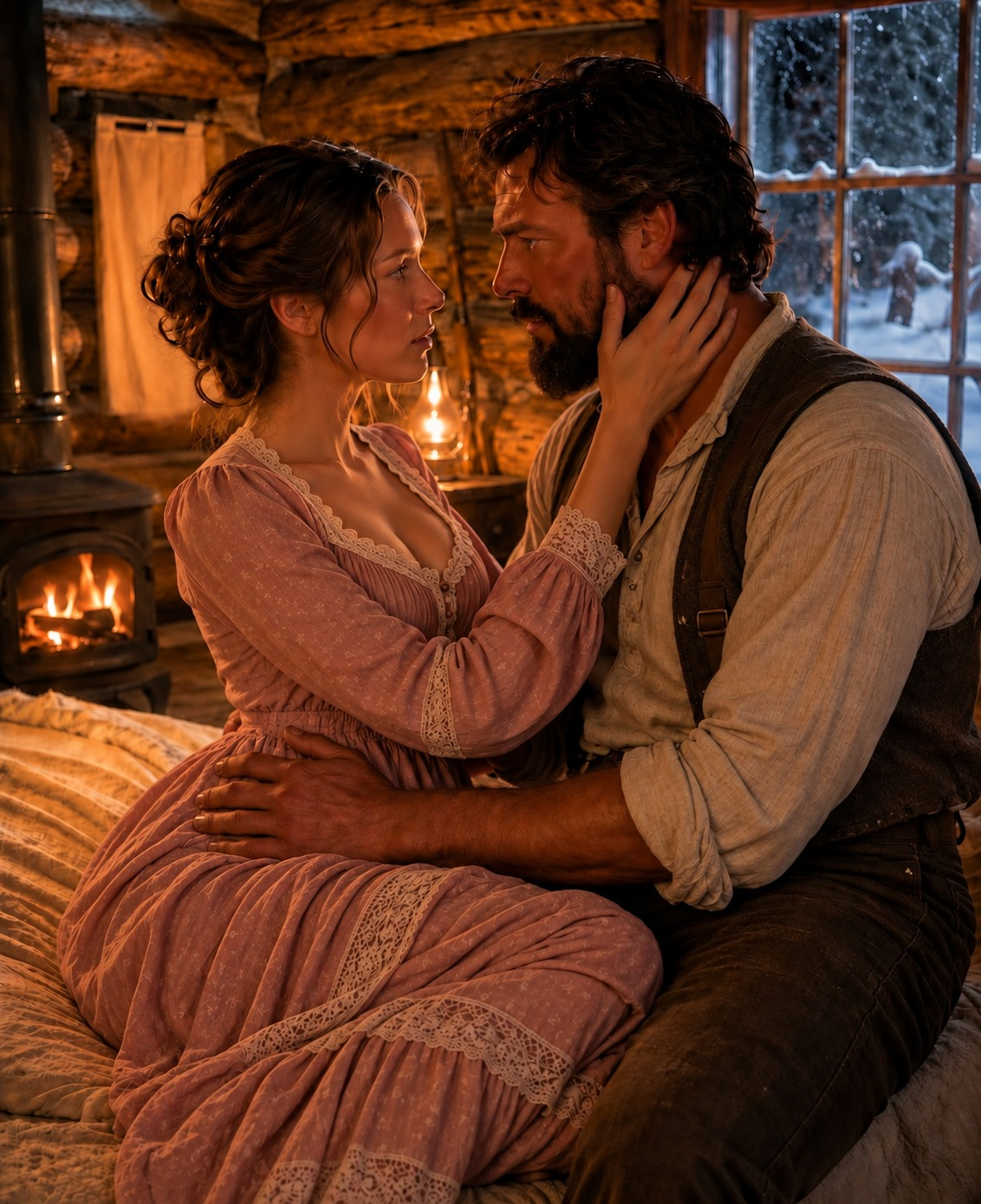
"Get away from that window!" Caleb shouted.
Eleanor stumbled backward.
The iron latch was turning.
Slowly.
Deliberately.
From the outside.
Caleb crossed the cabin in three enormous strides, seized the window frame, and slammed his palm against the latch.
A sharp metallic crack echoed through the room.
The movement stopped.
For one terrible second, Eleanor saw a man's face beyond the frost-covered glass.
A dark hat.
A scarf pulled over his mouth.
Two eyes watching her.
Then the figure vanished into the storm.
Caleb grabbed the rifle resting beside the fireplace.
"Eleanor. Behind me."
She couldn't move.
Her legs felt as though they belonged to someone else.
The voice outside had been Henry's.
Her dead husband's voice.
She had heard it clearly.
Not in a dream.
Not in a memory.
Here.
In the Colorado mountains.
Eleven months after she had watched his coffin disappear beneath the ground.
"Did you hear him?" she whispered.
Caleb checked the rifle.
"Stay away from the window."
"Caleb, did you hear what he said?"
"I heard a man."
Her stomach dropped.
"A man?"
"Yes."
"But his voice—"
A heavy thud struck the cabin wall.
Eleanor screamed.
Caleb moved immediately.
He caught her by the shoulders, guiding her away from the window without gripping her tightly.
"Look at me."
She couldn't.
Her eyes remained fixed on the glass.
"Eleanor."
His voice was firm.
Not angry.
Not impatient.
Firm enough to reach through her panic.
She looked up.
"You're inside," he said. "He's outside. And he's not coming through that window."
Another thud sounded.
Caleb turned toward the door.
Eleanor caught his sleeve.
"Don't go out there."
He looked down at her hand.
"Someone's circling the cabin."
"Please."
The word escaped before she could stop it.
Caleb's expression changed.
He lowered the rifle slightly.
"I'm not leaving you alone."
"Promise?"
"I promise."
He led her toward the fireplace.
"Sit here. Keep away from the windows."
Then he moved to the front door and examined the latch.
It was still secured.
He checked the hinges.
The lower wooden panel.
The narrow gap beneath the door.
Eleanor watched him work.
There was nothing theatrical about his movements.
No shouting.
No threats.
No attempt to prove his courage.
He simply inspected every possible entrance with the calm concentration of a man accustomed to surviving dangerous situations.
At last, he returned to the window.
The storm had thickened.
Snow struck the glass in hard, slanting sheets.
The figure was gone.
Caleb waited.
One minute.
Two.
Three.
Nothing moved outside except the trees.
Finally, he lowered the rifle.
"He's gone for now."
Eleanor wrapped her arms around herself.
"How can you know?"
"Because the dogs stopped barking."
She stared at him.
"Dogs?"
"Two hounds in the shed. They were making enough noise to wake the mountains."
She had been so frightened she hadn't heard them.
Caleb looked toward the window again.
"Whoever came here knows how to travel in snow."
"Why?"
"Because he reached this cabin after dark without freezing to death."
Eleanor swallowed.
"Could he be a lost traveler?"
Caleb looked at her.
"A lost traveler knocks on the door."
Neither spoke.
Then Eleanor whispered the words she had been trying not to say.
"I think it was my husband."
Caleb became still.
"Your husband?"
"My first husband."
He looked at her for a long moment.
"Henry Whitmore?"
She nodded.
"He's dead," Caleb said quietly.
"I know."
"You told me he died last spring."
"He did."
"Then why do you think—"
"Because I heard his voice!"
The words burst out louder than she intended.
Caleb stopped speaking.
Eleanor pressed a trembling hand against her mouth.
"I'm sorry."
"Don't apologize."
"I don't know what's happening."
"Then we'll find out."
She looked at him.
His expression was serious.
Not dismissive.
Not amused.
He wasn't looking at her as though she were foolish.
He was looking at her as though something dangerous had happened and he intended to understand it.
That frightened her almost as much as the voice.
Because it meant he believed there might be a real threat.
Caleb built up the fire.
Then he brought Eleanor a cup of hot water sweetened with a little honey.
She accepted it with both hands.
He sat across from her.
The rifle rested beside his chair.
For several minutes, neither spoke.
The cabin smelled of woodsmoke and damp wool.
The wind rattled the shutters.
Eleanor stared into her cup.
Finally, Caleb asked, "What did he mean?"
She looked up.
"What?"
"The man outside. He said something about the night your husband died."
Eleanor felt the blood drain from her face.
"You heard that?"
"Every word."
She looked away.
Caleb waited.
She had learned during her first marriage that silence could be a punishment.
But Caleb's silence was different.
He was giving her time.
Somehow, that made the truth harder to tell.
"Henry died in our house in Baltimore," she began.
Caleb nodded.
"He had been drinking."
She stopped.
Her fingers tightened around the cup.
"He drank often. Especially toward the end."
"Was he sick?"
"No."
"Then what happened?"
Eleanor stared at the flames.
"We argued."
Caleb remained quiet.
"He had lost money. A great deal of money. He blamed me because I had refused to sell my mother's jewelry."
"Was it yours?"
"Yes."
"Then you had every right to refuse."
The answer came so naturally that Eleanor looked at him.
Henry had insisted that everything belonging to a wife belonged to her husband.
Even the things she had inherited before marriage.
Especially those.
She swallowed.
"He became angry."
Caleb's expression tightened.
"Did he hurt you?"
Eleanor looked down.
She had promised herself she would never tell another man what had happened inside Henry Whitmore's house.
Not because she was ashamed of surviving it.
But because people in Baltimore had already made their judgments.
A respectable woman did not speak publicly about her husband's temper.
A respectable widow did not complain about a dead man.
And a woman who needed money had little power to challenge the stories wealthy creditors told about her.
"Eleanor."
She raised her eyes.
Caleb spoke gently.
"You don't have to answer."
Something inside her cracked.
She had expected him to demand the truth.
Instead, he offered her the right to keep it.
"Yes," she whispered.
His jaw tightened.
"He hurt me."
Caleb looked toward the fire.
For a moment, she saw anger move across his face.
It was the first time she had seen anything truly dangerous in his expression.
But he did not raise his voice.
He did not strike the table.
He did not ask why she had stayed.
He simply said, "I'm sorry."
Eleanor blinked.
"You're sorry?"
"That somebody treated you that way."
She lowered her head.
The words should not have mattered so much.
But they did.
"That night," she continued, "Henry came home after midnight."
Caleb listened.
"He was drunk. He had been gambling. He accused me of hiding money."
"Had you?"
"No."
She hesitated.
"Not then."
Caleb said nothing.
"I had started putting aside small amounts from the household allowance. Enough to leave, eventually. But he found the money before I could."
Her voice grew quieter.
"He said I had stolen from him."
Caleb's hands tightened around his knees.
"He dragged me into his study."
She could still remember the smell.
Brandy.
Cigar smoke.
The expensive leather chair beside the desk.
The sharp edge of the silver letter opener Henry kept near his papers.
"He demanded that I sign something."
"What?"
"A document saying I had borrowed money against the house."
"Had you?"
"No."
"Why would he want your signature?"
"I didn't understand then."
She looked at Caleb.
"After he died, the creditors came with documents bearing my name. They said I was responsible for debts I had never agreed to."
Caleb frowned.
"Did you sign?"
"No."
"Not anything?"
"I refused."
"What happened next?"
Eleanor's mouth went dry.
"Henry grabbed my wrist."
She rubbed it unconsciously.
"He pushed me against the desk. I tried to get away."
Caleb's gaze dropped to her hand.
"Then?"
"He slipped."
The word came out almost soundlessly.
"He had been drinking. There was a broken glass on the floor. His foot caught against the rug."
She closed her eyes.
"He fell backward and struck his head against the stone fireplace."
Caleb waited.
"There was blood."
Her voice trembled.
"So much blood."
She remembered kneeling beside him.
Calling his name.
Shaking his shoulder.
The terrible stillness.
Then the servants rushing into the room.
The physician arriving.
The police asking questions.
And the dreadful moment when everyone stopped looking at Henry and began looking at her.
"Did you try to help him?" Caleb asked.
"Of course."
"Then you did nothing wrong."
She shook her head.
"You don't understand."
"Tell me."
"The physician said Henry died from the injury. But one of his creditors claimed I had pushed him."
Caleb's expression hardened.
"Did you?"
"No!"
The answer came immediately.
She stared at him.
"No. I never pushed him."
"I believe you."
Eleanor went silent.
He had said it without hesitation.
Without demanding proof.
Without asking whether she had provoked Henry.
She looked down at her hands.
"Most people didn't."
Caleb leaned forward.
"Then most people were wrong."
The fire settled.
A log cracked.
Eleanor took a slow breath.
"There was an investigation."
Caleb nodded.
"The servants told the police what they heard. The physician confirmed the injury. Eventually, Henry's death was ruled accidental."
"Then why did the creditors take your property?"
"Because Henry had borrowed against nearly everything we owned."
She gave a bitter smile.
"Everything except the things that had belonged to my mother. And even those they tried to claim."
Caleb studied her.
"That's when you answered my advertisement."
"Yes."
She remembered the newspaper.
The narrow column of notices.
The strange little advertisement that had seemed almost too plain to be genuine.
Colorado landowner seeks respectable wife. Isolated mountain property. Honest work. No children. No drinking. Correspondence invited.
She had read it three times.
Then she had written a letter.
She had not expected an answer.
But Caleb had replied within three weeks.
His handwriting was careful.
His sentences were short.
He had explained that he owned his cabin and the surrounding land.
That he trapped through winter.
That he had no family nearby.
That he wanted a wife willing to endure solitude.
He had asked whether she liked mountains.
She had never seen mountains.
She wrote that she hoped she would.
Then came more letters.
Practical questions.
Honest answers.
Eventually, he offered to pay her outstanding debts and travel expenses.
She accepted.
Not because she loved him.
Not because she believed in romance.
But because she was tired of being afraid.
"I thought I was escaping Baltimore," she whispered.
Caleb looked at her.
"Maybe you still have."
She shook her head.
"Someone followed me."
"Someone came here," he corrected. "That doesn't mean he'll stay."
"You don't know who he is."
"No."
"He knows about Henry."
"Yes."
"And he knows what happened that night."
Caleb's expression grew thoughtful.
"Or he knows what somebody told him."
Eleanor looked up.
"What do you mean?"
"If he wanted to frighten you, he'd use the thing that frightened you most."
She considered that.
The voice.
The handwriting.
The accusation.
It had all been designed to reach into the deepest part of her past.
"Someone wants me to believe Henry is alive," she whispered.
Caleb nodded.
"That would be my guess."
"But why?"
He looked toward the window.
"That's what worries me."
Near dawn, the storm weakened.
Caleb stood and reached for his coat.
Eleanor immediately rose.
"Where are you going?"
"Outside."
"You promised you wouldn't leave me."
"I promised I wouldn't leave you alone while that man was outside the window."
"He might still be there."
"Then I need to know."
She caught his sleeve.
"Please don't."
Caleb looked down at her hand.
His expression softened.
"I'll stay where you can see me."
She glanced toward the window.
"From inside?"
"From inside."
He took a lantern from the shelf.
Then he moved toward the door.
Eleanor stood behind him.
He opened it only after checking the snow through a narrow crack.
Cold air rushed into the cabin.
The lantern flame trembled.
Caleb stepped onto the porch.
Eleanor remained just inside the doorway.
The world beyond was white.
Snow covered the woodpile.
The fence.
The narrow trail leading into the trees.
Caleb crouched beside the window.
Then he stopped.
Eleanor saw his shoulders stiffen.
"What is it?"
He didn't answer immediately.
He lowered the lantern.
Then he examined something beneath the window.
"Caleb?"
"Stay inside."
"What did you find?"
"Tracks."
Her stomach tightened.
"Human?"
"Yes."
"How many?"
He studied the snow.
"One person came close to the cabin."
"Only one?"
"Near the window."
He moved a little farther.
"There's a horse trail behind the shed."
Eleanor stared.
"Someone rode here?"
"Looks that way."
He followed the tracks toward the woodpile.
Then he stopped again.
He bent down.
When he straightened, something small rested in his gloved hand.
He returned to the doorway.
Eleanor stepped aside.
Caleb closed the door and placed the object on the table.
It was a silver button.
Round.
Heavy.
Engraved with a tiny crest.
Eleanor recognized it immediately.
Her knees weakened.
Caleb caught her elbow.
"What is it?"
She stared at the button.
A rearing horse stood beneath a crown.
The Whitmore family crest.
Henry had worn buttons like that on his favorite black coat.
She remembered sewing one back onto his sleeve after he tore it during an argument.
"That belonged to Henry," she whispered.
Caleb looked down.
"Are you certain?"
"Yes."
"Could someone else own the same kind?"
"Possibly."
She touched the engraved crest.
"But Henry had them made especially for him."
Caleb said nothing.
Eleanor looked at him.
"How did it get here?"
He studied the button.
"Somebody wanted you to find it."
The answer frightened her more than she expected.
Because it meant the stranger had not merely come to the cabin.
He had come prepared.
Caleb examined the window latch.
The metal was scratched.
A thin wire had been pushed through a narrow gap in the wooden frame.
He showed Eleanor how it worked.
"The latch is old. Someone who knew what he was doing could lift it from outside."
"Could he have entered?"
"If I hadn't reached it, yes."
Eleanor looked toward the bed.
She had been sleeping inches from that window.
Caleb saw where she was looking.
"I'll fix it today."
She nodded.
"And I'll put a bar across the frame."
"Thank you."
He hesitated.
"Would you rather sleep farther from the window?"
Eleanor looked at the bed.
Then at the blankets beside the stove.
"Where would I sleep?"
"We can move the bed."
She almost smiled.
"Caleb, the bed weighs more than I do."
"I can move it."
"Of course you can."
He looked confused by her tone.
She shook her head.
"That isn't necessary."
"Are you sure?"
"Yes."
He nodded.
Then he picked up the button.
"I'll keep this somewhere safe."
Eleanor reached for it.
"May I?"
He placed it in her palm.
She turned it over.
The back was scratched.
A thin line ran across the silver.
And beneath the clasp was something she had not noticed before.
A small number.
Seventeen.
She frowned.
Henry's buttons had never been numbered.
At least, not that she remembered.
"Caleb?"
He looked up.
"Do you have paper?"
"Of course."
"And a pencil?"
He brought both.
Eleanor copied the number carefully.
Then she wrapped the button in a scrap of cloth.
"Why seventeen?" she whispered.
Caleb leaned against the table.
"Could be anything."
"An address?"
"Maybe."
"A date?"
"Could be."
She looked toward the window.
"Or a warning."
Caleb didn't answer.
By midday, the sun appeared briefly between the clouds.
Caleb worked outside, repairing the window frame and reinforcing the door.
Eleanor watched him from the table.
He moved with remarkable efficiency.
Every nail had a purpose.
Every board was measured.
Every tool returned to its place.
When he came inside for more nails, she asked, "Were you always so good with your hands?"
He looked at her.
"At fixing things?"
"Yes."
"My father taught me."
"Was he a carpenter?"
"Trapper."
"Like you."
Caleb nodded.
"He said a man who couldn't repair his own shelter wouldn't survive his first winter."
Eleanor looked at the shelves he had built.
The carefully fitted door.
The smooth wooden table.
"He taught you well."
Caleb's expression softened.
"He did."
She hesitated.
"Do you miss him?"
"Every day."
The answer was quiet.
Eleanor lowered her gaze.
"I'm sorry."
Caleb set down the nails.
"He was a good man."
"What happened to him?"
For a moment, Caleb said nothing.
Then he looked toward the mountains.
"Winter accident."
Eleanor waited.
He did not elaborate.
She remembered how gently he had allowed her to keep her own painful memories.
So she did not press.
Instead, she asked, "Did your father teach you to cook?"
Caleb looked relieved.
"No."
"Then who did?"
"Hunger."
She laughed.
The sound surprised them both.
Caleb stared at her.
Eleanor covered her mouth.
"I'm sorry."
"Why?"
"I didn't mean to laugh."
He looked almost pleased.
"I was trying to be funny."
She laughed again.
This time, he smiled.
It transformed his face.
For a moment, the enormous wilderness trapper looked younger.
Less guarded.
Almost shy.
Eleanor felt a warmth that had nothing to do with the fire.
Then she remembered the silver button hidden in her trunk.
The smile faded.
Caleb noticed.
"He's not here now," he said.
She looked up.
"The man from last night."
"I know."
"You're safe inside."
She wanted to believe him.
More than anything.
That afternoon, Eleanor decided to make bread.
Caleb had flour, yeast, and a heavy iron baking pan.
He watched her measure the ingredients with open curiosity.
"Have you never seen bread made?" she asked.
"Not like that."
"How do you usually make it?"
"Mix flour and water. Cook it."
She stared at him.
"That's not bread."
"It fills you up."
"Caleb Mercer, you have been living like a bear."
He considered that.
"Bears don't bake."
She laughed.
He smiled again.
For nearly an hour, the cabin felt ordinary.
Eleanor kneaded dough.
Caleb repaired a broken chair.
They spoke about small things.
The nearest town.
The mountain trails.
The garden he wanted to plant in spring.
He told her where wildflowers grew after the snow melted.
She told him about the roses her mother had planted behind their Baltimore house.
He listened as though every detail mattered.
When she mentioned that her mother had loved yellow roses, he asked whether they could grow in Colorado.
"I don't know," Eleanor admitted.
"We could try."
She looked at him.
"You would plant roses?"
"If you wanted them."
"Even though they might not survive?"
Caleb shrugged.
"Most things don't survive the first time you try."
She smiled.
"That's a rather grim philosophy."
"It's how I learned to grow potatoes."
She laughed again.
And for one beautiful afternoon, she almost forgot that a stranger had stood outside her window claiming to know the secrets of her dead husband's final night.
Almost.
The bread was cooling when Eleanor found the second message.
She had been searching her trunk for a clean apron.
At the bottom, beneath her folded dresses, lay the marriage agreement.
She had placed it there herself.
But now the paper was unfolded.
She stopped.
She was certain she had folded it before arriving at the cabin.
She picked it up.
The handwriting remained at the bottom.
Payment received. H.W.
She turned the document over.
There was nothing on the back.
Then she noticed the paper felt unusually thick.
She held it toward the lantern.
A faint line appeared along one edge.
Two sheets.
Not one.
Her heart began to pound.
She examined the seam.
The pages had been glued together.
Carefully.
Almost invisibly.
She reached for her sewing scissors.
Then stopped.
What if the document was important?
What if damaging it created problems for Caleb?
She looked toward the door.
He was outside stacking firewood.
She could ask him.
But something inside her resisted.
The agreement had come from Baltimore.
The money had passed through the hands of the same people who had taken her home.
And Caleb had signed the papers without knowing what Henry's creditors might have hidden.
She decided to look.
Very carefully, she slipped the tip of the scissors between the sheets.
The glue cracked.
She worked along the edge.
Slowly.
Patiently.
Until the pages separated.
A narrow strip of paper fell onto the table.
Eleanor caught it.
There were only two lines.
Balance outstanding: $4,800.
Security: Mrs. Eleanor Whitmore Mercer.
She stared.
Security?
What did that mean?
She read the words again.
Then a third time.
Her hands began to shake.
The document was not simply a marriage agreement.
Someone had used her name as security for a debt.
A debt she had never agreed to.
A debt larger than the amount Caleb had paid to settle her creditors.
She turned the paper over.
On the back was another handwritten note.
Transfer valid upon delivery.
Eleanor felt sick.
Delivery.
Not marriage.
Not consent.
Delivery.
She remembered the wagon driver.
The way he had insisted on bringing her directly to Caleb's cabin.
The way he had watched until she stepped inside.
The way he had seemed unusually eager to leave.
Had someone been waiting for confirmation that she had arrived?
She heard footsteps outside.
The door opened.
Caleb entered carrying an armful of firewood.
He stopped when he saw her face.
"Eleanor?"
She looked up.
"Did you know?"
He set down the wood.
"Know what?"
She held up the paper.
"Did you know I was listed as security for a debt?"
His expression changed.
"What?"
She crossed the room and placed the document in his hands.
"Read it."
Caleb studied the words.
His jaw tightened.
He turned the paper over.
Then he looked at the original agreement.
"Where did you find this?"
"Hidden between the pages."
He read it again.
Slowly.
Carefully.
Then he placed the paper on the table.
"I've never seen this."
Eleanor searched his face.
"Are you telling me the truth?"
He met her eyes.
"Yes."
"Then who wrote it?"
"I don't know."
"Who handled the payment?"
Caleb frowned.
"The bank in Denver arranged the transfer."
"Through whom?"
"A man named Samuel Pike."
Eleanor went cold.
"Samuel Pike?"
Caleb nodded.
"Do you know him?"
She sat down.
The room seemed to tilt.
Samuel Pike had been Henry's business associate.
The man who had arrived at her Baltimore home two days after the funeral.
The man who had presented the first stack of debts.
The man who had told her that respectable widows did not argue with financial obligations.
And the man who had personally recommended she consider marriage if she wished to avoid complete poverty.
"Eleanor?"
She looked up.
"Samuel Pike worked for my husband."
Caleb went completely still.
For a long moment, neither spoke.
Then Caleb pulled out the chair opposite her.
"Tell me everything."
Eleanor stared at the paper.
"I thought Pike was helping me."
"What did he do?"
"He handled Henry's business affairs. After Henry died, Pike said he was trying to protect me from the other creditors."
"Did he?"
"No."
She swallowed.
"He sold the furniture. The horses. The carriage. Almost everything."
"Was he authorized?"
"He said he was."
Caleb leaned forward.
"Did you see the documents?"
"Some."
"Did you sign anything?"
"Receipts. A few acknowledgments."
"Did you read them?"
She looked down.
"Not carefully enough."
Caleb's expression softened.
"Eleanor."
"I know how foolish that sounds."
"It doesn't."
"I trusted him."
"That's not the same as being foolish."
She looked at him.
The distinction seemed so simple.
Yet it was one she had never been allowed to make.
Henry had blamed her for trusting him.
The creditors had blamed her for not understanding the debts.
And now she had discovered that someone had placed her name on another financial document without her knowledge.
"Why would Pike arrange my marriage?" she whispered.
Caleb studied the paper.
"I don't think he arranged it."
She frowned.
"What do you mean?"
"You answered my advertisement."
"Yes."
"I wrote to you."
"Yes."
"We exchanged letters for months."
"Yes."
He tapped the hidden strip.
"But Pike handled the money."
Eleanor understood.
"Someone used the payment."
Caleb nodded.
"Someone turned our marriage into a transaction neither of us agreed to."
She looked at the words again.
Transfer valid upon delivery.
A cold sensation spread through her.
"Caleb."
"Yes?"
"What if the man outside wasn't trying to frighten me into leaving?"
He waited.
"What if he came to make sure I was still here?"
Caleb's face darkened.
He stood and walked toward the window.
The new wooden bar was firmly secured.
He checked it anyway.
Then he examined the door.
When he returned, his voice was low.
"Nobody is taking you anywhere."
Eleanor looked up.
"You can't promise that."
"I can promise I won't hand you over."
"What if they have legal papers?"
"Then we'll find someone who understands the law."
"What if they say you owe them money?"
"I'll show them what I paid."
"What if they threaten you?"
Caleb stopped.
He looked at her.
"Then they can speak to me face-to-face."
She stared at him.
He was not boasting.
He was not trying to impress her.
He sounded like a man discussing a fence that needed repairing.
A practical problem.
A task to be handled.
But Eleanor knew men like Samuel Pike.
They did not always use fists.
They used signatures.
Witnesses.
Judges.
Sheriffs.
And carefully written lies.
"Caleb," she whispered, "you don't know what these people are capable of."
He looked at the paper.
"Neither do they."
That evening, Caleb moved his blankets closer to the bed.
Not onto it.
Beside it.
Eleanor watched him arrange them.
"You don't have to sleep on the floor."
He looked up.
"I know."
"Then why do you?"
"Because I said I'd give you time."
She studied him.
"Even now?"
"Especially now."
The answer made her throat tighten.
She sat on the edge of the bed.
"Caleb?"
"Yes?"
"Come here."
He approached.
She held out her hand.
He took it.
His fingers were warm.
Rough.
Steady.
"Last night," she whispered, "you told me you were afraid of hurting me."
He nodded.
"I remember."
"I think you should know something."
He waited.
"I am more frightened of being treated like property than I am of sharing a bed with you."
His expression changed.
"Eleanor—"
"Henry made every kindness feel like a debt."
Caleb lowered himself onto the edge of the bed.
She continued.
"If he bought me a dress, I owed him gratitude. If he gave me money, I owed him obedience. If he allowed me to visit my mother, I owed him silence afterward."
Her voice trembled.
"I stopped knowing the difference between love and payment."
Caleb looked down at their hands.
"That's not love."
"I know that now."
He was quiet for a moment.
Then he said, "My father used to tell me something."
"What?"
"He said a good bargain leaves both people able to walk away."
Eleanor considered that.
"Did he mean marriage?"
"No."
A faint smile touched Caleb's mouth.
"He was talking about trading pelts."
She laughed softly.
"But I think it applies."
He looked at her.
"You can walk away from any bargain you don't want, Eleanor."
She stared.
"Even ours?"
His expression grew serious.
"Even ours."
"After everything you paid?"
"Yes."
"After bringing me all this way?"
"Yes."
She looked down.
"And if I choose to stay?"
Caleb's hand tightened gently around hers.
"Then I'd be grateful."
Eleanor felt tears sting her eyes.
She had promised herself she would not cry in front of another husband.
But Caleb did not seem to expect tears.
Or fear.
Or gratitude.
He simply waited.
She leaned toward him and rested her head against his shoulder.
He became still.
Then, very carefully, he placed his arm around her.
"Is this all right?" he whispered.
She closed her eyes.
"Yes."
They remained that way for a long time.
Outside, the storm moved across the mountains.
Inside, Eleanor listened to the slow, steady beating of Caleb's heart.
She wondered how a man who had spent thirteen years alone could understand tenderness better than men who had spent their lives surrounded by people.
Eventually, Caleb spoke.
"Eleanor?"
"Yes?"
"Can I ask you something?"
She lifted her head.
"Of course."
He looked embarrassed.
"That kiss last night."
She smiled faintly.
"What about it?"
"Did you mean it?"
Her smile faded into something softer.
"Yes."
He swallowed.
"I've been thinking about it all day."
She looked into his eyes.
"So have I."
Caleb seemed surprised.
She touched his cheek.
Then she leaned forward and kissed him.
This time, he was less startled.
His hand remained gently at her waist.
When they separated, he looked almost overwhelmed.
Eleanor smiled.
"You're learning."
He gave a shy laugh.
"I've got a good teacher."
For a few precious moments, the fear loosened its grip.
There was no Henry.
No Samuel Pike.
No mysterious debt.
Only two people sitting beside a warm fire, discovering how much comfort could exist in a simple touch.
The knocking began shortly before midnight.
Not at the window.
At the front door.
Three hard blows.
Caleb was on his feet immediately.
Eleanor sat upright.
The rifle rested beside the fireplace.
He picked it up.
"Stay here."
Her heart began pounding.
"Caleb—"
"I won't open it until I know who's there."
Another knock.
Then a man's voice called through the door.
"Mercer! Open up!"
Caleb stopped.
He recognized the voice.
Eleanor saw it in his face.
"Who is it?" she whispered.
He did not answer.
The man knocked again.
"Caleb, it's Sheriff Harlan! I've ridden six miles through this damned storm!"
Caleb lowered the rifle slightly.
Eleanor stood.
"A sheriff?"
Caleb nodded.
"County sheriff. Known him for years."
The voice outside grew impatient.
"Mercer! I know you're in there!"
Caleb approached the door.
"What do you want, Harlan?"
"Need to speak to you about your wife."
Eleanor felt the room tilt.
Caleb's expression hardened.
"What about her?"
A pause.
Then the sheriff answered.
"Got a complaint filed against her."
Eleanor gripped the bedpost.
Caleb looked back at her.
"What kind of complaint?"
The sheriff's voice came through the door.
"Forgery. Fraud. And there's a question about whether she's legally married to you at all."
Eleanor stopped breathing.
Caleb stood motionless.
"What are you talking about?"
"Open the door, Mercer."
Caleb did not move.
"Tell me who filed it."
The sheriff hesitated.
Then came the answer.
"Samuel Pike."
Eleanor closed her eyes.
Of course.
Of course it was Pike.
Caleb's voice turned cold.
"Where is he?"
"Denver."
"Then he can stay there."
"Caleb, this isn't a social visit."
"Then explain yourself."
Another pause.
The sheriff sounded uncomfortable.
"There's a warrant."
Eleanor felt her knees weaken.
Caleb's hand tightened around the rifle.
"For my wife?"
"Yes."
"On whose authority?"
"County magistrate."
Caleb stared at the door.
Then he asked the question Eleanor was too frightened to form.
"What exactly are they accusing her of?"
The sheriff lowered his voice.
"They say she signed a false death statement in Baltimore."
Eleanor felt the blood drain from her face.
The room seemed to shrink around her.
Caleb looked back.
She shook her head.
"No," she whispered.
The sheriff continued.
"They say Henry Whitmore's death was never properly established."
Caleb's expression changed.
"And?"
A long silence followed.
Then the sheriff said something that made Eleanor's heart stop.
"There's a man in Denver claiming to be Henry Whitmore."
Caleb stood perfectly still.
Eleanor pressed a hand against her mouth.
The sheriff spoke again.
"And he's identified your wife as the woman who tried to kill him."
Caleb looked at Eleanor.
She shook her head desperately.
"No. Caleb, I swear—"
"I know."
He spoke without hesitation.
Then he turned back toward the door.
"Harlan."
"What?"
"Did you see this man yourself?"
"Yes."
"And you're certain he's who he says he is?"
Another pause.
"He's got papers."
"Papers can lie."
"Caleb—"
"Did you see his face?"
The sheriff hesitated.
Then answered.
"Yes."
Caleb's jaw tightened.
"And?"
The sheriff's voice became strangely quiet.
"He looks exactly like the photograph Mrs. Mercer sent with her marriage correspondence."
Eleanor froze.
The photograph.
She had enclosed a photograph of herself in one of her letters to Caleb.
On the back, she had written her name.
But there had been another photograph.
An older one.
A wedding portrait from her first marriage.
She had kept it in her trunk because she had not known what else to do with it.
She had never sent that photograph to Caleb.
Never.
"Caleb," she whispered.
He turned.
"Someone has my wedding portrait."
His eyes narrowed.
"What?"
"The photograph of Henry and me. Someone must have taken it."
Caleb looked toward the trunk.
Then back at the door.
Outside, the sheriff shifted his weight on the porch.
"Mercer, I need you to open this door."
Caleb did not move.
Instead, he asked, "Harlan, did you ride here alone?"
The sheriff hesitated.
Too long.
Caleb's expression hardened.
"Harlan."
A second voice came from the porch.
Smooth.
Polite.
Familiar.
"There's no need for all this unpleasantness, Mr. Mercer."
Eleanor's blood turned cold.
She knew that voice.
Samuel Pike.
The man who had stripped her home bare.
The man who had sold her belongings.
The man who had told her she would be ruined unless she accepted his arrangements.
The man whose name appeared on the hidden financial documents.
Caleb slowly turned toward Eleanor.
She shook her head.
"Don't open it."
Pike spoke again.
"Mrs. Whitmore, I know you're listening."
Eleanor's hands trembled.
Caleb moved between her and the door.
Pike continued.
"I've brought someone who has been very anxious to see you."
Eleanor couldn't breathe.
Caleb's voice was low.
"Who?"
Pike laughed softly.
"Why don't you open the door and find out?"
Caleb remained still.
Then another sound came from the porch.
Footsteps.
Slow.
Measured.
A man approaching the door.
Eleanor heard the scrape of a cane against the wooden boards.
Three steps.
A pause.
Then a familiar voice spoke.
"Eleanor."
Her body went cold.
"Henry?" she whispered.
Caleb looked at her.
The voice came again.
"My dear wife. Surely you aren't going to make me stand outside in the snow."
Eleanor backed away.
"No."
The man outside chuckled.
"You always were stubborn."
Caleb raised the rifle.
"Whoever you are, step away from my door."
The voice changed.
It became sharper.
Colder.
More familiar.
"Put that rifle down, Mercer. You're speaking to another man's wife."
Eleanor stared at the door.
She knew that tone.
She knew the cruelty beneath it.
She knew the way Henry spoke when he believed someone had challenged his authority.
Her knees almost gave way.
Caleb stepped closer to the door.
"Your wife is dead to you," he said.
Silence.
Then the man outside laughed.
"That's an interesting choice of words."
A key scraped against the lock.
Caleb froze.
Eleanor stared.
The key turned.
Once.
Then again.
The iron latch lifted.
Caleb had installed a new wooden bar across the door that afternoon.
But the old lock was still there.
And someone outside had a key.
"Caleb!" Eleanor cried.
He moved toward the door.
Too late.
The lock clicked open.
The wooden bar held.
For one second, the door remained shut.
Then something heavy struck it from outside.
The bar cracked.
Caleb raised the rifle.
Eleanor stumbled backward.
Another blow landed.
The wood split.
A third blow shook the entire frame.
Then the door burst inward.
Cold air flooded the cabin.
Snow swept across the floor.
A tall man stood beyond the broken doorway.
He wore a black coat.
A dark hat.
And carried a silver-headed cane.
Slowly, he lifted his face toward the firelight.
Eleanor saw the scar above his eyebrow.
The narrow mouth.
The familiar eyes.
The face she had kissed at her wedding eleven years earlier.
The face she had watched disappear into a coffin.
Henry Whitmore smiled.
And behind him, Sheriff Harlan raised a folded document.
"Eleanor Mercer," the sheriff said, "I'm placing you under arrest."
Caleb stepped forward.
"On what charge?"
The sheriff unfolded the paper.
His eyes moved down the page.
Then he looked directly at Eleanor.
"For the attempted murder of your husband."
Eleanor opened her mouth.
No sound came.
Henry smiled again.
And then, from beneath his coat, he withdrew something small and silver.
Her mother's missing brooch.
The one she had placed inside her trunk that very afternoon.
He held it between two fingers.
"Looking for this, darling?"
Eleanor stared at the brooch.
Then at her trunk.
The lid was closed.
The lock was intact.
She had never opened the door after Caleb repaired it.
No one had entered the cabin.
No one except—
Her eyes moved toward the sheriff.
Then toward Samuel Pike.
Then back to Henry.
And suddenly, she understood something terrible.
The brooch had not been stolen tonight.
Someone had replaced it before she ever arrived.
Caleb glanced toward her trunk.
His expression changed.
He crossed the room, opened the lid, and lifted the false wooden bottom.
Beneath it lay a second envelope.
Sealed with black wax.
Addressed to him.
In handwriting he recognized.
His father's handwriting.
Caleb stared at it.
His father had been dead for thirteen years.
He broke the seal.
Inside was a single folded page.
He opened it.
Read the first line.
And went completely pale.
Because the letter began with the words:
Caleb, if a woman named Eleanor Whitmore ever comes to your door, you must never let her discover who her first husband really is.
Then Caleb's eyes reached the next sentence.
And the name written there was...






Comments 0