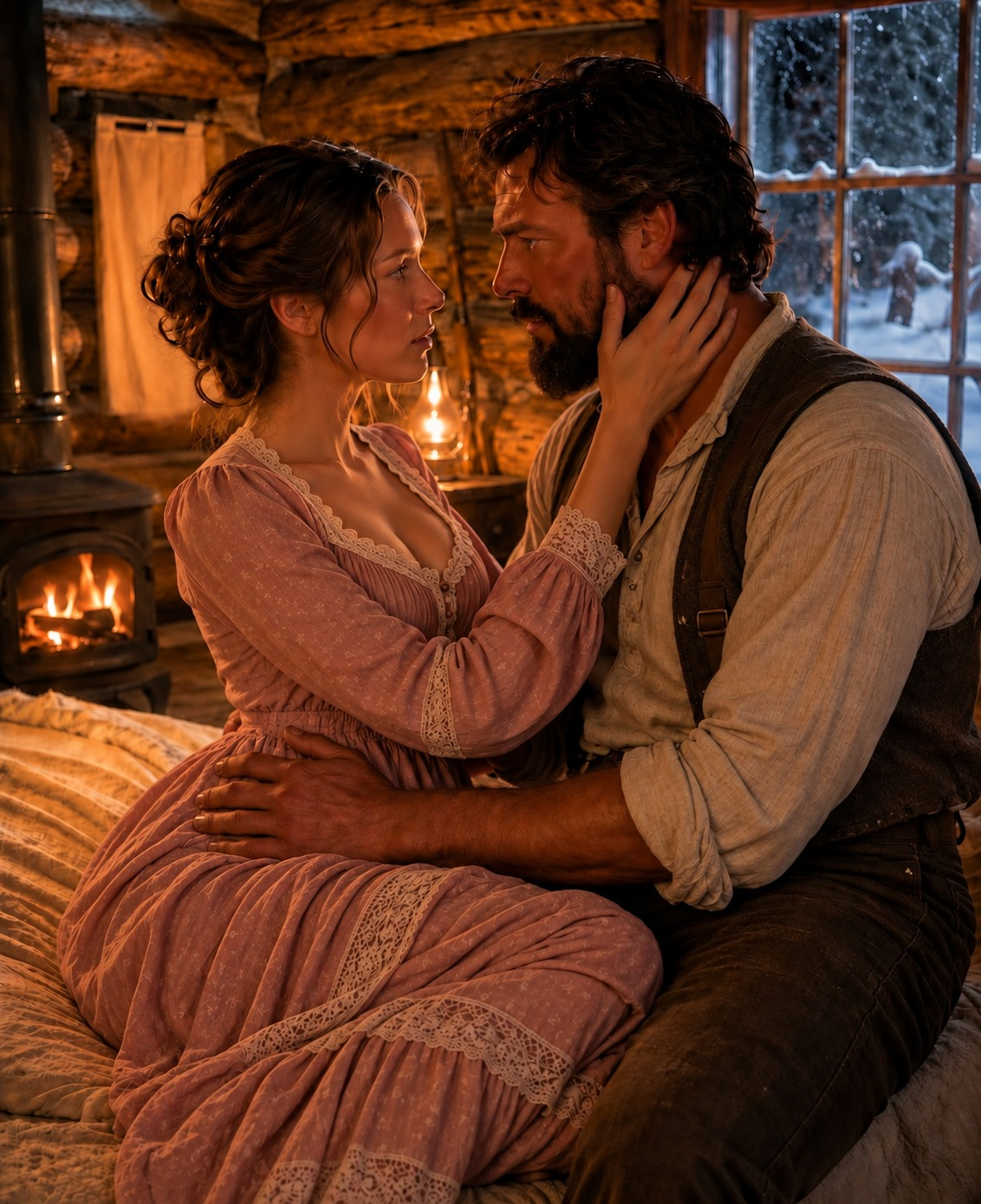
"Don't read another word!" Henry Whitmore shouted.
Caleb Mercer looked up from the letter.
The man standing in the broken doorway had suddenly lost his smile.
Snow blew around his polished black boots. Behind him, Sheriff Harlan stood with an arrest warrant in one hand and a revolver hanging at his hip. Samuel Pike waited beneath the porch roof, his narrow face almost hidden by the brim of his hat.
But Caleb barely noticed them.
He was staring at the name written in his dead father's handwriting.
Jonathan Vale.
Beneath it were seven words that made his blood run cold.
The man calling himself Henry Whitmore is Jonathan Vale.
Caleb read the sentence again.
His father had died thirteen years earlier.
Eleanor had married Henry Whitmore eleven years ago.
And somehow, a letter written by a dead man had predicted the arrival of a woman Caleb had never met.
It was impossible.
Unless someone had deliberately placed the letter inside Eleanor's trunk.
Unless the handwriting was forged.
Unless the past he believed he knew had been built on a lie.
"Mercer," Sheriff Harlan warned, "put down that paper."
Caleb folded it once.
Then he slipped it into his shirt.
"No."
Henry's expression hardened.
"That document belongs to me."
Caleb looked at him.
"Funny. It has my name on it."
"Your wife stole it."
Eleanor stood beside the bed, her hands trembling.
"I've never seen that letter before."
Henry turned toward her.
"Still lying, Eleanor?"
She flinched.
Caleb saw it.
Something changed in his face.
He stepped between them.
"Don't speak to her like that."
Henry laughed.
"Are you giving me instructions about my own wife?"
"She's my wife."
"Not for much longer."
Sheriff Harlan raised the warrant.
"That's enough. Mrs. Mercer, you're coming with us."
Caleb did not move.
"Not tonight."
Harlan sighed.
"Caleb, don't make this worse."
"You rode six miles through a blizzard with a man who supposedly died eleven months ago, and now you're asking me to hand over my wife without an explanation."
"I have a lawful warrant."
"Then show it to me."
Harlan hesitated.
Caleb held out his hand.
The sheriff glanced at Henry.
It was a small movement.
Almost nothing.
But Caleb noticed.
So did Eleanor.
Henry gave a slight nod.
Only then did Harlan surrender the paper.
Caleb read it carefully.
His expression darkened.
"There's no magistrate's seal."
Harlan stiffened.
"The seal is on the reverse."
Caleb turned the document over.
There was a stamped circle near the bottom.
But the paper was damp, and the impression was blurred.
He studied the signature.
"Judge Bellamy?"
"That's right."
"Bellamy retired last autumn."
Harlan's jaw tightened.
"He still signs emergency orders."
"Not since he lost the use of his right hand."
Silence fell.
Eleanor looked between the men.
Henry's smile disappeared.
Pike stepped forward.
"Mr. Mercer, perhaps we can settle this without unnecessary hostility."
Caleb handed the warrant back.
"Get off my property."
Harlan's face reddened.
"You don't understand the position you're putting me in."
"I understand it perfectly."
"Caleb—"
"You came here with a questionable warrant and a man who claims to have risen from the dead."
Henry took a step forward.
"I am very much alive."
Caleb looked directly at him.
"Then you can explain that to a judge in daylight."
Henry's eyes narrowed.
"You're making a mistake."
"Maybe."
Caleb reached for the broken door.
"But it'll be my mistake."
For one long moment, nobody moved.
Then Henry smiled again.
It was not a pleasant smile.
"Very well."
He adjusted his gloves.
"We'll return when the roads are clear."
He looked past Caleb toward Eleanor.
"And next time, sweetheart, you won't have your mountain animal standing between us."
Caleb's hand tightened around the doorframe.
Eleanor felt the old terror rise in her chest.
Henry saw it.
He seemed pleased.
Then he said something that made her blood turn cold.
"Tell him about the blue room, Eleanor."
She stopped breathing.
Henry watched her reaction.
"Tell him what you found behind the fireplace."
Caleb turned slightly.
"Eleanor?"
She shook her head.
"No."
Henry's smile widened.
"That's what I thought."
He stepped backward into the snow.
Pike followed him.
Sheriff Harlan remained on the porch.
"Caleb," he said quietly, "you need to be careful."
Caleb looked at him.
"Of whom?"
Harlan glanced toward the retreating men.
Then he lowered his voice.
"Everybody."
Before Caleb could ask another question, the sheriff turned and followed the others into the storm.
Caleb pushed the broken door shut.
The damaged wooden bar barely held.
Outside, the sound of horses faded into the darkness.
Inside, Eleanor stood motionless.
The silence that followed felt worse than the shouting.
Because Henry was alive.
Or someone wearing Henry's face was alive.
And he knew about the blue room.
"Sit down," Caleb said.
Eleanor shook her head.
"I can't."
"You're shaking."
"I know."
He approached slowly.
"Can I help you?"
She looked at him.
The question almost broke her.
Henry had never asked permission before touching her.
Not once in seven years.
Caleb had asked it so often in the last two days that she was beginning to understand how much those simple words mattered.
She nodded.
He guided her to the chair beside the fireplace.
Then he knelt in front of her.
His enormous frame made the movement awkward.
But he stayed there, bringing his eyes level with hers.
"You're safe for the moment," he said.
She stared at him.
"He's alive."
"We don't know that."
"You saw him."
"I saw a man who looked like the photograph."
"You heard him."
"Yes."
"He knew my name."
"Yes."
"He knew about the blue room."
Caleb paused.
"What's the blue room?"
Eleanor closed her eyes.
She had spent eleven months trying to forget that room.
Now the memory returned with cruel precision.
The blue wallpaper.
The velvet curtains.
The small marble fireplace.
The locked cabinet beside Henry's desk.
And the strange discovery she had made on the morning before his death.
"I need to tell you something," she whispered.
Caleb waited.
"But first, I need to know whether you're going to believe me."
His expression softened.
"Eleanor, I've believed you since the moment you told me Henry hurt you."
"This is different."
"Then tell me."
She looked toward the broken door.
"What if he comes back?"
Caleb followed her gaze.
"He won't get inside quietly."
"You can't know that."
"No."
He looked at the rifle.
"But I can make certain we hear him."
He stood, carried a heavy oak chest across the room, and positioned it against the damaged entrance.
Then he wedged a length of timber beneath the door handle.
Eleanor watched him.
"Will that hold?"
"Long enough."
"For what?"
"For me to get you somewhere safer."
She swallowed.
"Where?"
Caleb hesitated.
"There's a root cellar beneath the floor. It has another exit."
She stared.
"Another exit?"
"Comes out behind the wood shed."
"Why didn't you tell me?"
He looked embarrassed.
"You hadn't asked."
Despite everything, Eleanor almost laughed.
Caleb Mercer could survive a blizzard, repair a rifle, and face three armed men without trembling.
But he seemed genuinely uncertain about how much information a husband ought to share with his wife.
She looked at the timber bracing the door.
Then at him.
"Caleb?"
"Yes?"
"Please come sit beside me."
He obeyed.
This time, he did not leave an enormous space between them.
"The blue room was Henry's private study," Eleanor began.
Caleb listened.
"He didn't allow anyone inside without permission. Not the servants. Not his business partners. Not even me."
"What was in it?"
"Books. Ledgers. Letters. Things he didn't want anyone else to see."
She rubbed her hands together.
"Three weeks before he died, I discovered that he had been borrowing money using my mother's property as security."
Caleb frowned.
"Without telling you?"
"Yes."
"Was the property in your name?"
"It was supposed to be."
"What happened?"
"Henry said the law gave him the right to manage everything belonging to his wife."
Caleb's expression hardened.
Eleanor continued.
"I went to the blue room while he was away. I wanted to find the documents."
"Did you?"
"Some of them."
She paused.
"And something else."
Caleb waited.
"There was a loose stone behind the fireplace."
"How did you find it?"
"I noticed scratches on the floor. The hearth had been moved."
She could still remember kneeling beside the cold fireplace.
The dust beneath her fingernails.
The strange hollow sound when she tapped the stone.
"I pulled it loose."
"What was behind it?"
"A small iron box."
Caleb leaned forward.
"Did you open it?"
"Yes."
"What was inside?"
Eleanor stared into the flames.
"Money."
"How much?"
"I don't know. Hundreds of dollars, perhaps more."
"Anything else?"
"Letters."
She swallowed.
"And a photograph."
Caleb became still.
"Of whom?"
"Two men."
"Did you recognize them?"
"One was Henry."
"And the other?"
She looked at Caleb.
"I didn't know him."
"Can you describe him?"
"He was younger than Henry. Dark-haired. Thin. There was a scar near his left ear."
Caleb's eyes narrowed.
Eleanor noticed.
"What is it?"
"Nothing yet."
"Caleb."
He looked at her.
"Did the photograph have writing on it?"
She hesitated.
"Yes."
"What did it say?"
She tried to remember.
The photograph had been old.
The edges were yellow.
The two men stood beside a carriage in front of a brick building.
On the back, someone had written a date.
And beneath it, two names.
She closed her eyes.
"One name was Henry Whitmore."
Caleb waited.
"The other was Jonathan Vale."
The cabin seemed to grow colder.
Caleb slowly reached into his shirt.
He removed the folded letter.
Eleanor stared at it.
"What?"
He opened the page.
Then he placed it before her.
She read the first sentence.
Caleb, if a woman named Eleanor Whitmore ever comes to your door, you must never let her discover who her first husband really is.
Her breath caught.
Then she saw the next line.
The man calling himself Henry Whitmore is Jonathan Vale.
Eleanor looked up.
"Where did this come from?"
"It was hidden in your trunk."
"I didn't put it there."
"I know."
"Then who did?"
Caleb looked toward the door.
"I intend to find out."
She read the words again.
"Jonathan Vale."
The name felt like a key turning inside a lock.
"But Henry was Henry."
"Maybe."
"I married him."
"Yes."
"I lived with him for seven years."
Caleb nodded.
She looked down.
"Then who was Jonathan Vale?"
Caleb did not answer.
Because he had a question of his own.
Why had his father known that name thirteen years earlier?
And why had someone hidden a letter bearing his father's handwriting inside the belongings of a woman who had never visited Colorado before?
Eleanor studied the letter more carefully.
The paper was old.
The ink had faded.
There was a water stain near the bottom.
And the handwriting did resemble Caleb's father’s, judging by the few letters Caleb had shown her earlier.
But something troubled her.
"Caleb?"
"Yes?"
"Your father died thirteen years ago."
He nodded.
"Henry and I married eleven years ago."
"Yes."
"How could your father have known my name?"
Caleb looked at the letter.
"I don't know."
"Did he ever travel east?"
"Once."
"When?"
"Before I was born."
"Did he know anyone in Baltimore?"
"Not that he told me."
Eleanor looked at the words again.
"Then this letter can't be what it appears."
Caleb nodded slowly.
"That's what I've been thinking."
"Someone forged it?"
"Maybe."
"Why use your father's handwriting?"
"To frighten me."
"Or to make you believe something."
He looked at her.
"Exactly."
Eleanor felt a small spark of determination beneath her fear.
For the first time since Henry appeared at the door, she was thinking instead of simply reacting.
"Then we shouldn't assume anything in that letter is true."
Caleb nodded.
"Agreed."
"Not even the name."
"Not yet."
She looked at the final line.
You must never let her discover who her first husband really is.
"What if the person who wrote this wanted us to distrust each other?"
Caleb studied her.
"Then we shouldn't give them what they want."
She held his gaze.
"No secrets?"
He hesitated.
Only for a moment.
But she noticed.
"Caleb?"
He looked down at the letter.
"There are things about my father I don't understand."
"That isn't the same as keeping secrets."
"I know."
"Then tell me what you do know."
He rubbed his jaw.
"My father was a hard man."
Eleanor waited.
"He taught me to hunt. Trap. Build. Survive."
"Was he kind?"
Caleb considered the question.
"Sometimes."
"And the rest of the time?"
"He was afraid."
"Of what?"
Caleb looked toward the window.
"Men."
Eleanor frowned.
"Men?"
"Not animals. Not storms. Men."
She stared.
"My father could face a wounded mountain lion without shaking. But whenever strangers came up the trail, he'd reach for his rifle."
"Why?"
"He said some debts couldn't be paid with money."
The words settled between them.
Eleanor thought of the hidden agreement.
The mysterious balance.
The phrase written beneath her name.
Transfer valid upon delivery.
She looked at Caleb.
"Did your father owe someone money?"
"I never found proof."
"But you suspected?"
Caleb nodded.
"After he died, I found a locked chest beneath the floor."
Eleanor sat straighter.
"What was inside?"
"Old papers. A few coins. A photograph."
Her heart began pounding.
"A photograph?"
Caleb looked at her.
"Of two men."
Eleanor stopped breathing.
"One was your father?"
"Yes."
"And the other?"
He hesitated.
"A younger man."
"Dark hair?"
Caleb nodded.
"A scar near his left ear?"
His expression changed.
"How did you know that?"
Eleanor stared at him.
Because suddenly she understood why the letter had frightened him.
And why he had hesitated before answering her questions.
The man in Henry's photograph had also appeared in Caleb's father's belongings.
Two men.
Two photographs.
Two lives separated by thousands of miles.
Connected by a stranger whose name neither of them understood.
"Caleb," she whispered, "where is that photograph?"
He looked toward the floorboards.
"Somewhere safe."
"Can I see it?"
He hesitated.
Then nodded.
"Tomorrow."
"Why not tonight?"
"Because I need to make sure we're alone before I open the hiding place."
Eleanor stared.
"You think someone knows where it is?"
Caleb looked toward the broken door.
"I think somebody knows more about this cabin than they should."
The wind grew stronger after midnight.
Caleb repaired the door as best he could.
He worked quietly while Eleanor sat near the fire, examining the marriage agreement.
The hidden strip remained on the table.
Balance outstanding: $4,800.
Security: Mrs. Eleanor Whitmore Mercer.
She had never owed that amount.
At least, not knowingly.
Henry had been deeply in debt.
But the figure seemed strangely specific.
She remembered Samuel Pike standing in the parlor after the funeral.
His polished shoes.
His expensive gloves.
His smooth voice.
Your husband left complicated obligations, Mrs. Whitmore.
She had asked whether she could challenge them.
Pike had smiled.
Of course. But legal proceedings are expensive, and your circumstances are unfortunate.
Then he had suggested marriage.
A practical solution.
A respectable arrangement.
She had believed the idea was her own.
Now she wasn't certain.
"Caleb?"
He looked up from the door.
"Yes?"
"When you sent the money to settle my debts, did you send it directly to the creditors?"
"No."
"Who received it?"
"The bank arranged the transfer."
"Through Samuel Pike?"
"Yes."
"Did you ever meet him?"
Caleb paused.
"Once."
Eleanor went still.
"When?"
"Before I placed the advertisement."
She stared.
"What?"
Caleb set down his hammer.
The silence changed.
Eleanor slowly rose.
"Caleb, what do you mean?"
He looked uncomfortable.
"Pike came through the mountains last summer."
"Last summer?"
"Yes."
"Before I answered your advertisement?"
"Yes."
Her heart began pounding.
"What did he want?"
"He said he represented investors interested in buying land."
"Your land?"
"Some of it."
"Did you sell?"
"No."
"Then why did he come?"
Caleb looked at the floor.
"He asked whether I had a family."
Eleanor felt cold.
"What did you tell him?"
"That I didn't."
"And?"
"He asked whether I intended to marry."
She stared.
Caleb continued.
"I told him I hadn't thought much about it."
"What did he say?"
"He said there were women back east who might welcome a quiet life."
Eleanor's stomach twisted.
"Did he suggest placing an advertisement?"
Caleb nodded.
The room seemed to tilt.
"You told me you wanted a wife because you were lonely."
"I did."
"But Pike gave you the idea."
"He mentioned it."
"And you never told me?"
Caleb looked at her.
"I didn't think it mattered."
Eleanor stepped backward.
Henry's voice echoed in her memory.
You always misunderstand things, Eleanor.
She hated how quickly fear returned.
How easily one unanswered question became a hundred.
"Caleb," she whispered, "did Samuel Pike choose me?"
"No."
"Are you certain?"
"I answered your letter because I liked what you wrote."
"But how did you know about the advertisement?"
He frowned.
"What do you mean?"
"Which newspaper carried it?"
"The Baltimore Gazette."
"Why Baltimore?"
Caleb hesitated.
Then he said, "Pike recommended it."
Eleanor stared.
The truth settled over her like falling snow.
Pike had known where she lived.
He had known her debts.
He had known she was desperate.
And he had directed Caleb's advertisement toward her city.
Perhaps toward her specifically.
She looked at the marriage agreement.
Then at the hidden strip.
Then at the man she had begun to trust.
"Was any of this an accident?" she whispered.
Caleb took a step toward her.
"Eleanor—"
She moved backward.
He stopped immediately.
Her chest tightened.
"I need to think."
He nodded.
"All right."
"Please don't come closer."
He remained still.
"All right."
She hated the relief she felt when he obeyed.
And she hated herself for doubting him.
But trust was not something she could simply decide to possess.
It had to survive the truth.
Caleb returned to his work.
He did not defend himself.
He did not demand forgiveness.
He repaired the door while Eleanor sat beside the fireplace, trying to make sense of everything.
Eventually, she spoke.
"Did Pike pay you?"
Caleb stopped hammering.
"No."
"Did he promise you anything?"
"No."
"Did you know he worked for Henry?"
"No."
"Did you know he handled my debts?"
"Not until you told me."
She studied him.
His answers were direct.
Unembellished.
Exactly like his letters.
"Why did you marry me?" she asked.
Caleb set down the hammer.
He turned toward her.
"Because you wrote that you wanted a home where nobody shouted."
Eleanor's breath caught.
She remembered writing those words.
She had almost crossed them out.
They seemed too revealing.
Too desperate.
But she had left them.
Caleb continued.
"You wrote that you could work hard. That you didn't expect comfort. That you understood loneliness."
He paused.
"And you said you wanted a place where silence didn't mean somebody was angry."
Eleanor looked down.
Tears stung her eyes.
"I remember."
"I read that letter six times."
She looked up.
"Six?"
He nodded.
"Why?"
Caleb's face reddened slightly.
"Because it sounded like you understood what I wanted."
"What did you want?"
He looked toward the empty chair.
"Someone who wouldn't mind sitting beside me when neither of us had anything to say."
Eleanor pressed her lips together.
Caleb continued.
"I didn't know Pike had anything to do with your past. I didn't know he had handled your debts. And I didn't know he'd hidden anything in our marriage papers."
He met her eyes.
"But I know why I wrote back to you."
She swallowed.
"Why?"
"Because you sounded like someone who needed peace."
His voice softened.
"And I thought maybe we could find some together."
Eleanor began to cry.
Quietly.
Without warning.
Caleb looked alarmed.
"Did I say something wrong?"
She shook her head.
"No."
"Are you hurt?"
"No."
He took one uncertain step toward her.
Then stopped.
"Can I sit beside you?"
She nodded.
He sat.
For several moments, neither spoke.
Then Eleanor reached for his hand.
"I want to believe you."
Caleb looked down at their joined fingers.
"Then let me earn it."
Near dawn, Eleanor woke to the sound of Caleb moving across the cabin.
She had fallen asleep in the bed.
He had covered her with another quilt.
Now he stood beside the table, examining something by lantern light.
A small leather notebook.
She watched him for a moment.
"Caleb?"
He turned sharply.
Then relaxed.
"Sorry. Didn't mean to wake you."
"What are you doing?"
"Looking for something."
"What?"
He hesitated.
Eleanor sat upright.
"No more secrets, remember?"
He looked at the notebook.
Then carried it to her.
"This belonged to my father."
She accepted it.
The leather was cracked.
The pages smelled faintly of smoke.
Inside were dates.
Names.
Numbers.
Most entries concerned supplies and trading.
But near the middle, Eleanor found something different.
A list of payments.
Some were small.
Others enormous.
Beside several entries appeared the initials J.V.
Jonathan Vale.
She looked up.
"Your father knew him."
Caleb nodded.
"Seems that way."
"Why didn't you show me this before?"
"Because I didn't know what it meant."
She turned another page.
A date caught her attention.
June 17.
Seventeen.
The same number scratched into Henry's silver button.
Her heart began pounding.
"Caleb."
He leaned closer.
She pointed.
"Look."
The entry read:
June 17 — J.V. arrived. Payment refused. Agreement remains with Whitmore.
Eleanor stared.
"Whitmore."
Caleb nodded slowly.
She turned the page.
Another entry.
June 19 — Whitmore sent word. The woman must never know.
Eleanor felt the blood drain from her face.
"What woman?"
Caleb shook his head.
"I don't know."
She looked at the next line.
June 21 — If they come for the child, take him north.
Her fingers stopped moving.
"The child?"
Caleb leaned closer.
His expression changed.
Eleanor turned another page.
The handwriting became hurried.
June 23 — Jonathan has betrayed us. Whitmore knows the truth. I must hide the evidence before they return.
Then the entries stopped.
Eleanor looked up.
"Caleb, when did your father die?"
He swallowed.
"June twenty-fourth."
The room went silent.
One day after the final entry.
Eleanor stared at the notebook.
"What happened to him?"
Caleb looked toward the window.
"I told you. Winter accident."
"In June?"
He closed his eyes.
For a moment, he seemed to struggle with himself.
Then he whispered, "It wasn't winter."
Eleanor's heart began pounding.
"Caleb."
He looked at her.
"My father didn't die in an accident."
She waited.
He swallowed.
"I found him beside the river."
"Was he hurt?"
"Yes."
"How?"
Caleb's voice dropped.
"He'd been shot."
Eleanor stared.
"Who shot him?"
"I never knew."
"Did you tell the sheriff?"
Caleb shook his head.
"Why not?"
"Because my father left instructions."
"What instructions?"
Caleb looked at the notebook.
"He said if anything happened to him, I was to bury him quietly and never tell anyone what I'd found."
Eleanor felt cold.
"You were twenty-six."
He nodded.
"And you obeyed?"
"Yes."
"Why?"
Caleb's eyes filled with something she had not seen before.
Old grief.
Old fear.
And something darker.
"Because I was afraid they'd come back for me."
Eleanor reached for his hand.
He looked down.
Then slowly tightened his fingers around hers.
For a long moment, neither spoke.
Finally, Eleanor whispered, "You don't have to face this alone anymore."
Caleb looked at her.
The words seemed to reach somewhere deep inside him.
He had spent thirteen years believing silence was the only way to survive.
Now a woman he had known for only a few days was offering to share the burden.
He looked almost overwhelmed.
"Eleanor—"
She touched his cheek.
"You told me I didn't owe you anything."
He nodded.
"Then believe me when I say I'm staying because I want to."
His expression softened.
She leaned forward.
Their kiss was gentle.
Unhurried.
Caleb's hand rested carefully against her waist.
When they separated, he smiled faintly.
"Was that all right?"
Eleanor laughed through her tears.
"Yes, Caleb."
He smiled.
"Good."
She rested her forehead against his.
For one brief moment, the cabin felt safe again.
Then Eleanor remembered the notebook.
And the child mentioned in its pages.
"Caleb?"
"Yes?"
"Did your father ever tell you where you were born?"
He looked surprised.
"Here in Colorado."
"Are you certain?"
He hesitated.
"That's what he told me."
"Did you ever see a birth record?"
"No."
"Did you know your mother?"
Caleb shook his head.
"She died when I was small."
Eleanor looked down at the notebook.
If they come for the child, take him north.
A terrible possibility began forming in her mind.
She did not want to speak it.
Not yet.
Instead, she asked, "Where is the photograph your father kept?"
Caleb looked toward the floor.
"Under the cabin."
"Can we get it?"
He nodded.
"Yes."
Caleb moved the heavy wooden chest away from the corner.
Beneath it lay a square section of floorboards.
He lifted one plank.
Then another.
A dark opening appeared.
Eleanor leaned forward.
A narrow ladder descended into the root cellar.
Cold air rose from below.
Caleb lit a lantern.
"Stay here."
She shook her head.
"No."
"Eleanor—"
"We agreed. No more secrets."
He looked at her.
Then nodded.
"All right."
He climbed down first.
Eleanor followed carefully.
The cellar smelled of earth and old wood.
Shelves lined the walls.
There were jars of preserved vegetables, sacks of potatoes, and several wooden crates.
At the far end stood a heavy iron chest.
Caleb approached it.
He removed a small key from a cord around his neck.
Eleanor watched him unlock the chest.
Inside were folded blankets, old letters, a leather pouch, and a wooden box.
Caleb lifted the box.
His hands were steady.
But Eleanor noticed the tension in his shoulders.
He opened it.
Inside lay a photograph.
Two men stood beside a carriage.
One was older.
Broad-shouldered.
Bearded.
The other was younger.
Dark-haired.
Thin.
A scar marked the skin near his left ear.
Eleanor gasped.
"It's the same man."
Caleb nodded.
"Jonathan Vale?"
"I think so."
She took the photograph.
Turned it over.
There was writing on the back.
A date.
A place.
And three names.
Thomas Mercer.
Jonathan Vale.
Henry Whitmore.
Eleanor stared.
"Three names."
Caleb frowned.
"But only two men."
She looked at him.
"Then who was Henry Whitmore?"
Caleb did not answer.
Because suddenly, the question was no longer whether Henry was alive.
It was whether the man Eleanor had married eleven years earlier had ever been Henry Whitmore at all.
She turned the photograph toward the lantern.
Something had been scratched into the lower corner.
A small number.
Seventeen.
The same number as the button.
The same date as the notebook entry.
Eleanor felt her pulse quicken.
"Caleb, what happened on June seventeenth?"
He stared at the photograph.
"I don't know."
She looked at the chest.
"Is there anything else?"
He searched through the papers.
Then stopped.
At the bottom lay a sealed envelope.
The wax was broken.
The paper had yellowed.
On the front, written in Thomas Mercer's handwriting, were four words.
For the boy's mother.
Caleb stared.
"My mother?"
Eleanor looked at him.
"Open it."
He hesitated.
Then carefully unfolded the paper.
His eyes moved across the first line.
His expression changed.
Eleanor watched the color leave his face.
"Caleb?"
He didn't answer.
She touched his arm.
"What does it say?"
He looked up.
His voice was barely audible.
"It says my mother didn't die."
Eleanor froze.
Caleb looked back at the letter.
"She was taken."
"Taken?"
He nodded.
"By whom?"
Caleb's hands began trembling.
He read the next line.
Then another.
His breathing changed.
Eleanor moved closer.
"Caleb, please."
He lowered the letter.
His eyes were filled with disbelief.
"My father wasn't hiding me from strangers."
Eleanor stared.
"Then who?"
Caleb looked toward the cellar entrance.
He had heard something.
Footsteps.
Above them.
Slow.
Deliberate.
Someone was walking across the cabin floor.
Eleanor stopped breathing.
Caleb extinguished the lantern.
Darkness swallowed the cellar.
A floorboard creaked overhead.
Then another.
The footsteps stopped directly above the open hatch.
Eleanor clutched Caleb's arm.
A shadow appeared across the opening.
Someone leaned down.
And a woman's voice whispered:
"Caleb Mercer, if you've found your father's letter, then you already know why I came."
Caleb went rigid.
The voice spoke again.
Softly.
Almost tenderly.
"Son, don't be afraid. It's your mother."
Eleanor looked toward the ladder.
The woman above them began to descend.
Caleb reached for the lantern.
His fingers trembled.
Then the stranger whispered a name that made Eleanor's blood turn cold.
"Jonathan sent me."
And when the woman's face finally emerged from the darkness, Eleanor recognized her immediately.
She was the woman whose portrait had hung above Henry Whitmore's desk for seven years.
The woman Henry had always called his dead sister.
The woman whose name was...






Comments 0