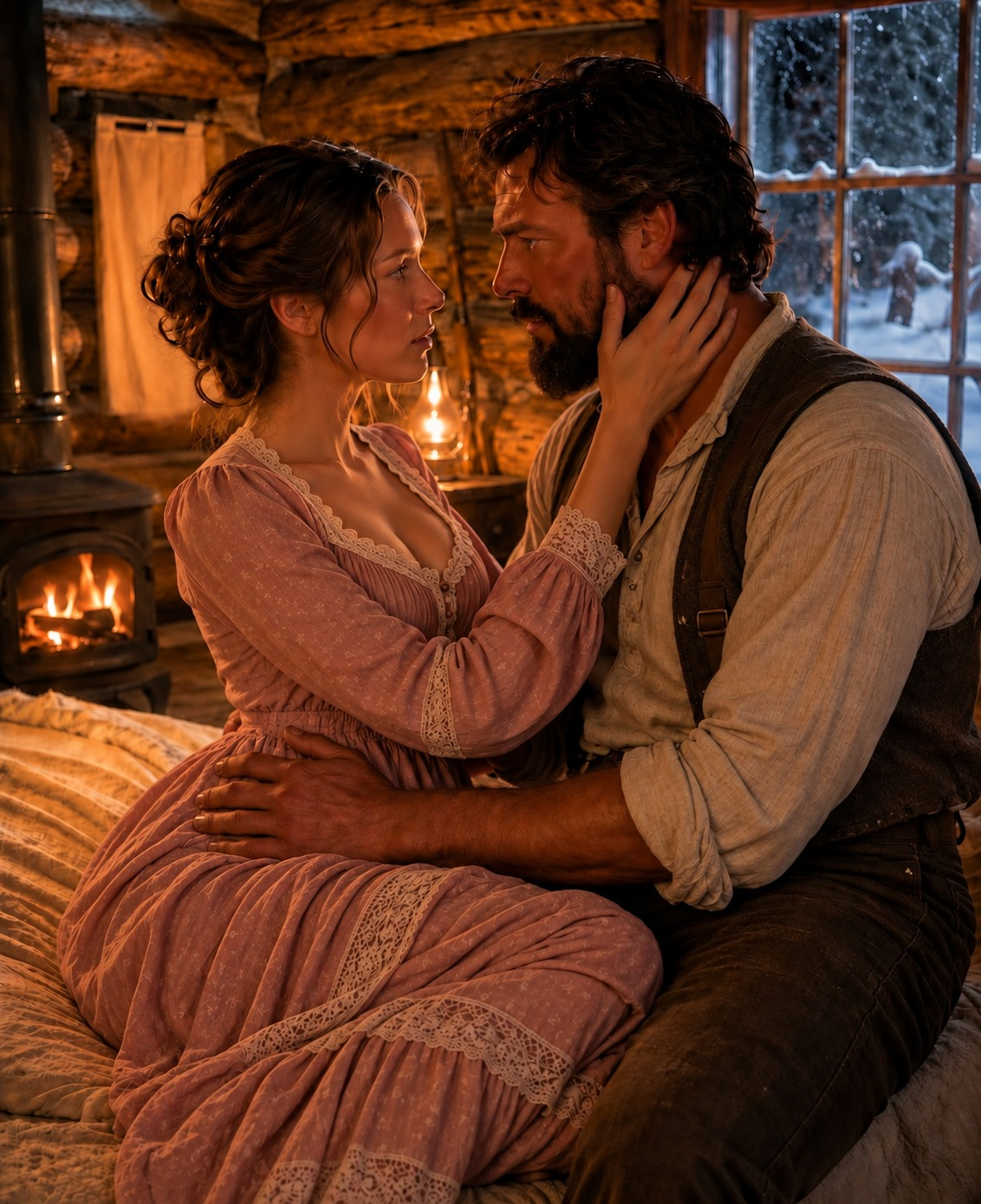
"Don't touch me!" Eleanor Whitmore whispered as the enormous stranger reached for her trunk.
Caleb Mercer stopped immediately.
The mountain trapper stood in the doorway holding a folded marriage agreement and a small leather purse containing the last of Eleanor's money.
Across the bottom of the agreement, beneath her dead husband's name, someone had written three words in faded ink.
Payment received. H.W.
Eleanor recognized the handwriting.
Her husband had been dead for eleven months.
And suddenly, the marriage that was supposed to save her felt like another trap.
"Mrs. Whitmore?"
The man's voice was deep enough to make Eleanor look up from the document.
She had been staring at those three words for so long that the cold had begun creeping through her gloves.
Caleb Mercer stood before her, his broad shoulders nearly filling the cabin doorway.
He was not what she had expected.
His letters had been short, careful, and almost painfully practical. She had imagined a stern farmer, perhaps a lonely widower with thinning hair and a respectable house somewhere near a small town.
Instead, she had found a giant.
He stood well over six feet tall, with thick sandy-blond hair, a reddish beard, and the kind of weathered face that suggested years spent fighting storms rather than avoiding them.
A pale scar disappeared beneath the collar of his dark green wool shirt.
His hands were enormous.
His eyes were gray.
And he was looking at her as though he had no idea what to do next.
"You're freezing," he said.
Eleanor folded the agreement before he could notice where she had been looking.
"I'm perfectly well."
Caleb glanced at her trembling fingers.
"No, ma'am. You aren't."
She stiffened.
Henry had always hated being contradicted.
Even over something small.
Especially over something small.
For one terrible instant, she waited for Caleb's expression to harden.
It didn't.
He simply stepped aside.
"Come inside. The fire's going."
Eleanor hesitated.
Behind her, the wagon driver was already securing his horses for the return journey.
There was no town within easy walking distance.
No hotel.
No boardinghouse.
No respectable widow waiting to offer her a room.
There was only the cabin, the mountains, and the man she had agreed to marry.
She stepped inside.
Caleb reached for her trunk.
Her body reacted before her mind could stop it.
"Don't touch me!"
He froze.
The words seemed to hang between them.
Eleanor felt heat rise into her cheeks.
"I meant—"
"You can carry it yourself," Caleb said quietly.
He withdrew his hand.
"I wasn't thinking."
She stared at him.
Most men she knew would have taken offense.
Henry would have demanded an apology.
Caleb simply waited.
After a moment, Eleanor looked at the trunk.
It was heavy.
She had struggled to drag it across the station platform in Denver, and the long journey had left her arms aching.
"I suppose," she said carefully, "you may carry it."
Caleb nodded once.
"Thank you."
He lifted the trunk as though it weighed nothing.
Eleanor watched him carry it toward the far wall.
He did not smile.
He did not tease her.
He did not mention her outburst.
And somehow that made her more uncomfortable than anger would have.
The cabin was smaller than she had imagined.
There was a stone fireplace, a cast-iron stove, a wooden table, two chairs, shelves lined with jars, and a single bed beneath the window.
The bed was the first thing Eleanor noticed.
The second was that there was nowhere else to sleep.
Caleb noticed her looking.
"I can make up a place beside the stove," he said.
She turned toward him.
"Beside the stove?"
"Yes, ma'am."
"On the floor?"
"I've slept on worse."
She glanced at his enormous frame.
"You cannot possibly fit there comfortably."
"I'll manage."
Eleanor removed her gloves.
"Mr. Mercer, we are married."
His expression changed slightly.
Not with desire.
With embarrassment.
"Yes, ma'am."
"Then perhaps you might stop speaking to me as though I were the schoolmistress."
He looked genuinely puzzled.
"What should I call you?"
"Eleanor."
He repeated it quietly.
"Eleanor."
There was something strange about hearing her name in his voice.
Henry had rarely used it without irritation.
Usually it had been woman, or wife, or the clipped, warning version of her name that meant she had disappointed him.
Caleb spoke it carefully.
Almost respectfully.
She looked away.
"And I suppose I should call you Caleb."
"I'd like that."
The answer came so quickly that she almost smiled.
Almost.
They had been married in a brief civil ceremony three days earlier, after Eleanor arrived in Colorado.
The ceremony had taken place in a small town far below the mountains.
Caleb had worn a clean shirt and looked more frightened of the county clerk than of any wilderness animal.
There had been no flowers.
No wedding breakfast.
No family.
Only two witnesses, a signed certificate, and a man who had promised to take her somewhere safe.
Eleanor had signed her new name with a steady hand.
Eleanor Mercer.
The letters had looked unfamiliar.
She had wondered whether she had just escaped one prison by entering another.
Now, standing inside Caleb's cabin, she wondered again.
Caleb carried a kettle to the stove.
"There's hot water if you'd like to wash."
"Thank you."
"I made stew."
"That was thoughtful."
He looked uncomfortable with the compliment.
"It's only elk."
"Only elk?"
"And potatoes."
"That sounds wonderful."
He glanced at her as though trying to decide whether she was being polite.
Then he took two bowls from a shelf.
Eleanor watched him work.
Everything about the man seemed contradictory.
His shoulders were broad enough to block the doorway.
His arms were marked with old scars.
A rifle rested against the far wall.
A hunting knife lay on a workbench.
Yet he moved around the cabin with extraordinary care, as though he feared disturbing something fragile.
Or someone.
When he placed a bowl before her, he did not stand too close.
When she reached for the spoon, he withdrew his hand.
When she thanked him, he nodded and sat across from her.
Then silence settled over the table.
Eleanor's stomach tightened.
She knew silence.
Henry had used it like a weapon.
When dinner displeased him, he stopped speaking.
When she disagreed with him, he stopped speaking.
When he intended to punish her, he became so quiet that she could hear the clock ticking in the hallway.
Caleb ate slowly.
He did not look angry.
But he did not speak.
Eleanor forced herself to swallow a spoonful of stew.
It was delicious.
She waited another minute.
Then another.
Finally, she set down her spoon.
"Have I offended you?"
Caleb looked up sharply.
"What?"
"Have I done something wrong?"
"No."
"Then why won't you speak to me?"
He blinked.
For a moment, he seemed genuinely confused.
Then he looked down at his bowl.
"I don't know what to say."
Eleanor stared.
"Surely you have something to say."
"About what?"
"Anything."
Caleb considered this with such seriousness that she nearly laughed.
"The snow's getting heavier."
"Yes. I noticed."
"The north trail will probably be buried by morning."
"I see."
"And I fixed the chimney last week."
Eleanor pressed her lips together.
"That is reassuring."
He nodded.
Silence returned.
She watched him for several seconds.
"Caleb?"
"Yes?"
"Do you always speak so little?"
He looked toward the window.
"Most days there's nobody to speak to."
The simplicity of the answer unsettled her.
"How long have you lived alone?"
"Since my father died."
"When was that?"
"Thirteen years ago."
Eleanor lowered her spoon.
"Thirteen years?"
He nodded.
"You've been alone in these mountains for thirteen years?"
"Mostly."
"Surely you visit town."
"Twice a year, sometimes three."
"And the rest of the time?"
He shrugged.
"Work."
She tried to imagine it.
Thirteen winters.
Thirteen springs.
Thirteen summers spent beneath enormous skies, surrounded by trees and animals and silence.
No laughter across a dinner table.
No footsteps in the next room.
No one to notice whether he came home.
The thought made her unexpectedly sad.
"That must be terribly lonely," she said.
Caleb looked at her.
For the first time, something unguarded moved across his face.
"Yes," he answered.
Just one word.
But it held thirteen years.
After supper, Eleanor insisted on helping with the dishes.
Caleb refused.
She insisted again.
He finally set down the pot he was washing and turned toward her.
"You don't have to earn your supper."
Eleanor frowned.
"I beg your pardon?"
"You've been telling me what you can do since you arrived."
"I thought you would want to know."
"You said you can cook, sew, preserve vegetables, mend clothes, and keep accounts."
"Those are useful skills."
"They are."
"Then what is the problem?"
Caleb dried his hands on a cloth.
"I didn't bring you here as hired help."
Eleanor felt herself grow defensive.
"You asked for a wife."
"Yes."
"And wives work."
"I know that."
"Then what exactly do you expect from me?"
He hesitated.
It was the first time she saw him struggle with an answer.
Finally, he looked toward the empty chair across the table.
"I wanted someone here."
Eleanor said nothing.
"Someone talking across the table," he continued. "Someone whose footsteps weren't mine."
His voice grew quieter.
"Winters get so long that sometimes I wonder if I've forgotten what another human voice sounds like."
He looked embarrassed.
"That probably sounds foolish."
Eleanor shook her head.
"No."
He studied her face, as though checking whether she meant it.
Then he returned to the dishes.
She remained standing beside the table.
Something inside her had shifted.
She had expected a man who wanted a servant.
Or a cook.
Or a woman to warm his bed.
Instead, Caleb Mercer seemed to want the one thing she had never considered valuable.
Company.
Later, Eleanor unpacked her trunk.
She found her comb, her sewing kit, two dresses, a Bible that had belonged to her mother, and the small silver brooch she had managed to keep hidden from Henry's creditors.
At the bottom lay a folded letter.
She recognized the handwriting immediately.
Henry Whitmore.
Her first husband.
The envelope had been delivered shortly before she left Baltimore.
It contained only a few sentences.
My dear Eleanor,
You have misunderstood the situation.
Certain obligations remain unsettled.
You will discover that distance does not erase what is owed.
There was no signature.
Only his initials.
H.W.
The letter had terrified her when she first received it.
Henry was dead.
She had seen his coffin.
She had stood beside his grave.
The physician had signed the certificate.
The creditors had come afterward, armed with documents and demands.
Yet someone had written to her in Henry's hand.
She had told herself it was an old letter.
A delayed delivery.
A cruel joke.
Anything but the impossible.
Now she had found the same initials on her new marriage agreement.
She stared at the paper until the words blurred.
"Eleanor?"
She flinched.
Caleb stood several feet away.
He had stopped when he saw her expression.
"Are you all right?"
She folded the letter quickly.
"Yes."
He glanced toward her hands.
"Bad news?"
"Nothing important."
He did not press.
Instead, he looked toward the canvas screen in the corner.
"You can change behind there. I'll keep my back turned."
Eleanor nodded.
"Thank you."
She carried her cotton nightdress behind the screen.
As she changed, she listened to Caleb moving around the cabin.
First came the sound of the stove door opening.
Then the scrape of iron.
Then the click of a rifle being checked.
Then footsteps.
Then the latch of the front door.
Then footsteps again.
Finally, the rhythmic sound of metal against stone.
She closed her eyes.
He was sharpening a knife.
Her breathing changed.
Henry had sharpened knives when he was angry.
Not because they needed sharpening.
Because he liked watching her notice.
She pulled the nightdress over her head.
The fabric was soft and plain.
Her mother had sewn the cuffs years earlier.
For a moment, Eleanor pressed her fingers against the embroidery.
Then she stepped out from behind the screen.
Caleb was seated beside the fire.
A hunting knife rested across his knee.
He was sharpening it with extraordinary concentration.
Eleanor stopped.
"Caleb."
He looked up.
"The stove is fine."
He glanced toward it.
"Yes."
"The rifle is clean."
"Yes."
"And that knife appears quite sharp."
He looked down at the blade.
Then at her.
"Yes."
"Then why are you still sharpening it?"
He set it aside immediately.
"I suppose I was keeping busy."
"Why?"
He rubbed the back of his neck.
"Didn't know what else to do."
Eleanor stared at him.
The enormous man looked almost boyish in his discomfort.
He stood.
"I can sleep beside the stove."
She looked at the single bed.
Then at him.
"Caleb, we're married."
His eyes dropped to the floor.
"I know."
"Then why are you acting as though I'm a stranger?"
He looked up.
"Because you are."
The answer startled her.
He continued before she could respond.
"We've exchanged letters. We signed papers. But I don't know what makes you laugh. I don't know what frightens you. I don't even know how you like your tea."
Eleanor swallowed.
"That doesn't change the agreement."
"No."
"You paid my debts."
"Yes."
"You paid for my journey."
"Yes."
"You gave me your name and this roof."
"Yes."
She lifted her chin.
"Then what exactly do you believe I owe you?"
Caleb's expression hardened for the first time.
But the anger was not directed at her.
"Nothing."
Eleanor stared.
"Nothing?"
"Nothing."
"Surely you don't expect me to believe that."
"I do."
"You paid a considerable sum of money."
"I know what I paid."
"Then why?"
He took a breath.
"Because you needed help. And I needed a wife."
"There must be more to it."
"There isn't."
"Caleb—"
"I didn't buy you."
His voice was suddenly firm.
The words struck her harder than she expected.
"I didn't buy you," he repeated. "And I won't have you thinking I did."
Silence filled the cabin.
Eleanor felt the old fear rising.
Not because he had threatened her.
Because he hadn't.
She did not understand kindness without conditions.
Henry had always demanded payment for every small mercy.
A dress.
A meal.
A warm room.
Even a smile.
Caleb stood before her, waiting.
She looked at the bed.
Then at the door.
Then at the man whose hands were large enough to break her wrist without effort.
And she made a decision.
She would stop guessing.
She would discover what he truly wanted.
Eleanor crossed the cabin.
Caleb watched her.
She reached the heavy wooden door and slid the iron latch into place.
The click sounded unusually loud.
Then she turned.
Caleb's expression changed.
"Eleanor?"
She walked toward him.
Slowly.
Deliberately.
She stopped a few feet away.
Her heart was pounding.
But she kept her voice steady.
"May I ask you something?"
"Of course."
"And will you answer honestly?"
"Yes."
"Even if the answer embarrasses you?"
He hesitated.
Then nodded.
Eleanor drew a careful breath.
"Can you make me come tonight?"
Caleb went completely still.
For a moment, he looked as though he had misunderstood her.
Then color rose into his face.
He took one step backward.
"I..."
She waited.
His eyes flickered toward the fire.
Then toward the floor.
Then back to her.
"I don't know."
Eleanor frowned.
"Don't know what I like?"
"No."
"Then what?"
Caleb swallowed.
His enormous hands opened and closed at his sides.
"I don't know any of it."
She stared.
"What do you mean?"
He looked more frightened than she had ever seen a grown man look.
"I've never been with a woman."
Eleanor did not move.
The words seemed impossible.
This man had survived winters that killed horses.
He had trapped wolves.
He had lived alone in the mountains since he was barely grown.
He was nearly forty years old.
And he had never been with a woman.
"Never?" she whispered.
He shook his head.
"No."
"Not even once?"
"No."
She searched his face.
There was no amusement.
No manipulation.
No sign that he was making a joke.
Only painful embarrassment.
"Why didn't you tell me?"
Caleb looked toward the fire.
"Didn't know how."
"Surely you could have mentioned it in your letters."
"I thought about it."
"And?"
"I figured you'd change your mind."
Eleanor felt something twist inside her chest.
"About marrying you?"
He nodded.
"Most women would."
She studied him.
"Caleb, look at me."
He did.
"Are you afraid of me?"
His answer came so quietly that she almost missed it.
"I'm afraid of hurting you."
Eleanor's throat tightened.
She had spent years being afraid of what a husband might do.
She had never imagined a husband being afraid of what he might accidentally do to her.
"Sit beside me," she said.
He hesitated.
Then followed her to the bed.
He sat at the far edge.
The distance between them was almost comical.
Eleanor looked at the empty space.
"Caleb."
"Yes?"
"You may come closer."
He shifted a few inches.
She nearly smiled.
"A little closer."
He moved again.
Finally, their shoulders were almost touching.
She reached for his hand.
His fingers trembled beneath hers.
The sensation surprised her.
These were hands that could lift a heavy trunk without effort.
Hands that could split logs.
Hands that had survived cold, hunger, and danger.
Yet they trembled because a woman was touching them.
"Listen to me," Eleanor whispered.
He nodded.
"If I don't like something, I'll tell you."
"All right."
"If something frightens me, I'll tell you."
"All right."
"And if I ask you to stop?"
"I stop."
"Immediately?"
"Always."
She held his gaze.
He did not look away.
For the first time since Henry's death, Eleanor felt the tension in her shoulders begin to loosen.
She gently guided Caleb's hand to her waist.
He barely moved.
"Is this all right?" he asked.
"Yes."
"You're certain?"
"Yes."
His breathing changed.
She lifted her free hand and touched his cheek.
The beard beneath her fingers was softer than she expected.
Caleb looked stunned.
She leaned closer.
He remained perfectly still.
Their first kiss was brief.
Awkward.
Gentle.
More question than possession.
When Eleanor drew back, Caleb stared at her.
"Was that wrong?"
She smiled.
"No."
He blinked.
"You're sure?"
"That was very right."
His face changed.
Something hopeful appeared in his eyes.
Something almost disbelieving.
He looked at her as though she had given him a gift he had never expected to receive.
"Will you teach me?" he whispered.
Eleanor rested her forehead against his.
"Yes, Caleb."
His hand relaxed beneath hers.
Outside, the snow continued falling.
Inside, for one brief moment, Eleanor forgot about Henry.
Forgot about the creditors.
Forgot about the mysterious letter.
Forgot about the handwriting on the marriage agreement.
There was only Caleb.
His nervous breathing.
His careful hands.
His quiet promise that she would never owe him anything she did not freely choose to give.
And for the first time in years, she believed she might finally be safe.
Much later, after Caleb had fallen asleep beside the dying fire, Eleanor remained awake.
He had insisted she take the bed.
He had made himself a sleeping place with blankets near the stove.
She had argued.
He had smiled shyly and said there would be plenty of time for them to learn how to share a bed.
She had not argued again.
Now the cabin was quiet.
Eleanor lay beneath the thick quilt, listening to the wind.
She thought about the folded agreement in her trunk.
Payment received. H.W.
The handwriting had been unmistakable.
But perhaps she had been mistaken.
Perhaps Henry's initials belonged to someone else.
Perhaps grief had made her imagine things.
She turned onto her side.
Then she heard something.
Three knocks.
Not at the front door.
At the window beside the bed.
Eleanor froze.
The cabin stood miles from the nearest settlement.
Caleb was asleep near the stove.
The snow outside was deep enough to bury a wagon wheel.
No traveler should have been standing beyond that window.
Another knock came.
Then another.
Eleanor slowly pushed back the quilt.
Her bare feet touched the cold floor.
She approached the window.
At first, she saw only frost and darkness.
Then a gloved hand pressed against the glass.
Something white was trapped between its fingers.
A folded envelope.
Eleanor's breath caught.
Across the front, written in the same unmistakable handwriting she had known for eleven miserable years, were two words.
My Eleanor.
She stumbled backward.
Behind her, Caleb suddenly sat upright.
"Eleanor?"
She could not answer.
The gloved hand disappeared.
Then came a sound from outside.
A man's voice.
Low.
Familiar.
Impossible.
"Eleanor, sweetheart. Open the window."
Her blood turned cold.
It was the voice she had heard every night for seven years.
The voice she had believed was buried beneath six feet of Baltimore earth.
The voice of Henry Whitmore.
And then the man outside whispered something only her dead husband could have known.
"Tell your new husband what you did the night I died."
The window latch began to move.
Someone was opening it from the outside.






Comments 0