Fiona grabbed my sleeve and whispered:
"Mama, they're here to take us!"
When the county men entered, I saw the court order in the tallest man's hand.
A red county seal marked the bottom corner.
But there was something else.
My husband's name.
They had brought Adrian Abbott's name back from the dead.
And suddenly, I understood that this was not simply about my children.
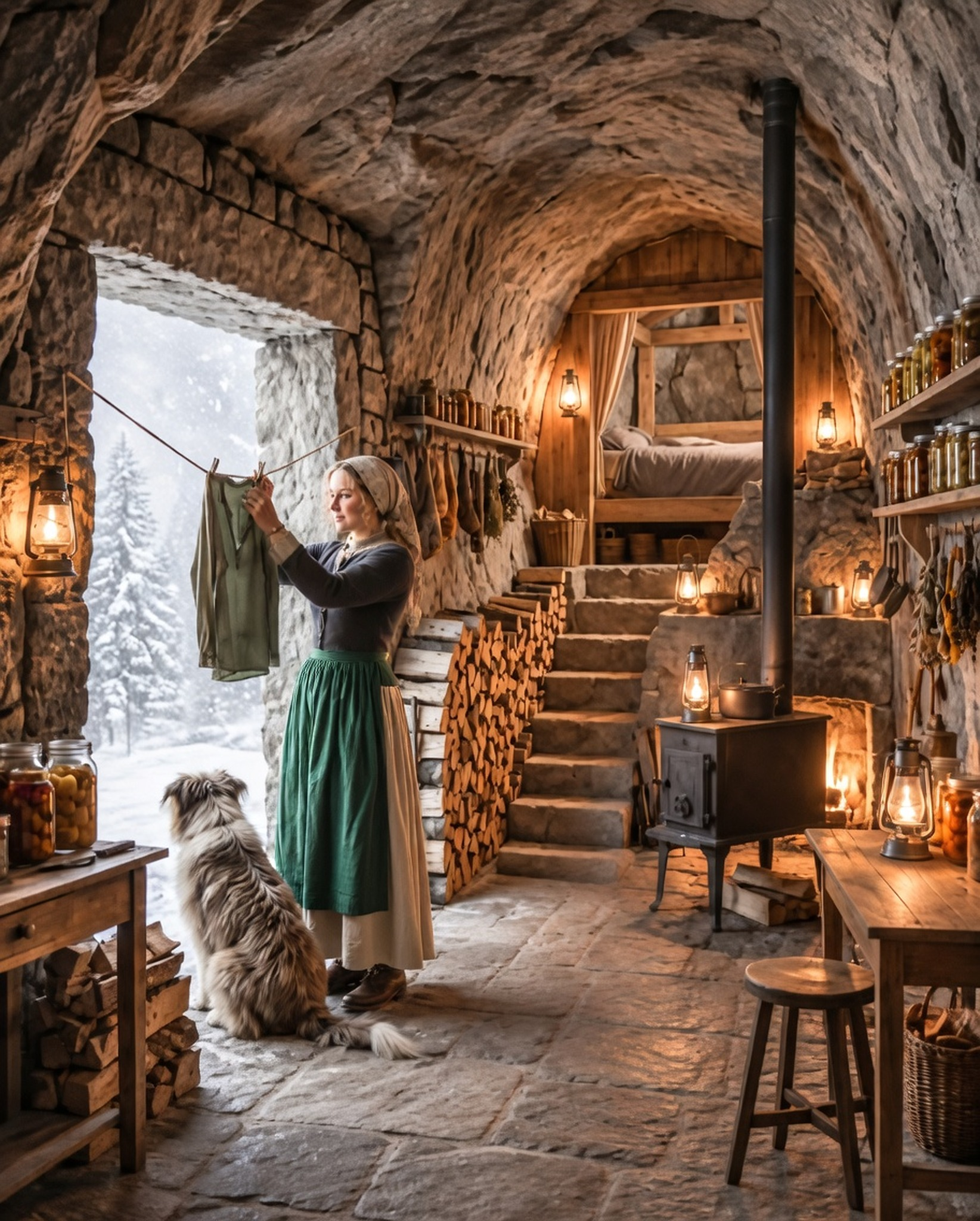
Three men stood at the entrance of my underground home.
The tallest one held a folded document. The second carried a crowbar. The third remained a few steps behind them, watching my children as though they were already possessions waiting to be collected.
I stood barefoot on the stone floor.
Behind me, Fiona held her two younger brothers close. My eight-year-old son had one arm around his five-year-old brother, who was clutching the little wooden horse his father had carved for him.
The wood stove burned steadily against the far wall. The oil lanterns cast warm light across the stone ceiling. Shelves filled with preserved vegetables, jars, and supplies stood along the walls.
Our thermometer read eighty-six degrees.
Outside, the Wyoming winter had reached thirty-one degrees below zero.
Yet the man holding the court order looked at my home as if it were a crime.
"Mrs. Abbott Ellison?"
"Ellison," I corrected quietly.
He glanced down at the paper.
"Alana Ellison?"
"Yes."
"My name is Deputy William Carter. These gentlemen are here on county business."
I looked at the crowbar.
"What business?"
He unfolded the document.
"An order concerning the safety and custody of your three children."
Fiona's fingers tightened around my sleeve.
I felt her trembling, but I did not turn around. I could not allow those men to see how frightened she was.
"On what grounds?" I asked.
The deputy cleared his throat.
"This structure has been reported as an unsafe dwelling. There are concerns regarding ventilation, heating, and the general welfare of the minors residing here."
I looked past him toward the snow-covered entrance.
The men had come prepared to describe the place where my children slept as dangerous.
They had not bothered to ask whether we were warm.
They had not asked whether we had food.
They had not asked whether my children had slept peacefully the previous night.
Instead, they had arrived with a crowbar.
"Who made the complaint?" I asked.
The deputy folded the document halfway.
"That information is included in the county record."
"Then read it."
His expression hardened.
"Mrs. Ellison, I don't believe you understand the seriousness of this situation."
"I understand perfectly."
The second man shifted his weight. His gloved hand tightened around the crowbar.
"Let's not make this difficult," he said.
I looked at him.
"Then don't."
For several seconds, nobody spoke.
I heard the stove crackling behind me. Somewhere above us, the winter wind moved across the hillside.
Then the deputy raised the paper again.
"You are required to surrender the children pending an investigation into their living conditions."
Fiona made a small sound behind me.
I reached backward without looking and found her hand.
Her fingers were cold.
"You're not taking them," I said.
The deputy sighed.
"That's not your decision anymore."
I stared at the red seal.
It was the same county seal I had seen on notices delivered to our cabin after Adrian's funeral.
The same authority that had allowed wealthy men to approach a grieving widow with offers for her land.
The same county whose officials had never questioned why three different men wanted the same piece of hillside.
And now they were standing inside my home, telling me that my children could not remain with me.
I looked down at the paper again.
Near the bottom, beneath the official language, I saw a name.
Damon Griffin.
My stomach tightened.
Of course.
It had always been Damon.
I remembered his polished black carriage, the brass lamps, and the five hundred dollars he had placed on my kitchen table.
I remembered the pleasant expression he wore while offering me a new beginning somewhere back east.
And I remembered his words.
"Pride won't mean much if you lose someone else."
At the time, I thought he had been threatening me.
Now I understood that he had been making a promise.
Three months earlier, I had been a thirty-four-year-old widow with three children and an unfinished cabin.
My husband, Adrian Abbott, had died that spring while working as a logger.
The authorities said a tree had fallen on him.
They told me death had been immediate.
When I asked to see his body, they advised me against it.
There was no reason, they said, to put myself through unnecessary suffering before the burial.
Grief had left me so exhausted that I accepted their explanation.
I had three children who needed their mother.
Fiona was eleven. My older boy was eight, and the youngest was five.
They had already lost their father.
I could not afford to fall apart completely.
For weeks, I moved through the cabin as though I were watching someone else's life.
I cooked because the children needed food. I washed their clothes because they needed clean things. I counted our remaining coins because winter would eventually arrive.
I did not know that my husband's death had left behind something more dangerous than grief.
It had left a secret.
I discovered it inside the handle of an old carpenter's level.
Adrian had owned that tool for years. He used it when repairing the cabin, measuring timber, and checking the wooden supports he had built along the north side.
One afternoon, while sorting through his belongings, I noticed a small piece of oilcloth tucked inside the hollow handle.
I almost threw it away.
Then I recognized the handwriting.
My hands began to shake.
It was Adrian's.
I unfolded the paper carefully.
"Alana, should I fail to come home, be careful of the timber owners. Keep the north ridge, whatever anyone offers."
I read the words once.
Then again.
The north ridge.
I looked through the cabin window.
Beyond the unfinished structure, the hillside rose gently behind the property. There was nothing particularly impressive about it. Just grass, exposed stone, and a few scattered trees.
I had never considered it valuable.
But Adrian had.
And he had written those words knowing that he might not come home.
I folded the letter and placed it inside my dress.
For the first time since his funeral, I felt something stronger than sadness.
I felt suspicion.
The first man approached me two weeks after the funeral.
He introduced himself as a timber buyer and asked whether I had considered selling the northern portion of our property.
I told him I had not.
He offered a sum that sounded generous.
I refused.
The second man came several days later.
He spoke about the difficulty of maintaining a property with three young children and no husband.
He suggested that selling the ridge would give me enough money to start over.
I refused again.
The third man was Damon Griffin.
Everyone in Cottonwood County knew his name.
He owned timber interests, large stretches of land, and several businesses. People lowered their voices when discussing him, even when they had nothing negative to say.
His carriage stopped outside my cabin one afternoon.
The brass lamps gleamed in the sunlight.
He stepped inside without waiting long enough for me to feel comfortable.
He placed five hundred dollars on the kitchen table.
Five hundred dollars.
I could have bought enough food to fill our cupboards. I could have purchased winter coats for the children and repaired the roof. I could have paid for a proper house somewhere far away.
For a moment, I imagined what it would feel like not to count every coin.
Then I remembered Adrian's letter.
"You could start over with this," Damon said. "Find a decent house somewhere back east. Give those children something better."
I looked at the money.
Then at him.
"I'm keeping the ridge."
His pleasant expression hardened.
"You've noticed the season changing, I assume."
"Yes."
"Then consider what you're asking three children to survive. There's no husband here, and this cabin isn't fit for winter."
I said nothing.
He gathered the money slowly.
Before leaving, he leaned toward me.
"Pride won't mean much if you lose someone else."
I watched his carriage disappear down the road.
Only when it was gone did I realize how tightly I had been holding Adrian's letter.
That evening, Fiona came to stand beside me at the window.
"Do you think we'll make it through, Mama?"
I looked at my daughter.
Her face was still young, but grief had already taught her to worry about things children should never have to consider.
Across the room, her brothers were playing together.
The younger one pushed his wooden horse along the floor while the older one pretended to build a fence around it.
They did not know how little money remained in the flour tin.
They did not know how expensive the coming winter would be.
I knelt in front of Fiona and took both her hands.
"We're staying alive," I told her.
She looked at me.
"How?"
"Your grandfather taught me something."
I remembered my father in Ohio.
He had worked in coal mines for most of his life. When I was a little girl, he sometimes took me through the underground storage rooms where he explained how the earth could protect people from the worst of the weather.
He had taught me about drainage, ventilation, and the dangers of gases that could kill without warning.
He had also taught me never to underestimate the ground beneath my feet.
"Dirt isn't a furnace," he used to say. "But it keeps the weather from stealing every bit of warmth."
I looked toward the north ridge.
For the first time, I imagined something different from the cabin.
A home beneath the earth.
A place where the wind could not find the cracks in the walls. Where the snow could pile overhead without freezing the children inside. Where a properly built stove could keep us warm without consuming every piece of firewood we owned.
It would require nearly everything I had.
But staying in the cabin would require something I could not afford to lose.
My children's lives.
By September, I had made my decision.
I would build beneath the hillside.
I spent nearly everything I had on timber, insulation materials, tools, and the supplies necessary to construct a properly supported underground shelter.
I planned for drainage before digging deeper.
I planned for fresh air to enter through one passage and stale air to escape through another.
I planned a safe stove, a protected chimney, and an entrance that descended before rising again.
I did not intend to bury my children.
I intended to build them a home.
On the first morning, I carried a shovel to the north ridge.
Fiona followed me with two empty buckets.
My older boy collected stones.
The youngest sat near an overturned barrel, watching our tools and holding his wooden horse.
The first shovel struck the earth.
The sound was small.
But it was the beginning of everything.
By evening, my palms were blistered.
I looked down at the blood beneath my fingernails, then toward the unfinished cabin.
There was still so much work ahead.
And somewhere in Cottonwood County, Damon Griffin still believed I would eventually accept his money.
He was wrong.
I placed Adrian's letter inside a small wooden box and returned to the hillside.
I had no idea that the ground beneath that ridge would soon reveal something none of us had expected.
And I had no idea that the first person to discover what I was building would be the man who laughed at me.
Back in the shelter, Deputy Carter folded the court order.
"Mrs. Ellison, we have waited long enough."
The man with the crowbar stepped forward.
I moved between him and Fiona.
"Don't touch that door," I said.
He stopped.
The deputy looked toward the third man, who had remained unusually quiet.
The man finally removed his gloves.
Then he stepped into the lantern light.
I recognized him.
He was Damon Griffin's attorney.
And he was carrying another document.
This one had Adrian's signature.
Tiếp theo: Chapter 2–15 sẽ được triển khai theo đúng thứ tự 15 chương đã liệt kê, giữ nguyên cốt truyện gốc, kể ngôi thứ nhất bằng tiếng Anh, mỗi chương hướng tới khoảng 2.000 từ, có cliffhanger ở cuối chương 2–14 và kết thúc có hậu trọn vẹn ở Chapter 15.
Phần tiếp theo bắt đầu ngay tại bí mật về chữ ký của Adrian trong tài liệu mà luật sư của Damon vừa đưa ra.






Comments 0